GLADIATOR II

By Marc S. Sanders

With Gladiator II, you get two of everything.  Two heroes, two emperors, two great white sharks, but only one Denzel Washington which is plenty.

The sequel to Ridley Scott’s Best Picture Oscar winner takes place sixteen years after those events when we had the impression that Rome was left in a state of nobility, devoid of treacherous gladiator games. Not so.  

Two flamboyant young men named Geta and Catacalla have taken joint rule of Rome thanks to their continued worldwide conquering delivered by their General Acacious (Pedro Pascal).  The general fought for Rome, even if he didn’t agree with the rulers’ policies.  Now he wants to rest with his wife Lucilla (Connie Nielsen, one of two returning cast members of the original film).  Though it’s hard for Acacious to remain apathetic even while the two brats demand more widespread conquests.

Elsewhere is Lucius, Lucilla’s son, a child in the first film, now an adult whose African army suffers defeat at the opening of this film.  The opening naval sea raid upon an impenetrable fort is massively impressive with arrows, fireballs, swords, sea water drownings and gory bloodletting.  Lucius is played by Paul Mescal.   

Gladiator II is full of parallel stories.  Still, you can bet these characters’ paths will all intersect in coincidental soap opera fashion during the run time of the film.

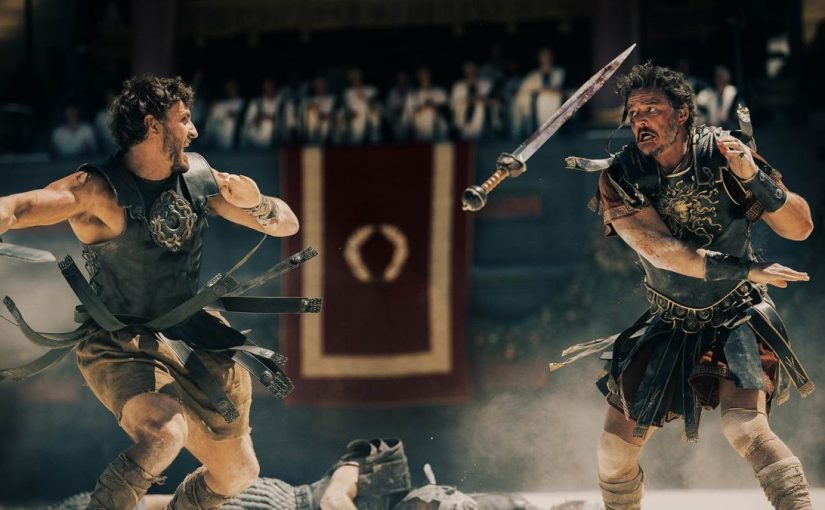
There’s nothing new to this follow up picture that you hadn’t already seen in the original Gladiator.  In fact, the first hour follows a near exact blueprint of its predecessor.  Lucius, a once revered battle commander who lost his wife, is purchased as a slave by Macrinus (Denzel Washington) to fight in gladiator games throughout the Coliseums of Rome.  Because the violence of the sport is so well assembled and enhanced compared to the last movie, it’s easy to get caught up in the fun the film offers.  The action pieces are magnificent.

Though most of the movie is ridiculous.  Historians just close up your encyclopedias.  

Most absurd, yet deliciously fun, is when the emperors arrange for the ring to be filled with salt water and man-eating sharks at the ready as naval battles are reenacted.  Now I’m not sure if this was truly accomplished in Roman times with state-of-the-art plumbing to transport and hold all of this water.  I am also skeptical of bringing bloodthirsty great white sharks straight from the Mediterranean directly into the Coliseum, but I’ll be damned if anyone tells me this centerpiece of bloodshed is not giddy to behold.

Other moments that will have you clapping are match ups between the warriors and big ass mutant, buck toothed (I mean like BUCK TOOTHED) monkeys as well your typical rhino melee.  That latter match had Miguel thinking of Attack Of The Clones.  

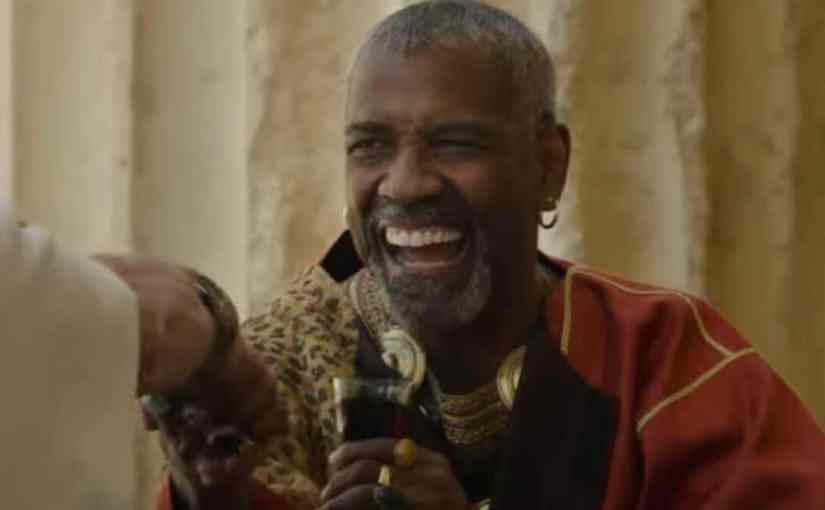
The best of the performances belongs to Washington.  As gleefully over the top (Miguel’s description) as Ridley Scott’s sequel is, Denzel Washington is doing scene stealing work on level with Jack Nicholson and Gene Hackman.  He’s playfully deceitful while appearing proudly respectable with his signature, toothy grin and colorfully eloquent robes that billow with his performance.  The film is not Oscar worthy, but Washington’s performance is because he masterfully works the mind-bending trickery of the character.  Macrinus worms his way through the Senators with conniving wagers placed on Lucius’ undetected fighting talents.  Actor Tim McInnerny is someone I’ve never heard of but as he plays a pitiful, gambling addicted weakling (think of Beaker from The Muppets) against Denzel Washington’s brash and conceited character, you can’t help but take pleasure in how things work out for each of the pair.

Joseph Quinn and Fred Hechinger are the cherub appearing emperors with extroverted cheekbones highlighted in bright rouge.  Combined,  these guys work really well as fill ins for the spoiled brattiness that Joaquin Phoenix left behind in the prior film.  Oh these kiddies are cruel and you just love to hate them.

The two heroes, Paul Mescal and Pedro Pascal, are what is left a little too bland.  They do not match the appeal that Russell Crowe delivered and it’s not simple to care for them or their outcomes.  Lacking any kind of dynamics, they occupy the athletic builds of these guys they’ve been cast to play and that’s where the script limits them.

Thankfully, Gladiator II is very entertaining.  It might not be wholly original when digging up tropes that have been used in many other sword and sandal epics, but Ridley Scott really committed to the carnage and gore we expect.  The director took much pleasure with the outrageous material and the smartest decision was to acquire Denzel Washington.  

Another actor would have slept his way through this role just for a paycheck.  Washington uses the twisted material at his disposal to own the picture all to himself.  I imagine the script documents an unforgettable monologue for his character in front of the weakling Roman senators.  This two time Oscar winning actor must have approached Ridley Scott and said let me try something.  Then the prop department made preparations for a sickeningly, grisly presentation that offers a marvelous image for the Roman Gods to behold, and one that’s hard to forget or not laughingly appreciate.  It may be a stomach-turning scene for some.  On the other hand, I applaud the brashness of the moment.

Our current Congress might be in disarray but with Gladiator II, Denzel Washington and Ridley Scott declare with confidence a resounding “HOLD MY BEER!”
GLADIATOR II (2024)

by Miguel E. Rodriguez

DIRECTOR: Ridley Scott
CAST: Paul Mescal, Denzel Washington, Pedro Pascal, Connie Nielsen
MY RATING: 6/10
ROTTEN TOMATOMETER: 72% Certified Fresh

PLOT: After his home is conquered by the tyrannical emperors who now lead Rome, a rebel soldier becomes a gladiator and must look to his past to find the strength to return the glory of Rome to its people.


[SPOILER ALERT: There is a key plot point that I must divulge in my review, but it is not something I knew before watching the film, despite the fact it was supposedly spoiled in one of the trailers.  You have been warned.]

While I was being underwhelmed by Ridley Scott’s latest film, Gladiator II, I was reminded of his previous lapses in judgement.  Although he is the deservedly acclaimed director of masterpieces like Alien, Black Hawk Down, Kingdom of Heaven, and Thelma & Louise, he also helmed such misfires as 1492: Conquest of Paradise, House of Gucci, and the regrettable Robin Hood [2010].  My point is that Gladiator II is a reminder that Mr. Scott is human like anyone else and occasionally makes mistakes.

I’m not saying that Gladiator II is a terrible film, though.  It is not aggressively bad like some other films I could mention (*cough, The Counselor, cough*).  It has some amazing sights, like the rhino battle in the Colosseum, and it boasts a triumphantly over-the-top performance from Denzel Washington as Macrinus, a flamboyant trainer of gladiators with designs of his own for the city of Rome.  On those merits alone, Gladiator II is maybe worth a watch.

But…but…

While the story is interesting from a standpoint of pure plotting, and while we get the requisite nostalgia bombs of seeing Connie Nielsen back again along with periodic flashbacks to the first Gladiator [2000], I felt curiously distant from the film itself.  I have theories about this phenomenon, but nothing conclusive.

First, the lead actor, Paul Mescal, as [SPOILER ALERT] Lucius.  He looks the part, I grant you that, at least from a physical standpoint.  He’s built, he appears to do most of the physical stunts himself, and he delivers his lines with the appropriate gravitas.  But I never got behind him as the hero of the piece.  Maybe it’s because he’s a complete unknown to me?  Maybe because we barely got to know him before he was suddenly thrust into the main story arc?  (By contrast, in the first Gladiator, we got to know Maximus inside and out before he became a gladiator.)

My sympathies went entirely towards Pedro Pascal as General Acacius, the military mastermind behind Rome’s greatest victories.  He is the new husband of Lucilla (played by the returning Connie Nielsen), whose son, you’ll remember, was last seen following Maximus’s body out of the Colosseum, sixteen years before Gladiator II begins.  Acacius is dutiful almost to a fault, deferring all glory on the battlefield to the empire of Rome, even if it’s currently being run by a couple of brothers (Emperors Geta and Caracalla) who are entitled, bloodthirsty tyrants.  He is weary of the constant bloodshed and wonders if there isn’t a better way to restore Rome to glory.

And Denzel Washington…well, I’ll get to him in a minute.

So, the story, while it must have been compelling on paper, seems to be a healthy echo of the first film.  Another defeated soldier becomes a gladiator.  Another successful Roman general wants to restore Rome.  More spectacular, bloody battles inside and outside the Colosseum.  More political intrigue regarding power-hungry senators and double-dealing merchants.  Forgive me, but I’ve been there, and I’ve done that.  (And adding massive sharks to a Colosseum battle does not intrinsically make it better than anything from the first film.  However, some basic research does show that the Colosseum WAS occasionally flooded with about 5 feet of water to stage mock naval battles…so there you go.)

The undeniable highlights of the film are any scenes involving Denzel Washington.  Not since Training Day has he chewed the scenery with this much gusto (although his recent turn as Macbeth comes pretty close).  I’m guessing he still has traces of Gladiator II set pieces stuck between his teeth.  He can command a scene by his presence alone, but he adds these marvelous gestures of adjusting his robes and tossing in one of his dazzling smiles when you might least expect it.  He makes one of the greatest uses of a dramatic pause that I’ve ever heard.  (“I own…[beat, beat, beat, beat, beat]…your house.”)  In another scene, he uses an exceedingly gory prop as a punctuation mark during a speech; if he gets nominated for an Oscar for this role, that’s the scene they SHOULD use for a clip, but they probably won’t.  Shame.  The whole performance is a classic example of taking a smaller role, owning it, and turning it into a thing of beauty.  In hindsight, it’s probably a good thing that he doesn’t have much screen time, because he simply outguns his scene partners at every turn.  You can’t take your eyes off this guy.

The drawback to Washington’s masterful performance is that I found myself marking time between his scenes, instead of falling into the world of the story.  I followed along, was able to keep track of which senator was doing what and why Lucilla was so distraught and so on.  But to the degree that I was able to follow along, I just didn’t care.  I was reminded of Troy, another sword-and-sandals epic, also told on a grand scale with innumerable extras and some world-class battle scenes, but which also left me apathetic for much of its running time.

Gladiator II improves on the first film only in terms of the complexity of its visual effects and the addition of Denzel Washington.  Aside from that, I’m afraid it does very little to make me care about its heroes, its plot twists, its unexpected deaths, and the glory of Rome.

(And I had to exercise superhuman restraint, at the final shots of the film, to keep myself from yelling out loud, “Talk to me, Goose!”)

WICKED PART ONE

By Marc S Sanders

The blessing of film is that it provides a channel to forms of entertainment that not everyone necessarily has access to.  I was never fascinated with the Tony Awards so much (even though I attended three live ceremonies) because the nominees were exclusive to what was performed in the last year on Broadway in New York City.  How can I or the rest of the country get enamored with the best of the best when we hardly have access to see any of the performances?  With movies, well you just go to the movies!

Wicked is one of the few musicals in the last twenty years that has taken on a worldwide fascination.  It was a very long novel before it became the touring stage production following a massive debut on Broadway. Perhaps because the story returns to a familiar setting, the fantastical land of Oz, the book and show carried a strong appeal.  Wicked arrived with an established brand.  Who doesn’t know The Wizard Of Oz?  Nevertheless, Wicked never needed magical ruby slippers (or rather silver as author L Frank Baum intended) to find its footing.  It’s always been worthy of its accolades apart from any other properties.  The new film, directed by John M Chu, will become a timeless classic all by itself.  Despite some technical issues, this cinematic adaptation is wondrous.

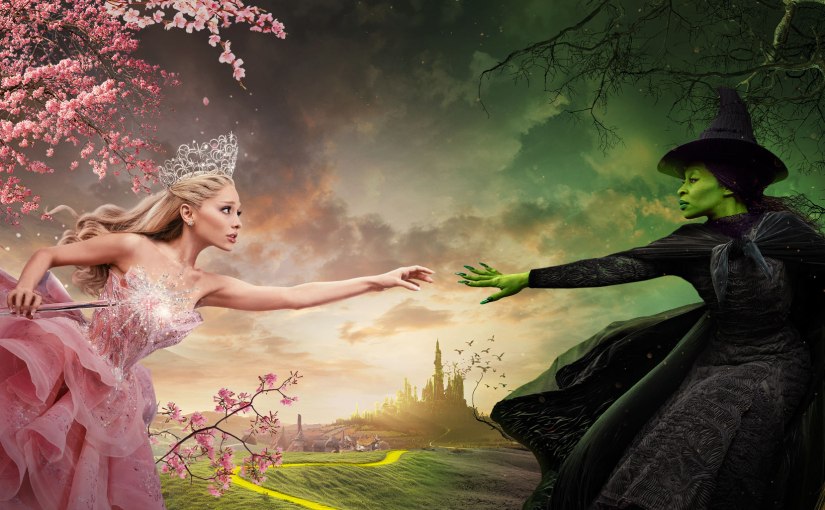
Elphaba (Cynthia Erivo) is the green skinned awkward teen, who was rejected by her father and only served a purpose to tend to her wheelchair bound sister Nessarose (Marissa Bode).  She accompanies them to drop her sister off at the esteemed magical school known as Shiz.  However, the headmistress of the institution, Madame Morrible (Michelle Yeoh), requests that Elphaba stay on as a student that she will personally teach as well.  Elphaba is roomed with the self-absorbed Galinda (Ariana Grande), where their relationship is frictional at first and later adoringly empathetic.  Eventually, we come to realize the destinies of these young ladies will develop into what is all too familiar in L Frank Baum’s eternal The Wizard Of Oz – Elphaba becomes The Wicked Witch Of The West while Galinda is recognized as Glinda, the pinkishly tender Good Witch Of The North. 

This Part One iteration of Wicked is very faithful to the stage production.  Every recognizable number is included from the operatic “No One Mourns The Wicked” to the giddily cheerful “Popular” to the climaxing, fist pumping, take charge “Defying Gravity” that closes out Act One.  The latter number is arguably one of the most well recognized and beloved theatrical songs of the twenty-first century thus far.  The edits and choreography of every number is magnificent, full of energy, and the harmonies work like natural dialogue as opposed to something like West Side Story where it’s not crazy to ask exactly why rival street gangs suddenly break out into song while trying to knife one another. 

John M Chu makes sure that his cast use every prop and set piece available.  You can’t help but grin while Ariana Grande does a circular swan flight from a chandelier while making a case for why it’s best to be popular.  “One Short Day” is a massive declaration within narrow school courtyards and corridors that berth out toward wide open endless fields into a vast blue sky for Elphaba to declare what she yearns for.  Cynthia Erivo has that knack to sing and perform personally to her character’s own subconscious when she’s in these intimate, private moments.  She then bursts out with confident volume to show that as repulsive as she might appear to everyone around her, the soul inside is what is beautiful.  In order to cast Elphaba, you really need one of the most beautiful singing voices in the world because the character is most stunning when she is expressing herself vocally. 

Ariana Grande is good. Though I still prefer the two iterations of the character that I saw on stage prior to this film.  Her performance is a different interpretation than what is traditionally in a live production.  I especially noticed that change when her character attempts to explain how to properly pronounce her name of Galinda.  The stage version of this memorable moment induced the laughs from me more.  As beautiful as Grande is in her characterization and singing, she’s not so humorous as the live stage performances.  So, the humor of Galinda, the self-entitled spoiled rich girl with everything, is not as strong.  As well, at the top of the film, I had an issue with understanding precisely what Ariana Grande was singing at first.  Was she harmonizing or was she singing dialogue?  Perhaps, that is not so much a fault of the actress as it is the recording.  Yet, the issue does not last long, and soon you are treated to Galinda laying it all out there.  She might not be as funny this time, but she’s incredibly charming and loved by her surrounding entourage of student followers, especially from Bowen Yang (Saturday Night Live) and Bronwyn James. 

The sets are spectacular and I learned afterwards that they are mostly physically constructed.  So, there is a texture to the schoolgrounds of Shiz with bridges and babbling brooks as well as regal castle-like architecture.  This is a Universal picture and many may presume that Disney would have produced something like this musical fantasy.  However, in Disney’s hands, much of this film would have been polished in a grandiose, yet artificial, CGI.  John M Chu and his crew went the smart route and diminished the cartoon sheen that comes with CGI.

My issue though is in the cinematography.  Regrettably, I could not see Wicked in a Dolby cinema.  So, we settled for a traditional theatre at AMC which was fine.  Yet, I was wondering at first if there was something wrong with the projector.  A lot of the scenes taking place in the daytime seemed washed out, especially with close ups on Ariana Grande and her complexion.  Then I concluded that John M Chu’s cinematographer relied on a lot of blaring sunlight for many of the scenes.  I imagine it was used to contrast the dark green complexion of Elphaba, emphasizing how much she doesn’t belong in this environment and amping up what an eyesore the character must feel like within the world of Shiz.  When Elphaba dominates a scene or a caption or when the film arrives at the Emerald City, the photography is just right.  Elsewhere at Shiz, it’s very oversaturated with a fuzzy kind of look to it.  Was I wearing the wrong spectacles?  Wait, I don’t wear glasses or contacts!  I could not get past this for much of the film. There was just too much white light, and it didn’t compliment the pinks and pales that accompany Galinda and some of the environments and extras.

My wife and I agreed we are going to see it in theatres at least one more time within a Dolby surround sound.  You should too.  We missed the surround sound of the winning music blaring through the entire theatre.  In a traditional theatre, the sound feels as if it is only coming from the front, or behind the screen.  Dolby or IMAX enhance the audible as if your mind is right at the center of an orb with the most gorgeous, pitch perfect sounds accompanying you.  Dolby and IMAX will also enrich the colors, and Wicked is most certainly vibrant.  Every scene looks like a completed coloring book, despite my one noted imperfection.  A year after Barbie, and pink is still in.  Greens and blacks are just as impactful.

Wicked is magnificent entertainment, worth seeing again.  The music is enchanting and easy to catch on to.  It’s fun and dramatic and every lyric works to shape the characters.  The story is magnificent as well with eye opening twists while allegorically adopting a message demonstrating the harm of prejudice.  There’s also opportunity to show where life can be a disappointment at times when you encounter false idols and learn truths about yourself and those you have grown close to.  I speak in vague terms on these accounts so as not to spoil what this powerful story delivers.

The film is smart in invention as well.  There are good, solid moments that were never staged in the live performances, but thanks to the art of filmmaking new ideas seem totally appropriate where the classic 1939 film, The Wizard Of Oz, are referenced.  Though, I have yet to see Part Two, I can confidently say Wicked works as a solid prequel.

I was one of the skeptics who believed breaking this film into two parts was a shameless studio cash grab.  It certainly seems that way and maybe it is, but considering how good this new musical film adaptation is, I am eager for another installment.  So, I will happily fork over more admission money a year from now and I am confident that I’ll wholeheartedly enjoy Wicked Part Two.  This is a brilliantly creative story with a strong cast, sensational music and eye-popping invention.  I may know what becomes of the characters and how this story ends, but I can’t wait to see it reenacted for its latter half, and I am eager to see what new creations present themselves in its next chapter. 

Wicked is one of the best films of the year.  A triumphing soar through the skies on a magical broomstick.

UNSTOPPABLE (2010)

By Marc S. Sanders

An adventure of the unexpected needs to start with urgency. 

“Let’s say there’s a runaway train that’s barreling through the state of Pennsylvania and no one is on board to stop it.”

“Not bad.  What else you got?”

“This train is a half mile long. So, it’s a roller coaster of a beast.”

“Go on.”

“How about there’s another train on the same track and the two are going to collide with each other?”

“It’s got potential.  Anything else?”

“Oh yeah.  The train is carrying toxic chemicals that could cause mass destruction and casualties of epic proportions throughout the rural area.”

“Okay.  Now we’re talking.  Any guns?  Can we find a way to get machine guns into the mix?” 

“Yes!  I got it.  How about if the people try to derail it and the only way to make that happen is the cops shoot at this tiny button on the bottom of the engine, and this button is located between the gas tanks?  So it’s gotta be a direct hit while the train is in motion.”

“Okay.  Okay.  That’s genius.  Let’s green light it.”

Now this might have been how Unstoppable, director Tony Scott’s final film, got put into commission, but what is especially fascinating is that this is based on a true story. An out-of-control locomotive actually went off with no one on board to control it.  It happened within the state of Ohio about fifteen years prior to the release of this film.  Only it was not as dramatic or suspenseful as Tony Scott and his crew assembled their movie.  Unstoppable is a pumped-up, steroid enhanced reenactment of the actual story.

The director recruited his most common go to lead, Denzel Washington, for the role of Frank Barnes.  He’s an engineer with over thirty years’ experience who is wiser than the big wig suits on the top floor.  He can bring this potential disaster to a halt before it happens.  Frank is also a mentor to the fresh, young conductor, Will Colson (Chris Pine). 

Will is cranky because his wife is upholding a restraining order against him and the two are at a standstill of hashing their problems out over the phone.  Frank is in a bad mood because the young guys like Will are being brought in to replace the grizzled fellows who are being pushed out.  Frank is also a widower with two estranged daughters. Though, he gets a kick out of telling Will the girls are paying their way through college by working at Hooters.

Denzel Washington and Chris Pine make a good pair.  Buddies who antagonize each other at first, they later share what’s eating at them personally and professionally. Then they work well together to resolve the crisis at hand.  Their characters are not very dimensional, nor should they be.  After all, it’s all about the train.  Yet, I believed them as train engineers/conductors.  Either of these guys could be operating a merry go round and I’ll believe they know some serious shit about how the carousel operates and moves in a circular motion.  My point is these actors really work at it to appear like guys who are well trained within the freight train industry, and I buy all of it.

In the control center, staring at large monitors with high tech maps is Connie (Rosario Dawson).  She’s communicating on the CB with Frank and Will and giving them updates on the status of when their engine will be within hookup range with the one speeding out of control.  She’s also the figurehead with the smart mouth, needed to stand up to her bubbleheaded corporate boss (Kevin Dunn) who threatens to fire all of them.  In other movies, this guy would be the angry police captain in a cop movie.  He’d be the government official who believes he can protect the President while Kevin Costner or Clint Eastwood knows that’s not how it works.  This is a slot role.  Use the same dialogue for a guy like this no matter what the picture is about because it’s all standard stuff. 

On paper, Unstoppable sounds ridiculous and quite ordinary for an adventure.  A runaway train.  Isn’t there anything else?  Yet, Tony Scott applies his quick edits and aggressive zoom in and zoom out shots to the movie’s breakneck progression.  He’s also got those curved Steadicam movements within Connie’s control center accompanied with glowing bright lights of greens, reds and blues. 

News reporters’ updates, along with footage from helicopters, are spliced in between the scenes that Washington and Pine share together in the cab of their train engine.  The glue holds up well.  There’s time allowed for Frank’s girls to cheer daddy on while at Hooters. Will’s wife played by Jessy Schram holds their young son while nervously fidgeting and tearing up watching the news.  I don’t think she has any dialogue beyond the line “C’mon Will!” Soon, she’s live on the scene staring straight ahead for the final act of the film.  That’s a problem.   I’m questioning why she’s looking in the same spot straight ahead if this train barrels on and on.  It’s certainly not in a stationary position.  She’s not watching a baseball game.  No bother.  It’s not fun to question a picture like this with such semantics. 

The exhilaration comes in how Tony Scott sets up his action pieces with daring leaps on and off the train and running sprints on top of and in between the cars.  Guys hang from helicopters with attempts to board the train.  Cop cars turn their sirens on and speed parallel to the locomotive, and yes, as in any Tony Scott film, a handful of cop cars bang themselves up real good in some gritty pile ups. A gorgeous red pickup truck works its way into the story too.

Screeching sound effects are also necessary.  They were nominated for an Oscar. 

Perhaps my one complaint that’s hard to accept is that in some shots, the train, which is supposedly going at over 70 mph, doesn’t look like its going fast enough.  Urgency is important in a film like this and when I get the impression the train is not traveling at a high enough speed, well then the threat doesn’t feel so threatening.  It’s when there are shots underneath from an on the track perspective that you really get an idea of the exhilaration.  In a movie like Speed, the bus always looked like it was accelerating and never slowing down.  Here, the train seems to move slow enough at times that anyone could have just leaped on board, but as Miguel always says, “Then there would be no movie.”

Don’t go into Unstoppable with your Neil deGrasse Tyson laws of physics.  Don’t get hung up on the wife who can see everything that’s happening by staring straight ahead when this speeding train is racing past her from right to left.  Don’t worry. Move on.  It may not look like it, but this train is going faster than it appears. 

Just enjoy the ride, and relish in what set Tony Scott aside as a well-equipped and capable action director.  Sadly, he left this world too soon.  There were more fun action movies to be made by him.  Unstoppable at least reminds you why he is still so sadly missed.

WALL·E

By Marc S. Sanders

There are some movies that seem to accurately predict what we can expect of our planet’s future.  Paddy Chayefsky was one such prophet with his script for Network and the rampant consumption of television influence and addiction.  Author Phillip K Dick might have also been a Nostrodomus of sorts when his writings were adapted into such films as Total Recall, Minority Report and Blade Runner which offered convincing convenience to lifestyles and evolved productivity.  Perhaps the imagineers behind PIXAR are also on to something because their adorable, futuristic WALL·E does not seem so farfetched.  

The robot title character is a trash collector on an abandoned planet Earth seven hundred years into the future.  A Wal-Mart/Sam’s Club amalgamation known as the fictional Buy N Large appeared to have become the main resource for any immediate need of the human population that once existed; what the coming of Amazon is turning into. This monopolized interpretation of absolute capitalism was run by a CEO and maybe Commander In Chief of the free world, played by Fred Willard, the one major flesh and blood actor to appear in this picture. 

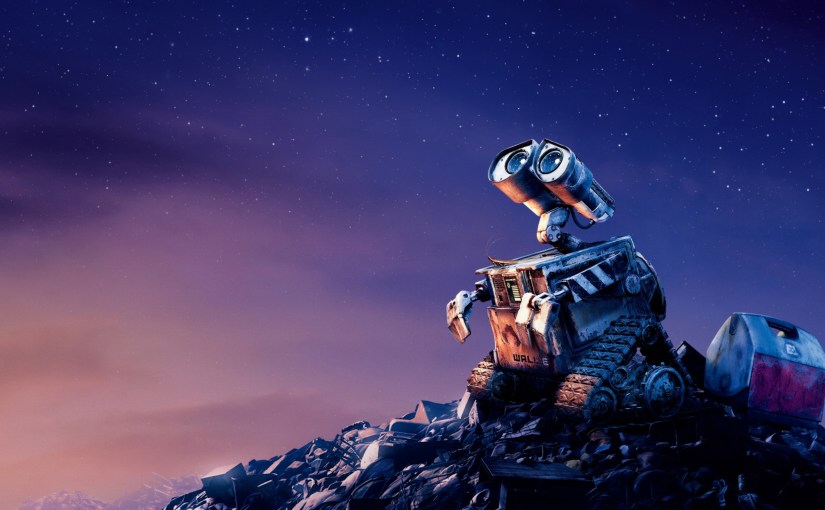
WALL·E, along with a faithful cockroach, roams the wastelands.  The puppy dog, bug eyed robot wheels around on his tractor legs collecting the endless amounts of leftover trash and compacting it into neat, stackable boxes.  Piled on top of each other, these boxes get as high as skyscrapers.  These are the remnants from what Buy N Large left for the planet.

One day a rocket ship arrives and drops off a highly sophisticated and glossy white droid that we come to know as EVE.  For WALL·E, it’s almost love at first sight even though EVE has a treacherous laser cannon for an arm and intimidating blue cyborg eyes.

Eventually, the two bots hitch a ride into space when the rocket returns to pick up EVE.  They arrive on a galaxy cruise liner that’s floating through the solar system.  While the two get into a bunch of Looney Tunes shenanigans running through the corridors and piping of the ship, the audience bears witness to what exactly happened to planet Earth, and who has survived to carry on.  At this point a prophecy seems to be declared by writers Andrew Stanton, Pete Docter and Jim Reardon (all PIXAR regulars at the time).

Humans aboard this liner have become oversized, lazy blobs with no neck, fat arms, fingers and legs, and reclined to permanent seats while robotics cater to their hungers and comforts.  These people are cheerful but happily lazy and unproductive.  Remember when your mother would tell you to clean your room?  Well, the wasteland universe of WALL·E bears justification for mom’s aggravation and constant pestering.

The computerized animation of this PIXAR romantic adventure is dazzling in details and character expression.  There’s an unattractive sand like and earth tone mood to anyplace we explore on Earth.  Yet, the industrial sheen of the cruise liner appears to have all the comforts imaginable.  You can practically taste the colors and feel the balmy air conditioning within this ginormous vehicular city in space. Yet, the telling story of WALL·E has no problem convincing me that this is not right.  This is not a future I’d want to be a part of.

Disney and PIXAR follow that mentality of ensuring a soul of emotion drives their characters of fantasy and it’s easy to fall in love with the clunky lead robot.  You want WALL·E to be safe from sandstorms, while also keeping his only friend, the cockroach, by his side for companionship in an entirely lonely world.  His only other source of cheerfulness comes from watching the musical Hello, Dolly! on an old TV. Even playing ATARI’s Pong is not stimulating enough for this little guy.

Sound Effects Wizard Ben Burtt, who pioneered staple sci fi elements with the Star Wars films, performs the vocal expressions of chirps and beeps for WALL·E’s innocence.  There’s a language to the little fella and it’ll leave a lump in your throat when he calls for EVE.  Elissa Knight brings a more experienced, technologically up to date personality to EVE.  We worry when an organized entity like EVE robotically screams for WALL·E when she thinks he’s in danger.  She’s only supposed to follow a program, but the manufactured mind lends to a side effect of genuine emotion.  As the two get acquainted with each other, there’s a touching chemistry to them both.  A floating dance through space is as much silly as it is adorably romantic.  You cannot help but smile because by this point you are invested in this relationship as much you’d buy Rick and Ilsa’s affections towards one another, or Harry and Sally’s.

I really embrace the childlike love story connecting these two non-living beings.  Set against what appears like an apocalyptic wasteland, there are layered dynamics to this animated film, one of PIXAR’s best.  

I have to also salute the film’s nods to classic science fiction that also offer not so unrealistic possibilities.  An antagonist comes in the form of a robot similar in appearance to HAL-9000 from Kubrick’s 2001: A Space Odyssey.  He’s a nasty bugger with an all too familiar blood-red eye. It’s also a delight to recognize Sigourney Weaver’s voice as the cruise liner’s computer, a sort of slap in the face to monochromatic computers that would countdown a certain doom for the actress’s most famous role of Ellen Ripley in the Alien films.  PIXAR has always been brilliant with their wink and nod delights.

The film was released in 2008, a near generation ago maybe, when iPhones and Androids were not even as entirely sophisticated as today.  Yet PIXAR could telegraph what was to come.  The environments on Earth and on the cruiser tell us just how overly reliable we’ve become on technological conveniences for socializing or even one stop shopping.  

We are getting to a point where we might not even procreate with one another.  It’s a sad irony that it will take two self-thinking, yet designed for programing, robotic appliances to remind us how valuable the human touch is and what a purpose to life really serves ourselves and those we have to interactively live with.  

You might be embracing that cell phone tight in the palm of your hand, but will that device ever hold your hand in return?

HERETIC

By Marc S. Sanders

Heretic operates like you’re playing Dungeons & Dragons but adapted into an Escape Room experience.  The stakes at play are bigger than just your life.  You have no choice but to truly test your faith.  Can you adhere to the religious beliefs you always vowed to uphold when a lunatic is holding you captive?

Sister Barnes and Sister Paxton (Sophie Thatcher, Chloe East) are two impressionable young ladies who are proud to spread the gospel of The Church of Jesus Christ of Latter Day Saints from door to door.  With bicycles and pamphlets in hand, proudly wearing their name tags, they visit the homes of those who have recently expressed interest in the church.

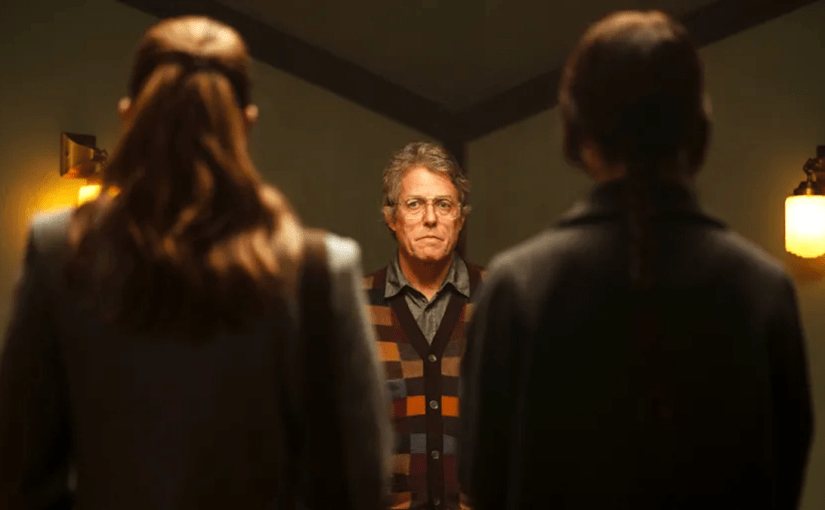
As a dark and stormy night approaches, they knock on the door of an eerie house that belongs to the charming Mr. Reed (Hugh Grant in an utterly surprising role).  Once the ladies are assured that the gentleman’s wife is at home, ready to offer some blueberry pie, they happily enter and are quickly engaged in an unsettling test that will carry on through the evening.

I went into Heretic not knowing a single thing about the film and that made my encounter with the piece that much more interesting.  It’s a disturbing thriller that always kept me curious.  Mr. Reed seems to go on tangents that eventually get to a point where the Sisters are confused, but eventually coherent of the strange man’s demonstrations.  The film is not shy about challenging practically every religious denomination known to man from Christianity to Judaism to Islam and Mormonism.  According to Mr. Reed the ten thousand other doctrines spread across the planet need also be questioned.

Higher powers and miracles – do they really exist?

There’s no doubt that Heretic is a suspenseful thriller teetering on horror but unlike most effective efforts in this genre I was never uneasy with the picture.  It doesn’t rely on jump scares and only gore introduces itself when it must serve the storytelling.  However, it’s an intelligent character study where the heroines are challenged over and over again while remaining in captivity.  So, I was always enthralled with how Sister Barnes and Sister Paxton will entertain their destiny from one step to another.  Stay for pie or don’t.  Lie or tell the truth.  Choose the purple door or the green door.  Belief or Disbelief.

As someone who is primarily educated in Judaism only, it was still not hard to follow the wordy, rambling dissertations of Mr. Reed.  He easily compares his own take on religion to the different interpretations found in music from bands like The Hollies and Radiohead, as well as the various editions of the board game Monopoly which suddenly take on new meanings.  He even brings up Jar Jar Binks to deliver a point.  It’s odd.

Hugh Grant is an unlikely selection for a role like the charming, yet sinister Mr. Reed.  As weird as he is in this darkened house with endless hallways, I wanted to trust him through most of the first half of the picture.  I didn’t care if there was a haunting corridor or staircase to walk down.  This is Hugh Grant of Notting Hill fame.  Grant’s resume of roles lends to the surprising effectiveness of his part here.  He’s always been that adoring charmer on screen.  Ian McKellan or Anthony Hopkins?  I’d never trust them.  Hugh Grant?  Well, why wouldn’t I?

I was hoping-praying actually-that Heretic would not dissolve into a sick rape and slasher movie typical of when young girls are welcomed into a creepy, inescapable house.  That’s cheap, exploitative thrills.  Fortunately, this movie never goes that route.  

The roles of the two Sisters are brilliantly written.  To open the piece, before you know anything about Sister Barnes and Sister Paxton the two women are sitting on a park bench that bears a seedy condom advertisement while staring into a heavenly Utah sky. The topic of their conversation is of a pornographic nature.  Sinful and mischievous, despite the value they hold in their religion and the proud purpose they serve with the church.  These are complex characters that are compelled by their antagonist to make some fair hypotheses about if they genuinely embrace what they claim to value and share with a community.

Heretic is most definitely a psychological thriller with some grotesque imagery.  It gets its audience caught in a trapped claustrophobia thanks to a lot of spooky atmospheric labyrinths.  Furthermore, its strengths lie in the writing, directing and most importantly three of the best performances to come out this year from Hugh Grant, Sophie Thatcher and Chloe East.  

This is a thinking thriller for anyone who has ever uttered a single prayer at least once in their lifetime.  If that’s you, then Mr. Reed may have some questions for you.  Get out of the rain and step inside.  

TRAP

By Marc S. Sanders

The devil is in the details and when you are watching an M Night Shyamalan film it’s transparent enough to know the writer/ director has a penchant for disregard.  He’ll put the two by fours together but he doesn’t hammer the nails into place treating his structure with less sturdiness than a house of cards.

His latest thriller Trap gains from a respectable, though nothing great, performance by Josh Hartnett as a psychotic serial killer named Cooper, also known as The Butcher.  However, Shyamalan takes away the actor’s credibility by allowing his portrayal to make unbelievable escapes while also being granted an ability to eavesdrop on people while attending a loud pop/rock concert with his pre-teen daughter, Riley (Ariel Donoghue). 

Cooper and Riley have a great father/daughter relationship.  She’s beyond thrilled to see her favorite singer, Lady Raven (Saleyka Shyamalan, the director’s real-life daughter), live on stage.  He’s thrilled to accompany her while munching on stadium snacks and granting the dutiful empathy she needs from middle school drama. Cooper only gets alarmed though when he sees an overwhelming amount of police officers and FBI agents roaming all over the stadium.  He asks some questions and learns that this event is being used as a means to capture the infamous killer on the loose known as The Butcher.  Now Cooper must play a game of cat and mouse by evading the authorities while not alarming Riley.

Once again, Shyamalan has an enticing set up, but then he doesn’t deliver.  First it’s hard to swallow Hartnett’s character listening in on conversations happening yards away down hallowed hallways, or even backstage where Lady Raven’s voice is blaring through stadium speakers while she’s dancing and singing in front of thirty thousand fan girls.   Reader, I saw Sting in concert performing one of the quietest songs imaginable, “Fields Of Gold,” and I still could not hear my wife ask me to get her a Coke when she was standing right next to me.

Midway through the film it only gets more ridiculous and even corny as Lady Raven ends up at the family home where Cooper’s wife (Alison Pill) and children become enamored with the celebrity playing piano in their living room.  Then there is an overly long scene meant to offer terrifying suspense when a character locks herself in the bathroom.  Then it’s back to Raven’s limo and then onto a new house and then back to the first house.

The structure of Shyamalan’s script seems to always paint itself into a corner.  So what does the writer do? If he’s trapped with no idea, well he just deepens the corner further and further.  He defies his blueprint, and pushes those two by fours further and further out.  

All of it is hard to digest.  Cooper needs to escape a limousine surrounded by swarms of both fans and police officers. Cut to the next shot and Josh Hartnett’s character is walking away from the commotion unbeknownst to everyone else who stayed glued to the doors and windows of the limo.  Excuse me but none of the car doors ever opened.  I didn’t even see the sunroof open.  Yet, the film insists the guy escaped from the vehicle.  So just go with it.  OKAY??? 

The irony of a film called Trap is that the filmmakers could not even figure out the traps they devised.  Therefore, they’ll just disregard offering up the sleight of hand and move along.

No good magician insists his audience trust him when he says that his assistant who stepped in the box has disappeared.  A good magician, or even a bad magician, is at least smart enough to know that we need to see it for ourselves.  

AIRPORT

By Marc S. Sanders

Burt Lancaster described his participation in what would become the first of a batch of 1970s all-star disaster epics as the worst picture he’s ever done.  He declared it “the worst piece of junk ever made.”  Perhaps because of this assessment we were eventually blessed with the Airplane! spoofs a decade later.  

Airport is a sudsy soap opera drama from novelist Arthur Hailey.  It’s an indiscreet invitation to make fun of it, but I doubt it was meant to be regarded that way in 1970.  Then, Airport was likely celebrated as that new kind of picture like The Godfather, Jaws and Star Wars would pioneer in their own rights.   

The film was a box office smash for Universal Pictures, garnering an acting Oscar for kindly old Helen Hayes along with nominations for Best Picture, Cinematography and Screenplay.  It spawned three more films following its success.  Yet, it’s terribly cornball, drowning in floods of cheese, and coated in the thickest of sap.  You better swallow that Maalox now.  This airport is all backed up!

Lincoln International Airport is getting blanketed in one of the treacherous, most blinding snowstorms imaginable.  So naturally it’s the right time to launch passenger airlines into the night sky while also welcoming jets to land.  Were harsh weather conditions not so alarming fifty years ago for air travel?

Well, this blizzard is going to be the first of several problems starting with a plane stuck in the snow right in the middle of the airport’s major runway.  Burt Lancaster is Mel Bakersfield, Lincoln’s Controller, who once again puts aside his family and his troubled marriage to oversee the matter.  He recruits the grizzled, cigar chomping Joe Petroni (George Kennedy) to clear that runway.  Mel firmly believes Joe is the only man who knows what the hell to do.  (Best I could tell is that Joe picks up a shovel like everyone else.) Mel’s other issue is that his pesky wife is disrupting his happy affair with Tanya Livingston (Jean Seberg), the no nonsense, yet perky appearing, blond airline executive with the mini uniform dress hemline.

Further upholding the proud chauvinism of this picture is everyone’s favorite lounge singing lizard Dean Martin as Vern Demerest.  These names!!!! If this movie wasn’t taking place at an airport, I’d swear it was a news station.  Vern also has an inconvenient marriage now that he’s learned his cutie stewardess Gwen Meighen (Jacqueline Bisset) is pregnant.  Cue the squeaky violin music as Vern offers to cover the abortion.  Shocking!!!! Gwen might want to have the child, but she’s gracious enough not to make it an obligation for Vern.  She’s gonna let her dreamboat wonder of a man be, so he remains a doting husband on the side.

So we got melodrama for the airport staff, the pilot, the stewardess… Hmmm…Oh yeah!  The passengers!!!!

A mentally ill, down on his luck man (Van Heflin) spends six dollars cash on a life insurance plan for his wife Inez (Maureen Stapleton) before boarding Vern & Gwen’s plane with a dynamite bomb in his briefcase.  Can Inez warn Mel, Tonya and everyone in time before the plane takes off?

Of course, this kind of stressful tension requires some adoring comic relief, and Helen Hayes as kindly old Mrs. Ada Quonsett delivers an Oscar winning performance.  She takes pleasure in being a habitual stowaway on one flight after another.  Gosh darn it if Tonya is going to make sure to put a stop to this lady’s shenanigans.  

The Cinemaniacs (Miguel, Thomas, Anthony and I) watched this together and Mig pointed out the cinematography first.  It’s dull like straight out of a Sunday night TV movie.  Thomas reminded us that this was in the same vein as most of Arthur Hailey’s material, like Hotel – the book that became a movie that became a TV series.  The soap opera occupies the first two thirds of the picture.  Then a potential threat of disaster occurs, and you work to guess who lives and who dies.  

Directors George Seaton (also screenwriter) and Henry Hathaway work to get the audience invested in these people first while trying to educate us on the most up to date operations in a fully functioning airport.  If George Kennedy’s character is not shoveling snow on a runway and giving it all he’s got in the stuck plane’s cockpit, he’s telling the others what to expect from a potential bomb explosion aboard a jet.  And Look!!! There’s telephones in Mel and Vern’s cars.  Push button ones too.  All over the airport are red phones next to white phones.  There’s luggage.  There’s blankets and pillows for everyone on board the plane. There are also unsuspecting women wearing minks and smuggling jewelry into the country, but the seasoned custom security guard has got a good eye. He can see everything, except for the guy with the bomb. And there’s snow.  Lots and lots of snow but the cabs make it to the airport in the nick of time.  There’s also a message about the need for updating construction on our country’s airports with the most sophisticated traffic controls and operations imaginable.  Should the money be spent?  On top of all this, how are Mel and Vern’s wives and families holding up?

Maybe it’s unfair.  It’s hard to embrace Airport when I have already grown up watching the ZAZ team brilliantly spoof the picture with the Airplane! films.  Yet, I’m confident that had I seen Airport upon its initial release, I likely would not hail the romances of Lancaster, Seberg, Martin and Bisset as the next iterations of Rick and Ilsa.  The dialogue and scenarios are eye rolling at best.  The chemistry sputters as soon as we see the characters for the first time.  The men are twenty five years older than the women, but the love is supposedly passionate?

The extras who are granted snippets of dialogue look like they are reading cue cards and the major players truly look bored.  Watch the cast when the bomb goes off on the plane (like you didn’t think it wouldn’t happen).  There’s no adrenaline from Dean Martin.  He looks lost without his signature scotch and cigarette. The passenger extras never got the memo that they are supposed to be on board a plane with a gaping hole in the rear lavatory.  The priest on board slaps the guy next to him, but I need more convincing of the panic that is supposed to persist.

Fifty years later, the legacy of Airport hinges on only one purpose and that is to give it the ol’ Mystery Science Theater 3000 treatment.  More importantly, once you finish watching it, about all you want to do next is watch Airplane! 

“The cockpit!  What is it?”

“It’s the little room at the front of the plane where the pilots sit, but that’s not important right now.”

ZURAWSKI V TEXAS

By Marc S. Sanders

The topic of the harrowing documentary Zurawski V Texas is abortion.  However, the debate is a different angle than I believe either side of the ongoing argument is accustomed to. 

Filmmakers Maisie Crowe and Abbey Perrault provide extensive up to date coverage on attorney Molly Duane who represents a growing contingent of women who suffered complications during their pregnancies.  The diagnoses might have varied but the commonality was that in most cases these circumstances became life threatening to the point where medical professionals deemed the best resolution was to follow through with an abortion so that an unhealthy child is not delivered and forced to suffer a brief life in agony.  At least just as pertinent is to preserve the health and often save the lives of the mothers.

Amanda Zurawski from Austin, Texas is the first mother to make a claim. Thereafter, a parade of other women sought out her attorney, Molly Duane, to testify of their experiences and plead with the Texas courts to make exceptions to the state’s altogether blanket outlaw of abortions performed within the state.  As soon as the prologue begins, we see Amanda testifying of her suffering at a congressional hearing.  Close ups jump to the expressions of the government officials who appear intent on listening to Amanda’s plight where she describes having gone into septic shock with her life in serious jeopardy.  It’s a very sad story, but Amanda demonstrates that she’s a stronger warrior than these men that she is facing.  They can do nothing but sit there speechless.  Who knows if they are even listening to the woman on the stand.

Later, as Amanda and Molly take their case to another court, the want to be mother describes how one of her fallopian tubes had to be closed up and her uterus needed to be reconstructed.  Because she was not permitted needed abortion, she is unable to try again with another pregnancy. 

Two other women are also focused on in the documentary. 

Samantha Casiano is forced to carry to term, and then at the end of nine months, deliver an anencephalic baby with no chance of living.  The experience comes at a cost of Samantha’s mental health and her marriage when her husband becomes withdrawn.  Following this incident, Samantha follows through with a tubal ligation to avoid the risk of going through this ordeal again.

Another plaintiff is Austin Dennard, an OB-GYN doctor, who as a patient left the state of Texas to terminate her pregnancy following a risk-laden diagnosis.  She eventually becomes a mother, but now she is a doctor not permitted to aid her patients with their ordeals. 

A struggling roadblock continuously reiterated in Zurawski V Texas is the threat that any medical professional faces should they perform or assist in an abortion, regardless of the reasoning behind it.  Molly Duane and her clients are arguing that if there any exceptions to Texas’ unreasonably strict laws that forbid abortions, it is unclear.  The ladies are petitioning for a clarified explanation which never comes.  Can’t they just get a straight answer on why exceptions for continued health care can not be executed?

I watched this documentary after I have already done my early voting ahead of the 2024 election.  Amendment 4 is on the state of Florida ballot and it’s a clear Yes or No vote of whether abortions should be made legal.  Zurawski V Texas goes beyond the typical Pro Life vs Pro Choice debate that will never satisfy this entire country.  This age old argument is split down the middle, and now politicians and lawmakers seem to weaponize the topic to earn constituents’ favors and votes.  In fact, it is the only reason I can figure for why Ken Paxton, the State of Texas Attorney General is always on the trail of each Molly’s wins within the Texas courthouses. 

Molly will win her arguments while standing in front of one judge after another, but then the uncompromising Paxton will overrule the judgment literally within hours afterwards.  Just as you are about to clap for her success, “Five hours later” appears on the screen.

The documentary covers the ladies’ families and friends who ask how can someone be Pro Life, while outlawing a medical procedure to save a life.  Ken Paxton is the villain of this frightening story because any shred of reasoning from him is never provided while he exercises his stubborn authority.  It’s monumentally unfair.

In the film, when Molly Duane takes the case to the Texas Supreme Court, it is astounding to see members of the court question why Molly and her clients are not going after the doctors who are denying the care that is needed.  It’s a direct insult to the intelligence of these women who are suffering physically, mentally, professionally and even domestically.  There are plenty of health care providers on the side of committing abortions to save the lives of the mothers and avoid any further suffering of embryos and newborns that cannot survive.  However, how can doctors be expected to perform when the state threatens them with criminal charges, license suspensions, fines and incarcerations? 

These professionals have earned the training to save lives.  Yet a governing body is not allowing them to make fundamental, ethical and appropriate decisions for best interests of their patients. 

Most documentaries will at least tell you in a byline that the producers reached out for comment from the other side, and usually that contingent declines to speak on the subject.  I cannot assume that the filmmakers reached out to the opposition of this topic.  People like Ken Paxton or even Governor Gregg Abbott and Senator Ted Cruz of Texas.  The film makes no claim to that idea.  So, I wish there was an attempt to get an answer from the opposing parties.  Still, we get footage of the naivety with governing figures asking questions that lack merit or substance, and worse, we get Paxton’s closeminded and unexplained reasoning for his overturning on cases legally ruled in favor of Molly Duane’s clients. 

Maisie Crowe and Abbey Perrault have assembled an informative film that hopefully will influence votes and ongoing petitions for this important argument.  The day after I post this article is Election Day, November 5, 2024.  Abortions do not just fall exclusively into the category of reproductive rights and the right for women to decide what they want and do not want to do with their bodies.  There’s even more at stake than that.

Zurawski V Texas presents a health crisis that never, ever should be a predicament.  Our doctors have the knowledge and experience to do what is necessary to save the lives of mothers who carry with no fault or mistake or lack of sound judgment.  They are women who chose or planned to become pregnant.  Sadly, complications interfered like it can in any kind of health situation.  Complications can occur during an appendectomy.  Are doctors supposed to stop what they’re doing and check to be sure they won’t go to prison before they proceed any further?  The same could be said with heart surgery or brain surgery.  There are resolutions for these patients to escape terrible, life threatening risks.  Yet, the weaponizing of a political argument for campaign wins stands in firmly in their way and disregards the simplicities of what can save human lives.

Last week, I declared one of the film’s at the 2024 AFI Film Fest was the best I’d seen this year, so far.  That was Clint Eastwood’s Juror #2.  Days later however, Zurawski V Texas stands at the top of the list.

This documentary might focus solely on the state of Texas, but the scenarios warn of a nationwide epidemic if the stringent rulings of our governing bodies continue to neglect basic health while the figures of authority work to prolong their political careers, at the cost of their constituent’s lives. 

Zurawski V Texas is without a doubt the most important film made this year. 

UNSTOPPABLE (2024)

By Marc S. Sanders

The Oscar winning film editor of Argo, William Goldenberg, finally directs his first film and it’s a winner.  The true story of Anthony Robles, the one-legged NCAA world champion wrestler is brought to the screen in Unstoppable.  While the story is paint by numbers for a typical sports movie, because it is adapted from his real-life experiences during his time at Arizona State University, it cannot help but be embraced.  The cast is sensational as well, with not one weak link.

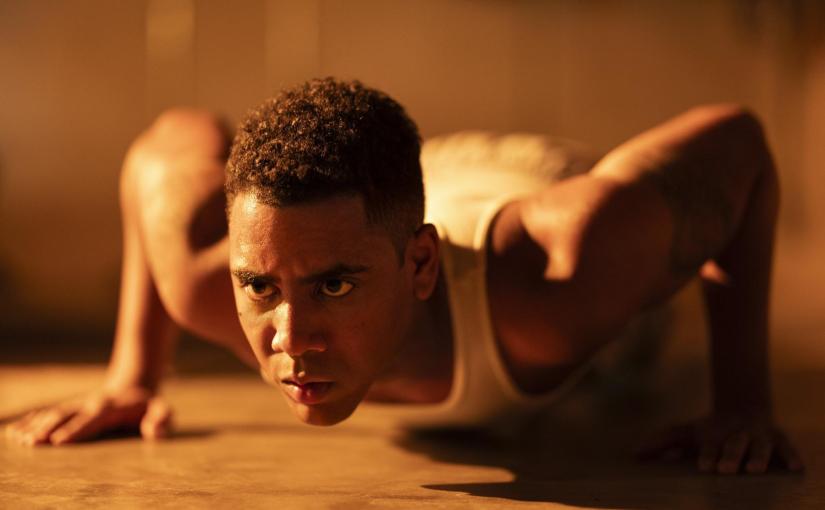
Anthony Robles (Jharrel Jerome, the Emmy winner of the HBO miniseries When They See Us) is a good kid.  Anthony is loved by his brothers and sisters, and his mother.  They cheer him on to persist and win.  He’s a hero to his younger siblings.  Anthony also gets much encouragement from his high school wrestling coach, Michael Peña, and his co-worker that he cleans airplanes with, played by Mykelti Williamson.  Still, he has a troubled domestic life.  His stepfather is an intimidating tyrant.  Bobby Cannavale plays one of the harshest villains in recent memory.  A towering monster with a voice that’ll make you wince.  He’s verbally abusive and eventually we learn physically as well to Anthony’s mother Judy (Jennifer Lopez). 

As the film begins, following a winning match, Anthony receives an all expenses paid ride to a Pennsylvania college.  However, that school does not contend in the NCAA and despite everyone telling him to take the free ride, he has his eyes set on Arizona State.  Even ASU’s Coach Shawn Charles (Don Cheadle, and dang is he ever good) is not confident in Anthony making the final cut for the team.  Yet, Anthony defies what everyone else thinks and scrounges up the monies with his family’s support to attend the local university.  Now the challenge is to make the team against all odds with his crutches to support him through rocky terrain hikes and laps around the track while carrying heavy weights.  How does a man with one leg stand upright and manage to climb mountainous terrains in the desert heat while staying in pace with the rest of the candidates?  How does he even hold a thirty-pound weight while running the track on crutches?  Anthony Robles will show you.

Unstoppable does not offer anything new or inventive.  Anthony even reflects on the fictional character Rocky Balboa a few times.  There are challenges to overcome, not just for Anthony, but for Judy as well.  The bank wants to foreclose on their home and her husband is monster of a jerk.  Plus, there’s Anthony’s handicap which can never serve as an excuse for falling behind with the rest of his squad. 

Some matches are lost.  There are scary episodes at home.  There’s the imposing undefeated champion that Anthony will eventually have to face.  There are the loving moments between mother and son.  It’s all textbook, and the ending is predicted as soon as the film begins.  Still, had I known Anthony Robles personally while growing up, I’d be saying this story is prime for a movie or a book and that is what became of it. 

At the 2024 AFI Film Festival, there was a Q&A following the film’s presentation.  Jennifer Lopez, Jharell Jerome, William Goldenberg, and Judy and Anthony Robles were in attendance.  To watch the film and then hear of these people’s real-life experiences afterwards is astonishing.  Both mother and son came from rock bottom scenarios mired in debt and abuse.  Now, long after Anthony has finished his career as a champion wrestler, we see that the two continue their crusades.  I won’t spoil what they went on to next.  The film provides a footnote ahead of the end credits, but it is nothing short of inspiring.  The Robles demonstrate that anything is possible and nothing works as an excuse.

Jennifer Lopez and Jharrel Jerome share a lot of beautiful scenes together.  Lopez might be easy fodder for gossip columns, but she is truly a wonderful actress.  Jerome reminds me of when I first saw Cuba Gooding Jr in Boyz In The Hood, which was an astonishing debut of a promising career.  This guy needs to be cast in a lot of beefy roles going forward.  He’s a sensation. 

William Goldenberg has made an under the radar film, but it has box office success written all over it like The Karate Kid or Rocky.  His vast experience in editing allows for a well-paced two hours so that even if you know what is coming next, you remain enthralled and wanting to cheer on the protagonists. 

The film will be streaming on Amazon Prime soon, and that is perhaps it’s only disappointment.  Again, as I have written in other recent columns, a movie like Unstoppable belongs in the theatres first and seen with well attended audiences who will clap and cheer at both Judy and Anthony’s triumphs.  Some of my fondest memories are watching the heroes I grew up with played by Ralph Macchio and Sylvester Stallone finally achieving that hard-to-reach gold crown, and suddenly there’s an overwhelming cheer from the audience within the darkness of the theatre.  Remember when Rocky sprinted up the 72 steps of the Philadelphia Museum Of Art?  A cued response almost seems edited into the context of the film.  That kind of experience is absent from the private confines of a living room.

Unstoppable has joined the lexicon of amazing sports stories.  You can’t help but cry while you are cheering.