
By Marc S. Sanders
Director Sarah Friedland took seven years to get her film Familiar Touch towards completion. It’s a very personal film about an elderly woman who must adjust to residing within the memory care unit of an assisted living facility. Friedland assembled this piece with a lot of intimate care and sensitivity.
Familiar Touch grabs you as soon as you see the back of actor Ruth’s (Kathleen Chalfant) head with thinning grey hair. She is sorting through her small closet looking for a particular outfit. Finally, she opts for the dress in the obvious dead center. She retrieves a slice of bread from her toaster and places it in the drier rack with other dishes. Then, she finishes preparing a sandwich by trimming one of her plants and sprinkling the stems over the tomato. Without any dialogue, Sarah Friedland has already provided enough exposition to understand the challenges this woman is facing.
Shortly after, Steve (H Jon Benjamin) arrives to have lunch with Ruth, and her conversation goes from flirtation to inquiring about what Steve does for a living and then asking if he’s met any girls lately. Steve reminds his mother that he is married. Two strangers with a history are occupying this scene followed by an awkward car ride over to Bella Vista, Ruth’s new home.
Familiar Touch operates observationally. It’s not a linear plot, but rather a dive into how someone continues life with a loss of memory. Memory loss whether it be dementia or Alzheimer’s does not finalize life for someone though. Friedland’s script provides opportunities for continued purposes for Ruth.
Kathleen Chalfant is quite dynamic in her role. One day, Ruth saunters into the facility’s kitchen, washes her hands and prepares a fruit salad. Then, she is arranging lovely breakfast dishes for the residents and her caretaker Vanessa (Carolyn Michelle). When Vanessa’s colleague enters to chat with her, Ruth censors him, insisting that Vanessa needs to study for her nursing exams. This moment, arriving at the center of the film, is a standout. Chalfant is disarming and out of control with the lifestyle she is forced to live, but then her history comes present and we learn what Ruth specialized in during her radiant years.
I was able to attend a Q & A session following this film showing at the AFI FEST 2024 in Hollywood. The audience consisted of many elderly residents of Bella Vista who served as extras in the picture. One person, who the director was familiar with, complimented the slow pace of the film and correlated to how the stride of life is allegorically reflected in Sarah Friedland’s final edit. The gentleman next to her commented on the title and how we lose touch with people as life goes on. That allowed me to reflect on the relationship between Vanessa and Ruth.
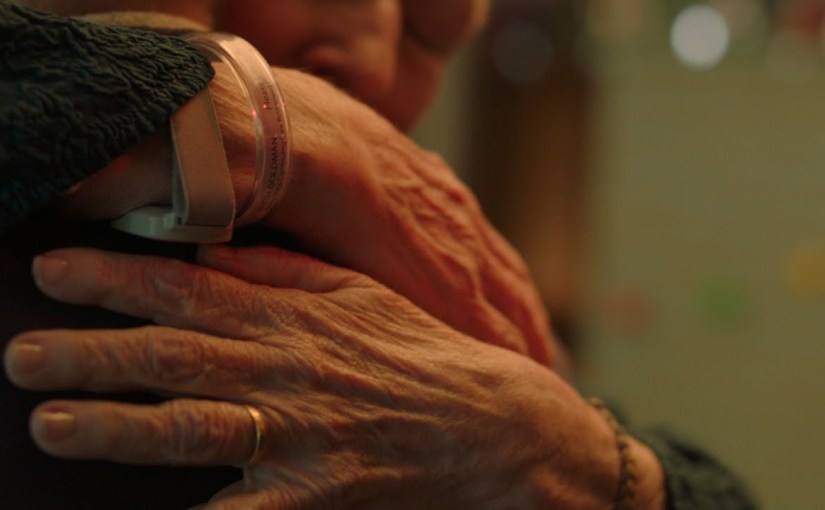
Carolyn Michelle and Kathleen Chalfant have beautiful scenes together. Friedland captures a long, warm embrace as Vanessa confesses a deep loss she personally experienced. Ruth, who should be challenged with comprehending much any longer, can still recognize sorrow in others. She serves a purpose to Vanessa’s healing.
I especially appreciated the colors of the picture. Food is an important prop in the picture considering Ruth’s penchant for fine cuisine with handwritten recipes and published books. A red cabbage is treasured as a RED cabbage when you see it on film. A head of white lettuce appears especially bright. Scrambled eggs look savoring in yellow. Sarah Friedland lent some recognition to her cinematographer, Gabe Elder, who masterfully finds a pleasing contrast between the pale complexion of Chalfant and the vividness of what her character can do with appetizing art. The colors are breathtaking. Ruth’s art remains vibrant while her lifestyle maybe isn’t as tantalizing as it used to be.
Even a swimming exercise in the facility’s pool is glorious to watch. Friedland and Elder have shots that work nicely with closeups of Ruth peacefully floating on the water’s surface while also providing overhead angles of this small pond of bright blue against her red bathing suit. A final call for “Momma” concludes the scene as Vanessa appears upside down on screen to tell Ruth it’s time to come out. It’s simply a scene of absolute comfort where illness or aging of any sort cannot overcome or intrude.
Familiar Touch is a beautiful piece of intimate filmmaking. It’s a study of illness but it is not narrated by doctors or science. Sarah Friedland’s script works away from the technical effects of Ruth’s ailments. I don’t even recall precisely what she was diagnosed with. It’s not important. Instead, what is essential is how life continues from here with a new kind of mentality that is a far cry from what was once a more vibrant and self-dependent way of living. I love that creative choice.
Familiar Touch is a beautiful, colorful piece of filmmaking.
 2 UNPAID MOVIE CRITICS!!!!