HERE

By Marc S. Sanders

I get a thrill out of being in a location occupied by someone from the past.  Last week, I toured Paramount Studios and sat on the bench that Tom Hanks did when he shot Forrest Gump.  There’s something exciting about it.  Time capsules or a recovery of an ancient burial are fascinating to me.  Just once I’d love to hold in my possession Action Comics #1, Superman’s very first appearance.  Often, items like this are preserved behind glass in museums to witness and study.

Robert Zemekis is a “What if?” director.  What if a man was marooned on a deserted island or what if you could communicate with extra-terrestrials from another galaxy?  What if live humans could interact with cartoon characters? He reunites with Hanks as well as Robin Wright for his newest film called Here.  The picture attempts to answer what precisely happened in one specific, exact location since the dawn of Earth.  

The film opens with the violent creation of the planet, complete with molten rock and falling meteors stirring about, along with an ice age, and a prehistoric period.  Then it is on to further points in history that the script from Eric Roth will occasionally return to, such as the plight of a Native American tribe and then later close to a post-Revolutionary War era where a house with a large bay window in the living room is erected and a famed historical figurehead is referred to.  We witness the activities on both sides of this living room’s bay window, and what was there before it.

There are brief views of folks living in the early twentieth century when new technology like airplanes are fresh, and eventually a Lazy Boy becomes essential to any home.  

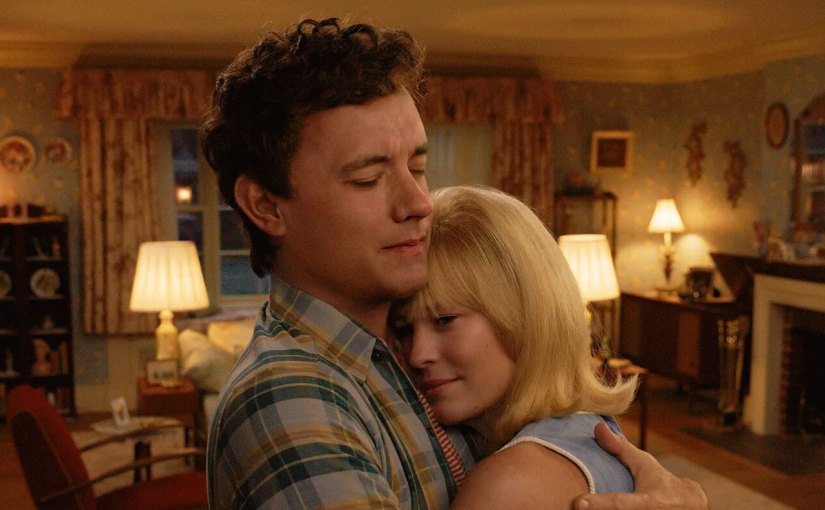
Primarily though, there are three generations of a twentieth century family lineage that starts with Paul Bettany as a PTSD alcoholic World War II veteran, and his housewife Rose (Kelly Reilly).  Tom Hanks portrays Richard, their eldest child who aspires to become a career painter before his plans are interrupted by marrying his pregnant girlfriend, Margaret (Robin Wright).  Life, however, gets in the way of his dreams.

Finally, we are brought to a more current point with an African American family living through challenging times of police brutality and Covid.

Over the course of the whole movie, Zemeckis has you believe that his camera never moves once from this specific place.  He narrates the activities that occur in this broad scope of time with pictures within pictures.  Rectangles or squares will appear to show what happened later in life or back in the past on this specific spot and then transition the scene to that new period episode he wants us to witness.  Where the fireplace is located, a squirrel climbed the bark of a tree that was once there.  Where the sofa is now, there worked a slave laborer from the 1700s, or its where a Native American smoked a pipe before then.

If Here was any longer the novelty might have worn off.  Fortunately, the characters with the most interesting storylines are given to Bettany, Reilly, Hanks and Wright.  The challenges of living long lives raising children, dealing with job security, health, love, loss and stress are carried by them.  We grow accustomed to how the family lineage evolves, particularly with Thanksgiving dinners, Christmas photos, marriage, graduations, and children growing up.  

It helps that the latest trend of visual effects, de-aging and aging the players, works convincingly in this picture.  I attended a live conversation at the 2024 AFI Film Festival between Tom Hanks and Robert Zemeckis, and the actor revealed that to get himself back to the age of seventeen and then a thirtysomething all the way to a man in his eighties required Zemeckis’ team to collect thousands of images and footage from the actors’ extensive careers.  Everything was then seamlessly assembled for effective performances.  I think the trickery works.  If it didn’t, then it’s likely Here would not succeed.

My one issue with the film is the glaring omission of substantial storytelling for the African American family compared to the amount of time devoted to the family who lived in this home before them.  The African American characters do not appear fleshed out enough.  They only serve to remind us of current, complicated times that we recently endured or are still living through.  Roth and Zemeckis did not go deep enough with this group, only to bookend it with an unimpactful death.

Here works like a warm blanket to snuggle up with.  I believe it is worth a second and maybe a third watch in order to catch all the little changes in details that vary as time travels through this piece of land that eventually became a living room.  The TVs and what’s on changes from the Beatles first appearance on The Ed Sullivan Show to The Three Stooges to CHiPs (neat wink and nod moment here; tell me if you know what I am thinking of) and Katie Couric and so on.  The furniture gets updated.  So do the phones. What occurs across the street in front of the two-story colonial house changes.  Though we are only seeing one room during the entire running time, it’s near impossible to pinpoint what was there before from left to right and top to bottom. What’s there now and what will be there later is part of embracing the experience of Here.  However, what kept my attention is how Eric Roth and Robert Zemeckis invent ways to keep different time periods connected.  It’s relative to how Zemeckis did numerous minute and detailed face lifts to Hill Valley in his Back To The Future trilogy.

By the end of Here, there’s opportunities to relate to how many of these people end up with their long lives.  They experience all the ingredients of life through love, frustration, happiness, illness, loss, anger, sadness and eventually death.

Here is a deliberate experimental film, and for most of the picture, its attempts at modifying the stage of performance truly work.  Where it falls short is not allowing equal attention to all of the stories that enter this locale.  Then again, if the movie were to go any longer, time might have come to a mundane standstill.  It’s simply a blessing that I had just enough time being Here.

UNIVERSAL LANGUAGE (FRENCH/PERSIAN)

By Marc S. Sanders

Writer/Director Matthew Rankin’s Universal Language is the selected Canadian submission for the 2024 Academy Awards consideration in the category of Best Foreign Language Film.  Though the picture was shot on location in Quebec and Winnipeg, many of the characters are of Persian heritage in this absurdist piece that moves along three different trajectories before they all collide with one another.

I had the opportunity to see Universal Language at the 2024 AFI Film Festival. Rankin, who also leads one of the storylines, opens the film with brilliant comedy as an eighth-grade classroom of unruly children are quickly silenced by an angry teacher who blames his students for his own tardiness and then unleashes on a latecomer who is unable to read the blackboard because a turkey has supposedly run off with his eyeglasses.  The child sincerely stands by this excuse.  The humor of this introductory scene, which I only wish could have gone longer, relies on the outrageous over the top temper of the teacher and the melancholy response from the students.  None of them seem to fear this guy.  One of them is even daring enough to dress like his idol Groucho Marx complete with a prop cigar and the mannerisms, as he aspires to become a comedian.  The teacher wraps up his frustration by sentencing the whole classroom to stand in the tiny closet at the back of the classroom until the boy is able to obtain a new pair of eyeglasses or at least gives up on his silly turkey story.

One classmate, Negin, and her sister Nazgol take the long walk home through the snow-covered paths and come upon a five hundred dollar Rubie bill that is buried under the ice.  There is no way to get it out, but if they do, they can use the money to buy their classmate a new pair of glasses, and thus class can resume and they will be free of their closet detention.  They’ll need something sharp to crack the ice like an axe, and so a search begins.

Elsewhere, Matthew (Matthew Rankin) quits his job with the Quebec government in possibly one of the funniest “I quit” scenes since Albert Brooks angrily stormed out of his boss’ office in Lost In America.  Neither scene from each movie are remotely similar, but they are terribly hilarious.  Rankin is so hilariously smart when he cuts from his perspective to that of the supervisor and the joke delivers on what is mounted on the background walls that mirror the greenish drab room.  For an accompanying soundtrack, there is poor schlub hysterically crying within a cubicle.  It’s the second of a series of great scenes within this picture.  Anyway, Matthew opts to purchase a large bottle of sleeping pills, dispose of his wallet, passport and keys and board a bus to visit his mother who he has not seen for several years.  Unexpected circumstances take place as this scenario moves forward.

Lastly, there is Massoud who is a tourist leader escorting a group on the most mundane and sublime journey through the locales of Quebec, such as a small patch of grass in the middle of a highway exit fork in the road.  He encourages his group to stand for a thirty-minute moment of silence in front of a cemetery that is wedged within this area.  Traffic speeds on by though. 

Universal Language might have been a dystopian kind of setting in another filmmaker’s hands.  However, Matthew Rankin prefers to draw inspiration from his own upbringing within Quebec and Winnipeg where the buildings are drab earthtones of tan, gray and brown, outlined in white from the snowfall that doesn’t seem to melt or the cold that never rises to a warmer temperature.  I had a brief moment to speak with Mr. Rankin following the film, using my limited knowledge of French and then English. He told me that he has a deep appreciation for this kind of appearance that the Canadian towns offer.  When I was in Quebec earlier this year, I witnessed the exact opposite actually, a town full of vibrancy and color. 

Fortunately, Rankin found a story of absurdist, sometimes subtle, humor to emote the dullness of these people’s lives.  People don’t really live like this, do they?  Universal Language makes a convincing argument.  So, I can’t be sure. 

First Rankin and his cinematographer were wise to shoot the picture on what seems like 16mm film which adds a noticeably grainy layer to the picture.  Rainbows and bright sunlight are not what delivers cheer to these people, and this looks like a movie you would find on your grandmother’s Zenith TV set from the 1970s.  Then, there is an acceptance to how Massoud and the two sisters, Nagin and Nazgol, live within this realm where a Persian governance has taken over a Canadian province.  No one complains or revolts, but there is no chance for a life of luxury among these inhabitants, only acceptance. 

When the three stories finally intersect there is a realization to how they move on beyond the confinements of the film.  Turkeys abound, the money is recovered, only to take on a new destiny.  Something becomes of the missing eyeglasses and Matthew encounters a new development when he arrives at his childhood home. 

Universal Language sort of works like three bedtime stories rolled into one.  There are visual symbols and props to consider in addition to the principal players.  Most significant to me is the fact that I do not believe there is one solitary answer or point that Rankin’s film offers.  Much of the picture is left up to each individual viewer’s interpretation.  For example, while my wife and I strongly appreciate the movie, we still had very different perceptions of the film’s conclusions in relation to the building storylines.

A film that is titled Universal Language only welcomes open minded discussion. 

FAMILIAR TOUCH

By Marc S. Sanders

Director Sarah Friedland took seven years to get her film Familiar Touch towards completion.  It’s a very personal film about an elderly woman who must adjust to residing within the memory care unit of an assisted living facility.  Friedland assembled this piece with a lot of intimate care and sensitivity. 

Familiar Touch grabs you as soon as you see the back of actor Ruth’s (Kathleen Chalfant) head with thinning grey hair.  She is sorting through her small closet looking for a particular outfit.  Finally, she opts for the dress in the obvious dead center.  She retrieves a slice of bread from her toaster and places it in the drier rack with other dishes.  Then, she finishes preparing a sandwich by trimming one of her plants and sprinkling the stems over the tomato.  Without any dialogue, Sarah Friedland has already provided enough exposition to understand the challenges this woman is facing. 

Shortly after, Steve (H Jon Benjamin) arrives to have lunch with Ruth, and her conversation goes from flirtation to inquiring about what Steve does for a living and then asking if he’s met any girls lately.  Steve reminds his mother that he is married.  Two strangers with a history are occupying this scene followed by an awkward car ride over to Bella Vista, Ruth’s new home.

Familiar Touch operates observationally.  It’s not a linear plot, but rather a dive into how someone continues life with a loss of memory.  Memory loss whether it be dementia or Alzheimer’s does not finalize life for someone though.  Friedland’s script provides opportunities for continued purposes for Ruth. 

Kathleen Chalfant is quite dynamic in her role.  One day, Ruth saunters into the facility’s kitchen, washes her hands and prepares a fruit salad.  Then, she is arranging lovely breakfast dishes for the residents and her caretaker Vanessa (Carolyn Michelle).  When Vanessa’s colleague enters to chat with her, Ruth censors him, insisting that Vanessa needs to study for her nursing exams.  This moment, arriving at the center of the film, is a standout.  Chalfant is disarming and out of control with the lifestyle she is forced to live, but then her history comes present and we learn what Ruth specialized in during her radiant years. 

I was able to attend a Q & A session following this film showing at the AFI FEST 2024 in Hollywood.  The audience consisted of many elderly residents of Bella Vista who served as extras in the picture.  One person, who the director was familiar with, complimented the slow pace of the film and correlated to how the stride of life is allegorically reflected in Sarah Friedland’s final edit.  The gentleman next to her commented on the title and how we lose touch with people as life goes on.  That allowed me to reflect on the relationship between Vanessa and Ruth.

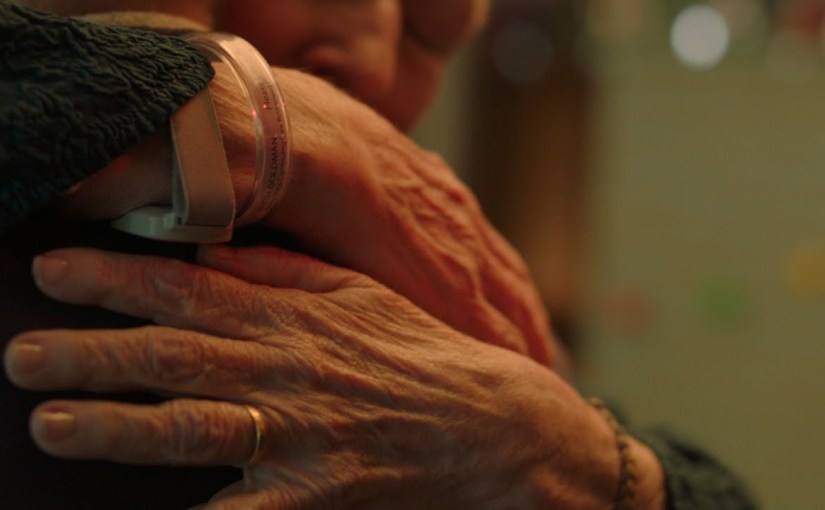
Carolyn Michelle and Kathleen Chalfant have beautiful scenes together.  Friedland captures a long, warm embrace as Vanessa confesses a deep loss she personally experienced.  Ruth, who should be challenged with comprehending much any longer, can still recognize sorrow in others.  She serves a purpose to Vanessa’s healing.

I especially appreciated the colors of the picture.  Food is an important prop in the picture considering Ruth’s penchant for fine cuisine with handwritten recipes and published books.  A red cabbage is treasured as a RED cabbage when you see it on film.  A head of white lettuce appears especially bright.  Scrambled eggs look savoring in yellow.  Sarah Friedland lent some recognition to her cinematographer, Gabe Elder, who masterfully finds a pleasing contrast between the pale complexion of Chalfant and the vividness of what her character can do with appetizing art.  The colors are breathtaking.  Ruth’s art remains vibrant while her lifestyle maybe isn’t as tantalizing as it used to be.

Even a swimming exercise in the facility’s pool is glorious to watch.  Friedland and Elder have shots that work nicely with closeups of Ruth peacefully floating on the water’s surface while also providing overhead angles of this small pond of bright blue against her red bathing suit.  A final call for “Momma” concludes the scene as Vanessa appears upside down on screen to tell Ruth it’s time to come out.  It’s simply a scene of absolute comfort where illness or aging of any sort cannot overcome or intrude.

Familiar Touch is a beautiful piece of intimate filmmaking.  It’s a study of illness but it is not narrated by doctors or science.  Sarah Friedland’s script works away from the technical effects of Ruth’s ailments.  I don’t even recall precisely what she was diagnosed with.  It’s not important.  Instead, what is essential is how life continues from here with a new kind of mentality that is a far cry from what was once a more vibrant and self-dependent way of living.  I love that creative choice.

Familiar Touch is a beautiful, colorful piece of filmmaking.

BLACK HERCULES

By Marc S. Sanders

Black Hercules is a new documentary short showing at the AFI Film Fest 2024 in Los Angeles, California.  Directed by Emmy nominated director Rodney Lucas, the film manages to provide an in-depth exploration into body builder Craig Monson.  Mr. Monson was raised in the South Central area of Los Angeles where like many people of color he experienced the challenges of oppression and unfair treatment in an often unjust legal system.  Yet, Black Hercules takes an optimistic approach in part because of Craig Monson’s proud recollection of his life.  He did not live an easy life, but he only smiles about his ongoing survival.

In just under ten minutes, Rodney Lucas’ camera covers Craig as an elderly man, who still works out every day maintaining a muscular and healthy figure with a signature grey goatee that only feels as welcoming as Santa Claus.  This is someone I could have a beer with on a Sunday afternoon while listening to his various anecdotes.  With Craig’s voiceover describing his past encounters, Rodney Lucas offers a plethora of home movie footage and photographs that paint a colorful and engaging life that has been well lived among personal hardships.

I could easily tell how much Craig valued his mother.  In South Central, there are no luxuries like an indoor gym with top of the line weights and equipment.  Therefore, Craig’s mother made a gym in their backyard for both her son and the neighboring black men to work on building up their bodies.  The equipment they relied on are described as “concrete weights.” 

As Craig continues on, you not only get an idea of the challenges he faced, but a descriptive sense of what South Central is like.  Rodney Lucas provides quick cuts of people in the community dancing and working in the local beauty shop.  In order to survive, Craig had to resort to dealing dope and weed.  Eventually, he was incarcerated for five years within the infamous San Quentin Penitentiary.  He might have committed drug related crimes, but was his punishment just?  Nevertheless, Craig Monson makes the most of his time there where he earns the respect of his fellow inmates as one of the physically largest residents while helping them to work out as well.  His confidence in himself and the body he’s proud of is only infectious to his fellow peers within prison.

A new chapter arises for Craig upon his release and suddenly this ex-convict is working out with none other than Arnold Schwarzenegger, an actor on his way to stardom with his role in The Terminator.  Though spectators would cheer for the famed Austrian, Craig proudly declares that he was actually bigger than the super star. 

I recently had the opportunity to interview Rodney Lucas who has a deep passion for documentary shorts.  He explained that originally this film consisted of over eighteen minutes of footage, but he’s a filmmaker who prefers to take out a lot of the padding that resorts to only enhancing a message. Mr. Lucas finds a way to get a point across or a description included in a condensed period of time.  That’s where I truly appreciated how the short film wraps up.

A terrific and subtle invention of the film is the framing of the moving picture.  The cut of the film appears as if it is paper or photographs torn from a scrapbook or out of a spiral notebook.  With a wealth of pictures from Mr. Monson’s life and some home movies, Rodney Lucas finds a way right from the start of the film to show a scrapbook narrative of this man’s life.  The editing of the film briskly moves from childhood home life to time in prison and then onto the various show stages where Craig makes a name for himself in the world of bodybuilding competition.

With provided competition video, Craig Monson tells of how he had been adorned with titles of Mr. America Of Pasadena, Mr. Los Angeles, Mr. Orange County and so on.  Yet, he would always come in second place.  As one of the few black bodybuilders competing at the time, he could never achieve first place.  One tale that will make viewers smile though is when he knew the audience considered him the best, despite the final judging, and then later a first-place trophy was delivered to his hotel room. 

Black Hercules is an uplifting story of survival with a strong defiance to remain proud and confident in oneself.  Rodney Lucas found that exceptional subject. Anyone else who lived a life like Craig Monson’s would likely choose to carry on with anger, bitterness and regret.  Yet, Craig Monson had no regrets.  Now, an older man that Rodney confirmed for me was still working out on a daily basis, Mr. Monson declares without compromise that the life he’s lived thus far has been a “helluva run” and he will be remembered forever.

This is a triumphant film destined to inspire a health and drive for bodybuilding, but more importantly to maintain a life of confidence and self-assurance.   

Anyone who sees Black Hercules will never forget Craig Monson. 

Seek out opportunities to see Black Hercules and I invite you to check out the trailer for the film here: https://wdrv.it/0692c7495

BATMAN (1989)

By Marc S. Sanders

If Warner Bros was to abandon the campy familiarity of the Adam West TV series, Tim Burton was the best candidate to deliver The Dark Knight into the macabre gloominess of a bustling crime ridden Gotham City.  Burton is proud of his grotesque weirdness which is what this famed comic book character demands.  

Despite a story that always teetered on flimsy to me, this close-out picture of the decadent 1980s, has so many elements that work. It begins with the marquee cast to the richly deserved Oscar winning hell on Earth art designs from Anton Furst to silly pop/funk samples from Prince and the orchestral score from Danny Elfman.  This is truly the film that put Elfman on the map.

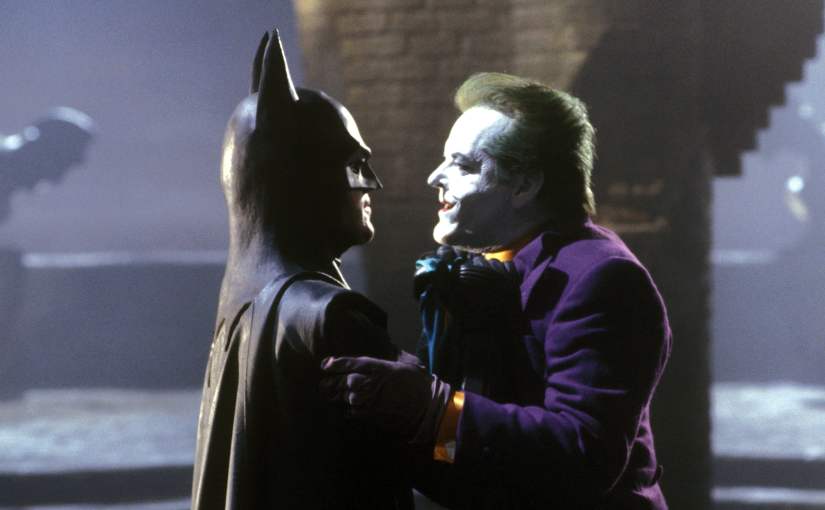
Jack Nicholson collected buckets and buckets of cash to bring Batman’s arch nemesis Joker to life.  He earned every penny.  There’s been copycat attempts (Hello Jim “Mr. Shameless” Carrey) to a handful of other interpretations of the psychotic clown, and still no one has overshadowed what Nicholson brought to the role.  His performance seems like a combined amalgamation of previous celebrated career roles from Easy Rider to …Cukoo’s Nest.  Prince served as his cheerleading entourage to compliment the purple and green color schemes.  This Joker is a perfect antithesis to the famed title character superhero.

Batman is portrayed by Michael Keaton.  Let the record show that when news broke of Mr. Mom occupying the part, I was not a skeptic.  I had seen the dark and dramatic side of the former standup comic a year prior (Clean And Sober, my review is on this site).  I knew he could pull it off.  His quiet pondering as either billionaire Bruce Wayne, whose parents were gunned down in front of him as a child, to the Batman under the cape and mask work on the opposite spectrum to Nicholson’s uncompromising insanity and hyperactivity.  

Keaton against Nicholson are a defined Yin and Yang.

The supporting cast have good moments too including the loyalty of Bruce’s butler, Alfred.  Michael Gough brings Wayne Manor alive and Burton, with a script from Sam Hamm, welcomes several spotlights from the expected council of the trusty character.  Kim Basinger is photojournalist Vicki Vale, Bruce’s love interest.  Frankly she has better scenes to share with Robert Wuhl as Gotham’s reporter.  The Batman fan in me stops short at Pat Hingle as Commissioner Gordon.  It’s not the actor’s fault however that the film offers little for him to do on screen.    Hingle never had much material to play with in the four films he occupied.  That’s regrettable.

The best supporting character is the setting of Gotham City.  With Burton’s penchant for a Vincent Price characterization, he relies on Anton Furst to bring the towering midnight blue steel, skyscraper pillars to enormous heights, reaching into the blackness of heaven.  Every street, alleyway, balcony, puddle, garbage can or mugger, policeman and cabbie that circumvent this city lend life to this hopeless, criminal world.  It’s astonishing how well constructed this Gotham is.  Designs go just as far with Wayne Manor, the underground Bat Cave and a chemical plant designed in hot steam,  with enormous barrels of rainbow, acidic liquids and rickety platforms. Even Vicki Vale’s apartment is gorgeous to look at as both Bruce Wayne and the Joker compliment it as having “lots of space.” Tim Burton and Anton Furst make certain the people who roam these environments are entirely aware of what they occupy.

Sam Hamm’s script doesn’t appear as solid as everything else on screen.  There’s never a cohesive beginning to end trajectory and a lot of the film feels like short story episodes.  Joker takes over the localized mob.  There’s that story.  Joker somehow concocts a chemical poisoning amid the various hygiene products.  Yet it only spreads to the local newscasters.  Gordon, Alfred, Vicki Vale, and certainly not Bruce Wayne ever gets exposed.  Once that storyline begins, it’s quickly disposed.  A little attention focuses on Batman’s beginnings.

The irony of Batman is that unlike other superhero films, this one does not hinge on an origin story for the good guy dressed in black.  That angle is devoted mostly towards Joker, and Nicholson makes the most of his large amount of screen time.  A favorite, sinister scene that maybe Edgar Allen Poe might have approved of is Burton’s invention for Joker to gradually reveal himself beneath the darkness.  He’s depicted sitting in a dirty office basement with an underground cosmetic doctor who witnesses a transformation in the gangster turned madman.  I just like it.  It’s hair raising.  The moment plays like Poe writing a new version of The Mask Of The Red Death.

For me, this is likely Tim Burton’s best film, just below his passion for detail in Ed Wood.  Batman offers up a lot of variety ranging from the darkness of the character to the disruptions revealed in the antagonistic, loudly dressed, Joker.  

There’s no denying how visually memorable the film remains and how quotable it is as well.  In 1989, when superhero movies were not the event release commodities they are today, the endless hype only enhanced the experience of finally seeing the movie on the big screen.  Over a year ahead of release, t- shirts, caps, action figures and costumes were of the highest demand among kids, teenagers and adults.  I actually miss the marketing blitz that overtook the finished film product.  Everyone you encountered was embracing Batman and Joker.  These might be pop culture phenomena, but they created a commonality among the masses of the world.  Batman was worthy of all its swag and endless mania.  It was a celebration of movies for people of all ages to take seriously.

Fortunately, the first half of the 1989 promotional partnerships were never squandered on a decidedly terrible movie.  The end product was immensely satisfying.

Tim Burton upheld his dedication while still a young director in a cutthroat and competitive industry.  As the later films, from a careless Joel Schumacher, demonstrated, it takes an endearing kind of passion to pull these eccentrics off on a silver screen.  Fanboys will happily toss that Bat logoed t-shirt away if they feel betrayed by the movie, they couldn’t wait to sink their teeth into.

An enormous sigh of relief came across the entire pre-internet world.  Keaton is great.  Nicholson of course.  Check out the Batmobile and Bat Jet as well!!! Prince’s music videos served as free commercialization to see the movie over and over again.  A separate record was released to highlight Danny Elfman’s work.

Rightly so!

The grand scheme of delivering Batman and Joker to audiences, was worth every second of the wait.

An astounding achievement of near perfect filmmaking, this Batman film was never overshadowed even with a better, leaner Dark Knight interpretation to arrive nearly two decades later.

Right this way Mr.  Nolan.  Your table is ready for you.

THE SHADE

By Marc S. Sanders

A ghost story works best when a mystery can be upheld.  Something so shocking or fascinating must draw you in and stay with you so that you want to look around every nook and cranny you see on screen and uncover clues that will eventually give you solid answers to the questions you have.  Writer/director Tyler Chipman, partnered on a script with David Purdy, to deliver The Shade.  His prowess with a camera had me darting my eyes from one corner of the screen to the next.

Newcomer Chris Galust portrays Ryan, a pot smoking student, who looks after his younger brother James (Sam Duncan) while his mother Renee (Laura Benanti) works the late shifts at the hospital.  When he is not delivering pizzas or working on his talents for tattoo artistry, Ryan is attending sessions with a mental health counselor (Michael Boatman) to discuss his attacks of anxiety.  Except that is an understatement.  Ryan awakens from night terrors where he encounters a ghoulish woman in skeletal white skin.  Charlotte Stickles portrays this phantom, known as The Harpy, and she puts on a terrifying performance to complement her grotesque makeup design.

These haunting episodes seem to amplify once Ryan’s disturbed brother Jason (Dylan McTee) returns home from school.  Jason is usually stand offish.  He’s disrupting the house in the middle of the night with loud death metal music blaring from his room.  He looks exhausted with a pale complexion and droopy eyes, and the two older brothers seem to get into bouts with one another very easily.

Chipman and Purdy plant a lot of intriguing seeds for a good campfire thriller.  I was curious through the whole course of the film.  The cast is especially top notch with an engaging performance from Chris Galust.  It’s easy to buy into all of his fear and panic. 

Tyler Chipman is also a promising filmmaker.  He’s got magnificent shots that made me blink twice because I am not a jump scare kind of guy.  So, when Ryan opens a medicine cabinet or the creaking door of Jason’s bedroom, for example, and there’s a change in angle, I got nervous for what would appear on the other side.  Camera shots loom on a darkened closet where something appears to be crawling inside of it.  All of this is very effective work in shot, editing and performance combined. 

The prologue to the film is positively eye catching.  Tyler Chipman depicts a late-night ride out to a cemetery and the whole sequence is cut beautifully, with a nervous, young boy staying back by the headlights of the truck, to the inebriated father who slovenly walks towards a tombstone and draws a gun from his pocket to a flame that goes out of control, and then on to the figures cloaked in black who emerge from the darkened woods.  The film had my attention from the start.

Yet, despite a solid cast, I wish the script for The Shade was stronger.  There’s too much written for the Ryan character from his job at the pizza place, to working on his tattoo art, and then providing scenes with friends at a campfire and sharing time with a girlfriend.  All the side characters in these various locations, do not serve much purpose.  Most of these people are unnecessary, including Ryan’s girlfriend Alex (Mariel Morino), who is never put in danger and never lends to the mystery at hand.  Morino is doing the job that the script demands of her but her character does not hold enough weight to belong in the final cut of the film.  Simply being a worrier for Ryan is not enough.

As well, Michael Boatman’s character works more like a collector of information than someone who can lend some clues or new intel to the mystery of The Shade.  During one of a handful of scenes with Boatman, Galust’s character only seems to relay an experience that the audience has already seen.  Once Ryan finishes his description, the moment ends and nothing new is established.  This is just repetitive.

Benanti’s character could have served more purpose, as the mother to these characters.  Not enough exposition is provided for the ghostly encounters that Ryan experiences, and I was hoping Benanti’s character would offer some Act 3 surprising insight and development. Renee always looked like she had a twist in the story to share.

Tyler Chipman needs to continue on with his filmmaking career.  He knows how to handle a camera that will lead to impactful edits with effective imagery, and he cast his film very, very well.  Yet, the writing of the script is too crowded with unnecessary characters that serve no purpose and weigh down the storyline.  Instead of arguing over who should be buttering a pizza crust or having a drawn-out drunken fight during a campfire outing, more attention could have been put towards the set up provided in the first few scenes of The Shade

As I understand through IMDb, Chipman first made this tale into a film short.  I’d be up for seeing a director’s cut of The Shade now that it is a full movie.  I want to learn more about The Harpy and her direct connection to Ryan and his family.  I imagine mom and Jason have more to share.  I simply wish they offered more of their knowledge in the finished product.

JOKER: FOLIE à DEUX

By Marc S. Sanders

Joker: Folie à Deux is an unnecessary sequel.  A lethargic bore.  That is its one problem, and it infects the merits the film clings to but never gets off the ground.

It amuses me, with a pinch of vitriol, that at the closing credits the picture is said to be based on characters published in DC Comics.  My perspective still stands as it did with Todd Phillips’ first film.  These characters are not consistent with any variation that appears with any superheroes/super villains who occupy the assorted comic books.  It is especially true in this new installment.  Just because the players are named Joker, Harley Quinn and Harvey Dent does not translate to where these folks stemmed from.  Joker: Folie à Deux stands on the shoulders of a hot, pop culture, geek property simply to bank on the residuals.

This sequel picks up two years after the original Joker left off.  Arthur Fleck (Joaquin Phoenix, returning to his deserved Oscar winning role) is imprisoned and awaiting trial for the murder of five people including the famed talk show host he shot on live television.  He’s abused both physically and verbally by the prison guards led by actor Brendan Gleeson, who is a better actor than this unoriginal dreck has to offer.  His attorney played by Catherine Keener believes in upholding a defense by reason of insanity.

Arthur normally keeps quiet while endlessly smoking cigarettes (boring stuff). Everyone else talks.  None of this goes nowhere for a very, very long time.  The one positive that enters his life is a fellow inmate named Lee Quinn played by Lady Gaga, another actor worthy of better material.  Lee is being held for setting fire to her parents’ house.  The two develop a quick kinship.

Within his psyche, does the clown image of Arthur’s Joker personality let loose in morose song and dance performances with Lee, also known as Harley.  Uplifting musical montages of classic numbers would normally invoke toe tapping cheerfulness.  Yet, that is not what happens for this disturbed man. Numbers like That’s Entertainment, Get Happy, and What The World Needs Now are given somber and depressing interpretations for these sad sack clowns to sing.  Singer Lady Gaga is not belting out the numbers.  Rather, she puts on a weakened, hoarse inflection to her performance.  Joaquin Phoenix works in tow with his co-star. YOU HAVE LADY GAGA!!!! YOU HAVE JOAQUIN PHOENIX WHO CAN ALSO SING (Walk The Line)!!!!! WHY WON’T YOU LET THEM REALLY, REALLY SING??????

The overall problem with Joker: Folie à Deux is that it remains very stationary.  Director Todd Phillips and Phoenix will set up a performance scene with building intensity of the original score.  You hear the treble of the string instruments build and build.  The camera will zoom on Arthur while signing a book or smoking cigarette as he gets taunted, and you think the animal inside is going to unleash, but then it doesn’t and the moment pancakes flat out.  Nothing means anything in this picture, and it looks like the script is being made up as the film goes along.

About halfway through the movie, the Catherine Keener character is simply dispatched from the film altogether with one line, never to be seen or focused on again. I guess this is supposed to be an impactful moment, but it seems to occur because the screenplay by Scott Silver and Todd Phillips had a bout of writer’s block and decided to “let’s try this!”.  I got to know this person, only to realize she’s pointless.  This is what an edit looks like within a finished product. 

The difference between this film and its predecessor is the Arthur Fleck character actually does not appear in every single scene of the movie this time.  The last film focused on Fleck’s internal struggle with an alternative personality and the cruel world he’s forced to live in.  This film seems to observe Arthur as a subject from the outside.  I believe Joaquin Phoenix has less dialogue this time as we get to hear from his attorney and the prison guards and Lee, and how each of them respectfully perceives Arthur.  So, I credit the film for going in that different direction.  It’s an alternate narrative.  Yet, there’s no advance in Arthur’s plight or story development.  The film just meanders and meanders.  You’d be drunk about ten minutes after the movie begins if you paced yourself by how often a cigarette is lit.  At the very least, Phoenix and Gaga could have exhaled smoke rings for a little fun.  Only Big Tobacco will be this film’s biggest fan.

Look there’s Harley Quinn!  Look there’s Harvey Dent!  He’s the one that becomes Two-Face, right?  Ha!  They said the word Gotham.  Oh, and check it out!  Arthur and Lee are being held at Arkham Prison!  Hold the phone!  Did I hear that witness’ last name is Kane, as in Batman creator Bob Kane? 

So what?

If you are seeking another DC Comics vehicle, look further please.  Joker: Folie à Deux is a possessor of someone else’s intellectual property and the film should surrender it.  Name drops from the universe of Batman does not constitute another variation of the celebrated Clown Prince of Crime.  As good as Joaquin Phoenix’ performance was in the first film (here, in the second film it is nothing special, just the same old same old), his Joker does not belong anywhere in the fraternity house that is shared with the likes of Romero, Nicholson, Ledger and yes even Leto.  Lady Gaga is doing the best she can here.  Beyond the sleepy song and dance numbers, this role is not up there with some of her other memorable performances though.  She is Lee, but she is not Harley Quinn.  No one will remember Lady Gaga for this film.

The original Joker was a box office smash that truly hinged on a very special and impressive performance from Joaquin Phoenix.  It also relied on the Joker label which Hollywood will never have enough of, despite Batman’s impressive vastness of villainous rogues.  That first film garnered a worldwide box office of over a billion dollars.  It stands to reason that Warner Bros would demand a follow-up film for more bucks to stuff under the mattress.  Whatever this new picture earns is not merited on anything but the theft of the brand names it incorporates.  This is a shameless cash grab that surges only to the top of that uncelebrated list. 

I recommend movie goers find a real Gotham City to step into.  Joker: Folie à Deux takes you on an endless detour you can’t find your way out of.