
by Miguel E. Rodriguez
DIRECTOR: István Szabó
CAST: Klaus Maria Brandauer, Rolf Hoppe, György Cserhalmi, Karin Boyd
MY RATING: 9/10
ROTTEN TOMATOMETER: 80% Fresh
PLOT: In early-1930s Germany, a passionate, prominent stage actor must choose between an alliance with the emerging Nazi party or a life of obscurity in exile.
[Author’s note: this is another in a series of movies I’ve watched lately whose subject matters have intimidated me. There are topics at play in Mephisto that are beyond my ability to analyze in coherent prose. I must advise you, this is a BRILLIANT film, even if my review below does not convey that fact…]
Watching Mephisto reminded me of the early days of Covid-19. As the infection spread and restaurants and other businesses voluntarily closed their doors, I was still naively hopeful that it would all just go away. A friend asked me, “When will you take this seriously?” I blithely said, “When all the McDonald’s restaurants close, that’s when I’ll know there’s a problem.” Not long afterwards, that’s exactly what happened. Then I was indefinitely “furloughed” from my job, and soon after that, the government shutdown occurred. In hindsight, I was foolish. The signs were all there. Had I paid more attention, I might have been better prepared for the stressful days that followed.
This situation is echoed in director István Szabó’s Mephisto, the first Hungarian film to win the Academy Award for Best Foreign Film. Mephisto tells the story of a popular actor in 1930s Germany, shortly before and after Hitler rose to power. Hendrik Höfgen (Klaus Maria Brandauer) is a hot-headed, passionate stage actor who throws himself into his performances with abandon. We watch him evolve from an actor/director to the leading force behind a “revolutionary” theater company that exhorts its audience to acknowledge the plight of the everyman in their society. He marries (for money more than anything else), but keeps a mistress on the side, a black German woman named Juliette Martens (Karin Boyd) who doubles as his private dance instructor. He rails at his wife for riding horses before breakfast – the ultimate in bourgeois behavior – but engages in frantic frolicking with his mistress between dance lessons.
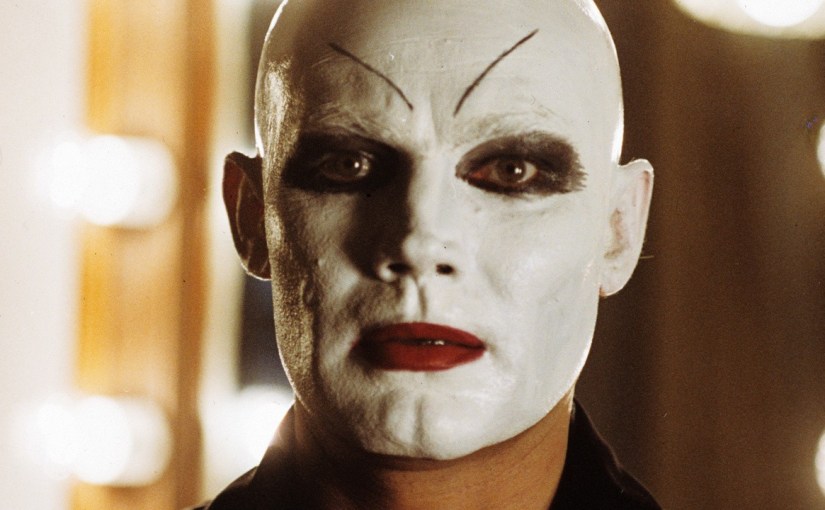
Brandauer plays Hendrik as a man who only feels like himself when he’s pretending to be someone else. Onstage or when directing his cast, he’s filled with boundless energy, dancing with the chorus line or leaping across the stage with abandon. Offstage, he is quiet and self-effacing, unless he’s socializing with other cast members. Mention is made several times of his “limp” handshake, a direct contradiction to the strong characters he portrays, especially his most famous role: Mephistopheles in Faust, a role that brings him even more fame and prominence within the theater community. The imagery of Hendrik is striking: He covers his face in white makeup like a kabuki player with sharply angled black eyebrows and red lips, the ultimate in being able to disappear inside a character.
But something is happening in the background that Hendrik is reluctant to acknowledge. A fellow cast member almost gets into a fistfight with him when he criticizes another actress because of her associations with a member of the Nazi party. His wife warns him about the dangers presented by this man who was just elected Chancellor. [Interestingly, the name of Adolf Hitler is never once mentioned onscreen.] She tells Hendrik that many of his friends are leaving Germany, fearing for their livelihoods, if not their lives. But Hendrik refuses to panic:
“There is still the opposition, no? They’ll make sure he doesn’t get too big for his boots. And even if the Nazis stay in power, why should it concern me? … On top of that, I’m an actor, no? I go to the theater, play my parts, then go back home. That’s all. … I’m an actor. You can design sets anywhere or buy antiques. But I need the German language! I need the motherland, don’t you see?”
Hendrik is so wrapped up in his profession that he simply cannot accept the fact that his freedoms are about to come crashing down around him. He would rather formulate a far-fetched scenario based on nothing but hope so he can just stay where he is and keep performing.
(I have to be honest: when we took our first steps out of the Covid lockdown, I felt the same way. Local theaters announced auditions for shows again, and I assured myself and my girlfriend that I would take the utmost precautions and wear masks at rehearsals and disinfect and wash my hands and I wouldn’t get sick. And, of course, I eventually got sick. I recovered, but you can probably imagine my disbelief when I tested positive that first time. “ME? But I was so careful!”)
Hendrik stays in Germany. His wife moves to Paris. Fellow actors either disappear outright or are arrested by the Gestapo in full view. Hendrik accepts an offer to direct the official state theater, despite his past affiliations with liberal/Bolshevik causes, because of his prestige in the theater world. A character known only as the General (probably intended to be Hermann Göring) gives him his marching orders as theater director. He witnesses several Nazis beating a man on the street and walks in the other direction…best not to get involved.
So, what we have here is an actor willing to trade away his soul and his conscience in exchange for the opportunity to remain in the limelight, performing as Mephisto or Hamlet. The metaphor is not exactly subtle, but director Szabó manages to land the message in such a way that it never feels like preaching. It’s a masterpiece of storytelling that lands somewhere between satire and Kafka.
An especially telling scene has Hendrik explaining to an attentive crowd of Nazi journalists that his production of Hamlet will portray the lead character as “a hard man…an energetic, resolute hero”, rather than as a neurotic, “pathetic” revolutionary. Hendrik tells them exactly what they want to hear so he can stay in the limelight. He’s made his own deal with the devil. I will not reveal whether Hendrik’s bill comes due during the film, but I will say the finale evokes the landmark documentaries of Leni Riefenstahl. I’ll leave it at that.
As I said, watching the film reminded me of the Covid lockdown…but it also made me think about all those many, many times in the past that actors and other celebrities have been criticized for voicing their political opinions in public. “Shut up and play/act!” is the usual cry. Many people would prefer their favorite actors to behave more like Hendrik: just keep your head down and let everything blow over, don’t make waves, it’s not your place, etcetera, etcetera. Mephisto argues that keeping silent in the face of injustice or tyranny is not an option, especially not for people in the spotlight. Those who do so risk suffering Faust’s fate. Or Hendrik’s, whose last words in the film are brilliantly contradictory.
 2 UNPAID MOVIE CRITICS!!!!