MAN WITH A MOVIE CAMERA (Soviet Union, 1929)

by Miguel E. Rodriguez

DIRECTOR: Dziga Vertov
CAST: Mikhael Kaufman, Elizaveta Svilova
MY RATING: 9/10
ROTTEN TOMATOMETER: 98% Certified Fresh

PLOT: This highly influential quasi-documentary captures a day in the life of a Russian city, as well as the cameraman doing the filming.


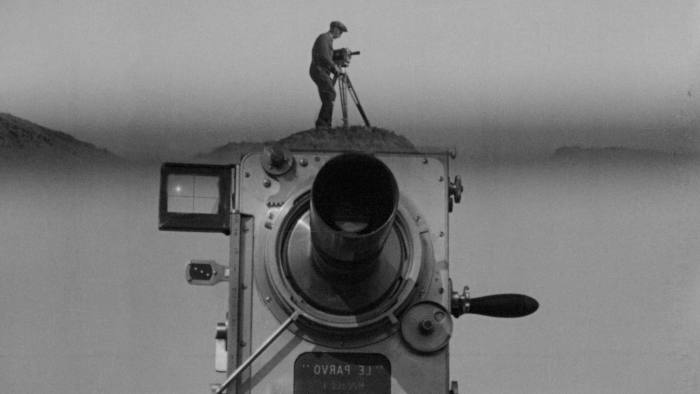
Film scholars more highly educated than I may be able to dispute this, but I think Man with a Movie Camera qualifies as the most “meta” film ever made: a movie about the making of itself.  Filmmaker Dziga Vertov, who cut his teeth on Soviet newsreels, cobbled together three years of footage of everyday life in Moscow and condensed it into a 68-minute quasi-documentary/newsreel that acts as a virtual wormhole into the past, revealing people and activities and life that is not that far removed from our own experiences.  Spliced into this footage are shots of the film’s cinematographer carrying the camera around on a tripod, setting it up, and shooting the footage we’re seeing, sometimes putting himself in mortal danger for the sake of getting the perfect shot.

Vertov used every camera trick available at the time, including [bear with me while I consult IMDb]: double exposure, time lapse/fast motion, slow motion, freeze frames, jump cuts, split screens, Dutch angles, extreme close-ups, reversed footage, and even stop motion animation.  The resulting film is extremely reminiscent of two of my other favorite films, Koyaanisqatsi (1982) and Baraka (1992), though the reverse is clearly more accurate.  When those two movies were hailed as art house masterpieces, fans of Vertov’s film must have been thinking, “Yawn, been there, done that.”

I’m sure entire books and even college courses have been written and designed around Man with a Movie Camera with its metatextual layers and its impossible-to-overstate influence on filmmakers up to and including the present day.  (There was even a small scene that reminded me of those spinning-atom “flashbacks” in Oppenheimer [2023].)  As a wise man once said, “Better to be remain silent and be thought a fool than to speak and remove all doubt.”  I won’t attempt to approach this beautiful movie from an intellectual standpoint.  Rather, I want to convey the emotional effect Vertov’s techniques succeeded in creating in me as I watched.

Basically, the movie can be broken down into several chapters.  We first see a city asleep: Moscow, mostly, though some sequences were shot in Odessa, Kiev, and Kharkiv.  Early morning streets are deserted except for street sweepers and homeless folks on park benches.  Department store mannequins stare blankly onto empty sidewalks.  A young woman lies in bed asleep.  We see a car pull up to a building and pick up a passenger: a cameraman, who is “played” by the film’s cinematographer, Mikhail Kaufman.

The city awakes.  Store shutters are thrown open.  Electric streetcars and motorbuses pull out of their “stables” and head for the city.  The young woman from earlier gets out of bed and, as the quaint phrase goes, “performs her ablutions.”  In a couple of interesting sequences, homeless men on the street awake to discover a cameraman filming them.  Invasion of privacy?  Exploitation?  Perhaps.  But of the two men I recall seeing filmed this way, one of them simply made no reaction, while the other smiled and laughed, then rolled over to snooze for a few more minutes.  Hey, a cameo’s a cameo.

Then the city gets to work.  People arrive at their factory jobs.  Vast machinery is switched on.  Steel mills rumble to life, and smoke belches from towering smokestacks.  We see the cameraman climbing the crude ladder on the side of one such smokestack with no visible safety equipment.  My palms got a little sweaty just watching it.

The city streets become unbelievably congested with mobs of people, herds of streetcars, and only crude manually operated street signals to maintain order.  Trains pull in and out of train stations right on schedule – presumably.  In one absurdly dangerous shot, we watch as the cameraman places his camera directly on the track in front of an oncoming train and then remains behind the camera for as long as possible, checking focus or whatever, as the train gets closer and closer and CLOSER…then we cut to a shot of the train rolling over us as if the camera was right on the ground underneath the train.

(In the first of several such sequences, we then see a series of shots showing the cameraman has dug a hole in the middle of the tracks large enough to fit him and the camera so he can still crank the film while the train rolls over him.  First the magic, then the explanation.)

Here and there in the middle of all this, we also get shots of the film’s assistant editor, Elizaveta Svilova, laboriously poring through endless feet of film, searching for the perfect shot or the perfect splicing point, cutting and pasting, and sometimes storing small reels on shelves marked with categories like “Factory” or “Street” to be used later.  We’re really getting a look at how the sausage is made here.  But to what purpose?  Perhaps Vertov is going to great pains throughout the movie to demonstrate to the audience that the magic of montage and any emotional reactions they may experience while watching is the result of intensely hard work by manual laborers much like themselves.

Vertov even exhibits a wicked sense of timing and dark humor.  We see a short scene in which a man and woman visit a city office to sign a marriage certificate, all smiles and nerves.  This is followed shortly by another couple, who are NOT smiling, visiting the same office…this time to sign a divorce certificate.  At this point I started to wonder if these scenes were being staged.  But there is a third sequence set in the same office, where a woman hides her face from the camera with her purse.  This time they are signing a DEATH certificate.  We’re then treated to a mixed montage showing a wedding, a live birth, and a funeral: ashes to ashes, dust to dust.  Manipulative?  I guess you could make that case, but that does not diminish its power one little bit.

The raw power of the freeze frame is utilized to great effect in several shots of athletes, horses pulling carriages, and children watching a magician.  Time lapse footage shows clouds scudding past a statue, a technique that would not be widely appreciated until over fifty years later.  Workmen push heavy wheelbarrows and walk directly over the camera, followed immediately by a shot showing the cameraman lying on the ground filming the workmen as they walk over him.  This kind of juxtaposition does not ruin the film’s impact, however.  For me, it emphasized something I tend to forget: this movie – in fact, ALL movies – are created by someone with an idea and a movie camera and the chutzpah to do what it takes to make it happen.

Another idea that deserves mentioning is that Vertov created a compelling and enduring film out of vignettes of everyday life in the city.  No melodramatic scripts, no overacting, no impossible coincidences…just life.  Maybe Vertov was reminding the audiences of his day that their lives, their recreation, their struggles, were no less enthralling or exciting than anything that could be dreamed up by a Hollywood screenwriter.  “You want to see something interesting?” he seems to ask.  “Look no further than yourselves and your family and your neighbors.  You are more interesting and unique than you believe yourselves to be.  Watch…I’ll show you.”

To summarize: Man with a Movie Camera is nearly a century old, but it has lost none of its power over the years because of the director’s utilization of groundbreaking techniques that are still being used – and, in some cases, copied – in today’s film industry.  Even more so than any of the silent films by Chaplin or Keaton, it feels like a time machine, beaming images to us today from a bygone world with none of our modern luxuries but all the emotions and experiences that make us human.  There is a quick sequence showing a hospital nursery, giving us closeups of several newborns.  I found myself wondering…it’s been 95 years since the movie was made and released.  It’s conceivable that one or more of those babies might still be alive today.  I don’t really know what that would mean in the grand scheme of things, but wouldn’t that be something?

TWISTERS

By Marc S. Sanders

Reader, often The Two Unpaid Critics will debate the merits or lack thereof in a film.  Usually, one likes the piece while the other does not.  It’s rare though when we both find fault with a movie but for entirely different reasons…and we argue about it.

Fair warning, a poorly constructed declaration is coming your way:

Twisters is better than Twister.  

However, this is like saying cat shit is tastier than dog shit.  

Understand, I had a grand ol’ time watching Twisters with Miguel by my side as the experience quickly gravitated to a Riff Trax viewing.  This apparent sequel to the stupidity that was released thirty years ago teaches us more about the nature of tornadoes.  Though when I insist that observation to Miguel, my comrade put me to the test and my giggles took hold of me because I couldn’t utter a single scientific fact.  Okay.  So it’s not that much brainier. Yet, it is brainier!!!

Twisters offers a background and a traumatic dimension to Kate (Daisy Edgar-Jones) who loses all but one of her entire collection of friendly storm chasers in the film’s prologue, and then weepily monologues about it later.  That’s what I wanted from Helen Hunt in the first movie.  Miguel rightfully questioned why she even needed to speak.  We were firsthand witnesses to this early tragedy.  

CURSES!!!! You foiled me again, Mig.

Okay, so with my arguments shredded to pieces within our debate, I heed to the fact that I am no Jack Kennedy.  Yet, at least I could laugh at how utterly ridiculous Twisters is.

Kate is requested back to her home state of Oklahoma to locate powerful tornadoes that now can be studied with new triangular sensors, each respectively called Scarecrow, Tin Man and Lion.  That garbage can called Dorothy has been put out to pasture.  There’s also a Wizard van. Cute wink and nod names.  No Glinda. No Witch. No Munchkin. No Flying Monkey. How lazy can a tornado movie get?

This corporation with the high-tech gear is competing against a convoy of redneck grunge daredevils led by Tyler, The Tornado Wrangler (Glen Powell).  He fits the persona with the cowboy hat that Brad Pitt wore in Thelma & Louise, along with the flannel shirts and a big ass belt buckle below his ripped chest.  

Tyler’s off road pickup is tricked out with anchors to drill in the ground holding his vehicle in place while he drives right into the middle of a storm.  He’ll also launch fireworks straight up into a funnel.  Whatever it takes to impress his You Tube followers.  

Get this!  Tyler is one of the most educated people in the world on meteorology.  Has to be true!!!! Absolutely has to be, because Glen Powell would never agree to portray a daredevil redneck without a brain to complement his chestnut hair and five o’clock shadow.

Twisters fails at suspense, but unintentionally wins at outrageous comedy when the movie opts to have its terrible tornadoes attack Americana.  As soon as they show small town USA with the little league softball game, I broke out laughing.  I was waiting for the homemaker to put out a pie on her windowsill.  Where’s Bob Seger singing “Like A Rock” from those Chevy commercials?  Tyler, Kate and the gang race to save everyone in town single-handedly without ever calling emergency services.  Only ONE COP appears in the whole movie. Fortunately, once the storm moves on from its devastation, there’s a complete clear road with absolutely no debris for the Tyler’s gang to drive on through. I mean does this movie think for itself or what?

We are treated to people flying away and a water tower toppling over.  A movie house rips apart while Frankenstein shows on the screen.  There’s the inevitable moment when a character gets a leg stuck under wreckage while the others try to get him free but can’t lift him out as the storm bears down.  But wait!!!! At just the last second– I saw this in episodes of The Incredible Hulk and CHiPs and…um…well…Twister!

Earlier in the film, Tyler and Kate have an opportunity to settle their differences while taking in a rodeo.  Of course, Tyler the redneck meteorologist and Tornado Wrangler used to be a rodeo clown as well.  

Then!!!!

What’s this?  

“We gotta get these people to safety??”  

“Is there a basement around here?”

Apparently, Oklahoma is running low on basements.  Not a single basement anywhere in the state where the wind comes sweeping down the plains!!!!!  

Twisters fails because it is paint by numbers, and it shouldn’t be.  It should never be this transparent. The most unpredictable of weather phenomena is so laughably unsurprising when it should be dazzling and frightening and nail biting.  None of it is new.  Everything you expect to happen, happens.

This picture even fails at lending a nasty bad guy to its screenplay.  The rich old guy with the bolo tie, a true indicator of villainy, tours around the devastation. He’s offering to buy the properties of people who have lost their homes so that further profitability can be made with ongoing research into tornado activity.  Yeah.  This guy is a regular Darth Vader or Hannibal Lechter, alright.  Hang him in the town square and then stone his rotting carcass.  Seriously, what’s so wrong with this guy’s intentions?  Kate is disgusted for some reason, but if I just lost my house and my farm and my crops and my flat screen and all my blu rays, heck yeah, I’ll take this fat cat’s money.  

Miguel refused to write a review for Twisters.  However, I’m taking free liberty to share his compounded thoughts. As the end credits rolled over home movie footage of the happy cast, he declared this film is devoid of any kind of suspense, whatsoever.  He’s not wrong, and neither am I.  

Twisters is better than Twister but for all the wrong reasons.

SOAPDISH

By Marc S. Sanders

To get inside the head of a character on a soap opera would best be portrayed by someone who’s literally living a soap opera off the set.  That’s the paramount theme of every member of the cast and crew of the daytime drama The Sun Also Sets.  Everyone is living through their own checkered background from the lead actress to the returning actor to the homeless deaf/mute extra on down to the trampy nurse and the buxom doctor on the show. By default, the program’s head writer and the producer fall into this category as well. 

The hilarity found in Soapdish gave me remembrances of classic films like All About Eve and Sunset Blvd. Ego and stardom are treasured commodities above all else and an actress’s greatest fear is being aged out of fandom and replaced by the new girl in town. 

Celeste Talbert (Sally Field) is a star actress with dozens of career awards but an insecurity with becoming past her prime. A diva concern is that the stories written for her are not worthy of her importance to the show.  David (Robert Downey Jr) is the young producer feeling the pressure to come up with something to boost the ratings before his boss, the always naturally funny Garry Marshall, replaces the program with game shows.  On David’s side for her own ulterior motives is Montana Moorehead (Cathy Moriarty) who plays the resident nurse and is ready to take the reins from Celeste and make the show her own.  She’ll seductively manipulate David into getting things to work out her way. 

In the meantime, Lori Craven (Elisabeth Shue) sneaks onto the set seeking an opportunity by way of Aunt Celeste.  Best she can get is to portray a deaf/mute homeless woman extra.  Head writer Rose (Whoopi Goldberg) has devised a new plot where Celeste’s character will be tried for murdering Lori’s homeless mute character.  Lastly, at least through the first thirty minutes of the film, Jeffrey Anderson’s (Kevin Kline) character who died on the show twenty years prior by an unfortunate beheading is recruited out of dinner theater by David to return to the program.  Both Lori and Jeffrey’s unexpected arrivals do not sit well with Celeste.

Following along okay, so far? Well…

SECRETS ABOUND on Soapdish!

This film was developed by the powers who delivered Steel Magnolias to the big screen a few years prior.  The original playwright and screenwriter, Robert Harling, teamed up with Andrew Bergman, to satirize the weepy material that daytime drama promises and which he embraced seriously with his beloved play.  The director of Magnolias, Herbert Ross, also serves as an executive producer on this film.  To add some extra authentic spice, Aaron Spelling is producer.  That’s right.  The guy who produced Dynasty, 90210 and Melrose Place.  Michael Hoffman directs. 

The look of this film is so odd and has a garish blood coated red appearance to the television studio where the show within the movie is set, as well as to the offices that hover above.  The set designer for the film, Eugenio Zanetti was inspired by Dante’s Inferno.  Makes sense really because no one is ever satisfied with how The Sun Also Sets develops from one atrociously delicious storyline to the next, and how it makes them look in the public eye.  Zanetti is quoted as saying the offices of the producers and writers hover above the set for the soap opera.  So, it looks as if the powers that be are staring down into the depths of hell that the cast and crew must work and reside in.  While it looks odd, after having seen the film, I can’t help but believe Zanetti makes sense.

There are moments here that are outright hilarious.  As a community theater actor and director, I can totally relate to Kline’s character being stuck in a retirement community steak/playhouse performing as Willie Loman in Death Of A Salesman while elderly patrons call for their waiters.  Poor Jeffrey also has to project that much louder for the old folks to hear him.  This scene stands as gold on its own. A whole farcical film could be developed on this side story alone. 

Soapdish does lose some of its comedic appeal before it reaches the middle of the picture when secrets are uncovered related to Celeste, Jeffrey, Lori and so on.  Sally Field goes for great physical comedy that lands perfectly with the skeletons that Celeste pulls out of the closet.  Kevin Kline makes for a hysterical arguing scene partner, and the craziness just gets bigger from there. 

Whoopi Goldberg is also very funny as the one with common sense and brains behind her character.  For once, she’s not going for the female Eddie Murphy equivalent.  I’m with Rose when she vents to David about how she’s supposed to write a believable return from the dead of a character who was killed when he lost his head.  Maybe a brain transplant?

Cathy Moriarty does a fine job of being the conniving seductress.  She’s a full-bodied intimidator of teased, frizzy blond hair and a buxom nurse’s uniform costume against Robert Downey, Jr.’s nervous preppy producer.

There’s satisfying moments for cameos from Carrie Fisher as a casting director as well as Teri Hatcher and Costas Mandylor as bubbleheaded supporting characters.  However, the best scene stealer is Garry Marshall. I don’t think a single line he’s given would be as funny if he was not providing them.  He’s just got that Neil Simon kind of delivery as the studio boss.  “The nurse is in the restaurant?  Was there a meeting I missed?”

Other than a few F bombs, I think Soapdish works as movie the whole family could watch the next time they are snowed in or hunkering down from a blizzard or hurricane.  Soap operas are designed for escape and the outrageous comedy of Michael Hoffman’s film reaches into outrageous areas that work with surprise and big laughs. 

This nonpaid critic, who endures his loving wife’s adoration for General Hospital each night before bed, is at least a fan of The Sun Also Sets and Death Of A Salesman dinner theater. 

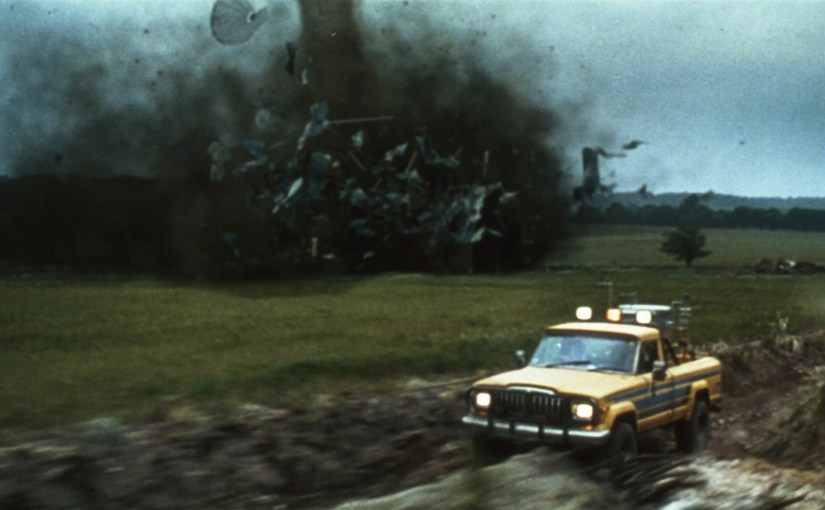
TWISTER

By Marc S. Sanders

About twenty minutes into Twister, Helen Hunt and Bill Paxton crash their pickup truck while trying to outrun the title character.  Amid the high wind, mud and rain, they take cover under a narrow bridge.  Then Hunt’s character, Jo Harding, becomes enamored, almost hypnotized, with what she sees of the powerful storm and steps out saying she wants to see more while reaching with her hand.  Paxton’s character, Bill Harding, pulls her back down.  Reader, why did Bill have to pull Jo back down?  I don’t care about Jo.  I don’t care about Bill.  They’re not characters.  They’re talking objects.  The only character given any kind of care and treatment is the twister.  The next most important character is the next twister and then after that it is the next twister.

Jan De Bont’s Twister is devoid of a brain with a big head full of wind.

A thin story is inserted to connect these talking props.  Bill needs to convince Jo to sign divorce papers.  Jo is focused on getting a tin can thing named Dorothy into the center of a tornado so it can release sensors and thus their team will be able to study the characteristics of a tornado’s behavior like wind velocity for example.  With each new tornado, their attempts fail and somehow the team has another tin can ready to go.  Where are they hauling these things?  As well, how can such a clunky thing that looks less sturdy than a beer keg offer up so much information?  Dorothy looks like it can easily get its ass kicked by R2-D2.

I guess for escapist humor, Bill brings along his fiancé Melissa (Jami Gertz).  Melissa is here for a couple of lame reasons.  One, to wear a white suit with a fashionable hairdo that you know is bound to get messed up (but actually really doesn’t).  Two, to be used as the device for the rest of the cast to explain where they are going next and what they are seeing.  After whatever explanations have been exhausted, the script literally has her exit the picture in a quick announcement. 

I have not seen the new follow up film, Twisters, but I want to and I’m embarrassed to admit that.  It’s the special effects my dear reader.  The visual effects are all that is to be cared about in these movies.  Visually and audibly these effects are unbelievably impressive and I can only expect some enhancements in the new film.  Unfortunately, once I see one twister, I’ve seen them all.  I’m risking cavities for the five minutes of flavor I get in a Starburst.

What’s regrettable about Twister is that with a good collection of actors that also include Philip Seymour Hoffman, Cary Elwes, Alan Ruck and Jeremy Davies, the acclaimed author Michael Chrichton and Anne-Marie Martin hardly attempt to insert any intelligence into the science of weather phenomena or the trauma that goes with it.  I know just as little about tornadoes as I did before I saw this film. 

A prologue scene has Helen Hunt’s character witness her father being violently taken away in a sudden storm.  However, it is never referenced again.  I started to think about that monologue from Jaws performed by Robert Shaw about his experience aboard the sunken vessel the USS Indianapolis.  The scene is an actor’s dream, but it also makes the nature of the world we live in much more personal for that character.  Shaw’s character has a personal vendetta against sharks based on experience.  That’s what is missing from Twister.  None of it looks personal. Helen Hunt is an Oscar and Emmy winning actor.  She could have had a brilliant monologue that demonstrated her need to follow tornados and learn more about their unforgiving nature.  Chrichton even lent more passion to John Hammond (Richard Attenborough) in the film adaptation of Jurassic Park.  The entrepreneur talked of aspirations for a dinosaur zoo.  Jo Harding possess neither passion nor animosity for her purpose in life.  Twister could have operated better as an observational documentary than a special effects action picture.

Since a tornado cannot have an evil laugh or a handlebar mustache, there must be another source for villainy and that falls on Elwes and his crew.  Jo, Bill and the rest of the gang do not like Bill because he leads a convoy of black (black like Darth Vader) SUVs with the most up to date technology around to study weather patterns.  Yet, what is so wrong with any of that?  We have to hate these guys because they drive shiny SUVs.  Is that all it takes?  At best, the competition heats up as the two convoys nearly sideswipe each other or cut each other off on multiple occasions.  None of this is exciting.

A beloved elderly aunt is conveniently nearby so the gang can chow down and disgust Melissa with their eating habits.  Later, the aunt’s house happens to be in the path of a storm and then a sequence is devoted to rescuing her amid the crashing debris.  We get to see the beautiful mid-west house crash upon itself because to see another twister would just be more of the same.  I hardly got to know the aunt.  So, I don’t care if she lives or dies or becomes catatonic or turns into a superhero named Storm.  This is extra cream filling in an over expired Twinkie. 

The mouth pieces of Twister just don’t matter and while I’m dazzled by seeing a tractor, a cow, another cow (or was it the same cow?), and a house fly around and topple all over the roads amid the wind and the rain, I’m just not taken with any kind of suspense or care. 

Special effects only work if they are ingredients to a story, and not just the story. 

THE SWIMMER (1968)

by Miguel E. Rodriguez

DIRECTOR: Frank Perry [reshoots directed by an uncredited Sydney Pollack]
CAST: Burt Lancaster, Janet Landgard, Marge Champion, Kim Hunter, Joan Rivers (!)
MY RATING: 8/10
ROTTEN TOMATOMETER: 100% Fresh

PLOT: A well-off ad man visiting friends in a suburban town impulsively decides to swim home via all his neighbors’ swimming pools.


The decidedly odd The Swimmer starts out like it’s going to be one of those pretentious mid-to-late ‘60s “art films” featuring attention-getting zooms, quick edits, and a kitschy/dreamy score that oozes “soap opera” from every note.  (Incidentally, this was Marvin Hamlisch’s first film score.)  It starts mundanely enough, but then it veers imperceptibly into vaguely Lynchian territory, until by the end we’re no longer sure what’s real.  If the payoff doesn’t quite live up to the build-up, I’m prepared to forgive it because of the film’s daring originality, Burt Lancaster’s nude scene notwithstanding.  Hope I didn’t spoil that for you.

Based on an acclaimed story by John Cheever, The Swimmer opens with those ostentatious zoom shots/quick edits of forests and woodland creatures before we meet Ned Merrill (Lancaster), visiting a friend and swimming in their pool.  The neighborhood is decidedly upper-middle class.  The conversation between Merrill and his friends is banal to the point of tedium.  “You ever see such a glorious day?”  “You old son of a gun!”  “Ned Merrill!  How are you, sport?”  Who talks like this?  The dialogue evokes the kind of vibe you’d get from reading a screenplay written by a moderately talented middle-schooler, or perhaps by an advertising executive with no sense of how people talk in the real world.

After some more boring pleasantries and treacly politeness and observations of how nice the weather is, Ned has a brainwave.  He and his wife and daughters live in a house on a hill a mile away.  Or two.  Or five.  It’s never really made clear.  Anyway, he realizes that his friends and neighbors, all of whom have pools, form a river that he can use to swim all the way home.  He never explains where this decision comes from, but whatever, off he goes, to the consternation of his neighbors.

That’s the plot in a nutshell.  For the rest of the film, Ned will visit his neighbors one by one, popping in unexpectedly, take a lap in their pool, and jog off to the next one.  Along the way, he’ll have encounters with his neighbors that will range from friendly to strained to flirty to outright hostility, and two unsavory encounters that involve borderline sexual harassment.  By the time he reaches his goal, everything we’ve seen before will be redefined in light of new information.  I had an idea of what would happen, but I was wrong.  Sort of.  See for yourself.

The Swimmer is a borderline one-trick-pony movie, like Primal Fear.  As good as that movie is, and as good as Edward Norton’s performance is, after watching it the first time, all the suspense is gone.  But The Swimmer is so much odder than anything I’ve ever seen that it gets some kind of award just because of its oddness.  We’re invited to simply watch a man swim in other peoples’ pools and talk to the owners.  At one such encounter, Ned marvels that their 20-year-old daughter, Julie, has grown up so much.  He mentions his own daughters, Ellen and Aggie, probably playing tennis at home.  Julie suggests driving to Ned’s home to meet them…but Ned changes the subject.  This will occur repeatedly.  Ned will mention his wife or daughters, someone will ask how they are, and Ned will abruptly move to the next topic.  (It’s this behavior that made me think I knew what was going on, but as I said, I was wrong.)

The encounter with Julie takes an odd turn: he invites her to join him on his swim, and she agrees.  After crashing a neighbor’s pool, and Ned hurts his leg jumping over a hurdle meant for horses (long story), Ned and Julie share an odd conversation where she confesses she used to like smelling his shirts when she was much younger.  Ned takes in this information and starts flirting with Julie, who is at least 30 years his junior, to the point where it looks as if something unsavory is about to happen.  Nothing does, but the scene itself is a very strange detour, even in the middle of this strange movie.

While Ned’s encounters with his neighbors are all different in one way or another, the first few all have the same thing in common: they’re all trite, by which I mean their dialogue with Ned is filled with lines and sentences that sound, well…scripted.  Not a word of it sounds or feels genuine.  I suppose one could interpret this triteness as an indictment of modern suburbia, where one house and one pool is so like the next as to be indistinguishable from each other.  The same could be said of the people.  One guy brags about his pool’s water filter: “It filters 99.99.99% of all solid matter out of the water.”  Another house features an enormous sliding roof so people can…go swimming while it rains, I guess?  We are treated to scenes of luxury that border on decadence.  At one party, caviar is served, and the guests scoop it up as if it were onion dip.  I was reminded of a line from The Philadelphia Story about “the privileged class enjoying its privileges.”  Is The Swimmer a clumsily disguised diatribe against consumerism?  Sure, why not.

At the end of the day, while The Swimmer does have a buried subtext that is not fully revealed right away, I’ll admit the subtext is not what compels me to recommend it.  I recommend it because it is a cleverly constructed “head-fake” movie, making me think it was about one thing when it was about something else altogether.  Viewers more astute than I may have guessed what was going on, and more power to them.  For myself, my theory was proven wrong at the finale.  The Swimmer gets points for originality, with deductions for the cheesy score and hammy acting.  The back of the Blu-ray describes the movie perfectly: “…a feature-length ‘Twilight Zone’ by way of The New Yorker.

(P.S.  If you have “seeing Burt Lancaster’s bare ass” on your Movie-Watching Bingo card, this movie will help you fill it.  You’re welcome.)

THE COLOR OF MONEY

By Marc S. Sanders

The Color Of Money is the first and only time that director Martin Scorsese tackled a sequel of sorts.  Paul Newman returned to the screen as Fast Eddie Felson, the hustling pool shark from thirty years prior in The Hustler.  That movie established his career on a bigger scale going forward.

Fast Eddie is older now, and wiser.  He’s much more humbled as a bar owner with a conservative amount of cash on the table to stake younger pool players for small time wagers.  A young John Turturro is who he relies on and quickly loses faith in when a brash, cocky kid named Vincent Lauria (a perfectly cast Tom Cruise) easily undoes his opponent. 

Eddie sees the talent in the kid.  He’s got a helluva break and clears a game of nine ball with as much speed as he has conceit.  What he lacks for in brains and instinct is made up in Vincent’s cool and mature girlfriend Carmen (Mary Elizabeth Mastrantonio in an Oscar nominated role).  It does not take long for Eddie to coach her into realizing that together they can make a lot of money off of what Vincent can do in pool halls across the country.  If only he’d listen to them and do what they tell him to do. Vincent can’t comprehend how sometimes you win a whole lot more, when you lose first.

Scorsese works his camera like a swinging Steadicam.  When he gets close ups of this trio of actors, it’s never just a close up.  He’ll position his lens in a northward direction and then swing around east.  Newman, Cruise and Mastrantonio trust the eye of the camera to follow their performances.  There’s an energy to this kind of shooting.  It makes for a great style.  Scorsese was doing this novel kind of filmmaking, going all the way back to 1971 with Alice Doesn’t Live Here Anymore.  The director is so favored because as typical as a script might seem by its title or its prose, he’s going to find an exhilaration to its narrative.

Along with the director’s resident editor Thelma Schoonmaker, there’s a crackle and quickness to the many variations of pool play – much more playing than I believe was featured in The Hustler.  Schoonmaker makes sure to cut in the cracks of the pool balls as they collide with one another.  The blue cue chalk snows off the tip of the cue sticks.  Reflections of the players appear in the shine of the balls.  Close up profiles of Cruise and Newman lower down into frame just before they take their shots.  Before the kinetic energy found in later films like Goodfellas and The Departed, Scorsese and Schoonmaker were already putting their tag team best at play in The Color Of Money.

Yet, all of this is style with not so much substance.  What kind of story does this next installment in the legacy of Fast Eddie Felson have to say?  Not much really.  While the three actors are doing top notch work, the conversations run very repetitive and do not build toward higher stakes or developments.  Time and again they argue over Vincent’s refusal or naivety to understand the hustling strategies that Eddie has in mind.  Carmen gets it but she goes her own way more often than cooperating with Eddie.  Simply, this is a story of the protégé not grasping what the mentor is trying to teach, and it never evolves from that problem.  It gets stagnant.

What changes within the second half of the film is the introduction of a championship pool tournament in Atlantic City.  Therefore, it’s easy to expect a showdown between Vincent and Eddie.  It happens and there is a twist of a dagger included, but then when the real competition is about to begin, Scorsese concludes his film.  Does it matter who is the better player?  I don’t know, but as the film is wrapping itself up, one character gets short changed.  When that’s discovered, the film opts to also shortchange the audience.  I didn’t think that was very fair.

I think about the notorious ending to the HBO series The Sopranos.  Sure, it’s an ending no one will ever forget but for all the wrong reasons, and I defiantly believe it is because the storyteller ran out of imagination or lost his confidence in upholding an ending that he really wanted.  I feel the same way with The Color Of Money.  The film establishes the skills, intelligence and capabilities of these characters.  Yet, when you take the tool kits away from them, the building never gets completed; only left abandoned.

I’m drawn to watch The Color Of Money.  Michael Ballhaus’ photography is smokey and colorful. I can’t get enough of Paul Newman’s gravelly vocal inflections or even how he unfolds hundred dollar bills from the roll in his pocket.  Tom Cruise humbles himself to look like an idiotic jerk and it works well against the maturity of his scene partners.  Mary Elizabeth Mastrantonio oozes sexual appeal with a lot of brains to uphold the cons.  She has sensational scenes with Paul Newman.  There’s a coolness to the picture because of the cast, the settings, the sounds, the visuals, the editing and the direction. 

This film arrived in 1986 with rock music from the likes of Eric Clapton and Phil Collins.  Beyond Miami Vice and an assortment of John Hughes teen flicks, these artists were making for effective needle drops of atmosphere in films from the 1980s.  Scorsese’s use of the camera keeps me engaged, but when I look at what the characters are anchored to only do, and never rise above, the film does not hold the weight of other character studies that several of Newman’s and Scorsese’s pictures were so astute at achieving.

One scene transcends the arc of Newman’s character and it works beautifully within or out of the context of the picture.  A relatively unknown Forest Whittaker portrays an unlikely kid who goes up against Fast Eddie. As the long scene evolves over their pool competition, the writing hearkens back to the weaknesses and torment that defined Eddie Felson’s character in The Hustler.  If you watch the first film and then jump over to this scene, you recognize a connection for the protagonist of both pictures.  Beyond that The Hustler and The Color Of Money stand a long distance apart from each other.  This scene though is always a favorite of mine for the eventual Oscar winner, Forest Whittaker.  Watch how Whitaker holds his cue stick when he exits the scene.  Think about how he picks the cash up from the table after Newman drops it.  Consider, what his character Amos really means when he asks Eddie: “Do you think I need to lose some weight?”

Had The Color Of Money used more of Whitaker’s character in the film along with the other three, there might have been something more solid to say and introduce within the world of pool hustling with a 1980s barroom vibe.  Same could be said if John Turturro’s character was utilized more.

Paul Newman received the Oscar for this picture.  The actor was nominated seven times before, having never won and the irony is by the time this nomination arrived, Newman opted not to attend the ceremony.  Roles in films like The Verdict (for which he should have won the award) and Cool Hand Luke were much more memorable and fleshed out.  I’d argue Newman likely knew this was not his best performance because it was not the best written of his long-established career, and so he genuinely did not expect to win.  Because he won, it became a celebration of his legendary status as an actor who should have been taken much more seriously, much sooner.   (Two more nominations would follow in Newman’s career.)

JACOB’S LADDER

By Marc S. Sanders

When a movie works beyond formulaic conventions, it takes risks.  A storyteller will either really impress their audience, or they will leave them feeling shortchanged.  You’ll either get a “Whoa!  Now that’s cool.” (The Usual Suspects, The Sixth Sense, but I did call that ending when I saw it in theatres.  Ask my wife if you don’t believe me.) On the contrary, you’ll arrive at “That’s it?” (The Happening, Signs or any other M Night Shyamalan reach for the rafters but come up foul kind of flick.)

A movie like Adrian Lyne’s Jacob’s Ladder is anything but standard and it asks you to trust in its ambiguity in order to arrive at its big payoff.  For most of the picture it is unclear what you’re watching.  What keeps you engaged is Lyne’s approach to atmospheric indicators, like dark tunnels, dim bulbs, distant echoes and a disturbingly scared and depressed Tim Robbins.  The creepier the film looks and the more ominous it feels, then perhaps it will lead to a conclusion that will leave you satisfied.  Jacob’s Ladder functions like an M Night Shyamalan film where you just want to arrive at the twist.  When it finally reached its destination though, I was ready to turn the car around and go home.

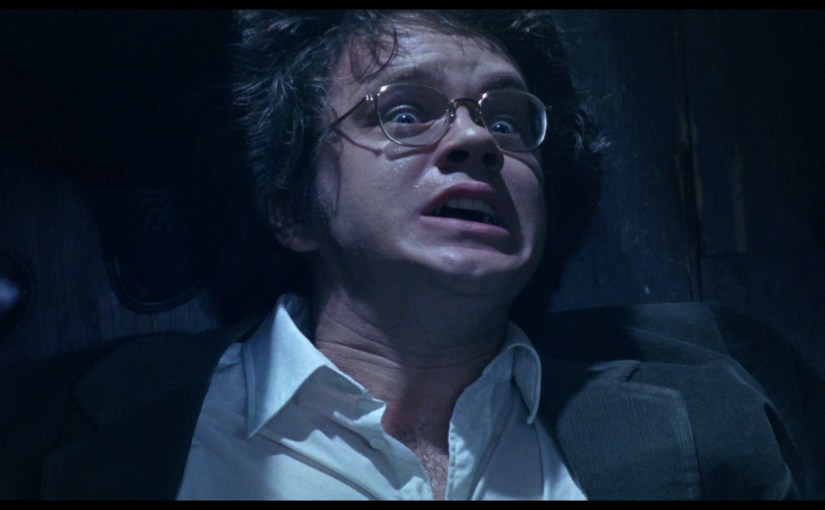
Tim Robbins is Jacob Singer, a Vietnam veteran.  The picture opens up with Jacob returning from the dense jungles to reunite with his squad after what was his like hundredth bowel movement, it seems.  The squad jokes about with men’s locker room talk and then a disturbing occurrence takes place.  The next scene, thereafter, has Jacob dressed in a mailman uniform awakening from a nightmare aboard a New York subway train.  He gets off at his stop, but then he cannot find his way out of the subway station and then he encounters unsettling images like perhaps a demon or two on board a train that just misses running him down.

Much of Adrian Lyne’s film sets up sequences like this where the unexplainable cannot be explained.  Jacob now lives with a girlfriend, Jezzie (Elizabeth Peña), who is growing frustrated with Jacob’s unusual behavior.  It seems he suffers from PTSD following his time in the war, but also he mourns the death of one of his three sons (Macaulay Culkin) from his first marriage.

Robbins is especially good at not going for big moments in his role.  He’s a quiet, cheerless individual working with very little dialogue.  That’s impressive but it’s also a little boring, especially considering that for most of the film it’s near impossible to decipher what is going on, nor what is the exact story to uncover in Jacob’s Ladder.  My patience was trying, up until a stand at attention moment that came from nowhere.  Still, not much arrives thereafter. 

Jacob receives a call out the blue from one of his old army buddies.  When they meet up, it dawns on Jacob that his friend is encountering similar kinds of feelings.  When he reunites with the rest of the squad it occurs to them to sue the United States government for experimental drug treatments that were administered to them while serving in the war.  They turn to an attorney played by Jason Alexander in a role far off from his Seinfeld sitcom days to later come in his career.  This lawsuit may uncover a link for Jacob.  Unfortunately, I think it diverts away from Adrian Lyne’s intended lack of clarity for another kind of movie altogether.  The movie goes in this detour with Alexander’s attorney role and then finds its way back on the main road for the third act.  Hardly any new mileage was to be gained from this rerouting though.

This new development may give a more literal understanding into Jacob’s psyche and condition. However, I think the film fails to pounce on a new opportunity to attack a topical storyline that had become suspect during the actual timeline of the war.  As the film arrives at its conclusion, the script seems to rush to the surprise ending it wanted to garner.

Frankly, an early conversation with a Jacob’s chiropractor (Danny Aiello) easily spelled out the twist for me.  Alas, perhaps that took me out of the film early on. 

There are good ideas and good performances to be had in Jacob’s Ladder.  Yet, I don’t think the film entirely works because of Adrian Lyne’s attempt to push it’s vagueness.  Demons that come out of nowhere during Jacob’s hallucinations should be scary and have a fright shock to them, but instead these moments come off like abstract art that only frustrated me. 

I always thought I knew the ending, and I was right for the most part, but why does a runaway car have to chase Jacob down an alleyway to deliver the point?  Arguably, a boogeyman like Freddy Krueger might have done a better job at disturbing a threat of death than what was ever going on in Jacob’s Ladder.