
by Miguel E. Rodriguez
DIRECTOR: Dziga Vertov
CAST: Mikhael Kaufman, Elizaveta Svilova
MY RATING: 9/10
ROTTEN TOMATOMETER: 98% Certified Fresh
PLOT: This highly influential quasi-documentary captures a day in the life of a Russian city, as well as the cameraman doing the filming.
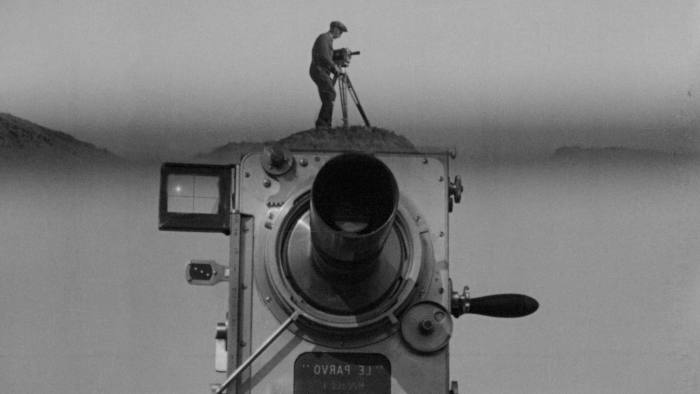
Film scholars more highly educated than I may be able to dispute this, but I think Man with a Movie Camera qualifies as the most “meta” film ever made: a movie about the making of itself. Filmmaker Dziga Vertov, who cut his teeth on Soviet newsreels, cobbled together three years of footage of everyday life in Moscow and condensed it into a 68-minute quasi-documentary/newsreel that acts as a virtual wormhole into the past, revealing people and activities and life that is not that far removed from our own experiences. Spliced into this footage are shots of the film’s cinematographer carrying the camera around on a tripod, setting it up, and shooting the footage we’re seeing, sometimes putting himself in mortal danger for the sake of getting the perfect shot.
Vertov used every camera trick available at the time, including [bear with me while I consult IMDb]: double exposure, time lapse/fast motion, slow motion, freeze frames, jump cuts, split screens, Dutch angles, extreme close-ups, reversed footage, and even stop motion animation. The resulting film is extremely reminiscent of two of my other favorite films, Koyaanisqatsi (1982) and Baraka (1992), though the reverse is clearly more accurate. When those two movies were hailed as art house masterpieces, fans of Vertov’s film must have been thinking, “Yawn, been there, done that.”
I’m sure entire books and even college courses have been written and designed around Man with a Movie Camera with its metatextual layers and its impossible-to-overstate influence on filmmakers up to and including the present day. (There was even a small scene that reminded me of those spinning-atom “flashbacks” in Oppenheimer [2023].) As a wise man once said, “Better to be remain silent and be thought a fool than to speak and remove all doubt.” I won’t attempt to approach this beautiful movie from an intellectual standpoint. Rather, I want to convey the emotional effect Vertov’s techniques succeeded in creating in me as I watched.
Basically, the movie can be broken down into several chapters. We first see a city asleep: Moscow, mostly, though some sequences were shot in Odessa, Kiev, and Kharkiv. Early morning streets are deserted except for street sweepers and homeless folks on park benches. Department store mannequins stare blankly onto empty sidewalks. A young woman lies in bed asleep. We see a car pull up to a building and pick up a passenger: a cameraman, who is “played” by the film’s cinematographer, Mikhail Kaufman.
The city awakes. Store shutters are thrown open. Electric streetcars and motorbuses pull out of their “stables” and head for the city. The young woman from earlier gets out of bed and, as the quaint phrase goes, “performs her ablutions.” In a couple of interesting sequences, homeless men on the street awake to discover a cameraman filming them. Invasion of privacy? Exploitation? Perhaps. But of the two men I recall seeing filmed this way, one of them simply made no reaction, while the other smiled and laughed, then rolled over to snooze for a few more minutes. Hey, a cameo’s a cameo.
Then the city gets to work. People arrive at their factory jobs. Vast machinery is switched on. Steel mills rumble to life, and smoke belches from towering smokestacks. We see the cameraman climbing the crude ladder on the side of one such smokestack with no visible safety equipment. My palms got a little sweaty just watching it.
The city streets become unbelievably congested with mobs of people, herds of streetcars, and only crude manually operated street signals to maintain order. Trains pull in and out of train stations right on schedule – presumably. In one absurdly dangerous shot, we watch as the cameraman places his camera directly on the track in front of an oncoming train and then remains behind the camera for as long as possible, checking focus or whatever, as the train gets closer and closer and CLOSER…then we cut to a shot of the train rolling over us as if the camera was right on the ground underneath the train.
(In the first of several such sequences, we then see a series of shots showing the cameraman has dug a hole in the middle of the tracks large enough to fit him and the camera so he can still crank the film while the train rolls over him. First the magic, then the explanation.)
Here and there in the middle of all this, we also get shots of the film’s assistant editor, Elizaveta Svilova, laboriously poring through endless feet of film, searching for the perfect shot or the perfect splicing point, cutting and pasting, and sometimes storing small reels on shelves marked with categories like “Factory” or “Street” to be used later. We’re really getting a look at how the sausage is made here. But to what purpose? Perhaps Vertov is going to great pains throughout the movie to demonstrate to the audience that the magic of montage and any emotional reactions they may experience while watching is the result of intensely hard work by manual laborers much like themselves.
Vertov even exhibits a wicked sense of timing and dark humor. We see a short scene in which a man and woman visit a city office to sign a marriage certificate, all smiles and nerves. This is followed shortly by another couple, who are NOT smiling, visiting the same office…this time to sign a divorce certificate. At this point I started to wonder if these scenes were being staged. But there is a third sequence set in the same office, where a woman hides her face from the camera with her purse. This time they are signing a DEATH certificate. We’re then treated to a mixed montage showing a wedding, a live birth, and a funeral: ashes to ashes, dust to dust. Manipulative? I guess you could make that case, but that does not diminish its power one little bit.
The raw power of the freeze frame is utilized to great effect in several shots of athletes, horses pulling carriages, and children watching a magician. Time lapse footage shows clouds scudding past a statue, a technique that would not be widely appreciated until over fifty years later. Workmen push heavy wheelbarrows and walk directly over the camera, followed immediately by a shot showing the cameraman lying on the ground filming the workmen as they walk over him. This kind of juxtaposition does not ruin the film’s impact, however. For me, it emphasized something I tend to forget: this movie – in fact, ALL movies – are created by someone with an idea and a movie camera and the chutzpah to do what it takes to make it happen.
Another idea that deserves mentioning is that Vertov created a compelling and enduring film out of vignettes of everyday life in the city. No melodramatic scripts, no overacting, no impossible coincidences…just life. Maybe Vertov was reminding the audiences of his day that their lives, their recreation, their struggles, were no less enthralling or exciting than anything that could be dreamed up by a Hollywood screenwriter. “You want to see something interesting?” he seems to ask. “Look no further than yourselves and your family and your neighbors. You are more interesting and unique than you believe yourselves to be. Watch…I’ll show you.”
To summarize: Man with a Movie Camera is nearly a century old, but it has lost none of its power over the years because of the director’s utilization of groundbreaking techniques that are still being used – and, in some cases, copied – in today’s film industry. Even more so than any of the silent films by Chaplin or Keaton, it feels like a time machine, beaming images to us today from a bygone world with none of our modern luxuries but all the emotions and experiences that make us human. There is a quick sequence showing a hospital nursery, giving us closeups of several newborns. I found myself wondering…it’s been 95 years since the movie was made and released. It’s conceivable that one or more of those babies might still be alive today. I don’t really know what that would mean in the grand scheme of things, but wouldn’t that be something?
 2 UNPAID MOVIE CRITICS!!!!