
By Marc S. Sanders
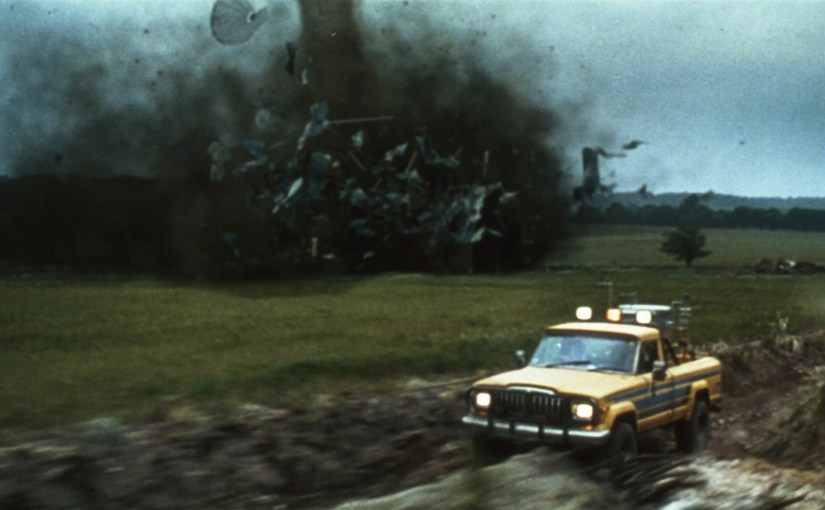
About twenty minutes into Twister, Helen Hunt and Bill Paxton crash their pickup truck while trying to outrun the title character. Amid the high wind, mud and rain, they take cover under a narrow bridge. Then Hunt’s character, Jo Harding, becomes enamored, almost hypnotized, with what she sees of the powerful storm and steps out saying she wants to see more while reaching with her hand. Paxton’s character, Bill Harding, pulls her back down. Reader, why did Bill have to pull Jo back down? I don’t care about Jo. I don’t care about Bill. They’re not characters. They’re talking objects. The only character given any kind of care and treatment is the twister. The next most important character is the next twister and then after that it is the next twister.
Jan De Bont’s Twister is devoid of a brain with a big head full of wind.
A thin story is inserted to connect these talking props. Bill needs to convince Jo to sign divorce papers. Jo is focused on getting a tin can thing named Dorothy into the center of a tornado so it can release sensors and thus their team will be able to study the characteristics of a tornado’s behavior like wind velocity for example. With each new tornado, their attempts fail and somehow the team has another tin can ready to go. Where are they hauling these things? As well, how can such a clunky thing that looks less sturdy than a beer keg offer up so much information? Dorothy looks like it can easily get its ass kicked by R2-D2.
I guess for escapist humor, Bill brings along his fiancé Melissa (Jami Gertz). Melissa is here for a couple of lame reasons. One, to wear a white suit with a fashionable hairdo that you know is bound to get messed up (but actually really doesn’t). Two, to be used as the device for the rest of the cast to explain where they are going next and what they are seeing. After whatever explanations have been exhausted, the script literally has her exit the picture in a quick announcement.
I have not seen the new follow up film, Twisters, but I want to and I’m embarrassed to admit that. It’s the special effects my dear reader. The visual effects are all that is to be cared about in these movies. Visually and audibly these effects are unbelievably impressive and I can only expect some enhancements in the new film. Unfortunately, once I see one twister, I’ve seen them all. I’m risking cavities for the five minutes of flavor I get in a Starburst.
What’s regrettable about Twister is that with a good collection of actors that also include Philip Seymour Hoffman, Cary Elwes, Alan Ruck and Jeremy Davies, the acclaimed author Michael Chrichton and Anne-Marie Martin hardly attempt to insert any intelligence into the science of weather phenomena or the trauma that goes with it. I know just as little about tornadoes as I did before I saw this film.
A prologue scene has Helen Hunt’s character witness her father being violently taken away in a sudden storm. However, it is never referenced again. I started to think about that monologue from Jaws performed by Robert Shaw about his experience aboard the sunken vessel the USS Indianapolis. The scene is an actor’s dream, but it also makes the nature of the world we live in much more personal for that character. Shaw’s character has a personal vendetta against sharks based on experience. That’s what is missing from Twister. None of it looks personal. Helen Hunt is an Oscar and Emmy winning actor. She could have had a brilliant monologue that demonstrated her need to follow tornados and learn more about their unforgiving nature. Chrichton even lent more passion to John Hammond (Richard Attenborough) in the film adaptation of Jurassic Park. The entrepreneur talked of aspirations for a dinosaur zoo. Jo Harding possess neither passion nor animosity for her purpose in life. Twister could have operated better as an observational documentary than a special effects action picture.
Since a tornado cannot have an evil laugh or a handlebar mustache, there must be another source for villainy and that falls on Elwes and his crew. Jo, Bill and the rest of the gang do not like Bill because he leads a convoy of black (black like Darth Vader) SUVs with the most up to date technology around to study weather patterns. Yet, what is so wrong with any of that? We have to hate these guys because they drive shiny SUVs. Is that all it takes? At best, the competition heats up as the two convoys nearly sideswipe each other or cut each other off on multiple occasions. None of this is exciting.
A beloved elderly aunt is conveniently nearby so the gang can chow down and disgust Melissa with their eating habits. Later, the aunt’s house happens to be in the path of a storm and then a sequence is devoted to rescuing her amid the crashing debris. We get to see the beautiful mid-west house crash upon itself because to see another twister would just be more of the same. I hardly got to know the aunt. So, I don’t care if she lives or dies or becomes catatonic or turns into a superhero named Storm. This is extra cream filling in an over expired Twinkie.
The mouth pieces of Twister just don’t matter and while I’m dazzled by seeing a tractor, a cow, another cow (or was it the same cow?), and a house fly around and topple all over the roads amid the wind and the rain, I’m just not taken with any kind of suspense or care.
Special effects only work if they are ingredients to a story, and not just the story.
 2 UNPAID MOVIE CRITICS!!!!