
By Marc S. Sanders
To get inside the turmoil that Fast Eddie Felson feels requires witnessing his highs and lows, all within a forty-hour time span, which equates to about thirty minutes in movie time. Fast Eddie is The Hustler, and he was famously portrayed by Paul Newman, arguably his breakthrough role as a top billing super star.
Felson is a cocky, hard drinking pool player. He’s got talent, but no matter how much he wins he’s always the loser because he has no discipline. Eddie and his partner Charlie (Myron McCormick) travel from town to town, entering pool halls and setting up a bait and catch for some quick cash. Charlie keeps his cool and treats the act like a profession. Eddie has no subtlety. Because he’s so how high on his expertise and what it earns him, he now only has his eye on dethroning the best in the country. Eddie wants to take on Minnesota Fats (Jackie Gleason, in his only Oscar nominated role).
Fats sure looks intimidating. Gleason handled his extra weight beautifully throughout his whole career, whether it be with his outrageous Ralph Kramden comedy, or when he was just being stand up Gleason for a live audience. As well, his large frame appears kingly when he enters the pool hall. He’s dressed to the nines with his hat, overcoat, silk tie, cuffs and studs, a cigarette in his hand, and the red carnation confidently tucked in his lapel. The movie is in black and white, but that little flower had to be red if adorned by Minnesota Fats. No question about it.
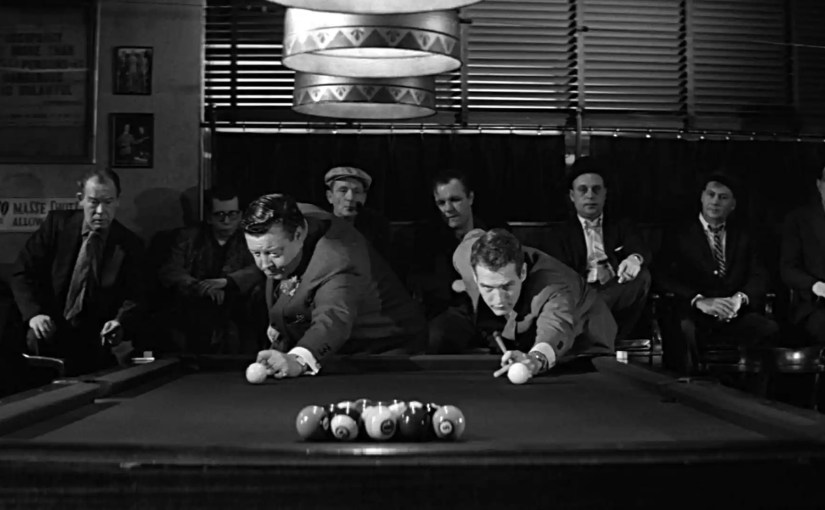
Newman versus Gleason in the first section of Robert Rosen’s drama is stunning to witness. Like the actors who portray these characters, the antagonist was already a legend, while the up and comer was on the brink of higher class. Both are the best of the best at pool, but as this scene progresses, with the regulars at Ames Pool Hall watching with their burning cigarettes and stained whiskey glasses in hand, the competition becomes a fierce and eerily quiet test of endurance. Fast Eddie can keep on winning and winning, round after round, hour after hour, taking thousands of dollars out of Fats’ pockets, but if the fat man doesn’t surrender, has anyone really won or lost?
The Hustler isn’t so much about pool playing as it is about being a hustler or a con man who has no way to be genuine with himself or others in his life. After the showdown between the two has finally concluded, Eddie gets acquainted with a woman who frequents the nearby bus depot. Her name is Sarah (Piper Laurie), another hard drinker and someone who is not looking for love or companionship but will get trapped in Eddie’s charm. What’s at play though is if their relationship, based initially on sex and booze, has anything more substantial to uphold their quick connection. That is about to get tested by another member of this cast.
Bert Gordon (George C Scott) is the high stakes investor ready to front Eddie with a lot of money to go on the road and clean up on other wealthy players at the table. Bert recognized a thoroughbred when Eddie went against Fats. Now he wants to use him, but will Sarah serve a purpose or become a distraction in Bert’s plans for himself first, and Eddie second?
There’s a lot to think about when summing up The Hustler. It’s not a typical sports film with the standard training montages. The protagonist doesn’t necessarily get a beat down, only to triumph by the end. Rosen’s film goes deeper than the pool playing that rests on the felt table surfaces. Rosen co-wrote this script based on a novel by Walter Tevis, about a man overcoming the demons pecking at his attributes and skills. When he’s not the trickster, he must ensure that he’s not getting tricked.
I was first introduced to Fast Eddie Felson with Martin Scorsese’s follow up picture called The Color Of Money, released twenty-five years after this film. I like the coolness and rhythm of that film, but it’s mostly an exercise in Tom Cruise machismo. It was only later that I saw The Hustler per my dad’s advice. I didn’t care for it the first time I saw it. Once the first act was over between Newman and Gleason, I found the picture to be slow moving and devoid of much energy. I could not relate to the long sequence of Eddie getting involved with Sarah. Unlike Scorsese’s film, Rosen does not rely on much music and quick edits to keep you alert. It felt more like a movie drowning in the characters’ own drunken stupors.
Now that I have seen the film for a second time though, many years later, I can’t help but recognize the themes that carry over to The Color Of Money. The Hustler works better than its sequel because it functions as a character study in maturity and endurance. The Color Of Money sets itself up that way for the Cruise character. Yet, I’m not sure it reaches a conclusion to any of the arcs or transitions for either an older Eddie Felson or for the hot shot 1980s kid, Vincent, the Tom Cruise character that Eddie mentors.
The Hustler has triumphs, but it has some shocking heartache for several characters as well. Eddie has much to overcome internally as well as physically throughout the course of its narrative. This fictional story had to be captured within this certain section of time (six months to a year, I think) to show how these appealing, yet cursed, individuals forever change one another. After the film has closed, Rosen brings up the closing credits in the quiet pool hall allowing his characters to pack themselves up and walk out of frame. There is something open ended to when the film chooses to stop. The viewer may think for a while after it’s over. Rosen allows the viewer to take his last gulp of whiskey or bourbon and put out his cigarette and throw on his overcoat before stepping out into the cold late hours on the wet sidewalk below.
There are many impressive pool shots on display, thanks especially to the professional Willie Mosconi. Shots are also done beautifully by Newman and Gleason. Absolutely amazing to watch what they accomplish with a cue stick. However, you don’t watch The Hustler for just trick billiard shots. Rather you look at this intense drama to see a man struggling to be a winner or remain a loser. What you realize very early on is that the outcome is never measured by how much money is wagered or what lines a man’s pockets. Instead, The Hustler is assessed by what these people choose to do next. Play or not play. Bet or not bet. Hustled or not get hustled.
 2 UNPAID MOVIE CRITICS!!!!