
By Marc S. Sanders
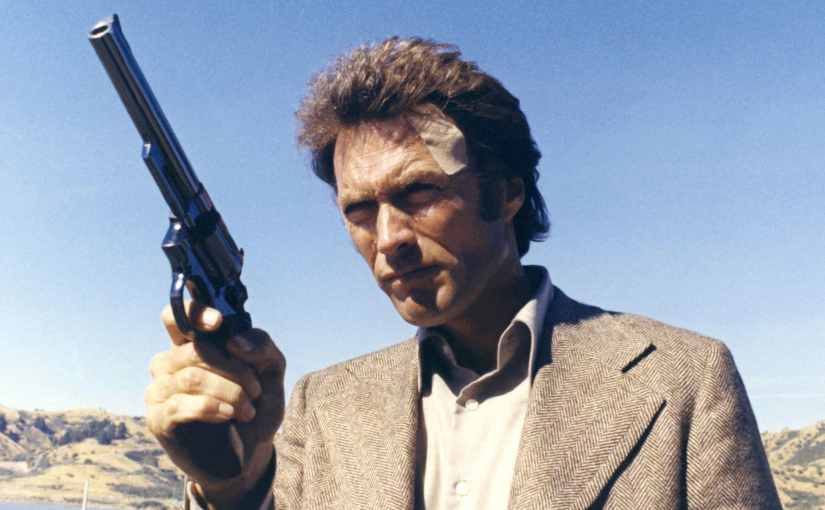
If you don’t know by now, I’m a huge admirer of Clint Eastwood’s work. His talents broach so many facets. He acts. He produces. He’s likely even better when he’s in the director’s chair. He actually sings and he has even orchestrated his own music for some of his films. Ever since I was first introduced to him at a young age when he played Dirty Harry Callahan and Fido Beddo, partnered with Clyde the orangutan, I was fascinated by his coolness and confidence in his stature on screen. Whether he’s raising a fist, donning a scowl, giving a smirk or a squint of his narrow eyes or using his most famous prop, a .44 Magnum handgun, as an extension of his right arm, I’ve always been magnetically drawn to what he does on screen.
Online, a common question is asked: What is your favorite Clint Eastwood movie? If I have to choose one, I guess it would have to be Magnum Force, the follow up to Dirty Harry. Yet, I always believed Magnum Force could not operate without hitching on to the impact and message from Dirty Harry. I can’t just like The Godfather Part II without liking the first film. I can’t just love The Empire Strikes Back without liking its box office predecessor. Same goes for The Lord Of The Rings pictures.
Magnum Force works so well because it questions what celebrated the Harry Callahan character that Eastwood portrayed two years prior. This is a San Fransisco cop who defies authority when he knows that a danger must be suppressed without the inconvenience of bureaucratic red tape and police procedurals that ultimately will work in the criminals’ favor if not taken care of immediately. As the first film demonstrated, it is easy for us to side with Harry’s desperation because we know the crazed killer is on the loose and he is only going to kill again and again while never surrendering or negotiating. This second follow up film (in a series of five) tests the ideology of Eastwood’s character.
A series of grisly murders are occurring within the city and it appears that a traffic cop is committing the acts. The victims are the worst mobsters and pimps within San Fransisco who time and again have been overlooked for their crimes and/or have been released from trial or prisons based on technicalities. A handful of characters within Magnum Force remind us that someone is saving the taxpayers a lot of money each time the body count increases.
There’s a slight mystery to this film. Harry encounters four rookie cops (David Soul, Robert Urich, Kip Niven and Tim Matheson) who seem very likable. They are admirable of Harry’s reputation. Harry is impressed by their shooting skills in particular. Another traffic cop is an old friend of Harry’s, a guy named Charlie McCoy (Mitchell Ryan) who is on the edge and might pose a threat if he continues working the streets. Any of these men could be suspects to these vigilante murders as it is soon realized that the scene of some of these crimes are similar. Often, cars are pulled over for traffic violations. As well, ballistics indicate that the weapons of choice are normally a .357 Magnum, the standard issued firearm for a police officer.
The debate with Harry’s philosophy, firmly established in the prior film, is staged against that of his superior, Lt. Briggs. He’s played by Hal Holbrook who is one of the best antagonists in all of Eastwood’s films. They play so well against one another. Early on, Briggs declares he’s never once had to pull his gun out of his holster. Callahan sarcastically salutes the lieutenant by reminding him that men have got to know their limitations and that’s where the measure of asking what is ultimately necessary in fighting crime. Where does it begin and when does it end?
Harry Callahan is that unusual cop who is frowned upon for the actions he takes in his own hands. Other cops in movies played by Stallone or Gibson go to extreme measures simply for the cinematic action of it all. Callahan is never thanked or given any serious commendations for what he executes with his .44 Magnum, a weapon that is as outside the lines as Harry himself.
The difference between Harry and whoever this vigilante is must be deciphered and much of Magnum Force’s grey area is all that is seen. Eventually, the black vs white clarity reveals itself and a telling lesson presents itself between what Harry Callahan stands for and what guise a vigilante operates under. At the risk of revealing too much, the best scene of the picture occurs between Holbrook and Eastwood’s characters as they sum up the entirety of the film before the climax. This film is over fifty years old and still the assortment of mindsets found within Magnum Force are worth pondering. Callahan is put to the test one time before in a haunting parking garage.
Beyond what’s worth considering among these many dangerous philosophies, this is a solid action picture with thrilling and well edited shoot outs among the cops and robbers. A hilarious plane hijacking is derailed by Harry when he poses as a pilot. Later there’s a store robbery that is undone and then there is a warehouse port exchange of gunfire that puts Harry and his partner in unexpected danger.
There is an interesting target competition between the cops that implies what Harry suspects. I like this scene in particular because it gives an inside look into how police officers interact and admire one another when not on the streets. Yet, when one particular cop cannot get a thought out of his mind, it carries over into the action of the moment. At the combat range, Harry fires his gun at one particular target that may cause you to sit up in your chair a little. Often, Eastwood performs with little to no dialogue in his films and this is one very informative moment.
As much as I’m a big fan of Magnum Force, the penultimate scene always sticks in my craw a little. Callahan is pursued on foot within the bulk of a freighter. There is very little light provided in this sequence as Harry moves down one corridor or around a corner elsewhere. It’s hard to see what is happening and who is where or who I am looking at. For such a thrilling movie, this is a bit of a letdown as overall much of the action of this movie is driven by the plot. Nothing feels random in Magnum Force. Everything moves towards more story development or realizations. Yet, I have to be somewhat forgiving only because this darkened scene occurs after all of the cards are put on the table and all the hero has to do is survive.
Just before the foot chase, there is a thrilling car chase with Eastwood actually doing the driving that takes us through the well-known twists of Lombard Street. Director Ted Post wisely covers this from an overhead shot. The car careens up and down the steep slopes of San Fransisco’s avenues and there are plenty of intense close ups of Eastwood behind the wheel accompanied by the screeching tires, bullets bouncing off the windshield and motors humming. I have declared it before, the best place to have a car chase is in San Fransisco. Surprisingly, this pursuit hardly ever gets categorized with the great ones like Bullitt, The French Connection, Ronin or The Seven Ups.
If you have never seen Magnum Force, check it out. It is off color at times, but the exploits of Harry Callahan and the scum he’s forced to associate with were never about political correctness. Still, there is much to debate, argue, and lend some serious thought to, especially in a newly unsteady climate of police acceptance and procedure. My one recommendation though is to watch it as a double feature with the original Dirty Harry to truly see the two sides of Harry Callahan’s coin.
NOTE: An interesting fact I just realized at the end of Dirty Harry, the cop shoots the bad guy with his right hand. Later, he tosses his badge, but with his left hand. Especially with Magnum Force as a follow up film, I see the internal struggle of Harry Callahan pitting his gun up against the mindsets that come with his badge.

 2 UNPAID MOVIE CRITICS!!!!