
by Miguel E. Rodriguez
DIRECTOR: Peter Greenaway
CAST: Anthony Higgins, Janet Suzman, Ann-Louise Lambert, Hugh Fraser
MY RATING: 8/10
ROTTEN TOMATOMETER: 97% Fresh
PLOT: An insouciant young artist is commissioned by the wife of a wealthy landowner to make a series of drawings of the estate while her husband is away.
The directorial debut film of Peter Greenaway at first feels like a mashup of earlier British period films, most notably Kubrick’s Barry Lyndon and Tony Richardson’s Tom Jones. It contains much of the painterly beauty and some – not a lot – of the stateliness of Kubrick’s film, combined with the irreverence of Tom Jones, especially concerning sexual matters. However, The Draughtsman’s Contract makes its own mark, particularly in the closing sequences when revelations occur throwing everything that has come before into a different light. In behind-the-scenes interviews on the Blu-ray, multiple people say multiple times that the clues to the mystery that pops up unexpectedly are hidden in plain sight. Well, kudos to the filmmakers, because I was fooled.
The story takes place in 1694 in one of the more beautiful portions of the English countryside. A dimly-lit prologue establishes the particulars: Mr. Neville (Anthony Higgins, whom you may recognize as Sherlock Holmes’s mentor in Young Sherlock Holmes [1985]) is a talented but arrogant draughtsman (pronounced “draftsman”), much in demand for the quality of his pencil drawings. After much prodding from Mrs. Herbert (Janet Suzman) and her married daughter, Mrs. Talmann (Anne-Louise Lambert), he is persuaded to enter into a contract to produce twelve drawings of Mrs. Herbert’s country estate while Mr. Herbert is away on business. But because Mr. Neville is abandoning a previous commitment, he insists that his payment be his regular fee, full room and board on the estate…and one private visit each day to Mrs. Herbert so that she may “comply with his requests concerning his pleasure.” I would say that this may have influenced Jane Campion’s masterpiece The Piano, except the favors in The Piano evolve into something deeper, while the favors in Contract have no deeper level than satisfying Mr. Neville’s appetites.
Given the reputed over-the-top nature of Greenaway’s The Cook, the Thief, His Wife & Her Lover (unseen by me so far), I expected the scenes depicting Mrs. Herbert’s contractual obligations to be far more explicit than what is shown. This is not a criticism. I think, for this film, that kind of attention-getting device would detract from the narrative momentum Greenaway achieves. Since the movie is extremely dialogue-heavy, we are better served by short scenes leaving no question as to the liberties taken by Mr. Neville, so we may return expeditiously to the plot.
(I stand corrected: there is one brief but potentially stomach-churning shot of Mrs. Herbert dealing with the effects of eating something that perhaps did not entirely agree with her…eeyuck.)
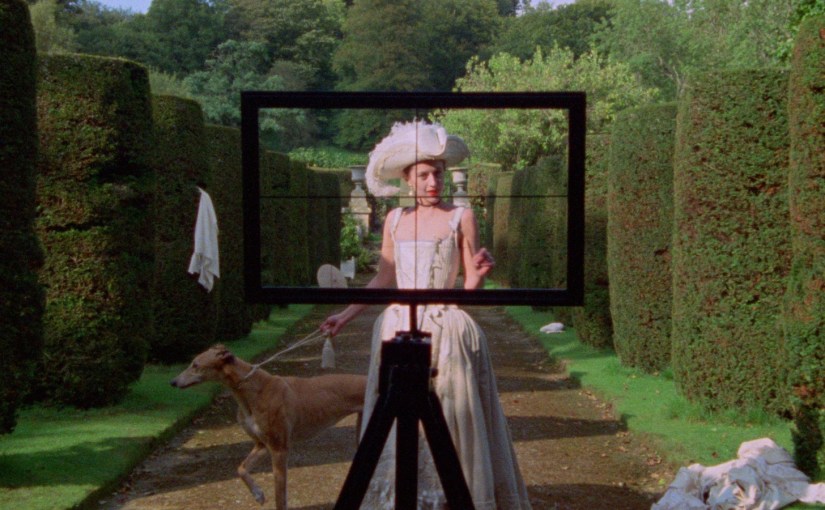
Leaving those interludes aside, the film is essentially a series of deliberately wordy conversations among Mr. Neville, his servant, Mrs. Talmann, Mrs. Herbert, etcetera, while we also watch Mr. Neville practicing his craft. Using an ingenious device I’ve never seen before, he sets up a framed grid of wires on a tripod so that the object he’s drawing is divided into multiple squares. Then he simply draws an expanded version of the framed object onto his sketchpad, grid by grid. (My girlfriend and I used a variation of this same process to draw Timon from The Lion King at Animal Kingdom.)
His one guiding rule is: “Draw what you see, not what you know.” As such, if the view has changed in any way when he returns to each site, he immediately incorporates those changes into his drawing, whether the changes be as simple as the addition of a ladder on the side of a building or more complex, like adding a dog standing outside a greenhouse. This credo will come back to haunt Mr. Neville in ways he cannot anticipate.
A mystery arises. Mr. Herbert never returns from his business trip. His horse is found wandering the estate. No one can confirm his arrival at his destination. Articles of Mr. Herbert’s clothing suddenly appear here and there around the estate…and as such, immediately become part of Neville’s drawings.
And what’s the story with the occasional appearance of a naked man whom we, the audience, can see, but which the movie characters cannot? True, he’s not quite in anyone’s field of vision, except twice, when a child can clearly see him, but his guardian cannot, and when a steward shoos him away off a bridge. I have gone over his scenes in my head multiple times, and I still cannot grasp the significance of this anomaly. Director Greenaway was a painter before he became a filmmaker (indeed, it is his hands we see making Neville’s sketches), so presumably there’s a reason behind it. Is this man a Fellini-esque or Lynchian sideshow, intended to raise questions without answering them? Or is this man a visual representation of the “paint what you see, not what you know” philosophy? If we extend that rule to our lives, are we being encouraged not to ignore the fanciful, the odd, the unusual, simply because they may not fit in the limited framework of our beliefs and/or prejudices? Perhaps the child could see this man because he did not yet have any prejudices that would exclude him from his awareness, whereas his guardian simply sees a wall, or a statue, because that’s easier to deal with. Discuss.
Whatever this naked man represents is secondary, at least during the film, to what happens among Mr. Neville, Mrs. Herbert, and her daughter Mrs. Tallman. I especially enjoyed just listening to them talk. In its own way, The Draughtsman’s Contract reminded me of the films of Tarantino, where outrageous incidents or conduct are always framed by characters who talk and talk. What a treat it is sometimes to just listen to dialogue that doesn’t feel like it was generated at the cliché factory. Some examples:
- “Why is that Dutchman waving his arms about? Is he homesick for windmills?”
- “When your speech is as coarse as your face, Louis, then you sound as impotent by day as you perform by night.”
- “He doesn’t like to see the fish. Carp live too long…they remind him of Catholics.”
- “Your inventory, Louis, is unlimited, like your long, clean, white breeches. There is nothing of substance in either of them.”
And so on. Full disclosure: before the eventual resolution of Mr. Herbert’s disappearance and the subtle change in relationship between Mr. Neville and Mrs. Herbert, I was resigned to the idea that the movie had nothing else to offer, plot-wise, and I was mentally giving the film a more mediocre score. But good things come to those who wait. Give The Draughtsman’s Contract a chance, and you will find, as I did, that Greenaway has a few surprises in store for anyone who thinks they know how this story will end.
 2 UNPAID MOVIE CRITICS!!!!