
By Marc S. Sanders
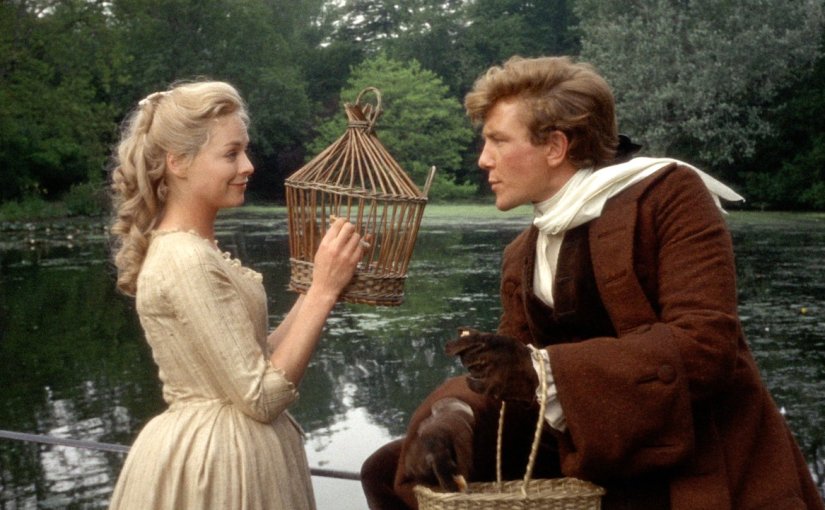
Watching Tom Jones I wondered if the Monty Python troupe took inspiration from producer/director Tony Richardson’s film. It’s all quite madcap. With Albert Finney as the lead title character, there’s a zany quality to this eighteenth century piece adapted from Henry Fielding’s novel The History Of Tom Jones, A Foundling.
The film opens like a silent movie with title cards being used to emote dialogue. The Squire Allworthy (George Devine) returns to his estate and upon retiring for bed, he discovers newborn Tom beneath the blankets. Allworthy decides to raise the child.
The film transitions to a talkie picture and Tom grows up to be portrayed by Albert Finney. The orphan man gets himself into all kinds of predicaments, notably with an assortment of women but his true affections are directed towards Sophie (Susannah York), the daughter of the neighbor Squire Western. The cad known as Blifil (David Warner, in his very first film role) convinces Allworthy that Tom is a villain and thus he’s excised from the estate with cash to seek out his own fortune. Interactions lead to unexpected circumstances for Tom, including being robbed penniless, crossing paths with the butler who was presumed to be his father, and being sentenced to death for murder after he rescues an endangered maiden from the assault of a British red coat (Julian Glover).
Tom Jones takes unexpected turns in its narrative, and it leads to big laughs. Upon discovering that his wallet is stolen, Albert Finney breaks the fourth wall seeking the viewers assurance that he is not making it up. Other characters are depicted in freeze frame silliness as they eavesdrop on Allworthy. There’s lots of running around escapades as Tom flees from being caught with a couple of mistresses. I was waiting for the Benny Hill music to cue in, though John Addison’s score suffices well to keep it all lighthearted during such times when the film speeds up with a Keystone Kops kind of pace.
A film like Tom Jones is not what I normally gravitate towards. Going back and forth, there’s lots of screaming banter and deep English dialects that swallow the words being uttered. Drunken debauchery is relied upon for Hugh Griffith as Squire Western; he was one of five actors nominated for the film. At one point, Griffith falls off his horse and the animal lands on top of him. Apparently, this was not stunt work as Griffith notoriously showed up drunk each day on set and the horse easily overtook him.
Albert Finney, though, is a comedy gem as he innocently portrays Tom with no ill intent. Watching him here in his youth, he’s adorable with an occasional prince and pauper romantic interpretation of his performance. A memorably hilarious scene involves Tom and a lady mistress seducing one another from both sides of the table as they gorge themselves with a bevy of food including pheasant, pears, potatoes and so on. Without Finney’s fearlessness in leading this sloppy, drooling scene, I’m not sure it would have worked as well. Richardson elongates the moment between the two to build the laughter.
I’m impressed with much of the filmmaking from Tony Richardson. Cameras must have been mounted on horseback to get up close pursuit during a sporting hunt of a deer that also included a large number of rabid dogs. Still, I was a little queasy in the follow up scene when the deer is slaughtered amid the canines barking for a portion. Technically speaking though, the film works on many levels.
As well, I could not help but consider that a modern filmmaker like Yorgos Lanthimos (Poor Things, The Favorite) adopted some of Richardson’s comedic approach. Tom Jones is proudly weird and obscure just like Lanthimos’ storytelling.
Yet, I cannot comprehend the praise awarded to this movie, including Best Picture and Director as well as the nominations in cast performances by critics, Oscars and BAFTAS. I’m convinced of the period timing and what the script and actors lend to the film, but I’ll never say any of it left me enraptured in the novelty. It’s a cute story, but that’s all. Kind of like Arthur with Dudley Moore, where the innocent man child happily lives within his sophomoric mentality while uncovering who he truly loves. There is likely more to take away from Tom Jones, but I didn’t recognize it.
If anything, as I continue my trek towards watching and reviewing every Best Picture winner in Oscar history, I’m at least glad I got Tom Jones checked off my list. At times, it’s delightful and it’s also proudly oddball in its execution. What constitutes it as the best film of 1963? Reader, I’m just not sure. Yet, it is at least entertaining with much praise for Albert Finney and cast.
 2 UNPAID MOVIE CRITICS!!!!