KAGEMUSHA (Japan, 1980)

by Miguel E. Rodriguez

DIRECTOR: Akira Kurosawa
CAST: Tatsuya Nakadai, Tsotumo Yamazaki, Ken’ichi Hagawara
MY RATING: 7/10
ROTTEN TOMATOMETER: 88%

PLOT: A petty thief with an utter resemblance to a samurai warlord is hired as the lord’s double. When the warlord later dies, the thief is forced to take up arms in his place.


Kagemusha is a double-edged sword for me, no pun intended.  On the one hand, its visual beauty is virtually peerless.  Only the films of Kubrick, Lean, and those shot by Vittorio Storaro are even in the same league as Kurosawa.  There are shots in Kagemusha that will remain in my mind long after the details of the story have been purged by old age.  In particular, there’s a shot with Japanese soldiers crossing a ridgeline in the background, more soldiers in the foreground, and the setting sun positioned perfectly, so the shadows of the soldiers in the background reach out towards the viewer and interact with the foreground soldiers.  It’s a masterpiece.

On the other hand, the pacing is so sedate that newcomers to Kurosawa or foreign films in general might wonder, my god, when is something going to happen?  At one point, a key figure is taken out by musket fire from an enemy soldier.  This happens so early that we haven’t been introduced to all the main characters just yet, so the conversations surrounding the gunshot were a mystery to me until later in the film.

On the other hand, Kurosawa proves himself over and over again to be a master of the visual aspects of cinema.  In addition to the shot I mentioned above, there is a trippy dream sequence that looks as if it were painted with an explosion at the paint factory (I mean that in the best possible sense), a wonderful camera move that reveals two characters who are conversing in a plain room are actually overlooking a stormy lake, and an eerie moment when the contents of a large vase are revealed after a lengthy burglary attempt.  There are way too many other examples, you simply have to see the film to appreciate what I’m talking about.  I suppose the way to get the most out of the Kagemusha experience is to surrender to the visuals, much like I do with Barry Lyndon or Doctor Zhivago.

I wouldn’t advise anyone to completely ignore the story, though.  There is immense food for thought here.  A condemned thief is conscripted to act as a warlord’s double.  We never learn the thief’s real name.  He is credited only as “Kagemusha”, aka “The Shadow Warrior.”  He must present an outward face to the other generals, friends and foe, in the event that the real warlord is injured or killed, which (SPOILER ALERT) inevitably happens.  There is portentous dialogue about how a shadow only exists if the man is alive.  Remove the man, and how can a shadow remain?

There are several close calls where Kagemusha’s secret is almost revealed.  His grandson – well, sort of his grandson, it’s a long story – immediately yells, “THAT’S not my grandfather!” when he sees him after a long absence.  The real warlord, Shingen, had a huge black horse that only he could ride.  The inner circle who knows Kagemusha’s secret agrees immediately that he should never try to ride it; you can fool some of the people some of the time, but you can never fool a horse.  Shingen’s mistresses present a real danger.  Kagemusha squirms for a few moments as they slowly start to question his identity during tea, but he brilliantly defuses the situation by telling them the one thing they would never believe: the truth.

There’s also a much larger issue at work in Kagemusha.  Shingen’s own generals (the ones outside of the inner circle), and the opposing warlords, all believe Shingen is still alive when they see him on the battlefield.  They have no reason to think he’s an impostor.  There are some skeptics, but their spies are helpless to discover the ruse.  For all intents and purposes, that is Shingen, and they behave accordingly.

There is one battle at night where this, I don’t know, philosophy becomes all too real for Kagemusha.  In the darkness, Shingen’s forces can hear enemy armies approaching, and then musket fire breaks out.  Instinctively, Shingen’s bodyguards leap to shield Shingen/Kagemusha from enemy bullets.  Some are killed.  The look of horror on Kagemusha’s face as the dead bodyguards are piled on top of other bodies is indescribable.  They gave their lives for him.  Or, more importantly, they gave their lives for the idea of Shingen, their belief that he was the most important person on the battlefield.  I was reminded of a bit of dialogue from American Sniper, of all things, when the lead character, an accomplished sniper, is asked to cover some soldiers on a raid.  He is told that the soldiers feel invincible with him up there.  He says they’re not, and the reply is eye-opening: “They are if they think they are.”  Just like the soldiers in American Sniper, the soldiers in Kagemusha are prepared to lay down their lives for a concept.  The man is nothing, a thief.  They don’t know that, though.

This took me down a little bit of a rabbit hole.  I thought of Secret Service agents whose literal job is to protect our President and take a bullet for him if necessary.  It doesn’t matter whether he (or she) agrees with the President’s policies.  That is secondary.  Their job boils down to one thing: I will die to protect this person if that’s what it takes.  The dedication on display by these men and women humbles me, and it makes me think.  Surely, they have opinions about world and national policies.  Doesn’t matter.  It’s not part of the job.

Watching those bodyguards fall in front of the imposter warlord made me think really hard about those kinds of jobs, about anyone in any branch of the armed forces.  Ready to kill and die for what they believe in.  In the case of Kagemusha, these people died for a fake.  It makes their deaths sad, but are they any less honorable?  Like I said, food for thought.

The film ends with a massive battle where, curiously, we are not shown any deaths, only the aftermath.  (The opposing general is especially cruel: “Shoot the horses first.”)  Then there is a dreamlike coda that recalls that philosophy of dying for the right cause.

To recap, though, the movie is slow going, at least as slow, if not slower, than Kubrick’s Barry Lyndon.  I can see that Kurosawa has a lot to say with this movie.  He employed thousands of extras and lavish costumes (financed thanks to the involvement of Francis Ford Coppola and George Lucas, which is this whole OTHER thing).  It’s not my favorite Kurosawa film.  That spot is reserved for Ran (1985), which I consider his career-capping masterpiece.  Kagemusha sort of lays the groundwork for that movie, in my opinion.  It was one of his first films in color (I think) and it shows a natural talent for the medium.  Like I said before, surrender to the visuals and contemplate the story, and the slow pacing will take care of itself.  (That doesn’t make much sense, but I’m sticking to it.)

THE MAN IN THE WHITE SUIT (United Kingdom, 1951)

by Miguel E. Rodriguez

DIRECTOR: Alexander Mackendrick
CAST: Alec Guinness, Joan Greenwood, Cecil Parker, Michael Gough
MY RATING: 8/10
ROTTEN TOMATOMETER: 100%

PLOT: An altruistic chemist invents a fabric which resists wear and dirt as a boon to humanity, but both big business and labor realize it must be suppressed for economic reasons.


First, a brief history lesson:

“The Ealing comedies is an informal name for a series of comedy films produced by the London-based Ealing Studios during a ten-year period from 1947 to 1957. Often considered to reflect Britain’s post-war spirit, the most celebrated films in the sequence include Kind Hearts and Coronets (1949), Whisky Galore! (1949), The Lavender Hill Mob (1951), The Man in the White Suit (1951) and The Ladykillers (1955)… Many of the Ealing comedies are ranked among the greatest British films, and they also received international acclaim.” – from Wikipedia

There.  That summarizes it way better than I could.  Watch enough British films and the term “Ealing Studios” will invariably come up.  Their comedy films have a breezy, economical quality, sometimes combined with dark humor and almost always with something to say about the conditions in Britain at the time.

The Man in the White Suit is a prime example of the Ealing comedies (although Kind Hearts and Coronets is my personal favorite).  In this film, the versatile Alec Guinness portrays Sidney Stratton, an unemployed inventor with a head for chemistry and textiles.  He stumbles upon a formula that he believes will create the ultimate cloth: impervious to stains and virtually unbreakable.  After a series of pyrotechnic failures, he cracks the code and makes a white suit out of his miracle material.

The storytelling for this whole first half of the film is quick as lightning.  Director Mackendrick wisely realizes that lengthy exposition is the enemy of good pacing, so we get a lot of quick scenes that linger only long enough to make their point before we fade into the next one.  While watching it, I began to worry that this rapid rhythm would hinder my investment in the story, but in retrospect, it almost feels like we’re inside Sidney’s head.  On film, he’s almost always running, rarely strolling except when he’s trying to fool any casual observers.  When he makes his breakthrough, his speech becomes a rattling string of syllables that might require subtitles to decipher, his excitement nearly derailing his ability to talk.

Once he creates this magical cloth and fashions a suit out of it (resorting to blowtorches to cut the suit patterns), he beams.  What a boon to mankind!  You can’t damage it, you can’t get it dirty…it’s the only suit you’ll ever have to buy!  What a windfall!  Well, not so fast.  He immediately encounters resistance from both sides of the textile supply chain.  The laborers who work in the textile mills don’t like it because they envision making only one set of clothes per person and that’s it; it never needs replacing.  Competing companies (management) don’t like it because no one will buy anything else, and it will put them out of business.  Sidney becomes caught in this tug of war, and the whole second half of the film becomes a variation of chase scenes as Sidney struggles to publicize his invention while labor and management fight to suppress it.

There’s an interesting subplot when management tries to persuade Daphne, the daughter of the company’s owner, to seduce Sidney into signing away his rights to his invention.  In an era when most women’s roles were relegated to love interests, her reaction to this offer is unique: she calmly asks, in so many words, “How much is this worth to you?”  She negotiates her fee much the same way as a high-priced escort might.  The board members are scandalized when they realize exactly what they’re asking her to do, and what is being negotiated.  But instead of shying away from it, Daphne embraces it.  Neat.  (Her “seduction” of Sidney has a clever resolution that I did not see coming.)

Like other great films, The Man in the White Suit offers a lot to chew over after the credits roll.  Sure, the last half of the film offers lots of comedy and chase scenes and farcical situations to satisfy any film lover.  But the underlying concept is more interesting the more I think about it.  It’s not exactly a NEW idea, but interesting, nevertheless.  One of the workers at the textile mill tells Sidney: “The razor blade that never gets blunt.  And the car that runs on water with a pinch of something in it.  No.  They’ll never let your stuff on the market in a million years.”  We’ve all heard the urban myths of rubber tires that never wear out, or even the cars that run on water (just saw that one on the internet the other day).  Are they real?  Probably not.  But it’s fun to think so, to imagine the shadowy forces suppressing brilliant inventions for the purpose of commerce.

But there’s a flip side to the story.  During Sidney’s pursuit, he runs into an old washer woman and asks for a coat to cover his suit (the material’s properties make it practically luminous at night).  She happens to know about Sidney and his invention, and she tells him, “Why can’t you scientists leave things alone?  What about my bit of washing when there’s no washing to do?”  More than anything else, this gives Sidney pause, and I can almost hear him thinking, in the back of his head, the immortal words of Ian Malcolm: “Your scientists were so preoccupied with whether or not they could that they didn’t stop to think if they should.”

In this way, The Man in the White Suit offers more food for thought than I would have expected.  It’s making a statement about the inevitability of scientific progress, pleading with the responsible parties to be more, well, responsible with their actions.  This film was released only six short years after America ended World War II by dropping atomic bombs on Japan, so the question resonates more dramatically than you might expect from such a breezy comedy.

I can almost hear you asking, “Yeah, but is it funny?”  Yes, this delightful Ealing comedy is in the best traditions of the form.  It’s not too heavy, asking the big questions but wisely not answering them.  It has plenty of smiles and laughs.  And for those who have never seen Alec Guinness as a young man in the movies, it’s a treat to watch a very young Ben Kenobi cavorting on the screen with his eyes bugged out and a silly grin on his face.  And if it offers food for discussion afterwards, all the better.

P.S.Look for a very young Michael Gough in the cast, aka “Alfred” in Tim Burton’s Batman.

PAST LIVES (2023)

By Marc S. Sanders

Facebook is a blessing and a curse for me.  It sustains a social media addiction that’s been hard to crack.  Fortunately, I never signed up for X (or Twitter), Instagram, My Space, or Snap Chat.  So, I can’t necessarily be as bad as other peers I know who are bringing on early arthritis by grasping their androids and iPhones to keep up with twenty different apps all at the same time.  The best thing to come out of Facebook, though, is access to reach across the planet and catch up with people of my past, from elementary school to high school, to college and past occupations.  Regularly, I speak to Israel, Australia, Canada, England, France and South America, as well as about thirty to thirty-five states.  Celine Song is a new writer/director who springs off the social media craze to cover a twenty-four-year span between a South Korean girl and boy.  

At age 12, Nora (Greta Lee) chooses to emigrate to Canada, and once she reaches her early twenties, she’s a budding playwright in New York City.  Hae Sung (Teo Yoo) is sad to see his friend go off to begin a new life while he remains in Seoul, eventually enlisting in the army followed by becoming an engineer.

After twelve years apart, they curiously find one another on Facebook and get hooked on Face Timing each other during every waking opportunity. It’s no matter that the time difference doesn’t ideally accommodate both of them.  They are happy to forgo sleep to keep up.  The problem is their future ambitions and lack of funds prevent them from seeing one another personally. Alas, there’s only so much substance to their rekindled romance that began as affectionate puppy love in middle school so many years ago.  Nora announces she’s ending the activity as it is time to move on.

Another twelve years pass.  Nora is married to Arthur (John Magaro, so memorable in The Big Short).  Hae Sung has just broken up with a girlfriend and opts to meet up with Nora for a visit to The Big Apple.

I know reader.  It appears as if I’ve recounted the entire film, but honestly I have not.  The magic of Past Lives does not thrive off the next story development.  Its strength falls within the various conversations that occur between the three characters.  Three quarters of this film is spoken in Korean, and an emotional tug latches on to you.  

My father and I were once waiting in the terminal of LaGuardia Airport, and we could not help but observe and conjure up made up backgrounds of the different walks of life who passed us by.  Celine Song wisely seats these three characters at a bar – two South Koreans and just off to the side is the melancholy Jewish guy.  Voiceovers begin to hypothesize what’s the story behind these individuals.  Initially, I was not even sure if there was a connection.  Maybe one of the three is an extra.  Then, the film opts to show us who is who and what is really happening here.  Who is talking, who is listening and what could the topic of conversation actually be.

I could never do justice by describing the near poetic and yet genuine dialogue that Nora, Hae Sung and Arthur deliver.  Sometimes it consists of what if scenarios.  There’s time to allegorically consider a Korean legend that comes from degrees of different generational connections.  

The best caption of the piece is when Celine Song aims her cameras at a fork within the pathways of Seoul, South Korea.  On the right, one character takes a flight of stairs.  On the left is a walkway going slightly west.  The two children will likely never see or speak to one another again once they say goodbye and follow down a separate route.  It’s heartbreaking, and this is only in the first ten minutes of the movie.  

Separation will alter relationships as well.  Nora learns to speak English.  Hae Sung relies on his Korean.  For him to even respond to Arthur is near impossible as much as they respect the value each man has in Nora’s life.  It will always be awkward among these three.  Nora can have a conversation with either man out loud, but any given moment one of the men will never comprehend the context of the discussions.

There’s an impossible outcome for Nora,  Arthur and Hae Sung, and what is so relatable is that I believe a situation like this affects many of us.  We all go on different trajectories in life that require us to shed portions of our past.  We can reminisce and reflect.  We can collect updates of those who have long been gone.  Yet, we can never get back what we once treasured, and I believe that is the sad, but true point of Past Lives.  We can only find comfort in memories while fantasizing over what could have been if I didn’t move away or I chose not to become an engineer, or I opted to marry or not marry.

Celine Song’s debut film succeeds with a very sensitive script built on genuine emotions of love, fear, loss and inner conflict.  It’s a special gift that she cast her piece with three actors who treat the dialogue with kid gloves.  Sometimes, before anyone speaks or says another word, there’s a silence, and you’ll find that you can still hear what Greta Lee, Teo Yoo and John Magaro are saying to themselves.  Past Lives is one of those films that asks you to read between the lines.  Fortunately, Celine Song doesn’t make the challenge that difficult because the filmmaker reins you in as quickly as her story begins.  When it ends, though, it’s much harder to let go.

BLOOD SIMPLE.

By Marc S. Sanders

 “blood simple” is a term coined to describe the addled, fearful mindset people are in after a prolonged immersion in violent situations.

         IMDb – originally located in the book Red Harvest by Dashiell Hammett

The Coen Brothers’ first of several legendary and unique films is a seedy noir thriller called Blood Simple.  Joel Coen is the director.  Ethan Coen is the producer.  They wrote the script together and collected whatever pennies they could find door to door from anyone willing to invest in the picture.  You see how shoestring the budget was for this small film, but that’s exactly why it works so effectively.  The lowlifes of their script are not the sophisticated type like Hannibal Lecter or Harry Lyme.

This is a condensed piece, just over ninety minutes, with four principal players who inadvertently cause themselves to get tangled in a bloody web of gory crime.  The fun part is that none of the four know the whole picture of what’s occurring, or how, or why.  I’m satisfied the audience is in on the whole thing, though.

Without giving too much away, Dan Hedaya is Marty, the owner of a sleazy Texas saloon.  A private investigator provides evidence of Marty’s wife, Abby (Frances McDormand, in her debut performance), having an affair with one of his bartenders, Ray (John Getz).  Marty hires the P.I. to murder the two lovers.

Simple enough, right?  Wrong, because the Coen Brothers wisely have their players color outside the lines and soon there’s blood all over the floor, as well as in the back seat, and maybe something important was mistakenly left at a crime scene.  Perhaps someone who was thought to be dead is not, and maybe what you thought occurred is something else entirely.

Blood Simple. works because it operates beyond convention.  The characters are so unaware of what to do next or what precisely has happened that it introduces one layer of confusion and misunderstanding after another.  This is nowhere near a common episode of Three’s Company.  What’s even more appreciative is that once the end credits roll, those that survive this lurid tale will still never have a complete grasp of what’s happened or when or where the convolutedness began.  It’s satisfying that all of the answers are at my disposal. It gives me a sense of omnipotence.

M Emmet Walsh is the scuzzy private investigator.  You’ve seen this celebrated character actor countless times before.  It is this performance that might be the one where you would no longer recognize him as “What’s that guy from?” because now you’ll never forget his name. He’s a villain who pounces on a genius opportunity, covering all bases, until there’s one minor oversight.  The Coen Brothers inventively have this guy circling the waters of the whole film, and yet only one other character is aware of his existence.  Still, this guy is vital to the assorted conflicts uncovered in this sort of graphic novel pulp fiction.

Blood Simple. sets up scenes  that can be bridged together by what if scenarios. How can two windows mere inches away from each other lend to a painfully agonizing, thrillingly welcome moment of terror and suspense? When this scene arrives, does it make sense for how the characters play it out?  You bet it does.  

The film is strong due to its lack of dialogue too.  We watch what these characters do much more than we listen to anything they have to say.  Important props and locations seem to tell us more than any of the actors, and that’ll allow you to think like the character.  You read their minds rather than feeling a need to have everything explained to you.

Blood Simple. is an inspired nod to some of Hitchcock’s bewildering best like Dial M For Murder and Strangers On A Train.  It succeeds because of the twists it offers as nothing ever goes according to plan.  You’ll watch it once and then you’ll want to see it again to follow the breadcrumbs that trail off the path.

THE LAST HOUSE ON THE LEFT (1972)

by Miguel E. Rodriguez

DIRECTOR: Wes Craven
CAST: Sandra Peabody, Lucy Grantham, David Hess, Fred J. Lincoln, Jeramie Rain, Marc Sheffler, Richard Towers, Martin Kove
MY RATING: 4/10
ROTTEN TOMATOMETER: 65%

PLOT: Two teenage girls heading to a rock concert for try to score marijuana in the city, where they are kidnapped and brutalized by a gang of psychopathic convicts.

*Note: This review contains spoilers.


I am not quite sure where to start with this review.  On the one hand, The Last House on the Left resembles the lowest kind of shock-ploitation movie…and if that’s not a word, it should be.  Rock-bottom production values, bad edits, hammy acting, gratuitous nudity, incongruous music on the soundtrack, and some of the most repulsive violent acts I’ve ever had the displeasure of watching on a movie screen. (Or TV screen, whatever.)

On the other hand, the sickest scenes are followed by an extremely gratifying second act where the chief perpetrators in the first act get what’s coming to them in an orgy of carnage that makes Halloween look like The Little Princess.  So, we’ve got a situation where the traumatic scenes at the beginning are necessary if the over-the-top revenge killings at the end achieve the necessary catharsis.  The question becomes: are you, the viewer, willing to sit through the filmic equivalent of eating a bowl of spider eggs in order to get to the chocolate cheesecake for dessert?

The story is as bare bones as it gets, except for the twist ending (and if you’ve ever seen Bergman’s The Virgin Spring, none of this would have come as a surprise anyway).  Two teenage girls, Mari and Phyllis, head to the city for a rock concert where a band called “Bloodlust” will be performing.  Subtle.  They try to score some weed from a skeevy character in a doorway, and before you can say “cautionary tale”, they’re in the clutches of four psychopaths who proceed to kidnap them, take them to the woods outside of the city, and force the girls to…but I find myself reluctant to even type out what happens to the girls.  Maybe I should leave that stuff out, if for no other reason than to preserve the surprises for any reader who still feels adventurous enough to watch this movie cold, as I did.  Suffice it to say the violent acts that follow are as distasteful as they can get.  If you know anyone who gets turned on or excited by these scenes, delete them from your contacts.

What makes these scenes even more outrageous is the background score used for some of the scenes.  In one shot, the bound and gagged victims are being slowly carried out the window of the apartment where the psychos were being holed up.  The apartment is 2 stories up, so they have to be carried down the fire escape, a delicate process.  And in the background, the score provides us with music that, instead of making the scene harrowing, makes it sound instead like a comedy beat from a cheesy TV comedy.  This jarring musical device is used again when the villains are driving the car out to the woods, with the girls tied up in the trunk, and again during a rape scene, although the music is far less giddy than before…more like a blues tune.

I’m shaking my head even now, thinking about it.  What was Craven thinking?  In interviews on the Blu Ray, Craven talks about how he had been disillusioned by how Westerns and war movies had glamorized violence to the point that it looked “cool” when good guys killed bad guys.  So, he set out to make a movie that showed violence, real and true, and showed the real effects of that kind of violence, without cutting away, without fancy camera tricks, and without anyone feeling good about it afterward.  He wanted to show violence as an ugly act.

Well, he succeeded.  The violence in The Last House on the Left is ugly, depressing, and deplorable.  It’s been said that it’s impossible to make a truly anti-war film because war, by its nature, is exciting.  Well, this may be the first truly anti-violence film, despite the amount of gut-churning violence it contains.  There is nothing exciting about any of it, not even at the end (which I’m getting to, I promise).

But I have to ask myself: while the goal is worthy, was this really the way to go about it?  At one point, the psychos’ leader, Krug, tells one of the girls, Phyllis, to pee her pants, or he’ll cut her friend, Mari.  Phyllis complies, in one of the most downright miserable scenes I’ve ever seen.  They’re forced to disrobe and make out with each other.  In another scene, one of the girls is stabbed so many times she’s disemboweled.

In another one of those Blu Ray interviews, David Hess, the actor who played Krug, nonchalantly mentions how, during a scene where he rapes Mari, the actress (Sandra Peabody) suddenly got this look in her eyes, like she had really gone somewhere else mentally, and he says, “At that point, I knew that if I’d really wanted to, I could have f****d her, and she wouldn’t have done anything.”  What???  So, yeah, the movie up to this point is ugly, unpleasant, repulsive, pick an adjective.  I found myself wondering how Craven found a career after this movie.

But then, a saving grace, plot-wise.  The killers’ car is dead, so they seek help/refuge from the people who live in a nearby house…and wouldn’t you know it, this is where Mari lived with her parents.  After some uneasy conversation, the parents offer them room and board for the night.  At some point, the mother discovers a clue that leads to the inescapable conclusion that these people have murdered her daughter.  She informs her husband, and in the dark of night, he carefully locks all the doors, removes the window handles, and lays out some rudimentary traps that look like nothing so much as the prototypes for Home Alone: whipped cream on the floor, hard-to-see wires in doorways to trip you up, even an ingenious way to electrocute someone that, if it doesn’t actually work in real life, it really should.

The bloodbath that follows is chaotic and messy, much like it might be in real life if an unassuming doctor tried to kill three people.  (Don’t worry, I didn’t lose count…the fourth psychopath has been seduced by Mari’s mother and led out to the neighboring woods where she gets her own revenge, Lorena Bobbitt style.)  To Craven’s credit, his credo for this film remains intact: while the violent acts inflicted on the bad guys do provide a catharsis, they are hardly glamorous or exciting.

(I haven’t even mentioned the two bumbling cops who provide an insanely inadequate level of comic relief…and of them is Martin Kove, who would later achieve fame as the sensei of Cobra Kai in The Karate Kid.)

So, the question remains: are you willing to sit through this series of depraved acts of (pretend) violence that have been designed to remind you that real violence is not cool?  See, I already knew that.  But then, I’m in my fifties.  The Last House on the Left seems geared towards younger mindsets than mine who, at the time (1972), had not yet seen The Silence of the Lambs or The Girl with the Dragon Tattoo, or Henry: Portrait of a Serial Killer, a movie that covers this same ground with equal or even greater impact, but without spending quite so much time depicting the violence it’s eschewing.  Craven’s philosophy and motives are sound.  I am just not a fan of this movie’s method.

P.S.  The story of this film’s surprise success is no doubt well-known, as is the fact this was a fledgling director’s first film.  I assure you, I’m well aware of the backstory, but to delve into that particular rabbit hole would result in a 3,000-word essay, which I have neither the time nor the inclination to write.  I’ve decided to focus on the immediate effect this movie had on me personally.

AQUAMAN AND THE LOST KINGDOM (2023)

by Miguel E. Rodriguez

DIRECTOR: James Wan
CAST: Jason Momoa, Patrick Wilson, Yahya Abdul-Mateen II, Amber Heard, Nicole Kidman, Randall Park, Temuera Morrison, Dolph Lundgren
MY RATING: 7/10
ROTTEN TOMATOMETER: 35%

PLOT: When Black Manta seeks revenge on Aquaman for his father’s death, Aquaman forges an uneasy alliance with his imprisoned brother to defend Atlantis and his family.


“They say everybody’s good at something.  Me?  I talk to fish.  …Some people think that makes me a joke.  But I don’t care.”

Those lines, spoken in narration by Aquaman at the beginning of Aquaman and the Lost Kingdom, admirably sum up just about every comic book fan’s opinion of Aquaman and his dubious powers over the course of his existence.  The genius move on the part of the DC Extended Universe was casting Jason Momoa as the King of Atlantis.  As I wrote in my review of Aquaman (2018): “Hell, I wouldn’t laugh at a guy who looks like that.  ‘You talkin’ to fish?  Ping away, Muscles!’”

So, you’ve got the right guy for the role, no worries there.  The problem now is how to use him.  Based on Aquaman and the Lost Kingdom, it would seem they used up all the best ideas in the first movie.  I wouldn’t call Lost Kingdom a rehash of Aquaman, necessarily, but it doesn’t exactly stake out new territory.  (Well, except for when they visit the underwater version of the Star Wars cantina, complete with a live band, seedy characters, and a pirate overlord who looks like Jabba the Hutt with fins for hands.  That was new.  I mean, sort of.)

Putting it another way, Aquaman and the Lost Kingdom does not transcend, or even seem to ATTEMPT to transcend, the boundaries of the comic-book-movie genre.  The filmmakers did add some witty banter between Arthur and his imprisoned brother, Orm (Patrick Wilson), that was a nice source of comic relief.  Orm’s almost complete ignorance of life on the surface world leads to some funny scenes involving such basic concepts of what to eat and how to run.  But aside from that, a rundown of the plot seems redundant because you’ve heard and seen it all before.  “Bad guy from first movie shows up, more powerful than before, threatens life on Earth for personal vendetta against good guy.  Good guy learns to get along with semi-bad-guy brother to defeat good guy.”

With that in mind, though, knowing full well that the movie followed the comic-book-movie formula step-by-step…I must truthfully report that I had a good time.  I enjoyed it.  I could intellectualize endlessly about the bankruptcy of the story, the bloated visual effects, the overly-preachy finger-wagging to climate-change deniers (Black Manta’s plan is to raise global temperatures in order to release an army of mutant henchmen from their icy prison in Antarctica; he has a line where he says something like, “I’m only continuing what we’ve been doing for decades.”  Shaaaame on us).  But…again, I must admit, I had fun.

At some point, when it comes to comic book movies, I have to start asking myself: what more do I want from a comic book movie?  If I expected every single comic book film to be as good as Superman or The Dark Knight or The Batman or even the first Shazam!, I would be sorely disappointed.  It’s impossible to have that kind of track record, quality-wise.  To be sure, there have been disappointments (Black Panther: Wakanda Forever, Venom, Wonder Woman 1984, and many others).  But none of those films were even close to being as much fun as Aquaman and the Lost Kingdom.  Others will no doubt disagree.  Understandable.

But I still had fun, and no amount of critical dismantling of the plot will change that.

SALTBURN (2023)

by Miguel E. Rodriguez

DIRECTOR: Emerald Fennell
CAST: Barry Keoghan, Jacob Elordi, Rosamund Pike, Richard E. Grant
MY RATING: 9/10
ROTTEN TOMATOMETER: 71%

PLOT: A scholarship student at Oxford finds himself drawn into the world of a charming and aristocratic classmate, who invites him to his eccentric family’s sprawling estate for a summer never to be forgotten.


What is Saltburn?

I sit in front of my keyboard and try to figure out a way to write a review of Saltburn that doesn’t spoil its surprises in any way.  I ponder.  I rack my brain.  As of this writing (January 2024), the film has already been released theatrically and in the public eye for almost three weeks.  Any avid filmgoer who hasn’t seen it has heard rumblings about some kind of dark undertones and risqué material in writer-director Emerald Fennell’s follow-up to her astounding debut film Promising Young Woman.  The trailers reveal nothing except a plot that seems almost too similar to another film released over a month ago, The Holdovers.

Having just watched it last night, I can say that Saltburn is a pure thriller, masquerading as a dark comedy about class warfare, heavily influenced by The Talented Mr. Ripley and, say, Howards End, but that’s just plotting.  With this movie, it’s all about style and delivery, both verbally and visually.

First, a plot summary.  Young Oliver Quick (nice Dickensian name), played by Barry Keoghan, is a scholarship freshman at Oxford University in the long-ago year of 2006.  Virtually friendless except for an antisocial math whiz, he notices the strikingly handsome Felix Catton (Jacob Elordi, unknown to me), a very rich…what, junior?  Senior?  Probably a senior.  People of all genders are attracted to him like bees to honey.  Oliver is instantly attracted to him, but that doesn’t stop him from making out with one of Felix’s paramours given the opportunity.  He is nothing if not opportunistic.

After a meet-cute involving a flat bicycle tire, Felix gradually folds Oliver into his flock of hangers-on, much to the dismay of Felix’s cousin, Farleigh (who is brown-skinned…that will be important later), and to Oliver’s math friend, who cryptically tells Oliver, “He’ll get tired of you.”  One thing leads to another, and Felix winds up inviting Oliver to stay at his – there’s no other word for it – palatial manor house, Saltburn.  There, Oliver meets Felix’s aristocratic, idiosyncratic family: Felix’s mother, Elspeth (Rosamund Pike); his father, Sir James (Richard E. Grant); his sister, Venetia (newcomer Alison Oliver); a “friend of the family”, Pamela (Carey Mulligan); and the creepiest butler since that guy in the men’s room with Jack Nicholson in The Shining.

Here at Saltburn, and at Oxford, Fennell proves to be a master at creating a certain kind of mood.  There is an air of…something in the offing.  You know how some animals supposedly know when an earthquake or a tornado is coming?  That’s what the movie feels like during its first half.  I kept expecting a gruesome murder to occur, or for Oliver to discover a literal skeleton in a forgotten closet, or an explosion, I dunno, something.  I don’t know how much of that is due to my expectations after Promising Young Woman and how much to the carefully modulated camerawork and editing, but either way, the mood was there, permeating the screen with a sense of foreboding.

Oliver revels in his proximity to Felix, and I remembered with some chagrin my own formative years as a geeky teenager.  Trust me, I recognize hero worship when I see it.  At Saltburn, they sleep in separate rooms with a common bathroom, but there’s no shower, just an old-fashioned bathtub in the middle of the room.  At one point, Oliver hears…noises…coming from the bathroom and takes a peek inside, where he sees Felix lying back in the filled bathtub and – well, I’m given to understand that in Catholic schools, it was called “interfering with yourself.”

And it’s here I must stop with any kind of summarizing.  It’s here where Saltburn abandons its masquerade as a comedy of manners and becomes something else entirely.  It’s still comic, in my opinion, but it becomes less about manners and more about Machiavelli.  Oliver may present a meek façade, but he reveals the ability to do some very quick thinking indeed, especially in a moonlit scene involving Felix’s sister, Venetia, and during a karaoke party when Farleigh suggests a song for Oliver to sing that hits a little too close to home.

I admired how the movie turned my expectations on their head…twice.  There were a couple of times when, I must admit, my conspiratorial thinking led me to a couple of conclusions that turned out to be right in the end, which is something I don’t really like to do.  I don’t like to be that guy who goes to see The Sixth Sense and thinks, “You know, I don’t see how Bruce Willis could have survived that gunshot…”  I want to revel in the mystery, to live in the moment of the film and let its surprises work organically.  When a movie does its job well, I don’t even have to think about it.

What’s cool about THIS movie is that I managed to pick up on little “clues” about what was happening, or about to happen, but as the movie progressed, other things occurred (especially Felix’s little field trip with Oliver), and I found myself thinking, “Nah, never mind.”  And that is pretty ingenious, I think.  To lead the viewer down the garden path, make a left turn, get back to what looks like the main road so you think you know where it’s headed, then to pull a sudden U-turn into something else entirely?  That’s masterful misdirection.  I dunno, I fell for it hook, line, and sinker.  Call me crazy.

I haven’t even really touched on what will no doubt be the most famous elements of this movie.  That would be the scenes involving the bathtub, the cycle of the moon, a surprise midnight visit, a freshly dug grave, and Oliver’s, er, choreographic inclinations.  With the exception of that last one, which occurs too late to mean anything to the plot except as a wonderful ribbon to tie it up with, these scenes were, yes, shocking, but not in a hostile way.  Or even a Hostel way, if you take my meaning.  They were not intended to disgust or horrify the audience.  Or perhaps they ARE meant to horrify, but not in the kind of way that a serious horror movie disgusts people, like The Thing or Hellraiser.  It’s very tongue-in-cheek.  I’d like to believe there was a certain kind of glee in Emerald Fennell’s face when she watched her actors performing those scenes, knowing the material might completely turn some people off to the film without hesitation.  I found them to be yet another example of misdirection.  The off-putting nature of those scenes sort of lulled me into thinking one thing was happening and that the movie would then follow that thread into a more predictable conclusion.  But it didn’t.

I know, I’m being maddeningly vague.  The movie is new enough that I don’t want to risk spoiling anything.  There are supposedly some moths that, once touched by human hands, can never fly again.  Or is that butterflies?  Either way, I don’t want to deprive this movie of flying high in the eyes of a first-time viewer.  It’s refreshing to see a movie that seems to be following all the mile markers towards one thing, when it was really leading you somewhere else.  Saltburn is a treasure.

IN THE LINE OF FIRE

By Marc S. Sanders

While watching Wolfgang Petersen’s In The Line Of Fire for about the umpteenth time, it occurred to me that good, solid action pictures work so well when there is at least one or two characters who suffer from a past trauma.  Recently, I wrote about John Rambo in First Blood where what haunts the character sets the story in motion.  In Petersen’s film, both the villain and the hero attack one another’s personal sufferings to stay ahead of a game that could result in the assassination of the President Of The United States.

Clint Eastwood is aging Secret Service agent Frank Horrigan.  He served on the team the day Kennedy was killed in Dallas.  A deranged lunatic who initially goes by the name of Booth (John Malkovich), a salute to Lincoln’s assassin, forces Frank to play hand after hand through disturbing phone calls he makes to Frank where he discusses his eventual rendezvous with death when he will finally kill the President.  Booth tests Frank mettle though.  Does Frank have the guts to take a bullet for the subject he is supposed to protect? 

In The Line Of Fire is a very effective thriller because of its lead performances from Eastwood and Malkovich – two actors of different ranges with very different personalities.  Eastwood is famous for being the quiet kind of hero in films like Dirty Harry and Unforgiven.  Malkovich is a character actor who hides within his roles, which is especially demanding of the character in this film.  It is hard to find two roles in his career that seem similar. 

Booth is a master of disguise.  Wolfgang Petersen takes more the one opportunity to show the endless possibilities of what Malkovich as Booth could do to alter his appearance.  The morphing of the digital composites-bald, hairy, thin, plump, glasses or no glasses-is a welcome disturbance.  Interestingly, the basic John Malkovich that audiences are familiar with does not even make an appearance until at least a third into the movie.  Prior to that he’s disguised as a hippie or Petersen has him concealed in dark corners where all that you are seeing are his eyes hiding behind a pair of binoculars. 

What holds your attention in a script from Jeff Maguire is that you learn more and more about the man called Booth as the story moves on, all the way to final act.  What would motivate someone to assassinate the most powerful leader of the free world?  The odds of accomplishing the act are enormous against the security and protection devoted to one person. 

You also witness the defeat that Horrigan endures as Booth stays ahead of him and torments him over his past transgressions. At first Frank is forced to recollect his past failures by what Booth brings up in one phone call after another.  Later, Frank gets the upper hand as his investigation uncovers more.  A later scene in the movie brings about a sensational exchange of dialogue between the two actors.  The agent also has to contend with a difficult supervisor (Gary Cole) and a Chief Of Staff (Fred Thompson) who carry no faith in Frank’s efforts and are more concerned with the President’s image versus saving his life. 

Clint Eastwood and John Malkovich are a terrific protagonist and antagonist. There are a few scenes the two actors share together but they arrive later.  Before those moments, much material depends on the phone calls they have.  So, they work well off each other without even being in the same room.  The characters come at one another with the demons they dig up and the responses from Eastwood and Malkovich appear very convincing.  Very effective work with script, direction, and performance.

The supporting cast is terrific too.  There’s a romantic angle that could have been filler, but thanks to a good matchup between Eastwood and Rene Russo, as another Secret Service agent, there are some humorous moments as well as tender scenes for the heroic agent who is approaching a dinosaur period.  Clint Eastwood is great to watch as a piano player in this film.  Watch as he plays As Time Goes By when Russo rejects his advances and wanders off for the elevator.   Shortly after, she succumbs and there’s a hilarious moment that pokes fun at what it takes to be an active agent.

Dylan McDermot is Frank’s younger partner.  He’s quite good, representing the fear that goes with being a man willing to take a bullet for someone else.  An opening scene presents a frightening moment for the character.  On a Clint Eastwood level, it works with the signature charm that most are familiar with, but from McDermott’s perspective it is something else entirely, helping to shape his character for the rest of the film.

The characters in In The Line Of Fire are not tough guys beyond dares.  They are conflicted.  They experience fear and hesitation.  They have pasts that haunt them as well, and the opponents use psychological warfare to weaken their enemy.

Because Maguire’s characters are so fleshed out, the suspense works nicely with Petersen’s direction and a recognizable Ennio Morricone soundtrack.  The ending is great, not just for the action and editing, but the tension is quite palpable as well.

In The Line Of Fire has magnificent performances. You get a clear picture of what is necessary to be in the Secret Service, all the way down from the department’s appearance while jogging next to a Presidential limousine while wearing a suit, to the process of preparations, and what heights Presidential protection strives for to stay ahead of endless threats that come their way.

Wolfgang Petersen’s film is thirty years old, and the technology and procedures within the governmental departments have assuredly been updated since its release, but this picture does not appear dated or out of touch.  This thriller still works.

FIRST BLOOD

By Marc S. Sanders

1982 was a significant year in Sylvester Stallone’s career.  He helped popularize a rock anthem from Survivor (Eye Of The Tiger) and he ushered in the pop icon figure with the mohawk and gold chains, known as Mr. T, when the third chapter of his Philadelphia sad sack boxer, Rocky,  became a huge hit at the box office.  More importantly, however, he initiated another, bloodier, franchise character.  

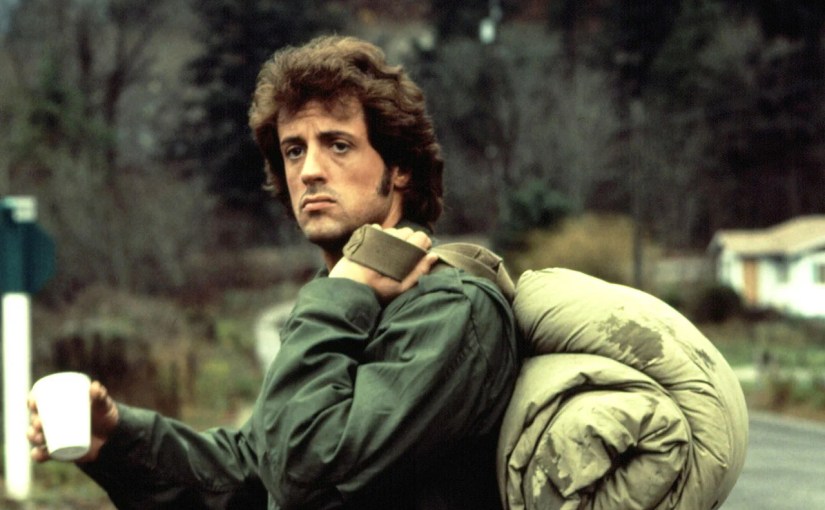
Vietnam Veteran John Rambo entered a small northwestern town to catch up with an old war buddy and grab a bite to eat in First Blood, based on a bestselling novel by David Morrell.  The film, with a screenplay co-written by Stallone, contains a simple plot.  The well-liked Sheriff Teasle (Brian Dennehy) of this community takes notice of Rambo, the drifter with an American flag patched on his army coat, and immediately does not take a liking to him or his appearance.  Teasle attempts to peacefully escort the stranger beyond the city limits.  As soon as he drops Rambo off on the other side of the bridge, the former Green Beret turns around and starts to walk back into town.  A conflict is now set off that will carry the rest of the picture.

After Teasle arrests Rambo, an abusive jail search and frisk awakens the post traumatic stress that the veteran appears to be haunted by from his experiences when he was held captive by the Viet Cong.  A thrilling action sequence is welcomed by Rambo’s escape into the wintery cold mountains.  Now a personal war pitting the tormented man against Teasle’s local law enforcement has been waged.  Perhaps the only way this will end peacefully is if Rambo’s former commander, Colonel Trautman (Richard Crenna), can reign the soldier in before there’s loss of life or any further injury.

The irony of First Blood, Rambo’s first cinematic adventure, is that there is only one fatality in the whole picture.  Rambo is not necessarily a cold blooded killer.  Just don’t push him.  Otherwise, the picture hinges quite a bit on the inventive booby traps that he sets up with only what accompanies his multipurpose six-inch bayonet knife and what can be uncovered within the dense woods.  The traps are quite daring and believable, and as an action picture, it makes for good entertainment.

First Blood may attempt to demonstrate the residual effects of returning home from a tortuous war, but I do not think it sends the best message.  I could never truly understand Teasle’s  immediate abhorrence for Rambo.  This is just a guy who’s walking on by.  Where does the alarm stem from in the Sheriff’s mind?  Maybe a reader can give me some insight that I have failed to recognize after repeated viewings of the film.  

The best part of First Blood is the ending which likely offers one of the best acting scenes in Sylvester Stallone’s enormously long career.  As the adventure is wrapping up, a well written and heartbreaking monologue is delivered that unleashes the terrible trauma the Veteran carries.  Stallone gets to such a manic state of tears and anxiety that it seems so natural.  His voice gets convincingly hoarse.  His face contorts into believable anguish.  At times it is hard to comprehend what he’s describing to Colonel Trautman, but it’s easy to see the distress the character has been living with.  It’s also a perfect summation of the film.  

In this first film, before the subsequent sequels focusing on sensationalized violence, it is apparent how John Rambo contains his heartache and resorts to release what he’s coping with by fighting back against a higher power and refusing to surrender.   The closing monologue perfectly demonstrates that.  It’s as if this man has been holding his breath under water and now, once all the ammunition is expended and the town is in flames, he can finally release what’s been buried in his gut, in his subconscious, for so long.  

1982 was an appropriate time to release First Blood.  It had been ten years since the United States pulled out of a long, losing war in Vietnam.  During the Reagan years, it is fair to argue that life had become quaint and peaceful in this country.  There were remnants of a Cold War still brewing, but there was not a violently long conflict any longer to report.  Pop culture and materialism were being embraced.  Cost of living was working well for the middle class.  Sadly though, there were plenty of people who served who could not put behind the mental scars they took home with them.  Many of these men and women remain forgotten.  Some never returned and some are still unaccounted for.  David Morrell’s story attempted to bring attention to these oversights.  Though the ending to the film adaptation is far different than Morrell’s book, the message is consistent.  

I do not think First Blood is a more effective narrative than The Deer Hunter or Oliver Stone’s well received Vietnam pictures to come out later in the decade.  After all, this is by and large an action adventure.  However, due to the popularity that Stallone carried with the Rambo character, it may have garnered attention for those that never should have been neglected.  

FUNNY GIRL (1968)

by Miguel E. Rodriguez

DIRECTOR: William Wyler
CAST: Barbra Streisand, Omar Sharif, Kay Medford, Walter Pidgeon
MY RATING: 7/10
ROTTEN TOMATOMETER: 94% Certified Fresh

PLOT: Barbra Streisand elevates this otherwise rote musical melodrama with her ultra-memorable star turn as real-life stage performer Fanny Brice.


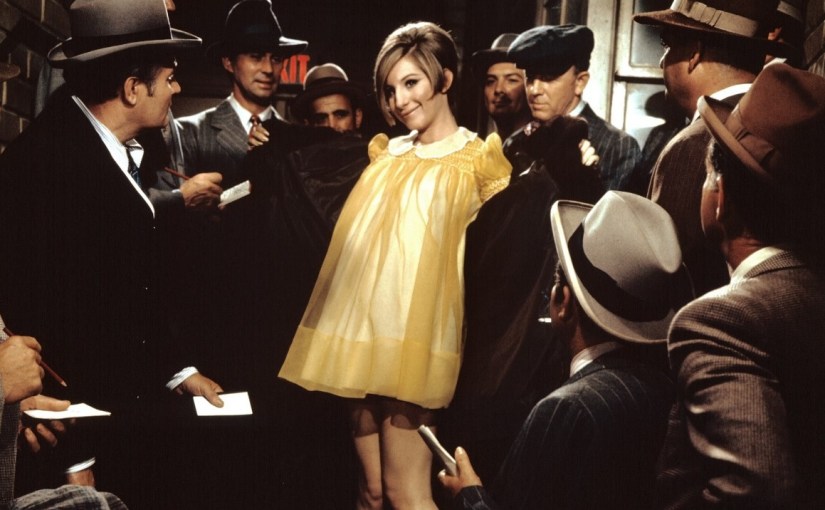
There is nothing wrong with Funny Girl that couldn’t have been fixed by the film not taking itself so seriously.  With its widescreen compositions and scores of extras and lavish stage productions featuring flocks of Ziegfeld girls in the most extravagant costumes imaginable, this should have been a romp, even with the serious bits in between.  Instead, the movie sinks under the weight of its pretentiousness, short-changing the funniest bits and wallowing in pathos way more than is necessary.  Thank goodness Barbra Streisand is there, giving a debut performance for the ages that is part Groucho Marx, part Debbie Reynolds, but mostly just Barbra.  Come for the spectacle, stay for the songs.

The story begins with Fanny Brice (Streisand) walking backstage at a theater and delivering her immortal opening line to a mirror: “Hello, gorgeous.”  From there, the rest of the movie is a flashback to the rise and rise of Fanny Brice, a plain-ish vaudeville chorus girl who is discovered by a roguish playboy, Nick Arnstein, played by Omar Sharif, who looks like a man whose last name would be anything BUT Arnstein.  He cleverly gets her boss to raise her pay to $50 a week (about $800 in today’s dollars, so not bad), and in the process captures Fanny’s heart.  Shortly after that, she’s invited to join Florenz Ziegfeld’s legendary troupe of dancing girls, where she manages to tweak his authority in probably the funniest number in the movie, “His Love Makes Me Beautiful.”

It’s in this number where the first tonal tug-of-war takes place between Streisand’s playfulness and the movie’s urgency to look “important.”  There is an earlier number, “I’m the Greatest Star”, that really showcases Streisand, but the movie never gets that tone right for the rest of the movie.  In “His Love Makes Me Beautiful”, she has these wonderful glances and occasional throwaway lines, but most of them are lost in medium or long shots that emphasize the extravagant Ziegfeld costumes and the expensive-looking set dressing.  It’s like watching a play where the lights are shining everywhere except the stage.

Arnstein comes and goes, sometimes for weeks or months at a stretch, always making sure to see Fanny when he’s in town but repeatedly pointing out that he doesn’t want to be tied down by a relationship.  Their “courtship” lasts through “People”, a song most people know without knowing what it’s from, and a curious number where Arnstein invites her to dinner in a private room upholstered entirely in red velvet, and we know and Fanny knows what’s going to happen, and she has a funny argument between her lust and her manners in “You Are Woman, I Am Man.”  The song also contains a duet with Arnstein, and brother, if you haven’t seen Omar Sharif crooning, you haven’t lived.

Everything comes to a head at the finale of Act One when Fanny learns Arnstein is sailing to Europe and decides to join him instead of going to the Ziegfeld girls’ next port of call.  Here is where Streisand really pours it on, proving her virtuosity with the classic “Don’t Rain on My Parade”, belting out note after note and ending on the iconic shot of her standing on a tugboat as it passes the Statue of Liberty.  If anyone ever doubted she was the real thing before that moment and this movie, their doubts were certainly erased by intermission.

Alas, all good things come to an end, and Act Two falls into a predictable series of economic rises and falls as Arnstein’s volatile income stream finally goes south permanently, while Fanny’s career continues arcing upwards without looking back.  It’s here where the pretentious sensibilities of the filmmakers finally take over for good.  In a second number that could have been downright hilarious, “The Swan”, the movie once again keeps its distance from Streisand’s (appropriate) mugging, asides, and pratfalls…although, being a ballet, it is interesting to see her doing all the dancing herself.

I found myself committing a critical sin by comparing this movie to another widescreen, elaborate movie musical from around the same era, My Fair Lady.  Here’s a movie shot on a grand scale with huge sets, lavish costumes, and big musical numbers, but instead of feeling ponderous, there is a lightness to it.  It zings along, even during the long stretches between songs, thanks to its crackling pace, and gives us just enough pathos to appreciate why we need glee and glamour.

Everything that’s wrong with Funny Girl could have been fixed by just lightening the mood, man.  You’ve got a star-making performance by an experienced theatre actress (Streisand is actually reprising the role she played on Broadway), you’ve got one of the most legendary directors of the time at the helm, William Wyler (Ben-Hur, Roman Holiday), and you’ve got some above-average songs that people can still hum over fifty years later.  Why cloak everything in this gloomy overcoat of affectation and heavy-handed emotional beats that we can see coming a mile away?

When all is said and done, Funny Girl is by no means a bad film.  Streisand is too good at what she does to let this movie fall by the wayside without recognition.  But without her, it’s easy to imagine this movie sinking into near-obscurity, yet another maudlin melodrama that crams 100 minutes of story into a 2-hour-and-35-minute film.  So, rather than mourn what could have been, let’s instead give thanks for what we’ve got: one of the last of the old-fashioned Hollywood musicals with a 24-karat-gold star at its center and a handful of memorable songs.  I suppose it could have been worse.  [insert shrug emoji here]