
by Miguel E. Rodriguez
DIRECTOR: Roger Donaldson
CAST: Bruno Lawrence, Anna Maria Monticelli, Greer Robson-Kirk, Keith Aberdein, Desmond Kelly
MY RATING: 8/10
ROTTEN TOMATOMETER: 100%
PLOT: After the break-up of his marriage, a racing driver sets out to get back his daughter – at any cost.
Since last night, I’ve been trying to figure out what to compare Smash Palace to, and I finally came up with something: John Sayles. Smash Palace resembles the best films of John Sayles, in that they are concerned with nothing more than character and plot. The performances and camerawork do not strive for effect or bias, and the plot, while it proceeds with perfect logic, remained a mystery to me right up to the final scene. I can’t quite vouch for its re-watch value, but any movie that can keep me guessing until the credits roll gets its due in my book.
Alan (Bruno Lawrence) is a once-famous Grand Prix racer who has semi-retired to a sprawling auto junkyard, the titular Smash Palace, with his fragrant wife, Jacqui (Anna Maria Monticelli), and their 7-year-old daughter, Georgie (Greer Robson-Kirk). The fact that these actors were all unknown to me created an atmosphere of reality that would have been more difficult to reproduce with established names and faces. The movie opens with a spectacular single-car crash on a lonely road and establishes Alan’s job: to haul away totaled cars to his junkyard for scrap. The size and scope of his automotive graveyard is shown in a shot that astonished me. (I was even more astonished when I learned in the Blu Ray special features that this graveyard is an actual location that still operates today.)
We watch as Alan tinkers in his garage with a racing car he plans to drive in an upcoming race. He’s also restoring an older car (from the ‘20s, maybe? I’m not an expert) for his best mate, Ray (Keith Aberdein), a local policeman. These opening scenes establish everyone’s relationship: Alan loves his wife and daughter, Jacqui loves their daughter but has become exasperated with Alan’s unwillingness to sell Smash Palace and move out of the sticks, and Georgie loves her mum and dad and enjoys helping Dad with his repair jobs. When Jacqui wants to go to a party, Alan demurs, citing work. Jacqui then says she won’t go at all, and Alan does what he thinks is the right thing: offers to drive her to the party, and Ray can drive her home. Alan’s perfect logic completely ignores the crumbling state of his marriage, much to Jacqui’s dismay. Even young Georgie questions his decision-making when Alan tucks her in that night.
Jacqui winds up driving herself to the party. At the party, Ray, Alan’s cop friend, finds it necessary to drive Jacqui home when she is drunk and claims her car won’t start. On the way home, a moment passes between Ray and Jacqui. We are teased with the possibility that either something or nothing happened. The next morning when Ray drives out to pick up the stranded car, he finds no trouble and the car starts with no problem. Curious…
As the song says, one thing leads to another. Alan and Jacqui get into a quasi-violent argument at home while Georgie retreats to her room, sucks her thumb, and turns a flashlight on and off, on and off, a precisely observed scene that brought back strong memories of when my own parents had their fair share of arguments leading up to their eventual divorce. We get a deeper sense of Alan’s emotional depth, or lack thereof, when his idea of making everything all right is apologizing to his wife while she cries on the bed, then having rough makeup sex. In the afterglow of their “lovemaking”, Jacqui calmly informs Alan she’s leaving him. His nearly wordless response is worth the ticket price.
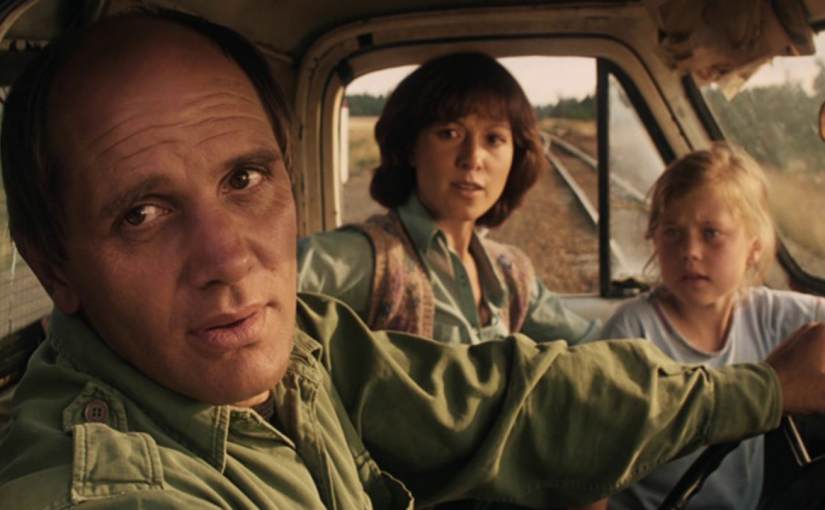
I don’t want to reveal too much of what happens next, because while it may seem like we’re heading into soap opera territory, and we kind of are, it’s important that I convey a peculiar emotional tug-of-war that occurred as I watched. There are scenes of violent emotions getting the best of Alan. I’m not talking about physical violence or beating his wife or anything like that; this movie is too smart to tip its hand in that direction so quickly and obviously. But, for example, at one point, Alan points a shotgun at someone while he yells at his daughter to “get in the truck!” Now, speaking as a rational person, there is obviously no situation, ever, in which pointing a shotgun and essentially kidnapping your own daughter would ever be justified. I think we can all agree there. But the subtle genius of Smash Palace is that, while the scene unfolded, I could so clearly see why Alan was doing what he did that, yes, in the moment, I sided with him. It wasn’t until the scene was over that I found myself wondering, wait, that’s not cool what he did.
But then, was it “cool” for Jacqui to file the New Zealand equivalent of a restraining order against Alan when he had taken her hunting without informing her after they were separated? Was it “cool” for her to almost immediately take up a relationship with Ray, Alan’s best mate, a move that would almost certainly enrage Ray even further? Well, what difference does “cool” make? Jacqui is doing what she feels is best for her and her daughter in the face of a loveless marriage to a man who would rather bury himself in the hood of a car than face up to his responsibilities as a husband.
That’s the beauty of Smash Palace. We may not agree with what these people do, but we can clearly see the why at every turn. The movie takes the trappings of a soap opera and turns it into a crystallized character study that explains why a man with limited emotional resources would point a shotgun at someone’s face because he believes that’s his last remaining option. Alan’s shortcomings have trapped him, and while we audience members know he’s in the wrong, we sigh and commiserate with him: “That poor, dumb bastard.” And the same applies to Jacqui. We know she’s doing the right things by moving out and taking Georgie with her, but because we know how shortsighted Alan is, and we know SHE knows it, too, we feel the same kind of regret when her actions force Alan’s hand. An old family friend, Tiny, even tries to warn her of the consequences of her actions, but she will not be deterred. Poor, dumb bastard.
Smash Palace may infuriate some viewers who have been programmed by Hollywood convention to see clearly defined boundaries between heroes and villains, especially in domestic dramas involving custody of a child. This movie denies them that. Instead, it invites viewers to probe their own psyches and wonder about themselves: what would I do to get my daughter back? What would I do to keep her safe? How far am I prepared to go to be happy in this world? The characters in Smash Palace supply their own answers to those questions in ways that had me rooting for both sides simultaneously. Now that’s hard.
 2 UNPAID MOVIE CRITICS!!!!