
by Miguel E. Rodriguez
DIRECTOR: Jean Renoir
CAST: Jean Gabin, Dita Parlo, Pierre Fresnay, Erich von Stroheim, Marcel Dalio
MY RATING: 9/10
ROTTEN TOMATOMETER: 97% Certified Fresh
PLOT: During WWI, two French soldiers are captured and imprisoned in a German P.O.W. camp. Several escape attempts follow until they are eventually sent to a seemingly inescapable fortress.
What a pleasure it is sometimes to be proven wrong. Years ago, back when Netflix was still sending physical DVDs to subscribers, I watched Jean Renoir’s anti-war masterpiece La grande illusion. Unfortunately, I either could not or would not appreciate it for what it was, and I returned it after giving it a mediocre rating. Flash forward to today, and even in the midst of suffering through my second Covid infection (thank YOU so much, [establishment name redacted]), I rewatched La grande illusion and found it charming, delightful, poignant, and full of (for me) unexpected comedy and ominous foreshadowing, especially because it’s a World War I film made two years before Hitler invaded Poland and ignited World War II. Turns out this is one of the best war films ever made, whose influences are clearly seen in later classics like Stalag 17, Casablanca, and The Great Escape. Who knew?
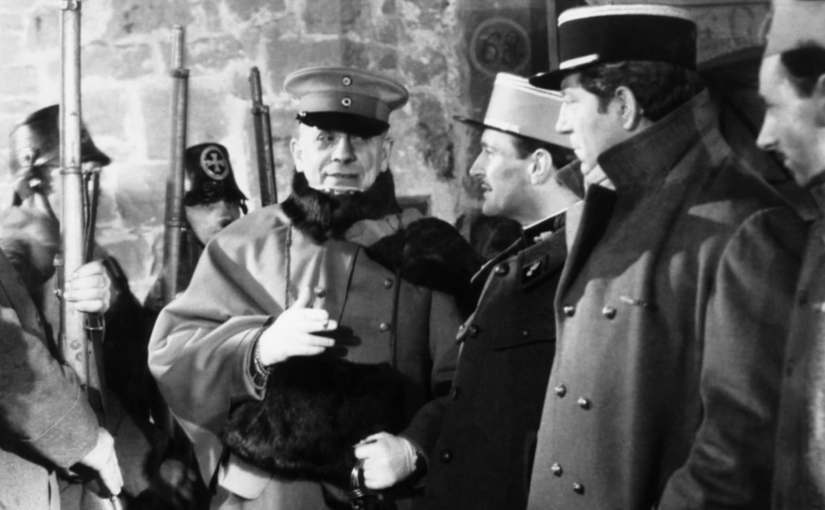
The film centers around two French soldiers in particular, Lieutenant Maréchal (Jean Gabin) and Captain de Boeldieu (Pierre Fresnay). They are captured after being shot down during a reconnaissance mission and are taken to a German prison camp…camp number 17, because of course it is. There they meet the paradoxical camp commander, Captain von Rauffenstein, portrayed by Erich von Stroheim as a man who knows the rules of war, but is willing to bend them – slightly – when it comes to imprisoned officers. He invites them to dine at his table and even offers de Boeldieu a private cell because, wouldn’t you know it, he knew de Boeldieu’s brother before the war. It’s almost like he’s saying, yes, we’re enemies, but we’re not savages.
There’s another reason for von Rauffenstein’s behavior that has nothing to do with chivalry. It’s very clear that de Boeldieu and von Rauffenstein are both aristocrats. They demonstrate this class affiliation by occasionally holding brief conversations in English, which the other soldiers, being mostly of working class, would not have understood. It’s fascinating to watch the German and the Frenchman interacting with each other, stubbornly maintaining an air of sophistication and bonhomie required of their class, when de Boeldieu knows he must attempt escape, von Rauffenstein knows it, and de Boeldieu knows he knows it. This might be considered the first and most obvious level of meaning in the film’s title: the grand illusion that we can still be friends, despite the war, because we’re both members of aristocracy.
Ironically, de Boeldieu doesn’t share this same kind of camaraderie with his own countrymen. Maréchal, the man he was imprisoned with, is clearly a working-class soldier, a bit less refined, and doesn’t know a lick of English or German. He makes one escape attempt too many and is put in solitary. Interestingly, de Boeldieu makes similar escape attempts (we learn later), but we never see him having to experience solitary confinement for his actions. Double standards?
The fourth major player in this drama is another fellow prisoner, Lieutenant Rosenthal, a French Jew played by Marcel Dalio. He and several other prisoners are in the process of digging an escape tunnel under the barracks, using gear and methods that are directly quoted in The Great Escape, especially the problem of soil disposal. It was fascinating to see so many elements in this 1937 film featured so prominently in later films. I never realized just how influential this movie was, and probably still is. (There’s even a scene – I won’t spoil the setup – that features a small orchestra spontaneously breaking out into La Marseillaise at a key moment…tell me the Casablanca screenwriters didn’t have this movie in mind when writing their script.)
After some months (perhaps longer, it’s unclear), Maréchal, de Boeldieu, Rosenthal, and several other prisoners are unexpectedly transferred to another camp before they can finish their tunnel. Their new digs are at an enormous gothic castle, also run by von Rauffenstein, who by now has sustained injuries from some kind of airplane crash which require him to wear a neck brace. He is still exceedingly friendly to de Boeldieu but assures him escape is impossible from this new “camp.”
What happens from there, I’ll leave for you to discover. What I will repeat is that this movie covers some heavy territory with a deceptively light touch. There is a scene where a prisoner receives a parcel from home, a large box containing nothing but women’s clothing, so the men decide to hold a mock “revue” with the male prisoners doubling for the showgirls. One of the soldiers tries on a dress and wig and walks out and asks, “Don’t I look foolish?” Au contraire. The men are struck dumb in a moment that is at first hilarious, then poignant, as they feast their eyes on the first thing even resembling a woman for the first time in forever. Another parcel arrives for some Russian prisoners in another barracks, a large box which they are sure contains food, but instead it contains – well, I won’t spoil it, but to say they are disappointed would be an understatement.
La grande illusion is brilliant at balancing profound ideas of men at war with the occasional humor in the everyday rhythm of life in a prison camp. It even gets into the ingrained prejudices of so many people against Jews, views that in 1937 were sweeping across Germany like a plague. (Nazi Germany banned the film, of course.) This dichotomy is a little hard for me to describe without just giving a play-by-play of the film in its entirety. Watching it again today, it’s impossible for me to remember what I didn’t like about this movie the first time around. It has everything: drama, suspense, comedy, daring escape attempts, a showdown between friendship and duty, men in drag…I mean, everything. This is one time I’m happy to admit: yes, I was wrong. La grande illusion is not mediocre. It’s a masterpiece.
 2 UNPAID MOVIE CRITICS!!!!