MAESTRO (2023)

by Miguel E. Rodriguez

DIRECTOR: Bradley Cooper
CAST: Carey Mulligan, Bradley Cooper, Matt Bomer, Sarah Silverman, Maya Hawke
MY RATING: 8/10
ROTTEN TOMATOMETER: 80% Certified Fresh

PLOT: This love story chronicles the lifelong relationship of conductor-composer Leonard Bernstein and his wife, actress Felicia Montealegre Cohn Bernstein.


Bradley Cooper’s Maestro is a film of scope and depth and tremendous technical artistry, both in front of and behind the camera.  The performances from the two leads contain some of the best acting I’ve ever seen, especially their argument during a Thanksgiving Day parade.  But I cannot deny that, for reasons I’ll try (and probably fail) to explain, I did not feel emotionally invested in the story until the final two or three reels, when something occurs that, if it were fiction, could easily be dismissed as a shameless attempt at Oscar-baiting.  The fact that this really happened lends these final scenes an emotional weight that was missing from everything that came before.

The story is straightforward, but beautifully told, visually.  After a brief prologue, we meet a young Leonard Bernstein (Bradley Cooper), in bed with his male lover (hope that’s not a spoiler), as he gets an early morning phone call that will change his life forever.  This opening scene sets the visual tone for the first half of the film: standard 1:1.33 framing as opposed to widescreen to give it a classic feel, as well as gorgeous black-and-white cinematography.  Indeed, this opening shot alone looks like it could hang in a museum of modern art and not look out of place.

Everything proceeds breathlessly from there, with some conversations held at speeds that would make the Gilmore Girls dizzy.  After a series of early musical triumphs, he meets the woman that will become the polestar of his personal life: actress Felicia Montealegre Cohn (Carey Mulligan, in a performance that will almost certainly win her an Oscar nomination).  After some verbal sparring/flirtation, it becomes clear to them, and to us, that they are meant for each other, despite his later dalliances with male fans and hangers-on.

I especially liked a scene during this early section where Felicia and Lenny – as his friends and family called him – dine with some older friends (or family? I can’t quite remember), and an older gentleman gives him some advice: “They’ll never give Leonard Bernstein an orchestra in America.  But Leonard S. Burns…”  I loved that scene because I loved how Bernstein’s entire career is a rebuke to that well-meant but wrong-minded sentiment.

This gentleman advises Bernstein to give up writing scores for musicals, but Felicia disagrees.  That sets up a wonderful sequence where Felicia and Lenny watch a rehearsal of the stage musical On the Town, with sailors leaping balletically, and then in a fantasy reminiscent of The Red Shoes, Bernstein himself becomes one of the sailors, and the dance becomes a micro-miniature of their relationship and his early successes.  It’s a thrilling little cutaway that had me grinning the whole time.

From there, the movie jumps forward chronologically in leaps and bounds, giving only a cursory glance at the 1960s before settling more or less for the rest of the film in the mid-to-late 1970s, with Bernstein’s face becoming the craggy icon that I personally remember from my own youth, while Felicia Bernstein somehow looks just as beautiful as she did thirty years and four children ago.  I would blame that on movie magic, but I mean, we are talking about Carey Mulligan here, so they get a pass.  And then the last act of the film arrives and we get a glimpse perhaps of why Mulligan receives top billing over the actor-star-director Cooper.  And that’s all I’ll say about that.

As I said, the movie looks amazing.  Obviously the period décor and costuming are all spot on, but the cinematography and direction – what theatre or film studies majors would call mise-en-scène – are just incredible to behold.  Another shot that stands out in my mind is a scene where Bernstein is conducting, and we get an angle where we are looking into the wings, but his undulating shadow looms large, and standing in that shadow, but still illuminated, is Felicia.  Verbal descriptions won’t do them justice, just see for yourself.

But as I mentioned, I just wasn’t invested in the story from an emotional standpoint.  I felt like I was watching an extremely inventive and ingenious exercise in moviemaking.  I suppose I could compare it to the recent sci-fi film The Creator, if that doesn’t get me accused of hyperbole.  Both films show supreme confidence in staging, cinematography, and direction.  But like The Creator, Maestro feels like something is missing where its heart should be for the first 75% of its running time.  Things happen, arguments take place, children are born, Lenny gets a little sloppy with his paramours, but I never felt like any of it really meant anything to me as the viewer.

I tried asking myself, “What statement is the film making?”  And I couldn’t answer that question, aside from fulfilling its purpose in presenting the facts of a story in almost documentary-like fashion.  But the performances and cinematography are so stunning that I must acknowledge that fact with a higher rating than I would normally give a film that doesn’t really grab me emotionally.  (EXCEPT for the last 25%, I mean…I don’t want to give anything away, but the last reels are heart-tugging.)

So, do you want to see this movie?  Well, certainly not if you are an absolute acolyte of Leonard Bernstein.  You’ll see some pretty cool stuff musically, but Maestro does not paint an altogether flattering picture when it comes to his personal life.  But if you want to see one of the best-acted, best-directed, best-LOOKING films of the year…Maestro is your ticket.

TRADING PLACES

By Marc S. Sanders

Dan Aykroyd and Eddie Murphy are the unaware invitees of a Prince And The Pauper R-rated, yet whimsical, scenario in John Landis’ Trading Places.  They are one of the best on screen pairings in film, and this is one of the best comedies to come out of the 1980s.

Randolph and Mortimer Duke (Ralph Bellamy, Don Ameche – another brilliant on-screen duo) are the filthy rich misers who live to make more and more money and use their wealth to cheat and make even more monies or to perhaps use those that are at their behest to test certain social experiments.  Namely, Randoph believes that regardless of a man’s environmental upbringing, anyone can become a success based on their merits.  Mortimer believes otherwise.  It’s in the blood, he claims.  Who you spawn from is how you are destined to become.  To settle this debate, they make a modest bet of switching out their protégé investment representative, Louis Winthorpe (Aykroyd), with homeless bum/con artist Billy Ray Valentine (Murphy).  Deplete Louis of all his possessions and wealth along with his sparkling reputation, his lovely fiancée, his friends and even his faithful butler, Coleman (Denholm Elliot).  At the same time, establish Billy Ray as an up and comer in the WASP Hoi Polloi and award him all of Louis’ assets, along with assistance from Coleman.  Then they will see what shakes out and who wins the bet.  A plot like this was staged in a few Three Stooges shorts during a post Great Depression phase.

The premise for Trading Places allows for a lot of gags that consistently serve the story set mostly in Philadelphia around Christmas and New Year’s.  The holidays lend an atmosphere to the picture.  The brutal cold seems to only make it downright worse for poor Louis, the suddenly accused drug dealer and petty thief.  It only looks worse for him when he’s dressed in a dirty Santa Claus suit and getting peed on by a dog just before the cold rain arrives.  For Billy Ray, the warm comforts of Louis’ home seem like a welcome respite from the chilly, damp streets he likely has slept upon night after night.  If not on the street, then in a jail cell. 

The characterizations are perfect.  I get a kick of Dan Aykroyd’s performance of Louis, the contemptible snob with not one hair out of place and the arrogant tone of his line delivery.  Eddie Murphy is basically doing his routine from all of his early work like Saturday Night Live and 48 Hrs or Beverly Hills Cop.  Yet, I have no complaints.  He’s just funny as hell and the dialogue lends to his basic schtick.  This is the Eddie Murphy I miss from most of his modern film releases.  Denholm Elliott is great at often breaking his regal character to refer to someone as a scumbag.  Bellamy and Ameche are equivalent to wicked stepsisters from a fantasy story.  They are scheming and dreadful with glee.  Paul Gleeson is that “seen that guy somewhere before” henchman working in line with the Dukes.  He’s a great jerk who gets Louis and Billy Ray into their unexpected predicament.  Jamie Lee Curtis is unforgettable as a hooker with a heart of gold, convinced to help out a poor down on his luck Louis when there’s nothing else available to his assist.  She portrays Ophelia whose got the street smarts and sometimes the Judy Holliday squeak in her voice to lend to the spoof comedy this film relies upon.  It’s hard to believe this is the same actor who was a scream queen in a couple of slasher flicks a few years before this film’s release. Never a glamourous actor, but Jamie Lee Curtis has such an amazing range that still surprises in newer films of today (see her Oscar winning performance in Everything, Everywhere, All At Once).

The imagination into this film’s story has to be admired.  When Louis and Billy Ray become aware of the ruse pulled against them, it’s suggested not to kill the villains in cold blood. Rather do unto them what they already committed. Thus, a wonderfully energetic third act is welcomed on the floor of the New York Commodities Exchange that hinges on insider trading and realistic mass hysteria for a silly, yet highly valuable commodity such as Frozen Concentrated Orange Juice.

John Landis incorporates so many side gags into Trading Places.  Imagine Billy Ray intruding upon the wealthy’s exclusive club of snobs and you get a memorable caption of ten police officers pointing their guns in his face.  Poor Louis being subjected to a strip search conducted by nerdy Frank Oz.  Randoph and Mortimer explaining how commodities trading functions to Billy Ray thereby inviting Eddie Murphy to break the fourth wall for a moment.  Even one of my favorite actors of today, Giancarlo Esposito, makes a blink and miss it appearance as Billy Ray tells a tall tale of how he got arrested after using the “Quart of Blood Technique” on ten cops at one time while two hilarious jail cell thugs listen in to his BS.  A train ride to set the victims’ plot of revenge in motion is great involving silly disguises, a New Year’s Eve costume party attended by James Belushi, and a live gorilla.  Even Bo Diddley gets a scene with Louis trying to sell his expensive wristwatch while wearing the ugliest sports jacket and tie combination.

I yearn for another comedy that reunites Aykroyd and Murphy.  We were treated to a little sampling of Bellamy and Ameche in Murphy’s later film, Coming To America.  Oh, how I wish those guys could have capitalized on that small scene.  They pair just as well as Jack Lemmon and Walter Matthau did. 

Trading Places is always a perfect holiday movie to watch in December.  It’s funny, charming, and very smart.  It remains one of the best comedies ever offered by any of the cast members listed in this film.

Looking good Billy Ray!

Feeling good Louis!

LEAVE THE WORLD BEHIND

By Marc S. Sanders

Anxiety and the unknown are the themes of Sam Esmail’s apocalyptic Leave the World Behind.  Actually, I can’t even be sure it’s apocalyptic or not until the end arrives.  Even then I wasn’t so sure.  

A family (Julia Roberts, Ethan Hawke as the parents, Farrah Mackenzie, Charlie Evans as the kids) make an impromptu getaway from New York City and rent a luxurious upstate air B & B for the next five days.  Upon arrival they are quickly relaxed amid all the amenities and beautiful outdoor pool.  A visit to the beach is refreshing until an oil tanker arrives from the deep ocean waters and drifts upon the shore with no warning.  Strange, but okay.  No need for that to ruin the vacation.

Then other unexpected occurrences happen.  A charming gentleman dressed handsomely in a tuxedo and his formally dressed daughter appear on the doorstep of the home in the middle of the night.  They are played very well by Mahershala Ali and Myha’la.  The man claims that he’s the owner of the house and while attending a concert in the city, they needed to make a quick exit and the best place to hold up was at this house.  Conveniently, he does not have any ID to prove his identity along with no specific personal items in this home he claims to own, not even the title ownership papers.  No photos of family tucked away anywhere.  He does have a key to the liquor cabinet, however.

Quickly, the scene is set where the internet goes down.  Federal blue screen warnings appear on every television channel.  Cell phones don’t work.  Deer, lots and lots of deer, appear in the backyard and then disappear.  Pink flamingos wade in the pool.  Elon Musk’s white Tesla cars have a stand out scene.  Roberts then recalls seeing a grizzled Kevin Bacon collecting an abundance of supplies when she made an earlier shopping trip in the local town.  

The paranoia starts to set in beginning with Julia Roberts’ character Amanda.  Amanda declares early on that she fucking hates people.  Hawke’s husband character, Clay, is not ready to hit any panic button and is happy to accommodate the strangers on the doorstep and just wait for the internet to be restored with a logical explanation.  Ali’s character, known as G.H., lends a welcome smile but it’s clear he’s not sharing all that he’s thinking or maybe what he knows.  

Sam Esmail’s film wants to provide a demonstration of how people respond when they don’t know all that’s going on, particularly when modern technology fails us.  A more relatable inconvenience is suggested as Mackenzie’s character Rose is frustrated that her streaming channel shut down just as she was starting to watch the final episode of the sitcom, Friends.  I felt her anguish immediately as my daughter consumes the trials and tribulations of Ross and Rachel on a repetitive cycle.  Ironically, streaming goes down and now the girl can’t watch Friends.  Netflix is the distributor of this film.  Yet, I think they just gave a ringing endorsement for a dying medium.  If only this girl collected the DVDs.  

My problem with Leave the World Behind is the slow pace of it all.  This is one of those movies where its triumphs hinge upon the final five minutes or so.  Either you applaud what sums up the last two and a half hours you invested, or you roll your eyes at where the picture drops you off with the urge to throw your popcorn at the screen.  

Watching Leave the World Behind brought back experiences of shows like Lost or The Walking Dead.  The set ups are brilliantly intriguing from one development to another.  The follow through on each new happening amounts to nothing or at least not anything where I can suspend my disbelief.  Questions are answered with questions.  It’s like calling an insurance company for information following a car accident.  You just want to slam the phone down.

When Ali’s character chooses to check on a neighbor, he sees a watch embedded in the sand nearby.  He picks it up only to get a fright that makes us jump.  The viewer sees nothing else and we are led to believe that Ali sees nothing else, until Esmail goes to a wide overhead shot showing the massive wreckage of a commercial airplane crash, complete with black smoke and flames and endless amounts of luggage and debris.  It’s hard for me to buy a scene like this.  G.H. doesn’t smell any burning fire nearby?  He doesn’t hear anything? He doesn’t see any other debris left mere inches away from the wristwatch only until Esmail’s direction goes from closeup to wide?  I cannot accept the character’s tunnel vision.  My eyes would go towards the crashed plane before I’d ever discover a wristwatch.  It’s just eerily quiet.  The director’s manipulation is a set up shock for me, the viewer, to grab my attention.  Yet, it backfires because it’s completely implausible.  There are many moments like this in the film.

Other than Marhershala Ali (who I still insist should be considered a viable candidate for the next James Bond or a 007 adversary), the rest of the cast is not dynamic enough.  Julia Roberts is working a little too hard.  Ethan Hawke is not working hard enough.  The dialogue is often boring arriving at no conclusions.  Thankfully, most scenes are enhanced by unusual camera angles from Esmail’s artistic freedoms with his lens.  It’s reminiscent of the deliberately weird structure that Stanley Kubrick often did with The Shining.  Nevertheless, it’s exhausting after a while.

Sam Esmail’s work is no doubt shown through long ponderous imagination.  I certainly felt Julia Roberts’ frustration on display, but still, I got the point.  I see no reason to repeat the same lines at higher volume.  I got the point of a lack of trust between the two parties being brought together.  However, I just got tired of the act.  The racial elephant in the room is even suggested.  Though I wish it wasn’t. People quickly forget that George Romero’s Night Of The Living Dead steered clear of any racial factor, and just look at the legacy of that film from the era of the Civil Rights Movement.

The ending that arrives seems inevitable.  Without revealing anything literal, it is doom and gloom.  However, I might have had more appreciation if suddenly the TV and internet got restored and these odd occurrences all just happened to be one big nothing.  At the very least, then I’d understand that this whole freaking planet would just go nuts without their You Tube, Instagram and Netflix.  

You might have had a conversation at one point in the last decade or so that began as “How did we ever manage to survive before the internet?”  The truth is we did just fine.  The adults in Leave the World Behind never stop to remember that though. 

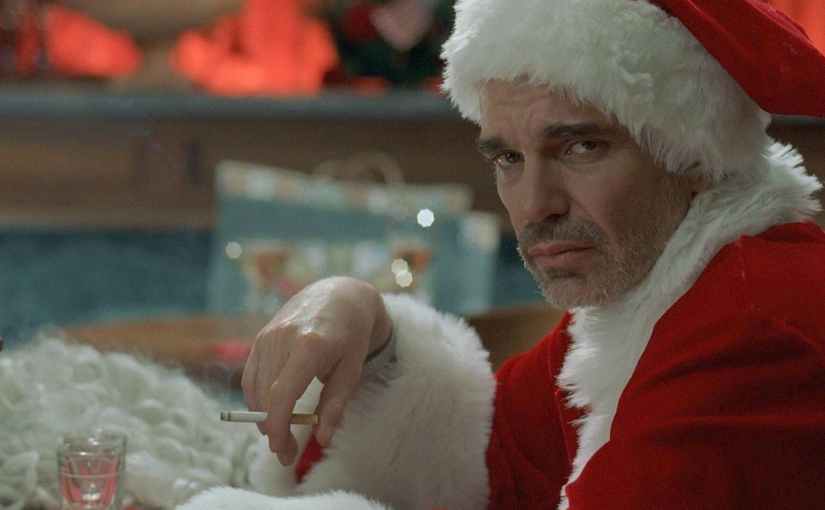
BAD SANTA: Director’s Cut (2003)

by Miguel E. Rodriguez

DIRECTOR: Terry Zwigoff
CAST: Billy Bob Thornton, Tony Cox, Brett Kelly, Lauren Graham, Bernie Mac, John Ritter
MY RATING: 9/10
ROTTEN TOMATOMETER: 78% Certified Fresh

PLOT: The world’s worst department-store Santa experiences an existential crisis in between drunken benders and burgling department stores.

[Author’s note: This review is of the Terry Zwigoff-approved Director’s Cut, NOT the studio-released Unrated “Badder Santa” version created without Zwigoff’s input. The Director’s Cut improves on the original theatrical release, in my opinion, by removing a lot of extraneous scenes (the Advent Calendar shots, Willie teaching the Kid how to fight, etc.) while keeping some bits from the Unrated version, resulting in a leaner, darker, yet even funnier movie.]


I recently re-watched this movie with my girlfriend, first time for her, first time in a long time for me.  I had forgotten how relentlessly funny it is, specifically because of how vulgar, offensive, and, let us not mince words, dirty it gets.  I don’t know if it’s because this was the Director’s Cut as opposed to the original version, but I was also reminded of the earlier films of Kevin Smith.  It has all the coarseness and low-budget production values of Mallrats, but with a better story and a funnier script (all due respect to Mr. Smith).

The film opens with our “hero”, Willie T. Soke (Billy Bob Thornton) getting drunk and puking in an alley while dressed as Santa Claus.  This is the high point of the movie in terms of his character.  It’s all downhill from here.  Almost.  Sort of.  Anyway, we learn that he is involved in a somewhat-feasible scam with Marcus, a felonious dwarf (Tony Cox), and his rather materialistic wife, Lois (Lauren Tom, aka “Julie” from Friends…I was today years old when I learned that, thanks to Penni).  After Soke does the Santa thing, muttering profanities under his breath the whole time, Marcus stays behind after hours, deactivates the store’s security system, and lets Soke in the back so he can crack the store’s safe.  Meanwhile, Marcus steals whatever is on the list his wife gives him.  (I liked that little touch; he’s not a random thief, he’s a very SPECIFIC thief.)

One day, a literally snot-nosed kid (Brett Kelly) perches on Santa/Soke’s knee and solemnly tells him, “You’re not Santa”…then peppers him with questions about the reindeer, Mrs. Santa, the elves, ad infinitum, while Willie does his best to keep up through his alcoholic haze.  To say this is the start of a beautiful relationship is straining the definition of “beautiful” and “relationship”, but there is a point to all of it.  Trust me.

There’s more, much more, that’s been crammed into this barely ninety-minute-long movie.  The bartender (Lauren Graham) whose non-traditional sexual kink makes Willie implausibly irresistible.  The department store detective (Bernie Mac) who senses Willie and Marcus are trouble but has plans of his own.  The store manager (John Ritter) who claims he’s no prude but who can barely pronounce the words he heard coming from the dressing-room stall in the plus-size section where Willie was…well, modesty forbids.  Not to mention the Kid’s grandmother with the apparent obsession with making sandwiches.  And the profanity.  The virtually non-stop stream of profanity pouring from Willie’s mouth.  In a comic strip, his dialogue would be almost entirely composed of symbols and punctuation marks.

The executives at the now-defunct Dimension Films must have had cojones of solid rock to give this movie the green light.  Who is this movie for?  I’ve seen so-called “polarizing” movies before, but this achieves some kind of high bar.  Some of the lines must be heard to be believed.  Bernie Mac and Tony Cox have an exchange late in the film that belongs in some kind of cuss-word Hall of Fame.  I can imagine Kevin Smith watching that scene and nodding his head in a kind of salute.

As I’ve said many times before, I have always had a hard time watching movies or TV shows with loathsome characters as the leads, no matter how funny they are.  I have never been able to stomach Seinfeld for this reason, but I do acknowledge the ingenuity of the show’s writing and the comic skills of the actors.  I just find it a shame it’s all been attached to characters whom I would cross the street to avoid.  But here is Bad Santa, with a lead character who is not only alcoholic, but who is also suicidal, who haunts mall arcades to hit on teenage girls (“She said she was eighteen”, he says at one point), has no compunction about swearing around children, and beats the crap out of some local bullies who are picking on his new friend…then has the chutzpah to look at the beating as a turning point in his life.  “You need many, many, many f***in’ years of therapy”, Marcus tells him.

And yet I don’t just like this movie, I LOVE this movie, because it makes me laugh.  I’ve been sitting here trying to self-analyze my affection (if that’s the right word) for this film, but I am failing.  I can only report that it has some of the raunchiest dialogue I’ve ever heard, that it is definitely NOT appropriate for kids, that it is certainly NOT one of Penni’s favorite movies (kudos to her for making it all the way through), and that hand-carved wooden pickles stained with blood are not the best Christmas presents ever.

And I laugh like a loon whenever I watch it.  Sue me.

MAY DECEMBER

By Marc S. Sanders

A blaring piece of pounding piano music from Marcelo Zarvos hearkens awake the silent opening few seconds of Todd Haynes’ May December against that of a caterpillar/butterfly terrarium.  I don’t like the music and I’m immediately reaching for the volume control on my remote.  It’s only as the film progresses, however, that I develop a grateful appreciation for the often-disruptive soundtrack.

Julianne Moore and Charles Melton are Gracie and Joe Yoo, the relationship referenced in the film’s title.  Twenty years prior, Gracie, at age 36 who already had children and a husband of her own, had an affair with Joseph, a 13-year-old seventh grader at the time, in the storage area of a Savannah GA pet shop where they worked together.  Gracie went to prison for the crime of statutory rape and delivered their baby while serving her sentence.  Once her term was finished, the two continued their relationship and got married, bearing a set of twins, a boy and girl.

As the twins are approaching graduation, a television actress named Elizabeth (Natalie Portman) has arrived in town to do observational research and interviews to prepare for her portrayal of Gracie in a made for TV account of what occurred.  On the surface, all seems calm with the past put behind everyone.  Townsfolk will say that Gracie and Joe are so appreciated and loved in the community, and they love each other.  However, the script from Samy Burch will reveal otherwise as Elizabeth develops different kinds of connections with Gracie and Joe, respectively, as well as others she speaks with in town, including Gracie’s attorney, her ex-husband, the pet shop owner, and Gracie’s now adult son from her first marriage.  His name is Georgie (Cory Michael Smith) who was close friends with Joe until the affair was revealed, and now let’s everything hang out avoiding any kind of subtlety.  He’s even candid about what he believes occurred in Gracie’s childhood that could have dictated why she committed her act.

Todd Haynes’ picture is a complete character study of a story that many would regard as sordid or seedy trash material to talk about over dinner with friends.  People like Gracie and Joe may seem real to any of us who live in another part of the country.  We will never have any kind of relationship with them.  They are meant for cover stories in People magazine and The Inquirer.  It’s soap opera junk or trashy romance novels brought to reality.  It’s easy to judge the kind of person Gracie in particular is because what she has done is wrong and disturbing.  All these years later and they are still receiving packages on their doorstep that contain feces.  Gracie committed a terrible crime, but what does an act like this say about someone who would go to that length, so many years later? 

The performances in this film are astounding.  Charles Melton especially.  Samy Burch writes a disturbing and well-drawn character with Joe.  He’s thirty-six years old now, in 2015 when this story takes place, and as his children are graduating and are about to make their home an empty nest, he seems so much more immature than them.  A telling scene occurs when his son takes out a joint and practically instructs Joe on how to use it.  Joe coughs uncontrollably.  He gets ill, and it is his son who is calming him down.  Gracie also appears to treat Joe like the child she bedded all those years ago, instructing him to straighten up the house and put away his butterfly garden, or not to get into bed because he reeks of the BBQ he used earlier in the day.  Joe lives in an adult body, but he skipped his progressive years to go straight into marriage and fatherhood, and therefore he has not had an opportunity to grow up.

Julianne Moore plays delusional all too convincingly.  She might have confessed guilt to her crime.  She served her time, but as her attorney and Georgie will imply, none of that means anything if she still believes she did nothing so terrible.  She’s now married to Joe, who is now well past legal age and has had a twenty-year relationship with him, as well as the children they share.  Gracie happily accepts her new role as a baker in the community.  Yet, it doesn’t even occur to her that some acquaintances merely place orders just to keep her occupied.  Either Gracie chooses to wear blinders or she’s truly unaware of how she’s considered; still remaining a pariah within her social circle.  It’s devastating when someone cancels a cake order, tells her to keep the money that was paid for the work, but is also told that the cake no longer needs to be baked.  Especially now, as her children from her second marriage are leaving the home for college, she is realizing that she has no worth or value to anyone anymore.  No one even wants to sample her cake any longer.  Part of me wants to say it serves her right, but with Julianne Moore’s performance, it’s also terribly heartbreaking.  There are acts we commit in our lives that we will never, ever recover from.

Natalie Portman adds another accomplished performance to an outstanding resume.  Todd Haynes assists with demonstrating how manipulative and subtle Elizabeth, the starlet actress, is supposed to be.  When she first arrives at the couple’s home for a summer barbecue, Haynes captures Elizabeth with no jewelry on and wearing a hat and sunglasses that she never takes off.  Gracie, Joe and the others come to greet her and offer her a hot dog, but Elizabeth doesn’t reveal herself.  She keeps herself hidden.  She’s begun a camouflage as she initiates her observations.  As the story moves on, we get to see how perhaps a Julliard trained method actor prepares.  She begins to apply her makeup just like Gracie would.  Elizabeth dresses like Gracie.  She wears her hair like Gracie.  Elizabeth duplicates Gracie’s hand gestures captured in news articles.  Most significantly, she develops a bond with Joe, just like Gracie did.  A crumpled-up letter from Gracie that Joe has held on to since they began their affair twenty years ago, is reintroduced later in the film that Elizabeth pounces on.  Todd Haynes captures an unbroken take of Portman reciting the letter in a mirror and it’s an eye-opening moment for the character.  Suddenly, I don’t see Elizabeth anymore.  I see Gracie, and Natalie Portman is playing the predatory sex deviant.

By 2015, this story is a been there/done that.  The general public has stopped caring.  Only a few still carry an anger with those packages that are left on the doorstep.  Otherwise, there’s nothing left to share or care about.  Yet, May December does a fine job of showing the residual detritus of what’s come from such an illicit affair.  Gracie’s husband before the affair will say he’s over the betrayal and humiliation, but clearly he’s not.  Gracie now has two families.  The first family from a standard marriage with adult and teen children she greets as if they are neighborhood kids.  She’s on the outside of what she used to have as a mother. Then there is the second family consisting of the college age daughter she delivered while in prison and the twins that came thereafter.  An awkward moment occurs in a restaurant when the two families run into one another.  No one is well recovered from Gracie’s transgressions, even if she served her time.

Reflecting back on the music, I wondered why it made such a presence in this intimate, quiet drama.  It literally pounds at you every time it is reintroduced.  I believe it first serves as an abundance of the cheesy melodrama that naturally spawns from an unwell story like this.  Elizabeth is set to appear in a television movie adaptation of this ripped from the headlines account, much like a Lifetime movie of the week which shamelessly thrives on this kind of gossip trash.  The music seems to tell me to “LOOK AT WHAT SHE DID!!!!!!”  Later though, Marcelo Zarvos’ composition seems to remind me that this is not just “another story” as Elizabeth freely dismisses it when talking to Joe during a personal crisis of insecurity.  Joe immediately snaps back at her that this is not just some story.  “This is (his) life!!!!!” 

Before Todd Haynes’ film begins, terrible acts have occurred.  During the course of the movie, we see that terrible results remain.  The narrative of May December is kept interesting because we don’t learn everything at once.  There is exposition to uncover as soon as the film begins all the way to the very end where Gracie undoes all of Elizabeth’s prep work with a curveball truth.  Then, we witness Elizabeth do one take after another on a soundstage with a pet shop prop snake twisting around her arms as the seduction of a young, teenage boy is reenacted.  I don’t think Elizabeth got a convincing grasp on what makes Gracie and Joe tick, and now she questions what she invested in and what she sacrificed of herself in order to learn about the character she committed to portraying.

It’s disturbing what Gracie did.  Perhaps it’s at least as ominous that it is now being duplicated for the sake of entertainment in front of a worldwide audience.

SEA OF LOVE

By Marc S. Sanders

Al Pacino is a twenty-year veteran New York City cop, working out of Manhattan, on the trail of a serial killer in Sea Of Love.  The profession is nothing new to Pacino’s repertoire of roles, but the portrayal is unique thanks to a smart and suspenseful script from Richard Price and intense directing from Harold Becker.

The killer leaves a calling card.  A 45 LP record of Phil Phillips ’50s classic crooner, “Sea Of Love,” spinning on the turntable.  The victims are naked men lying face down in bed with a bullet to the head.  Turns out that a cop from another precinct played by John Goodman has uncovered a similar crime scene in Queens.  So, the two team up.  They believe the murderer is a woman.

All the victims have posted a Lonely-Hearts Club blurb in a magazine. The invitation for a date stands out because the text rhymes.  The detectives decide to post their own ad in the same kind of format, meet the women who respond and hope to nab the killer.  It gets complicated when Pacino encounters a breathtaking and sultry woman played by Ellen Barkin. 

Pacino’s cop is a smart guy.  He’s got instincts.  Yet, perhaps due to his constant drinking, insomnia, and the bitterness he carries now that his partner (Richard Jenkins) has hooked up with his ex-wife, he’s also quite vulnerable.

The mystery is strong, and the tension builds as Sea Of Love moves on.  Barkin has Pacino and the audience convinced that she’s the prime suspect.  Still, he lets his defenses down because he’s easily getting seduced by her advances.

Whether you’re watching Al Pacino share scenes with John Goodman or Ellen Barkin, the execution is fantastic.  Great performances from the three.  Pacino and Goodman have a natural exchange with one another. Often humorous, but the guys always talk like cops.  When Pacino admits to tossing away a fingerprinted glass from Barkin, Goodman suggests lifting the prints from something- ahem – more personal of his.  A cute wink and nod exchange.

More important to the film is the erotic chemistry between Barkin and Pacino.  Harold Becker uses a late-night supermarket visit in the vegetable aisle to evoke the risky and irresistible nature the two characters develop for one another.  Other scenes build well on the relationship between these two lonely strangers who’ve only recently met. 

Moments of isolation and drunken stupors also work towards fleshing out Pacino’s burned out cop.  He’s got a schleppy posture to him and an exhausted expression with his sullen eyes and shaggy black hair.  At the same time, his character’s twenty years of experience seem to uphold his alertness.  This cop knows he’s letting his guard down. Without any dialogue, you see the internal struggle Pacino has with what should be done against what he is deliberately neglecting.

This film was Ellen Barkin’s breakthrough role.  She received rave reviews as someone who takes care to uphold a New York City trendy appearance by day as a shoe salesperson in contrast to a woman looking for some carefree lust in the evening.  For Pacino, Sea Of Love reinvigorated a career slump following a series of poorly reviewed films.  Together, they make for a sexy yet untrusting pair.

Circumventing this relationship is the mystery.  Is Barkin the culprit? She seems to have a dark way about her that may not surprise you.  Price, Barkin and Becker designed the character quite well for her to at least have the potential to be a killer of men.  Is she setting Pacino up to be the next victim?

New York City from the late 1980s looks great, even though interiors were shot in Toronto.  Trevor Jones offers a nail-biting soundtrack to keep the suspense heightened at just the right beats of the picture with Becker’s camera pointing down dark hallways or when new clues are discovered.

I’ve seen Sea Of Love a few times and even with knowing the surprise ending, the film still holds up thanks to the performances from its three stars, along with its taut editing, well-paced writing, and smart direction. 

This is a good erotic murder mystery.