
by Miguel E. Rodriguez
DIRECTOR: Kaneto Shindô
CAST: Nobuko Otowa, Jitsuko Yoshimura, Kei Satô
MY RATING: 7/10
ROTTEN TOMATOMETER: 90%
PLOT: In feudal Japan, two women kill samurai and sell their belongings for a living. While one of them is having an affair with their neighbor, the other woman meets a mysterious samurai wearing a bizarre mask.
Squint your eyes, and long stretches of Onibaba look as if they were adapted from comic books. I’m not talking about the eye-popping colors of Kirby, though. More like the moody noir of Miller or McFarlane…especially Miller. Extreme closeups, off-centered faces (to make room for word balloons, of course), sneering lips and bared teeth, gratuitous female nudity, shocking violence, the possibility of supernatural elements getting involved in the story – we’ve got all the makings of a new chapter for the Sin City saga.
But Onibaba misses its chance for true greatness by the disappointing nature of its ending, which I cannot, in good faith, describe in detail here. The last time I felt this cheated by the ending of a film was when I watched the original Night of Living Dead for the first time. When the credits for that movie rolled, I wanted to throw popcorn at the TV. Since I didn’t have popcorn, I cursed out my friends instead. C’est la vie.
The story of Onibaba begins as we see two women – one older, one younger – living in poverty in medieval Japan. Some later exposition informs us of an ongoing war far away between two warlords. Weary soldiers from both sides wander into the tall grassy fields where the women live, and the women promptly kill them, take their clothes and belongings, and sell them to local merchant for bags of millet. (We never learn the women’s names, by the way. They are identified only by how they relate to Kichi, a man we never see: one is Kichi’s mother, the other is Kichi’s wife.) The bodies of the men they kill are disposed of in a large, ominous pit hidden by the tall grass.
I should mention yet another stylistic and visual flourish. The two women live in a grass hut constructed in a vast field of tall grass at least six, possibly seven feet tall. There is poetry in many shots when the wind rises and pushes the grass. In one neat overhead shot, the only way we can see a man pushing his way through the grass is by tracking the hole he makes as he walks. It’s an indescribably lyrical moment in an otherwise mundane scene.
ANYWAY. A neighbor arrives, Hachi, with sad news for the two women: Kichi has been killed. When he asks how the women got by during his absence, they are cagey. It’s here where we get the first of many masterful sequences where faces and eyes are used to convey emotion more vividly than any prose could. When Hachi propositions the young woman, now a freshly-minted widow, she sneers. But as days go by, Hachi wears her down, and they begin an affair, much to the mother-in-law’s disapproval.
Night after night, the young widow wanders off to Hachi’s shack, while the mother-in-law sneaks off and follows her, disapproving but never interrupting their liaisons. All she offers as a rebuke are stern words and resentful glares. This cycle repeats itself several times, and despite the visually unique methods of showing us these middle passages, I found myself wondering where this was going. No doubt people more knowledgeable than I can make conjectures about how this might be a representation of Japanese culture at the time: the old severely disapproving of the young, but powerless to stop the march of progress. It’s not a far-fetched theory, but if so, it’s an obvious one. So, what’s the point?
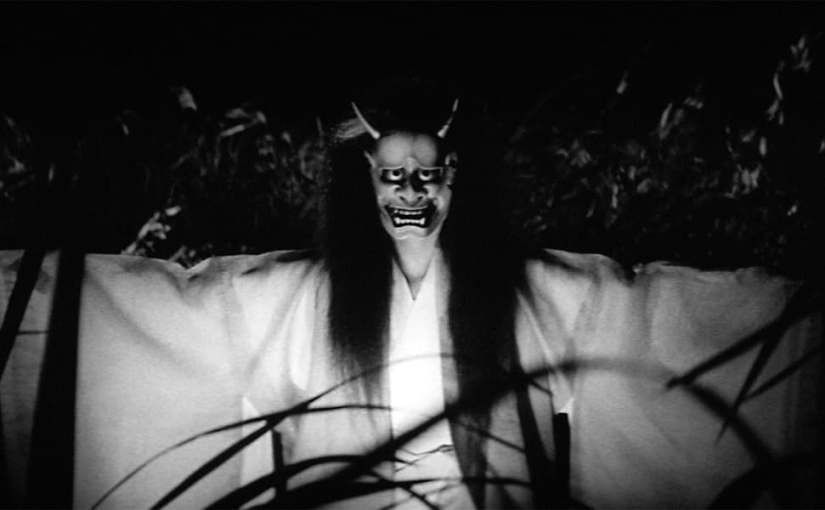
Hope arrives (story-wise) in the form of a tall samurai warrior the mother-in-law encounters in the tall grass one night. He wears a fearsome demon mask and demands the old woman show him the way to the nearest town. She asks him to remove the mask. He refuses, but he assures her that he is very handsome underneath. Right.
At this point, I was on the edge of my seat. At last, here we go, some real horror-story stuff. The mask looks awesomely horrifying, not like the kind of demons we tend to think of, but a weird, bug-eyed, fanged face that still looks vaguely human, which only makes it that much creepier. When the old woman finally gets her hands on the mask (I won’t say how), she formulates a plan. The next night, when the younger woman sneaks off to another rendezvous with Hachi, she is confronted by a tall figure with long black hair with the face of a demon…gliding through the grass is if it were floating over the ground. Floating? People can’t float. …what exactly is going on here?
At this point, I was primed for a Twilight Zone kind of twist, revealing the true nature of the samurai warrior, the mask, and the old woman. (Onibaba translates to “demon woman”, according to the main titles of the movie.) But what? I was pleasantly surprised by my eagerness to see what would happen next, even if it were mildly predictable. The movie had shown great visual flair, so even if the ending was a cliché story-wise, it would look really cool.
But…alas. The film’s ending teases us with several minutes of truly disturbing stuff psychologically, and then throws it away in a moment of ambiguity, the kind of open-endedness that may inspire discussions on the movie blogs, but which is terribly unsatisfying when it doesn’t work. And here, unfortunately, it doesn’t work. It leaves us with more questions than answers, and when “The End” appears, it almost feels like the director and/or screenwriter said, “That’s it, I’m out of story.”
The liner notes of the Criterion Blu Ray for Onibaba inform me that it’s based on an ancient samurai legend, so I guess I can’t totally blame the director/screenwriters. But I just wish there had been something meatier waiting at the end of what had been a visual treat. If it had provided a nudge into something deeper or more visceral, I’d have been ready to put Onibaba near the top of my favorite Japanese films. Visually, it’s stunning with a surprisingly modern feel. But, oy, that ending.
 2 UNPAID MOVIE CRITICS!!!!