
by Miguel E. Rodriguez
DIRECTOR: Georges Franju
CAST: Pierre Brasseur, Alida Valli, Juliette Mayniel, Edith Scob
MY RATING: 9/10
ROTTEN TOMATOMETER: 97% Certified Fresh
PLOT: A surgeon goes to extreme lengths to give his daughter a new face, which was disfigured in an accident he caused.
[NOTE: This review contains mild spoilers.]
I have become a fan of many of the new breed of horror films released in the last ten years or so – Under the Skin, The Babadook, Get Out, Hereditary, Doctor Sleep, and Saint Maud, just to name a few. Despite their cosmetic differences, these movies all accomplished the same thing: they got under my skin. They were genuinely unsettling as their stories unfolded, and they can still creep me out to this day.
Imagine my surprise when I sat down to watch George Franju’s Eyes Without a Face, a French horror film released over sixty years ago, during a time when most mainstream American horror films (Hitchcock aside) were exercises in jump scares, cheesy special effects, and outrageous premises. I was not prepared for how effectively this movie grabbed me from the outset and, except for a brief middle passage, did not let go. When a movie from 1960 begins with a woman dumping a corpse into a river…a corpse with a clearly, hideously disfigured face…I don’t know about you, but I sat forward a little in my seat. Where is THIS going?
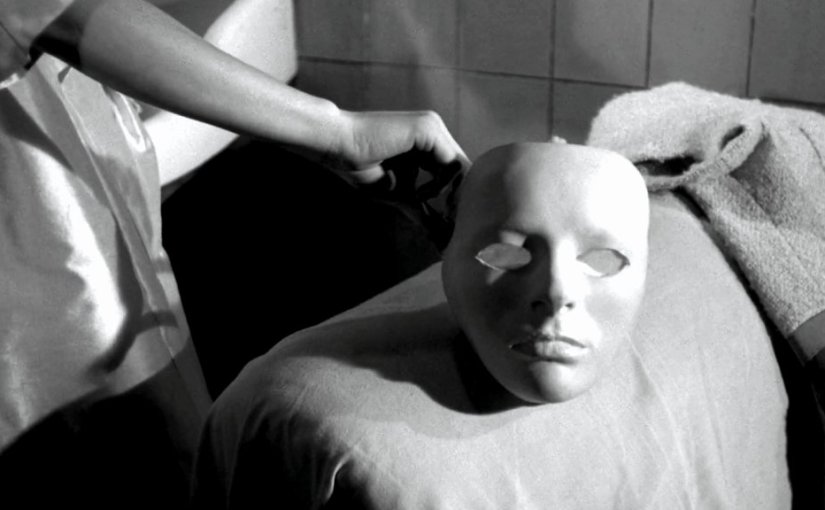
When the body is discovered, the esteemed Dr. Génessier (Pierre Brasseur) solemnly identifies it as his daughter, Christianne. There is a funeral, Christianne’s fiancé is distraught, and the police are satisfied. When the good doctor returns home to his large, gothic estate in the country, he goes upstairs to a room where we find his actual daughter, still alive and so disfigured the camera dares not show her face. The doctor’s assistant, Louise (Alida Valli, still exotic-looking 11 years after The Third Man), brings in a simple but disturbing mask for Christianne to wear. “Get into the habit of wearing it,” says the doctor.
Who was the girl in the opening scene? What happened to Christianne’s face? And why does Louise start searching the nearby city for young unattached women with blond hair and pretty faces? Why, indeed?
Eyes Without a Face may not have a particularly inscrutable or complicated story, but that doesn’t matter. The movie unfolds like a modern-day Grimm’s fairy tale, poetic, with princesses locked in tall towers, an evil father figure, and unspeakable violence hinted at but never quite seen. Except this time, in an unforgettably shocking scene, we witness one of the doctor’s operations.
In most films of this era, shockingly violent acts were tactfully carried out offscreen. I am thinking, for some reason, of Lawrence of Arabia, where Lawrence must execute a man in order to keep the peace between two Arabian tribes. Lawrence pulls his gun, we see the bound man try to escape, and we cut to Lawrence as he fires his gun, once, twice, several times. It’s a shocking scene, but we never see the carnage of those bullets. It’s left to our imagination.
In Eyes Without a Face, we watch as the doctor gently draws a grease pencil outline around his anesthetized victim’s pretty face. (“I must try removing it in one large section, not in pieces as before.” Yikes.) Then Louise hands him a scalpel, and the camera stays on Louise’s face, and I expected it to stay there for several seconds as the horror of what the doctor was doing was left to our imaginations. But no. We cut back to the scalpel piercing the skin as he gingerly follows his outline around her face. Some excess blood drips down, and Louise dutifully sponges it away.
This is already pretty strong stuff for 1960, at least when I compare it to other films I’ve seen from that era (again, Hitchcock aside). But I was doubly shocked when the movie didn’t stop there. The face must still be removed, but to do that we need clamps, more incisions (taking care around the eyes, of course), and we watch this process in several long takes which must have had some audience members fainting in disbelief.
When the doctor is finished, another body must be disposed of, Christianne has a new face, and all seems to be well. (The doctor reminds his daughter: “Smile. Smile. …not too much.”) What makes this movie great is that there is still so much more to the story, but I’ll leave that for you to discover.
This is the kind of gothic stuff that screams for a remake today, maybe by del Toro or Ari Aster. Although perhaps they are already fans and have made the decision that the film is too perfect as it is. I can’t blame that viewpoint. Eyes Without a Face has just about everything a modern horror fan could desire. Franju plays many of the film’s creepiest scenes with no score, creating a deeply unnerving mood like in The Blair Witch Project. It doesn’t shy away from disturbing gore. Christianne is not just a shrinking violet, but prone to heartbreaking philosophy. (“My face frightens me. My mask frightens me even more.”) To say the resolution of the story is satisfying is an understatement; it takes “poetic justice” to a whole new level. There is Hitchcockian – or, perhaps more accurately, Clouzot-esque – suspense when Christianne’s fiancé begins to suspect there is something fishy about Dr. Génessier’s clinic and tries to set up a sting operation with the help of local police.
And so much more. Eyes Without a Face is, for me, one of those buried treasure movies that I normally do not seek out, but when they turn out to be more than worth my time, I can’t help but share it with others. It holds its own with modern horror films, and then some. The fact it was made in 1960 still boggles my mind, and that just makes it even more fascinating.
[P.S… According to IMDb, John Carpenter once suggested that the selection of the mask worn by Michael Myers was influenced by Christianne’s mask from this film. I believe it.]
 2 UNPAID MOVIE CRITICS!!!!