
By Marc S. Sanders
I never knew much about Napoleon Bonapart. He was short. He’s French of course. There’s that famous painting with his right hand tucked into his tunic. Or was it his left? The big hat. I’d heard he was kind of a brat. Ridley Scott’s latest period piece, Napoleon, confirms most of what I recall. The painting was nowhere in sight though.
Joaquin Phoenix portrays General Bonapart, and he surely had a great challenge ahead of him. I cannot say that I was bored with any part of the film, but I did find Napoleon to be quite bland during the first act of the film. Phoenix, doing his best with a script by David Scarpa, seems to be a stand in with nothing of much consequence to say. It is only when the Captain all but invites a promotion upon himself to the rank of General, following the guillotine beheading of Marie Antoinette, that his arrogance begins to show. Thereafter, he takes it upon himself to force the hands of the governing council to resign from their positions, a very entertaining sequence for sure. Then Napoleon sees no other purpose but ongoing conquest.
With each passing scene in Napoleon, the ego of the title character grows and grows and that is the underlying theme of Scott’s picture. We journey to the pyramids of Egypt to witness Napoleon lead his armies towards further conquest. Alternatively, we also trek through the raw winters of Russia and on to a blazing Moscow. Who set the Russian city alight is a question that history may contradict of the General’s claim.
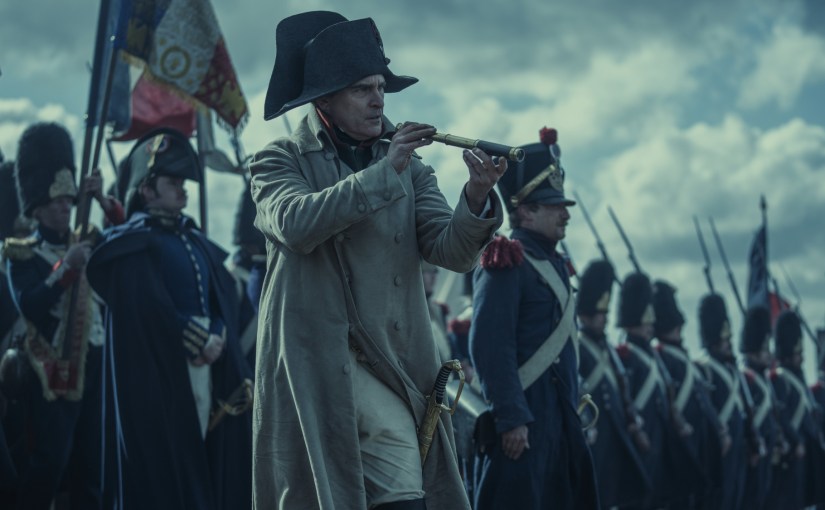
Napoleon is sure to get a slew of Oscar nominations. However, it will likely not be in any of the major categories. The numerous battles are outstanding in whatever setting Ridley Scott offers. Whether it is in the desert or murky winter grounds, I could not tell if the armies were physical extras or CGI. It all looked seamless in its construction. David Lean would be proud. Sound editing was also perfectly in sync. The set designs of the many scenes throughout are exemplary from bedrooms to halls and the wallpapers, furnishings and floors and even the outdoor landscaping of the French estates. Even Napoleon’s tent on one battlefield after another are absorbing. The costuming always makes a statement. Every stitch and distressed shade of blues, reds and whites tell a story. Yes, it’s all very impressive. However, I did not go to Napoleon to grade a college project assignment in fine arts. Overall, it has to be the movie itself that grabs me.
Unfortunately, Ridley Scott’s film suffers from shortcomings that cannot be forgiven. I have to lend credit to my wife who pointed out flaws that did not come to my attention until I heard her input, and thus could not deny. There are topics brought up in the film that are either not followed through clearly or are left with questions.
One moment in particular occurs when Napoleon opts to marry the daughter of a leader. Do not ask me to remember which leader. Characters leave the picture just as quickly as they enter. One daughter is of proper age. The other daughter we are told is only age fifteen and Napoleon turns down the idea of the latter, but in the scene afterwards it appears that he actually did choose to marry the fifteen-year-old. The girl certainly looked like a teenager. So, how did that come to be?
A storyline I really took an interest in was Napoleon’s marriage to Josephine (Vanessa Kirby). The widow of a dead soldier, with three children, he marries her for love. Then he leaves to conquer some more and more around the world. Yet, the general returns when he realizes she is happily having affairs in his absence. The bruised egotistic response of Napoleon is very well played out. Joaquin Phoenix has his best moments in the storyline he shares with Vanessa Kirby. However, while I thought I understood, my wife pointed out that the film does not clearly explain how the relationship continues. There’s animosity at first but then there is a mutual love between the couple and how exactly did that flourish and change? When was the mutual affection eventually sparked? What works best is how the two are unable to bear a child together. Napoleon is nothing but forceful in his moments of sex with Josephine. He will damn well force a pregnancy even if it means he has to thrust harder and harder inside of her. Yet, no results come of his efforts. An heir must carry on the Bonapart legacy. Since one does not appear, it taxes heavily upon the powerful leader.
Later in the film, following the couple’s dissolution of marriage, a child is born but who exactly carried the offspring? Details like these seem to be glossed over.
Few directors are as skillful at showing grand scenes of battlegrounds with sharp, clear edits of how the fighting progresses. Ridley Scott demonstrates that over and over again with one scene after another. He accomplishes fare like this so well in other films like Gladiator and his interpretation of Robin Hood. The dark hazy cinematography works beautifully on a big screen. However, I’m not sure if it will be as effective on a sixty-inch flat screen where there’s a risk of intrusive glares in your living room. These magnificent scenes need to be watched on a big screen.
Unfortunately, the attention to detail is not lent to the story as effectively. Napoleon’s mark in history did not just happen in a period of a few years. For a brief window of time, France was a superpower ahead of the likes of Egypt, Britain, Austria, Prussia and even Russia. Two hours and forty minutes may seem like a long film and yet Napoleon likely needed at least an additional hour to serve a complete historical recount.
If you want to see Napoleon, now is your chance while it plays in theaters. Again, I do not believe it will have the same effect at home. Regrettably, the film does not offer enough on the plate. No one in the cast is doing anything of Oscar caliber accomplishments. Ridley Scott comes up short of end of the year award considerations for not inviting tighter storytelling, and that also goes for David Scarpa’s script.
The visual marvels of this period piece are what is to behold. Watching Napoleon, I certainly felt like I was there amid the glorious costumes, set designs and cinematic photography. Nevertheless, while I may have been in the room, the hosts of the picture were not sharing their entire conversation with me around the dinner table. Alas, at times, I was left to stand in the corner, feeling like an unwelcome guest.
 2 UNPAID MOVIE CRITICS!!!!