

by Miguel E. Rodriguez
DIRECTOR: Ted Wilde
CAST: Harold Lloyd, Ann Christy, Bert Woodruff, Babe Ruth (!)
MY RATING: 10/10
ROTTEN TOMATOMETER: 100% Fresh
Everyone’s a Critic Assignment: “Watch a Silent Film”
PLOT: An everyman helps his girlfriend’s grandfather keep his obsolete horse-drawn trolley business alive by finding odd jobs in New York City (when he’s not having fun at Coney Island with his gal).
Speedy is charming, delightful, inventive, funny, thrilling…I could go on. For me, this movie, along with the other Harold Lloyd films I’ve seen (The Freshman, Safety Last!, The Kid Brother), cements my perception about Harold Lloyd when compared to the other giants of his day: Chaplin will always be The Tramp, and Keaton is the Great Stone Face, but Harold Lloyd, in his films, is us.
Lloyd plays Harold “Speedy” Swift (get it?), a young man who loves his girlfriend, Jane, almost as much as he loves Yankees baseball. How much does he love it? He interrupts his duties at a soda shop with frequent phone calls to a friend who gives him the up-to-the-minute score of the Yankees game. (No radio stations or televisions yet…ancient history, folks.) He then passes the score to the workers in the kitchen by using a pastry case as a scoreboard and doughnuts and crème horns as zeros and ones. When he finds out the Yankees have scored three runs in an inning, I found myself actively wondering what pastry item he would use for a “3.” The answer may or may not surprise you.
Jane’s grandfather, Pop, owns and runs the last horse-drawn trolley service in New York City. Big-shot railroad owners want his track for themselves, but Pop won’t sell until they meet his price (craftily inflated by Speedy himself in one of the movie’s funnier scenes). The rail tycoons learn that Pop must run the track’s route at least once in a 24-hour period, so they hire some goons to hijack the trolley the next day. When Harold learns of their plan…
But this is just a synopsis. There is a story here, but it is almost secondary to the delights to be had just from watching the film play out, not just because every scene is cleverly executed, but also because many of those scenes present the viewer with what amounts to a travelogue of New York City in 1927, from Times Square to Bowling Green to Washington Square Park to Coney Island. (A documentary on the Criterion Blu-ray of Speedy reveals there were several skillfully concealed cuts to the streets of Los Angeles, but I was absolutely fooled, so I stand by my statement.)
The highlight of the film is the sequence when Harold takes Jane to spend his week’s pay at Coney Island. These scenes left me flabbergasted. I have seen many vintage photos of Coney Island in the 1920s, but never had I seen film footage of any kind. Some of the rides there defy belief. There’s a giant flat disk that spins on the floor and guests pay for their chance at a prize if they can stay on the revolving disk for three minutes. There’s a flume ride where the ride vehicle shoots out into the bay instead of staying in a chute. There’s something called the Steeplechase that looks like a death-defying ride on a gravity coaster, but instead of sitting in a car, you’re riding on top of a metal carousel horse…no lap bars!
The Coney Island segment is home to some of Speedy’s funniest gags, like the live crab that improbably winds up in Speedy’s pocket and causes havoc on the midway by popping balloons, pinching passersby, and stealing a woman’s negligee…from her purse, of course. And let’s not forget the scene when Speedy looks at his reflection in a funhouse mirror, doesn’t like what he sees…and flips himself off. That’s right: in this pre-Hays-Code film, a character in a mainstream movie, certainly seen by children and adults alike, gives himself the finger. Don’t believe me? Take a look:
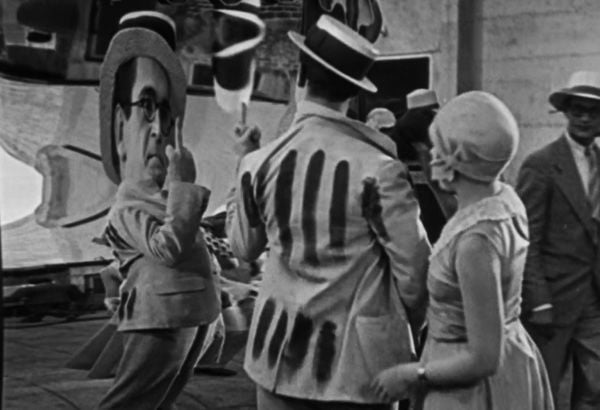
I must have rewound that scene five times to make sure I saw what I saw.
Anyway, the other highlight of Speedy is when Speedy gets a job as a cabdriver and gets to drive Babe Ruth to Yankee Stadium. That’s right. BABE. RUTH. Just like with Coney Island, I had only ever seen The Babe in grainy newsreel footage and still photos. To see the Sultan of Swat in a fantastically restored film from nearly a century ago was…damn, I seriously cannot think of the right word for it. I had a big grin plastered on my face during his entire scene, and it’s a long scene, with Speedy careening through traffic, barely avoiding accidents, while Ruth hangs on for dear life.
The experience of watching Speedy, with its real NYC locations and the inclusion of genuine sports royalty, felt less like watching a movie and more like watching a magic window into the past, like a wormhole through space and time. The last film that made me feel transported like that was the fascinating documentary Dawson City: Frozen Time, about a trove of forgotten films and newsreels from the turn of the century and slightly beyond found buried under the permafrost in the Yukon. To be sure, there are plenty of old films that I’ve seen before, but Speedy is the first one of those that presents, not a manufactured set or a western town that was already old in the 1920s, but a living snapshot of a real, tangible place where the locations in the film can still be seen today.
And I haven’t even started on the brilliant performance from Harold Lloyd himself. Lloyd carries the movie on his shoulders from the get-go, establishing himself as an everyday Joe who just wants to earn that cash and help his girlfriend. He doesn’t mug, like Chaplin, and he doesn’t stare, like Keaton. He just IS. He never comes off as overacting, playing every scene absolutely straight, expressing consternation and exasperation at the fates that, for example, gets him away from a dirty mutt on the street, only to back into a freshly painted fence. Or watch his face on the midway when he wins a special prize: a baby’s crib. Jane, his girlfriend, lights up. Speedy does what any man not ready for commitment would do: tries to give the damn thing back.
After a frantic chase under the city’s elevated train tracks that results in a genuinely unplanned accident – SUCK it, French Connection, we were here first! – everything comes together in a massive rumble (between the rail tycoons, their thugs, and residents of Speedy’s and Pop’s neighborhood) that has to be seen to be believed. At the end of the film, I still had that stupid smile plastered on my face from earlier. What a treasure this movie is. What a delight. I don’t know if Speedy is available on any streaming service, but if it’s not, I would urge anyone who loves film to buy or borrow a copy whenever they can. For film aficionados, it’s a gem. For anyone new to silent films, this would be a great place to start.
 2 UNPAID MOVIE CRITICS!!!!