
by Miguel E. Rodriguez
DIRECTOR: Paul Schrader
CAST: Ken Ogata, and a host of Japanese actors unknown to me
MY RATING: 8/10
ROTTEN TOMATOMETER: 79% Fresh
PLOT: Director Paul Schrader and executive producers George Lucas and Francis Ford Coppola present a fictionalized account of the life and shocking death of celebrated Japanese writer Yukio Mishima.
It’s hard for me to know where to start with this review. I had heard of Mishima: A Life in Four Chapters by reputation for years, mostly because of Roger Ebert’s rave review and also the film’s inclusion in the Criterion Collection AND in the invaluable compendium 1,001 Movies You Must See Before You Die (ed. Steven Jay Schneider). I finally got a chance to watch Mishima recently, and in my opinion, if it does not quite succeed as Entertainment, I believe it is worthy of consideration as a genuinely artistic achievement. Mishima is an elegant rebuttal to anyone who doesn’t believe cinema can be Art.
The lives of artists are notoriously difficult to translate to film, especially when it comes to the life of a writer. Who wants to watch two hours of an author typing, in a fit of inspiration? Paul Schrader came up with a rather brilliant method of getting over that hurdle by breaking up Mishima’s life story into four distinct acts, with each act featuring three separate storylines that coil around each other: the last day of Mishima’s life, flashbacks to Mishima’s earlier years, and scenes from his semi-autobiographical books that parallel events from those flashbacks.
If that sounds confusing, it’s not. Each story thread has its own easily distinguishable color scheme. If it’s black-and-white, it’s a flashback to Mishima’s real life. If there is muted color and a mostly hand-held camera, we’re watching the events of his last day on earth. If the colors are brilliant and saturated, we’re watching a scene from one his books.
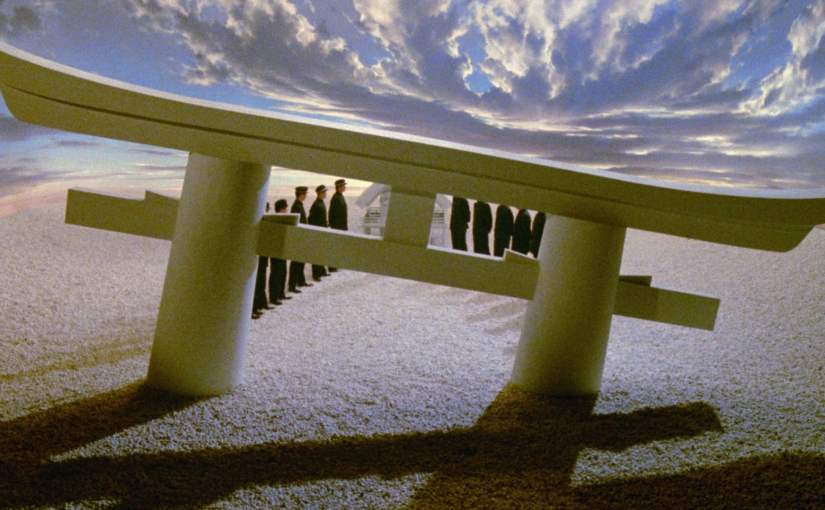
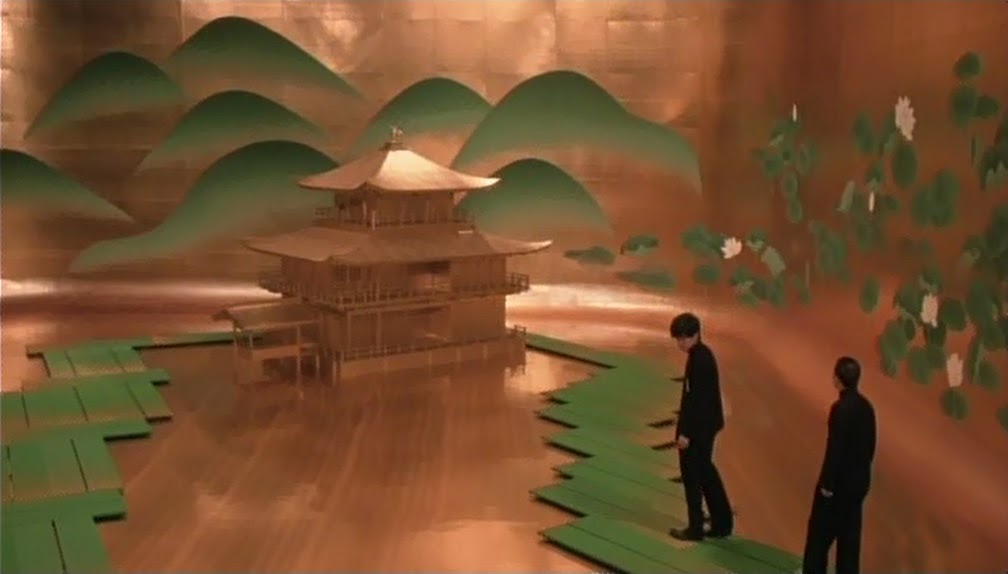
What sets Mishima apart are those sequences featuring scenes from his books…and right about here is where my powers of description may fail me, but I’ll try anyway.) It would be easy to just call them dreamlike, but that’s both true and reductive. To me, they look like a cross-between highly stylized opera and a David Lynch film. In the first segment, based on Mishima’s Temple of the Golden Pavilion, the set was built with lavish golden walls and accented with green lily pads, while the temple itself is a detailed miniature that at one point splits down the middle. The second segment, based on Kyoko’s House, is awash in garish pink lights and walls (production designer and Oscar winner Eiko Ishioka describes the scene as being highly informed by American “bad taste”…trust me, she means it in a good way). The third segment is only slightly more realistic than the first two, with breakaway walls, representational jail cells, and a ritual act that is echoed in Mishima’s real life.
Each segment is not just visually cool to look at; they are also extremely theatrical. In one scene, we watch a wall get pulled away from a character lying on the ground, and we can clearly see the tracks on which the wall is rolling. In another scene, a conversation at a roadside noodle stand is staged – literally on a stage – with the restaurant on a turntable turning clockwise, while groups of actors walk in a circle around the restaurant counter-clockwise. The effect is both simple and convincing, despite its obvious theatricality. (In fact, the visual aspects of the film are solely responsible for taking this movie up from a “7” to an “8.”)

Those scenes by themselves are reason enough for me to recommend the film to viewers. I am an unabashed fan of superhero films (the GOOD ones), but it seems as if we’re living in an age where, instead of finding different ways to tell the same story (which is bad enough), filmmakers are telling different stories, but doing it all the same way. For example, I know, intellectually, that Black Widow and Shang-Chi were made by different directors, but is there anything in either movie that bears the imprint of their respective directors? Nothing springs immediately to mind. However, here is Mishima, a film that is nearly 40 years old, which may not feature countless CGI battles, but which gave me more visual surprises than any two Iron Man movies combined. I don’t mean to pick on the MCU (which I do love, full disclosure), but you see what I’m saying. It’s refreshing to come across a truly original work of art.
The film also asks some serious philosophical questions. Throughout his life, Mishima believed in and advocated the bushido, which literally translates as “the way of the warrior.” He was unashamedly right-wing, advocating the restoration of the Japanese Emperor to power, as opposed to Japan’s governmental policies of democracy and globalism. In the film, he several times mentions “Harmony of Pen and Sword,” a philosophy in which one’s writings are nothing unless they are backed up by action. Mishima espouses this belief so fiercely that he ruthlessly follows it to its logical conclusion in the closing passages of the film.
What is director Paul Schrader trying to tell us here? Should we consider Mishima as a hero? He is certainly one of Japan’s most famous and celebrated writers, but he remains controversial for his right-wing views. (If you’re wondering how right-wing he was, in 1968 he wrote a play called “My Friend Hitler,” an event omitted from the film.) Does Schrader consider him heroic for following through on his beliefs, even when it became, shall we say, EXTREMELY inconvenient for him to do so?
That could be one interpretation, but I don’t see it that way. I came away from Mishima with the knowledge that, once, there lived a man who lived and died by a code. I did not agree with his beliefs, but they were defiantly his, and no one could take that away from him. I was reminded of one of my favorite lines from A Man for All Seasons: “But what matters to me is not whether it’s true or not, but that I believe it to be true, or rather not that I believe it, but that I believe it.”
At the end of the day, while I think Mishima’s moral stance was questionable, and while Mishima itself is less entertainment and more museum piece, the experience of watching Mishima was nevertheless time well spent, especially when considering the astonishing visuals.
(Oh, crap, I’ve gotten to the end of the review and just realized I never mentioned the phenomenal score by Philip Glass, parts of which are quoted at the finale of The Truman Show…if you’re a fan of the movie, you’ll know which parts I’m talking about.)
 2 UNPAID MOVIE CRITICS!!!!