
By Marc S. Sanders
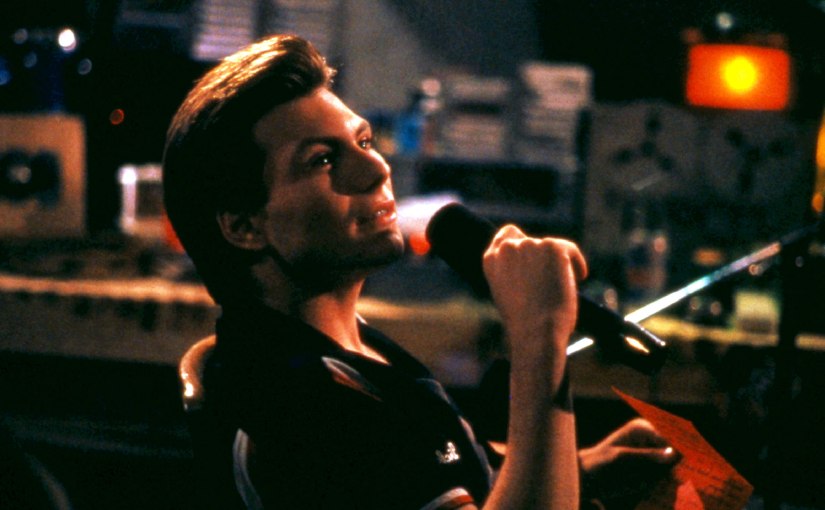
Travis Bickle, the character portrayed by Robert DeNiro in Taxi Driver, is arguably one of the most famous lonely men in film. There have been other iterations of the sad, angry and depressed individual that just can’t speak to anyone and vents his frustrations only to his consciousness that an audience is meant to hear while watching a movie. An isolated guy that stands out to me is a radio DJ known as Happy Harry Hard-On played Christian Slater in Pump Up The Volume, a sleeper hit on early 90s videotape.
Harry is a lonely, quiet high school student by day who goes by his real name of Mark Hunter. No one takes notice of him because he doesn’t socialize, and he hardly speaks. He just keeps to himself. Only an English teacher impressed with his writing and another student named Nora Diniro (perhaps a salute to Robert?) played by Samantha Mathis catch his eye. Mark’s parents really don’t even take much notice of him, other than to believe that Mark has problems adjusting. It’s much deeper than that, as the poor kid adopts his alter ego on a pirate radio station which reaches the neighboring homes around the school.
Pretty soon most of the student body is listening and relating to Mark’s diatribes of loneliness, depression, and the school administration’s efforts to doctor passing grades and average GPAs to enhance its image within the state of Arizona. The school proudly boasts of a program to help troubled kids too, but Mark as well as the other kids fail to see any legitimacy in that approach. All of it is a sham.
The efforts behind this ongoing fraud are being committed by the tyrannical Principal Cresswood (Annie Ross). However, Mark has access to confidential records thanks to his father who now works for the school. Drawing no attention to himself, he can uncover some students who were expelled just for having poor grades despite having no violations. One student was dismissed under dubious circumstances when it was discovered that she was pregnant.
Hard Harry’s radio show airs each night at 10pm where such secrets are revealed along with some of the most perverted and filthy material imaginable interspersed with the grunge/punk music of the time (Concrete Blonde, Ice-T, Pixies, Sonic Youth). Before podcasts and the internet, there was pirate radio in a kid’s basement. Hard Harry vents his frustrations about not speaking with anyone all day or how difficult it is for him to approach a girl. The student body empathizes even though they can’t identify this mysterious voice of airwaves.
Pump Up The Volume never made a huge impact at the box office, but my high school pals and I caught it anyway in movie theatres. It spoke to us. It was much more relatable than Taxi Driver because it was modern, and it was set in an environment that we were similarly living through. Everything that Mark/Hard Harry had to say I could understand. I felt his anguish. Writer/Director Allan Moyle goes for an early surprise when one listener sends in a letter saying he wants to kill himself. Wisely, Moyle doesn’t go for the standard call where the DJ talks the kid out of it. Mark isn’t mature or intuitive enough yet to be an effective “fast-food therapist.” Instead, Hard Harry makes the initial mistake of not taking the letter writer seriously. The aftermath amplifies the pirate DJ’s presence, and then the debate of his servitude comes into question. Mark can no longer toss this personality aside. He’s making a difference, whether some believe it is good or bad and now, with Nora’s encouragement, he must continue his crusade, even if he’s not sure what that is.
Pump Up The Volume was released in 1990 before the Columbine shootings and waves of other school violence that’s occurred since. It was around before social media. Though it is hardly spoken of anymore, perhaps because it lives only in the time of its original release, the context of the film speaks more openly than most of John Hughes’ films. A variety of different students reveal the pain they are suffering, from the genius student who only appears to have it all together in the brains and beauty department to the punk kid who was unfairly expelled to even the silly kids who just want to prank Harry while he’s on the air, and the kid who was cruelly tricked into coming out. The stress and suffering of what students endure still exists and it is perhaps more visible now due to how much further some students publicly act on their frustrations. In that respect, Allan Moyle’s film is not outdated. It might not be pirate radio anymore, but similar content that Harry incorporates in his nightly show continues to be seen in podcasts, Instagram and Tik Tok posts. Public actions are now performed on campuses – such as protest marches, rallies, voicing sexual interests or regrettably school violence, and suicide.
Christian Slater is perfect in this role, maybe one of his best, next to the misfit he would later play in True Romance. Slater has a Jack Nicholson personality. He’s great with the on-air smarmy comments and adoption of his own routines such as “pleasuring himself on the air with a cock ring.” He’s not literally doing any of this, but he keeps his listeners’ attention, the same as shock jocks like Howard Stern. Turns out Mark doesn’t even know what a cock ring is, but everyone is curious, nonetheless. He makes Hard Harry confrontational, as well as regrettable, when Mark feels things are going out of control. Another angle is the quiet student that Slater is by day wearing large glass frames and keeping his head down while subtly checking out the writings of Lenny Bruce from the school library. Slater does well with the multi-faceted character, and I couldn’t envision other actors of his brat pack age in the role.
Samantha Mathis is also sensational, a real surprise. This was her debut screen performance. She has the appearance of a 1990’s Winona Ryder, but she exudes complete confidence as Nora, the girl who seems to know everyone at school and what they are involved in. Moyle writes smart, and sometimes poetic, dialogue for her character. She delivers with a personality of being seduced or moreover being the seductress. Mathis has great chemistry with Slater. She works very well at breaking down Mark’s outer shell while encouraging him to carry on with what he has started.
Pump Up The Volume enters a third act that becomes a chase scene of sorts when the FCC is called in to find Hard Harry. The film ends abruptly because I think Hard Harry may have run out of things to talk about. However, I walk away from the film having seen a hero in a pirate DJ, who brought the wrongs of an administrative body to light. More importantly, he allowed attention to focus on the trials that high school youth encounter.
You’ll feel good after watching Pump Up The Volume, and you’ll understand when Harry tells you to “Talk Hard!”
 2 UNPAID MOVIE CRITICS!!!!