
By Marc S. Sanders
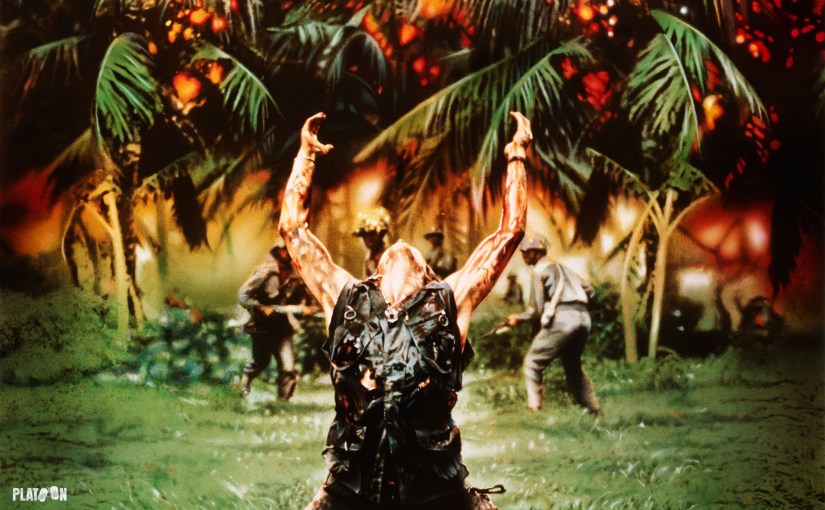
Oliver Stone’s Oscar winning Platoon takes place in the late 1960s, somewhere on the Cambodian border during the Vietnam War. Many of the chaotic happenings the film presents are based on Stone’s own experiences after he voluntarily enlisted to fight. However, while there is an unwinnable war occurring for the American troops, there is just as horrifying a battle going on within the ranks of the platoon the film focuses on.
Charlie Sheen echoes a lot of his father’s, Martin Sheen, voiceover narration, and performance in Francis Ford Coppola’s Apocalypse Now. He portrays Chris Taylor, a college dropout who voluntarily enlisted for a one-year tour of duty to serve. After only one week within the harsh, humid, and wet jungles, he’s writing his grandmother a letter asking what the hell was he thinking. Chris is quite virginal to the harshness of war and that won’t work to his advantage when needing mentoring and support from his fellow soldiers. The newest enlistees are the ones at the front point. They haven’t devoted enough time to sit in the back and because of their lack of experience with war, they are not as valuable for the ongoing campaign in battle. Platoon is not the heroics depicted in John Wayne movies. This was one reason that Oliver Stone wanted to make this picture. Platoon is a bitter retort to Wayne’s celebrated movie, The Green Berets.
There is an angel and devil flanking Chris in the form of Elias (Willem Dafoe) and Barnes (Tom Berenger). Berenger is the cruel side of the conflict with his battle-scarred face. He gives his underlings the impression that because he’s seen so much fighting and endured being shot seven times, that he must be invincible. Elias is a fighting soldier, but he adheres to the rules of war and when it is time for rest, he joins his fellow troops in a unified vigil of drug-induced relaxation. Chris warms up to Elias easily despite his initial fears of being a soldier with no experience or knowledge of how to survive, much less fight alongside his fellow men.
What drives the conflict between Barnes and Elias occurs following the first act of the movie. The infantrymen come upon a Vietnamese village. Some men, including Chris, get wildly abusive with the unarmed people, burning and pillaging their huts. Only after Chris gets control of himself does he realize the wrongs he’s capable of by serving in this war. He prevents a group of men from gang raping a child. Furthermore, he witnesses Barnes commit the illegal murder of a defenseless village woman, shot at point blank range. Elias has his bearings though and will file the proper reports when the opportunity permits. Nothing in Platoon is easy though. This war rages on and the possibility of an investigation and court martial is held off while the fighting continues.
An interesting take on Oliver Stone’s direction is that he never really shows any close ups or lends any dialogue to the Viet Cong. I believe Stone is confident that people know who our battalions were supposed to engage with. However, as another favorite picture of mine stated (Crimson Tide), the true enemy of war is war itself. The enemies of Elias, Chris, and Barnes as well as the rest of the platoon permeate within and among themselves and it lends to the chaos of the brutal combat scenes depicted in the film. Stone doesn’t offer much opportunity to see who any of the soldiers are shooting at or who is shooting at them. There is much screaming and hollering but who are any of the characters shouting at and can they even be heard or understand what is being said amid the gunfire? Platoon demonstrates that a Vietnam war picture is not one of heroics with grandstanding trumpets and a towering John Wayne who takes a hill. War is disorganized, messy, and terribly bloody.
This may be Charlie Sheen’s best film of his career. As he represents the fictional account of Oliver Stone’s personal experiences, we see the trajectory of his change. He is supposed to be there for 365 days, and he, along with his buddies, count down to when their tour will be complete. However, this one short year will be the longest he ever encounters, and it will change him permanently, assuming he survives. Chris is always tested of his tolerance. He’s always subject to respond to how Barnes commands or how Elias mentors and leads.
Oliver Stone is so convincing in his often-documentary approach to Platoon that it is at least understandable to see how the men in this picture behave and carry themselves. Why do they refer to the Vietnamese as “gooks.” Why do they bully with intent to commit rape. Why do they quickly pounce to kill when for even a moment there is no threat. Moreover, why they are willing to turn on each other.
They were never the decision makers for this conflict. These soldiers are depleted of sleep and rest. They are the pawns of a higher power, and they have been left to their own devices in a dense environment infested with bugs, snakes, unbearable humidity, and bodies that infest the waters and land while armed men appear out of nowhere ready to ambush. Some ensnarements might occur within their own regimen. None of these men are justified in their actions. Yet, it is not hard to understand where their motivations stem from. They are not programmed for heroics. Keith David portrays a likable soldier who tells Chris that his mission is just to survive until he’s summoned home. Survive among those you march and sleep with. Outlast this hellish environment and overcome those that are trying to mow you down in machine gun fire. Everything else around here is “just gravy.” When you are an infantryman, you are not making a statement any longer. You are not fighting for a cause anymore. You are only trying to stay alive.
Platoon is such a shocking film of unconventional madness and turmoil. Oliver Stone is relentless in the set ups he stages. This picture came out in 1986, long before the strategic methods of the modern “shaky camera” approach. It’s beneficial to watch the film as Stone must be positioning his camera on a track as the platoon hikes through the forest, parallel to his moving lens. We are walking alongside them. Early morning overhead shots depict the carnage of battles that occurred in the dark of night. Flares and sparks come from nowhere. I think you could watch this movie ten times and still not know when to expect gunfire to intersect with the story or when the bombs to go off. It’s hectic hysteria like I can only imagine these young men experienced before they spilled their blood on the battleground and either died right there or returned home physically and mentally crippled for life.
Platoon is one of the best and most frightening war pictures ever made.

 2 UNPAID MOVIE CRITICS!!!!