SERPICO

By Marc S. Sanders

In the 1970’s Al Pacino had a slew of Oscar nominated roles.  One of those revered performances was as Frank Serpico, the righteous cop working with a corrupt New York City police department, in Sidney Lumet’s gritty Serpico.  The wardrobes and appearances of New York and its five boroughs seem unfamiliar nearly 50 years later, but the film can still maintain interest for a viewer because it’s astonishing how valid and true all the facts remain.  Cops were happily taking handouts, while the politicians and commissioners took no issue with looking the other way.  Whether it was disregarding a deli owner’s double-parking offenses for a free sandwich, or skimming some payouts from drug and prostitution rings, Serpico’s morals were always facing an insurmountable conflict.

Lumet’s film starts off with an interesting observation.  Word gets out that Frank has been shot and is being rushed in an ambulance, and one police officer asks the other, if a cop did it (not who did it).  If you never knew anything about this guy’s life or what he experienced, you know in just a small economy of words that Frank Serpico has become everyone’s enemy; not just to the hoods, pimps and drug pushers, but to those who are supposed to be his allies and support.

Long before Al Pacino inherited his gruff smoker’s voice that bellows like an angry lion with too much phlegm, he had the ear piercing outbursts with the same intensity to frighten his co-stars.  His character is seemingly the one true blue cop in the entire squad who doesn’t befriend the local hoods.  Serpico never accepts a bribe or hides a report.  It’s a frustrating ordeal and Pacino goes to the limits with big outbursts while pacing back and forth and showing terrible fear and panic in his eyes.  Lumet’s camera is quick enough to capture every tick that Pacino exudes.  It’s not Al Pacino performing within the frame of the camera.  It’s actually Sidney Lumet’s lens adjusting to how wild Pacino goes physically with his volume and body language.  

Frank Serpico was a lone wolf.  As the story progresses, the other cops find it hard to believe that he will not accept being part of the gang that is on the take. They grow concerned.  Can they trust Frank to keep his mouth shut and let things be?  No, they can’t count on Frank to toss a blind eye.  He is persistent on getting this story out to the proper authorities.  Naturally, it’s hard for these corrupt individuals to share a locker room or ride in the same car with him as a passenger.  Frank’s limit though is that he is reluctant to testify.  Get the investigation going and have the authorities uncover it for themselves, and then do something about it.  That’s all.  If he testifies, then his life is truly in danger as this all becomes official in a court of law.

Serpico is a good film because of Pacino and because of the concept of the story.  It’s more compelling because arguably in the United States’ most well-known city, corruption actually abounds.  Dirty cops in New York City?  Why, that’s unheard of! It was sadly all true and justice was not being executed fairly.  

However, Serpico is not Lumet’s best film, nor Pacino’s.  Often it meanders.  There’s not a lot of action.  There’s quite a number of scenes where Pacino’s screaming paranoia takes over.  It grows tired, honestly.  Moreover, it gets repetitive.  Many of Pacino’s outbursts feel like I just saw a scene like that, five minutes earlier.  

What keeps me going through the film is the fact that one authority after another refuses to take this problem head on.  The captains, the commissioner, the prosecutors and even the mayor of New York City never allow any chance of pursuing the wrongdoing that’s occurring.  After all, if you prosecute everyone involved, who is going to be left and how would that make an elected official look in the eyes of his constituents?

There are subplots focusing on the relationship between Frank and a couple of his girlfriends played by Barbara Eda-Young and Cornelia Sharpe.  I found these connections to exist as additional outlets for Pacino’s outbursts.  I didn’t terribly mind this material.  The acting is fine, but what did I gain from moments?  I read that the actual Frank Serpico had four relationships during his time as a New York City cop.  From a story perspective however, condensed into a film, I didn’t gain any new insight.

Serpico is worth watching.  I just wouldn’t put this on the top of my Lumet or Pacino priorities for must see viewing.  Still, it’s a true story that I’m satisfied was told.  In 1974, Hollywood was taking risks to show the ugly side behind a uniform or face of nobility.  This is where I consider film medium to be a necessary conduit of information and awareness for us.  On that level, Serpico serves as an important treatment.

BOND, JAMES BOND & HIS TOP TEN SONGS

By Marc S. Sanders

Recently I was asked to list what I consider to the Top Ten Songs from the James Bond film series produced under the EON production group.

To factor in this list with only my viewpoint as an authority constitutes the meaning behind each song in relation to the film it represents.  Songs are songs.  However, each song selected for a James Bond installment should have some direct correlation to the Agent 007 and/or the elements of its respective film.  Do the lyrics, tempo and rhythms work directly with the movie as a whole?  If they don’t then they need not be considered. 

For example, I like All Time High by Rita Coolidge for the Roger Moore film Octopussy.  However, to this day I cannot figure out why that song was selected for the film focusing on Cold War conspiracy with a hint of Alfred Hitchcock sensationalism and the titillation of alluring, skintight clad women ready to serve at the behest of the title character, with machine guns strapped over their shoulders and busty chests, and gorgeous hairdos right out of the glamorous times of early 1980s decadence.

I expect some readers may vent frustrations over some glaring omissions here. I did not rank a certain Beatle’s contribution to the series with Live And Let Die.  It’s likely a runner up, ranked number 11 on my list.  Why not higher?  Well, I have issues with Paul McCartney’s number.  His gorgeous voice is there for sure.  However, I feel it disrupts itself over the course of the song.  McCartney is offering up beautiful harmonies and then a cult like ritual composition interrupts the number also serving as a repetitive chorus.  Then it slows down for Paul to sing the next verse. I never understood why.  It breaks up a consistent trajectory.  As well, the lyrics lend nothing to the story or setting of the film (honestly, not one of my favorite Bond pictures).  Blaxploitation and voodoo supernatural tones occupy much of this film and McCartney is definitely not the poster boy for any of those themes.  Out of context of the film, I’m a strong advocate.  I just don’t feel it enhances the picture it is linked with.

To be an effective memorable song for a James Bond movie, the record should contain the chords from Monty Norman’s horns and bugles that declare Bond is here ready for action, danger, and sex.  The lyrics should describe the story or maybe the villain or simply 007 himself. 

And so, let’s begin…

10) You Only Live Twice (You Only Live Twice) – Nancy Sinatra’s entry in the Bond catalogue comes off like the soundtrack of your vacation to Asia.  You can almost hear it as you explore the continent.  It has a quiet hypnotic approach that works so well with the visual locales of Hong Kong and Japan where much of the adventure takes place.  It’s seductive and bewitching, allowing Bond to effectively place a woman under his spell, with permission as a male chauvinist during Sean Connery’s tenure with the role in the 1960s.

9) A View To A Kill (A View To A Kill) – Okay, my justification for it being on the list may not be consistent with what constitutes an appropriate James Bond song, but I’m allowed to break my own rules.  This is a film that rests at the bottom of my rankings.  However, who has ever forgotten the 1980’s introduction of 007 into the world of pop music, compliments of Duran Duran?  This is a far cry from the standard Shirley Bassey numbers of earlier Bond films, not to be found on the easy listening stations programmed on your radio.  Another song not directly related to film’s central theme of the criminal world existing within Silicon Valley.  Still, the rock song is entirely recognizable.  One of the best movie songs to come out of the 1980s, that featured numerous tunes from the likes of Kenny Loggins and Glenn Frey, for example.  Arguably one of Duran Duran’s most popular songs.

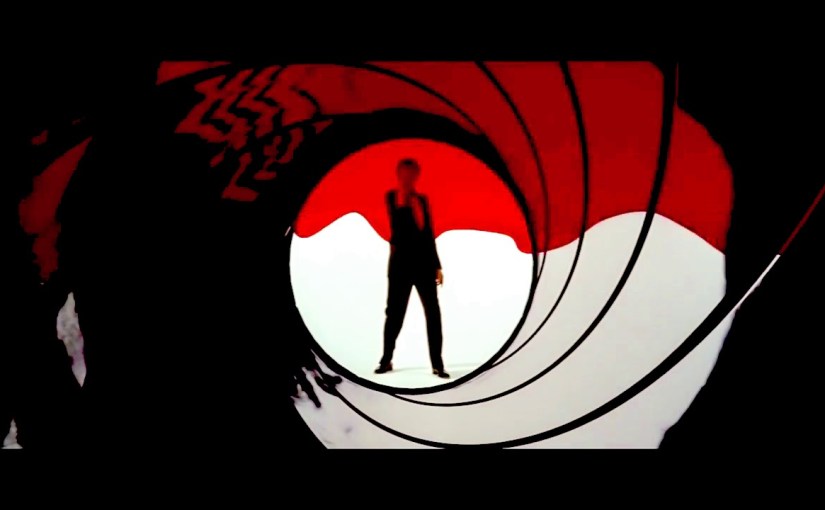
8) Another Way To Die (Quantum Of Solace) – While not a huge fan of the film, that does a poor job of hiding its flaws in story and construction, I cannot deny the single from Jack White and Alicia Keys.  White offers guitar riffs that sound dangerous and scary, like a fast-racing motorcycle equipped with machine guns firing at you.  When his vocals duet with Keys, the harmonies sound sexy and alluring like Bond would be with any of the women he meets, capable of seduction or maybe betrayal.  “A Bomb On The Table/A Woman Walking By/A Drop In The Water/A Look In Her Eye.”  These lyrics really don’t describe what is seen in the film, but they lend to the spy with a license to kill because of what he too often encounters on any of his missions.  The lyrics are chilling.  The music is treacherous; much like when Bond ritually walks into the center of the gun barrel pointing right at him at the beginning of most of the films in the series.  This song promised a better movie than we got from Quantum Of Solace.

7) Writing Is On The Wall (Spectre) – I thought all five songs from Daniel Craig’s time with the series were entirely fitting to the collective storyline of his interpretation with the character.  Spectre is a very personal film for Bond, as it reinvents the relationship he has with well-known arch villain, Ernst Stavro Blofeld.  Sam Smith has such a silky vocal to his Oscar winning song which comes off tragic for 007 as he has no choice but to revisit his past in order to accomplish his mission.  What does Blofeld mean personally to Bond?  Who will Bond have to meet up with, and what personal risks will he have to take in order to succeed?  Sam Smith’s song implies Bond was not ready for the fall, but the truth had to be met, nonetheless.

6) The Man With The Golden Gun (The Man With The Golden Gun) – I’m sorry but this film does not get enough recognition.  Neither does the song.  The theme is as devilishly entertaining as the title character’s fun house that pits James Bond in a climactic dual against Scaramenga played with wonderful glee by Christopher Lee.  While Lulu may be doing an obvious imitation of Shirley Bassey, I can’t deny the song’s recognizable musical tones from John Barry as the singer belts out how “No Hit Man Can Match Him” and “He’ll Shoot Anyone/With His Golden Gunnnnnnnn.”  With a song like this over the opening credits that follow after the character’s maniacal introduction in the opening scene, I have just been promised that 007 will come face to face with one of the most dangerous killers in the world, and it may in fact spell the end of James Bond.

5) Skyfall (Skyfall) – Daniel Craig’s films go for dramatic zeniths.  The film Skyfall certainly leaves you breathless on multiple occasions with the first time happening at the climax of the pre credit scene.  Bond has been shot, he falls from a great height and he’s presumed dead.  That hardly ever happens to 007.  Jump to the end of the film, and a personal loss occurs.  Adele’s Oscar winning song begins with a frightening declaration that “This Is The End/Hold Your Breath And Count To Ten.”  She is practically speaking to Bond himself of what’s to come from this point now that the world thinks you’re dead. Adele takes you on a narration easing you into the drama you’re about see over the next two hours. The tongue and cheek humor found especially in the days of Roger Moore may be long gone, but Craig’s interpretation of Ian Fleming’s “blunt instrument” is thankfully more serious and personal.  This is another perfect example that you will get your thrills from the super spy.  He’s just not as fancy free as he used to be, because the villains make it all the more personal.

4) No Time To Die (No Time To Die) – It may be the one song in the list that sums up James Bond’s relationship with a lover. That would be holdover, Madeliene Swann, from the prior film, Spectre.  Madeliene is the daughter of a former enemy of Bond that he just happens to fall in love with.  Billie Eilish hauntingly sings from the consciousness of 007.  “Fool Me Once/Fool Me Twice…You’ll Never See Me Cry/There’s Just No Time To Die.”  Early on, Bond has reason to suspect Madeliene has betrayed him, and he will not let it happen again because his career and mission and endgame is simply never to die by anyone else’s hand but his own.  Eilish’s song is a perfect wrap up to Daniel Craig’s characterization.  His 007 finds it hard to ever live peacefully and he will always have to keep his guard up.  If he will surrender to defeat, it is only going to be under his terms.  Madeliene, nor Blofeld, or anyone else will ever get the best of him.

3) Goldfinger (Goldfinger) – Shirley Bassey’s first of three contributions (so far) to the sixty-year-old series is her best.  She’s not singing about 007 though.  She’s celebrating one of the most memorable villains that Bond ever faced.  Auric Goldfinger is serious about his love for all things gold.  “He’s The Man/The Man With The Midas Touch.”  Wait for it, because there’s more.  “A Spider’s Touch.”  Deadly!  The fun thing about Goldfinger is that he kills just about anyone he encounters.  He’ll make his point with 007 that he’s not be trifled by suffocating his one-night stand and covering her entire body in paint, gold paint.  He happily lays down his plan for robbing Fort Knox of its entire gold supply to a bunch of hoodlum investors, but then moments later he gasses them all to death anyway.  This guy of immense wealth is proud of all he possesses and what he is capable of.  Rather than shoot Bond while he’s tied down to a table, Auric Goldfinger has the expectation of him to die by severing the spy in half with a laser beam beginning right at the “weapon” Bond carries everywhere between his thighs.  Shirley Bassey might have sung multiple times for the superspy, but in Goldfinger she’s sings from the sidelines of James Bond’s bad guy with unlimited resources.  Shirley practically implies that maybe you better sit this one out, James.

2) You Know My Name (Casino Royale) – Even if you reinvent the character, we are still going to know who you’re talking about.  Bond, James Bond.  In the opening moments of Daniel Craig’s first film, we get an overview of what constitutes Bond as an exclusive “Double O” agent for Her Majesty’s Secret Service.  Then Chris Cornell offers a hard-edged rock interpretation of what it takes to live dangerously, where agents like Bond are not expected to carry a long-life span.  We might be meeting 007 for the first time all over again, but we certainly know the man with the license to kill.  However, do we know what it means to behave like him? “Arm Yourself Because No One Else Here Will Save You/The Odds Will Betray You And I Will Replace You/You Can’t Deny The Prize It May Never Fulfill You/It Longs To Kill You, Are You Willing To Die?/The Coldest Blood Runs Through My Veins/You Know My Name.”  To be the kind of killer who does not dwell on the carnage a man leaves behind requires lyrics like this.  James Bond has to be cold like that with no time to reflect on who he dispatches in the name of Queen and Country.

1) Nobody Does It Better (The Spy Who Loved Me) – Carly Simon’s song, orchestrated by Marvin Hamlisch, arrives at just the right moment in the film.  Bond has outrun KGB agents on skis.  Yet, he’s running out of snow to escape on.  A dangerous cliff is ahead.  When I first saw The Spy Who Loved Me, my five-year-old self wondered how he would ever get out of this scenario alive.  He leaps off the mountain into the great wide open, his skis fly off his boots and Bond is left to endlessly fall…that is until his parachute bearing the Union Jack appears and his recognizable theme song kicks in.  Then Carly Simon reminds us that “Nobody Does It Better/Makes Me Sad For The Rest/Nobody Does It Half As Good As You/Baby You’re The Best.”  Can’t disagree with you Carly.  Simon and Hamlisch are playful with this crooning number, and just as mischievous as Roger Moore approached the super spy. Regardless, it never negates any of the various interpretations that 007 has offered through the years.  In sixty years, nobody has been better at the spy game than James Bond.  It’s not even a matter of opinion anymore.  James Bond is the best.

What did you think?  Am I far off from what you believe are the best Bond numbers, or did I at least get it mostly right.  Share your thoughts in the comments.  It’ll be “For (Our) Eyes Only.”

PRIMAL FEAR

By Marc S. Sanders

If you explore the career of Edward Norton, you may find a common theme of duality in many of his roles.  Certainly, The Incredible Hulk (man vs literal green monster).  There’s also the heist film The Score where he is an aspiring thief with a talent to take on a mentally handicapped persona.  American History X offered a wide transition from downright evil to wholesome redemption from the worst of sin.  Even the remake of The Italian Job shows one kind of jerky guy early on, and later there’s another kind of cad on display.  Yet, Norton’s role as a church choir boy named Aaron Stampler in his first film, Primal Fear, is maybe his most apparent, and it remains an astonishing performance.

I had read William Diehl’s novel long before the movie was even made.  My impression of the film is that it is well cast.  Early on in the story, Aaron is apprehended following the grisly murder of Chicago’s Archbishop.  His clothes are covered in the priest’s blood and he’s captured on the news trying to outrun the police.  This looks like an open and shut case, which is why hot shot attorney Martin Vail (Richard Gere) wants to take on defending Aaron, pro bono. 

Simply the name of Gere’s role, Martin Vail, could not be more appropriate.  He thrives on vanity and pride, ensuring that when he gives an interview it is none other than a cover story.  Gere is perfectly handsome and his energy is so right for the part.  He wears his suits with natural and self-assured swagger.  When Martin attends a benefit dinner in the first few minutes of the picture, everyone in the room knows who he is, whether they only at least admire the guy, or downright despise the ego he proudly carries.  Only Martin Vail will insist that young Aaron with a boy scout, puppy dog expression could be innocent.  Everyone else has deemed his client as “The Butcher Boy.”

The accused is a simple kid who was brought in off the streets by the Archbishop.  He’s a nobody.  It’s the victim who is prominent, and one of the first strategies that Vail engages in is putting the deceased Archbishop on trial because it could lend to just what he needs for exoneration – reasonable doubt.  That could mean other prominent figures in the city will get caught in the web. 

Like many mysteries and courtroom dramas before and after Primal Fear, red herrings abound.  The side stories dealing with botched real estate investments within minority neighborhoods feel like they sprung from a completely different cloth, like an episode of L.A. Law.  What keeps them above water though are the performances of the supporting cast with John Mahoney and Stuart Bauer, respectively portraying the state district attorney and a Hispanic well-established mobster that Vail represents.  Somehow, Diehl’s murder trial story circles back to these guys and what the Archbishop had to do with them.

A twisted sex scandal within the church also comes into play.  After all, where there’s murder there is motive.  The math is not that simple though.

To lend a little more conflict to the film is the prosecuting attorney Janet Venable.  She is played by Laura Linney, maybe doing a little over acting, who once had a tryst with Martin.  Honestly, it comes off as an unnecessary subplot, perhaps only there to give quick witted resentful dialogue for Janet to serve at Martin, while Gere puts on the teasing smirk to send back over the net.  The opposing counsel try to psych one another out, but we all know that Martin is the smarter attorney of the two. 

Primal Fear hinges on Edward Norton first and Richard Gere second.  Norton’s performance is written, and thereby performed, to come in under the radar for the first half of the film.  Aaron is a quiet, frightened, uncertain kid from the backwoods of Kentucky.  Gere and the supporting cast populate much of the first half of the movie.  Later, Aaron offers up a surprise delivery that turns the film on its heel, and the story takes on a whole new trajectory. 

Gere is superb with the conceit of the character.  Director Gregory Hoblit places Martin Vail front and center during transition shots where he gives statements to the press while entering the courthouse.  It’s a subtly effective way to uphold how proud and cocky the attorney is.  When the surprise from Norton comes around though, even a hot shot, intuitive lawyer like Martin can’t immediately figure out what to do next.  The surprise works even though it comes out of nowhere.

Primal Fear offers a lot of standard stuff from other typical courtroom thrillers.  Some players are introduced that could lend to why the crime occurred.  Some are there to distract you.  Some are there to circle back around in the third act.  There’s a ping pong volley of objections and witness testimony.  There’s the blood splattered crime scene investigation.  We’ve seen it all before.  Nevertheless, I don’t hold any of that against the film.  I still get a thrill out of standard car chases and shootouts the same way I stay alert through another courtroom mystery.  It’s fast paced and until the puzzle is completely assembled, I’m engaged especially if the cast is working on all cylinders. 

The end leaves you thinking though because just when you believe all the pieces have been put back into place there’s one hanging thread that is left unraveled and you may be asking yourself how that got past me.  That’s when you know you are watching an entertaining movie.  If you have to think about it long after it is over, then the movie got one over on you.  Primal Fear accomplishes that feat.

SIX DEGREES OF SEPARATION

By Marc S. Sanders

John Guare adapted his celebrated Broadway play Six Degrees Of Separation into a screenplay directed by Fred Schepisi.  Having never seen a stage production of the show, I can still see how well it would work in live theater.  It’s a talking piece with colorful dialogue and fast paced monologues revealing the true nature of people whether they are telling the truth, exaggerating, or simply being lied to.  Can a piece of writing succeed at showing the phoniness of people while at the same time displaying the authentic nature of a con man and a liar? 

In a very early career performance, Will Smith plays a young man named Paul.  One night, he stumbles upon the Park Avenue apartment of Ouisa and Flan Kitteridge (Stockard Channing, Donald Sutherland), wealthy art dealers ready to make a multi-million-dollar deal with a South African guest, named Geoffrey (Ian McKellan).  Paul is a handsome black man in a navy blazer and college tie, with a knife wound in his side.  He has just been mugged while on his way to pay the Kitteridges a surprise visit.  They welcome him inside, clean his injury and loan him a freshly clean pink dress shirt from their son’s closet. 

Talking and interaction take effect.  Paul describes how he intimately knows the couple’s children away at college.  He segues into an insightful literary evaluation of Holden Caulfied from Catcher In The Rye, and he eventually makes his way into the kitchen where he impresses the high society people with his exquisite dinner preparation and his immense background of being the son of celebrated actor Sidney Poitier. 

By the end of the evening, Geoffrey is ready to sign the deal and the Kitteridges are over the moon with the dumbfound luck of meeting this young man, who is now going to arrange for them to be extras in the film adaptation of the musical Cats, soon to be directed by Sidney, himself.  It’s all too good to be true.  The next morning, after insisting that Paul stay over for the night, surprises abound and perhaps Ouisa and Flan don’t know everything they should have known about Paul.

The couple meets up for lunch with Larkin and Kitty, another high society couple (Bruce Dern, Mary Beth Hurt) who can’t wait to share an unbelievable story with them.  Only their anecdote is eerily similar to the experience they had with Paul.  Could these people have been duped?  The only option is to go to the police, and yet was there really a crime ever committed?  Fifty dollars was leant to Paul to get back to school, and he made off with the pink shirt, but that’s it.  All of their prized artwork and collectibles remained.  No one was physically harmed.  Nothing was stolen.  Still, the four people are insistent on uncovering the mystery of this man. 

Ouisa, Flan, Larkin and Kitty eventually catch up with their children to see how they had come to meet Paul.  The kids have no idea what their parents are talking about and are downright resentful of mom and dad.  Ouisa and Flan’s son (Jeff Abrams, as in eventual director JJ Abrams) is especially hurt they gave Paul his pink dress shirt.  The horror!  Their daughter describes them as ignorant and uncaring simply because of their wealth.

While I can’t describe the structure of the play, Schpisi’s film does a back and forth of Ouisa and Flan gleefully telling their tall tale to anyone who will listen.  While guests at a wedding reception, the crowd of listeners seem to grow around the pair, eventually to the point that the bride and groom are even listening.  Their story spreads at a funeral and dinner parties and on and on.

Later, a young couple (Heather Graham, Erik Thal) enter the frame to share their encounter with Paul after meeting him in Central Park.  Their tale is not as similar as the others, but there is enough to determine that they met the same “Paul” in their experience.

Paul’s existence seems to grow and grow, but not necessarily because of Paul.  Rather, it is because of how widespread his various intrusions become.  While making efforts to pursue the mystery, Ouisa and Flan get interviewed for the paper.  Even more people within New York City (revered for having eight million stories) reveal their own encounters. More people, especially their peers, become even more fascinated by the outrageous anecdote, and it becomes the centerpiece of dinner conversations and social gatherings.  People can’t get enough of the night Ouisa and Flan met Paul and what happened afterwards.

Guare’s script is focused not so much on dimension and character change, as it is in demonstrating what can happen when one story blossoms into a multitude of others.  The title follows the idea that every person on the planet can somehow be connected within six different people of one another.  What I took from the film is how inauthentic the ones who were duped actually are.  Flan wants nothing ever more to do with Paul, repeatedly declaring a fear that he may come back and “slash their throats.” Yet, he can’t resist sharing the story and what happened after that and then after that.  Ouisa follows along, until perhaps the end of the picture.

Stockard Channing plays the most dynamic of all the characters thanks to moments offered in the script where Ouisa begins to contemplate how fascinating it is how many people have come in contact with Paul and thus lending credence to the film’s title.  A memorable monologue towards the end earned her Oscar nomination for the film. 

Will Smith is the con man at the center of the script.  It’s an extraordinary performance and it’s an insightful character as well.  Paul is a con man.  That is the one sure thing that viewers assuredly walk away with from the movie.  It may be the only genuine fact in the film.  The people he seduces are eventually revealed to be fake for the sake of laying impressions upon their peers or for exacting aggravation, as the spoiled college age children seem to do.  Nothing that Ouisa, Flan, Larkin, Kitty or any of their high society friends and children come off with genuine affection and care for one another.  Their tales are told simply to impress and uphold relevance.  Only as the credits roll, does Ouisa perhaps have a revelation of how she behaves with her friends, and her children, particularly when in company with her husband, Flan.

Film Critic Roger Ebert didn’t care for this film as he asked what are we supposed to gain from this picture; that everyone in the world is a phony?  Maybe so.  The irony for me however, is that Paul is nothing but a con.  He never deviates from that pattern during the course of the picture all the way to his final scene when he’s alone on the street speaking with Ouisa on a pay phone. He still insists on being Paul Poitier, son of Sidney.  Therefore, let’s at least admire Paul’s consistent behavior of lying, while turning our backs as we realize how artificial the well to do folks really are.  Irony is thought provoking, and I think John Guare’s script at least succeeds in that respect. 

INDIANA JONES AND THE KINGDOM OF THE CRYSTAL SKULL

By Marc S. Sanders

Indiana Jones And The Kingdom Of The Crystal Skull succeeds on so many levels of storytelling and construction. It stays true to form of its title character protagonist. Indy is not only a hero. He’s also a traveler of history. The film takes place in the year 1957, and director Steven Spielberg delivers visuals that reiterate the time, when the Cold War was on the horizon, and Nazi Germany was behind us. It’s time for the Russians to step up as the big bad.

David Koepp’s script really is quite brilliant as it never loses sight of the times with references to McCarthyism, communist red scare, and flying saucers and aliens directly inspired by the B movie serials of the decade. Even Shia LeBeouf portraying a sidekick to Indy is a model of Marlon Brando from The Wild One.

I’ve mentioned before how simply the silhouette of the famed archeologist with his fedora hat and bullwhip is as recognizable as Batman or Darth Vader or James Bond. Here, Spielberg uses the visual motif against a mushroom cloud of a nuclear bomb test site, and later against a flying saucer. As noted earlier, Dr. Jones moves with time; truly living up to his famous phrase, “It’s not the years honey. It’s the mileage.”

Harrison Ford maintains the character quite well, still skeptical of what is not literal. He’s not prepared to believe in higher powers until he sees it for himself. Ford conveys Koepp’s interpretation very well.

It’s refreshing that he is paired up again with Karen Allen as Marion Ravenwood (from Raiders), the best of Indy’s female companions. Their sparring remains natural. Allen folds back into her role quite comfortably.

Stalin’s top underling is dispatched with recovering a legendary Crystal Skull and revealing it’s true power. Master character actor Cate Blanchett makes for a great Russian bob haircut villain, with uniform physique. She’s smart but she’s got every fighting skill known to pose great threat.

An infamous scene involves Indy sheltering himself in a refrigerator to survive a nuclear blast. Majority despise this scene. The phrase “Nuke The Fridge” became almost as iconic as “Jump The Shark,” simply for the audacity of its imagination. After having witnessed the near-death escapes of his past adventures (parachuting from a plane in an inflatable raft, sliding under a speeding truck, becoming “a penitent man” to cross a cavern), what is so wrong with this moment? Heck, Spielberg knows it’s crazy which is why he offers a close up indicating the fridge is “lead lined.” The scene works because it holds true to Indiana Jones’ series of absurd survival.

Besides all of the periodic references, the set design of Kingdom… is spectacular. Looking at the final act of the film, we are treated to a column that opens itself up with ingenuity as sand must pour out of the column in order for the structure to open with a receding downward staircase. Then, there’s a beautiful open sesame moment before entering a circular throne room.

Another earlier moment stages a hidden chamber that is revealed on a large, stone, tilted disc. All of this collectively speaking is truly one of the best set pieces in all four of the Indy films.

A delightfully fun car/motorcycle chase on Indy’s college campus is great as well as there is jumping from bike to car and back to on to the bike before swerving into the library. The scenic background design has to be admired for showing protest signs to Communism on campus. The film never loses sight of where its story is set. Detractors of this film fail to recognize any of this.

Fans also took issue with LeBeouf. Not me. He’s got an adventurous fun side to him. The smart aleck way of Ford’s younger years, but not the same character background. He has fun with swinging from vines and sword fights, in the same vein of a mine car chase from a prior installment.

The story is moved by clues and maps and deciphering a welcome John Hurt who speaks in a gibberish of riddles that stem from a brainwash his character experiences. This is all good for a great pursuit. Nothing is easily revealed. Mayan writing needs to be interpreted; maps need to be read. Stories of legend need to be told. Indy needs to apply his professional knowledge to move forward through the Amazon to his final destination.

I’d argue that Indiana Jones And The Kingdom Of The Crystal Skull is one of the most misunderstood and divisive films of all time. People gave up on it too easily, I think. They reserved their approval because of either a ridiculous title (a great B movie title), or LeBeouf’s casting, or Ford’s age, or vine swinging and big ass red ants (a great monster horror scene by the way). I say those folks just didn’t get it and failed to recognize where all of this stemmed from. David Koepp, George Lucas and Steven Spielberg were very aware of what to present. If I were them, I wouldn’t have changed a thing.

Again, it’s not the years. It’s the mileage.

SAVING PRIVATE RYAN

By Marc S. Sanders

How much blood needs to be spilled to change the color of an ocean red?  The battle of Normandy during World War II showed quite a bit, and Steven Spielberg more than convincingly duplicates that terrible episode in world history with his war picture Saving Private Ryan

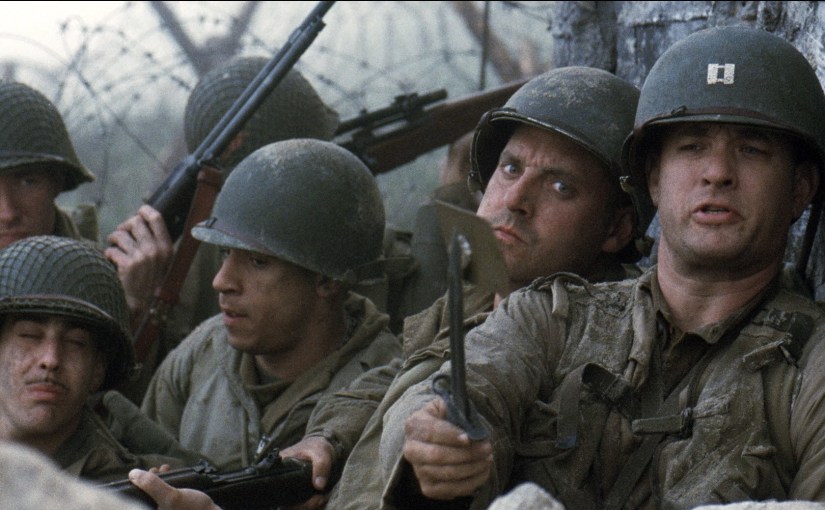
Spielberg earned his second Oscar for direction with this film from 1998.  It’s not only a technical marvel, but it’s a story that tests the nature of humanity when a squad of American soldiers ask themselves if saving the life of one man is worth sacrificing themselves.  Tom Hanks leads the team of recruits.

Saving Private Ryan begins on June 6, 1944 when thousands of American soldiers were inevitable sitting ducks as they washed ashore on Normandy Beach to engage in battle with German forces.  Spielberg’s footage is astonishing.  First of note is the cinematography is wisely washed out of color.  The sky is grey.  The ocean water and sand feel frigidly cold.  The most dominant color is blood red.  The fear displayed on the thousands of extras portraying soldiers, who never look mentally ready for battle, is palpable. 

The shots in this roughly thirty-minute opening do not compromise.  A soldier is seen walking around looking for his arm that has been shredded from below his elbow.  Other soldiers will turn over one way out of camera, but when they roll back into frame there’s a smoking hole where their face used to be.  Deadly head shots come out of nowhere.  Army medics have their hands soaked in bright red blood while trying to use scissors and thread to sew up wounds caked in wet sand. 

The action slows down at one point to focus on Hanks.  We haven’t even gotten to know his character yet, but we realize he is exhausted of this violence.  His hearing seems to deafen for a moment while he watches the horror quickly unfold as he puts his helmet back on only to have blood-stained water shower down over his head.  War is not meant for heroics and glamorization.  War only serves chaos and brutal death. 

Following this incredible opening sequence, one of the most impressive ever to start a film, Captain John Miller (Hanks) receives orders to locate the titled character, a paratrooper named Private James Francis Ryan (Matt Damon).  The army insists on sending the young private home to his grief-stricken mother, who has recently lost her other three sons in the conflict.  So, Miller recruits a handful of men consisting of fantastic actors like Tom Sizemore, Edward Burns, Vin Diesel, Adam Goldberg, Barry Pepper, Giovanni Ribisi and Jeremy Davies to make the trek across war torn Europe and rescue Private Ryan before he perishes as well.  How is that really fair though?

Any one of these men are sons to a worried mother back home.  The script for Saving Private Ryan by Robert Rodat has the men question why should they risk their own lives to find this one kid?  What makes him more special than any one of them?  Is the United States Army being fair?  Are they using this special mission as a means of propaganda?  Questions like this are irrelevant to the war department.  Just get him the hell out of there.

The journey of Miller’s squad is not just a simple hike.  At any given moment, they will come across a bombed-out town or another regimen who has just experienced their own kind of hell.  Further questions are asked when Miller recognizes an opportunity to take out an enemy battalion.  His own men suggest circumventing around this potential battle.  Miller won’t hear of it.  He’s a soldier.  Yet, after it is done, there is loss of life.  Should he have listened to their warnings or was he right to engage the enemy to avoid another team of allies suffering a terrible fate? 

Other dilemmas also come into play.  Should they escort a family and their young children who have lost their home?  The brutal dialogue of the script says that’s not their job.  Their goal is to take out the enemy and eventually rescue this one man.  Should an unarmed German prisoner be forced to dig his own grave and later be executed for the atrocities he’s committed?

War tests the ultimate limits of man.  What has to be done to allow us to finally, ultimately and justifiably shed ourselves of our humanity?  A correct answer is never provided in Saving Private Ryan.

Amid a series of astonishing battle scenes and images, two parts of the film stand out for me.  Following the loss of one of their comrades, there is disorder within the ranks.  This is where Tom Hanks takes control of a chaotic scene.  John Miller knows his soldiers have placed bets on what he does for a living back home.  Considering the strategist that Miller shows himself to be, its quite startling to find out what his occupation is.  It’s so surprising that Hanks as Miller uses it to temper his men which segues nicely into why Miller honors the mission assigned to him, even if it means risking his own life.  It’s not the best answer to why one man is more valuable than any other, but it’s the only one we are going to get. 

An even more powerful image comes to mind in the third act.  Jeremy Davies plays a Corporal assigned to the team to be a German and French interpreter.  He’s a soldier in this war, but he’s the last one you would want in combat.  As the American forces await the inevitable arrival of a German tank and a large number of troops to arrive, the men assign Davies to hold on to the long chains of ammunition and artillery.  He is draped in bullets around his neck and shoulders.  As the battle engages, shots are fired in all directions, men are quickly dispatched and Spielberg wisely has his cameras follow a helpless, weeping Davies do nothing but run from one end of the street to the other and up the stairs of a blown-out building.  He has all of the power in the world but he lacks the muster to kill and destroy which is what the nature of war demands.  He can even hear a man slowly die by stabbing in the floor above him. Yet, the Corporal can’t even rush to rescue his friend, and slaughter the enemy.  War destroys, but it also paralyzes man to act beyond an intrinsic nature of peace.  Each time I watch this scene, I can’t get past what this poor young man is truly capable of while being utterly helpless at the same time. 

I found Spielbergian techniques in Saving Private Ryan that hearken back to other celebrated moments in his film repertoire.  Tom Sizemore engages an enemy, only for both of them to run out of ammunition.  So, they wind up clumsily throwing their helmets at each other.  Indiana Jones might have done something like this for the sake of some form of slapstick.  Spielberg applies desperation to this scenario however.

The German tank at the center of the third act is somewhat reminiscent of the shark from Jaws.  Before we get an opportunity to see it, a focused Barry Pepper in a sniper’s bird’s nest gives a visual description of how big it really is and what accompanies it.  Later, Miller and Ryan have taken cover in a trench of rubble only to be overtaken by this beast as it careens over them.  The mouth of its cannon seems to come alive just before it blasts out a tower.  It’s just as scary and shocking as even Spielberg’s pictures of fantasy and adventure came before the release of this picture.  Every shot Steven Spielberg provides in any one of his films build towards an intrinsic and organic response from his viewers.  He always works with that goal in mind.  The tank is the tool used here.

The art direction is fascinating in this film as well.  A knocked over chair is picked up before a soldier stands it up as sturdy as he can on top of splintered wood and crumbled stone.  Sand on the beach is blasted up and out, sometimes splattering the lens of the camera.  Ocean water too.  Pockets of afterburn flames will be seen in the distance of a war-torn area.  The tangibility of these set pieces works cohesively with the distressed colors of a weathered and battle-stricken Europe. 

As chaotic as Spielberg demonstrates war to be, the editing is also commendable.  A war movie like this is not an action picture for the sake of escapism.  We don’t need to see the gun that fired the bullet that pierces the skull of a person.  We just need to see the person get a bullet that penetrates his helmet only to blow his head off to understand the unforgiving nature of war.  A man might be dialing up headquarters requesting air support, but he suddenly will not finish the conversation.  Editing allows the unexpected to become all too common in the midst of battle.

Saving Private Ryan is one of the best films ever directed by Steven Spielberg.  He had already shown real brutality not embedded in fantasy with films like The Color Purple, Empire Of The Sun and especially Schindler’s List.  Yet, with this picture, small factions of men, seeking world conquest, might have started this terrible conflict, but the movie does not concern itself with those instigators.  Instead, we witness the pawns at the disposal of war.  We see the collateral damage that suffer and die at the hands of unseen powers that be.  With Robert Rodat’s script, Steven Spielberg questions the value of one man versus a collection of men, and how any man, who may physically endure this terrible period in time, can also mentally survive long after it is all over.