SAINT MAUD (2019, United Kingdom)

by Miguel E. Rodriguez

Director: Rose Glass
Cast: Morfydd Clark, Jennifer Ehle, Lily Frazer
My Rating: 8/10
Rotten Tomatometer: 93% Certified Fresh

PLOT: A pious nurse becomes dangerously obsessed with saving the soul of her dying patient.


This is a review where the less I say about the plot, the better, so this will be a short one.

What happens when a horror movie that’s 84 minutes long is virtually all build-up to a shocking payoff in the last 10 minutes?  You divide audiences and critics, that’s what happens.  The handy-dandy Rotten Tomatoes website gives Saint Maud a hefty 93% critics score…but manages a substandard 65% from audiences.

I get it.  This film is an exercise in tone and mood.  In a word, it’s unsettling.  Look at it in hindsight and not much happens.  But this is one of those films where the destination isn’t really the point…it’s the journey.

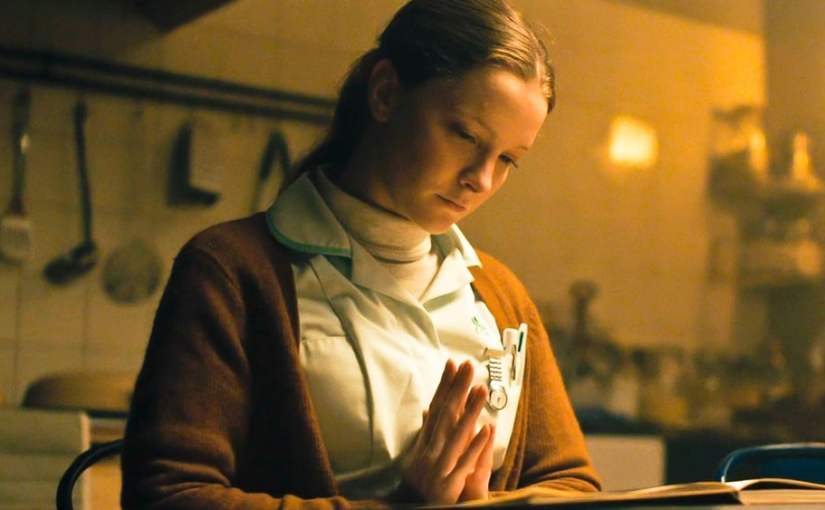
Maud (Morfydd Clark) is a private nurse to a terminal cancer victim, Amanda (Jennifer Ehle), who used to be a famous choreographer until she fell ill in her prime.  Maud seems timid and competent, but she is a recent convert to Catholicism and has taken its teachings perhaps a little too much to heart.  For example, when she prays in front of her makeshift altar at home to pray, she sprinkles unpopped popcorn kernels in front of her before she kneels.  This is based on fact: there is an outdated practice called Corporal Mortification where devout Christians would inflict self-harm while praying.  The sight of her knees settling on those kernels made me wince.  And I won’t even mention what she does to the insoles of her shoes.  She also experiences sporadic moments of religious ecstasy (what the filmmakers refer to as “Godgasms”, though that term is never mentioned in the film).  These mini-epiphanies have a disturbing tendency to end just as Maud’s face seems to stretch beyond any human capability.  Creepy.

(A brief prologue also insinuates that something horrific may have happened in Maud’s previous posting, but it’s left mostly in the background.  Mostly.)

Maud is taken with Amanda, perhaps physically, but mostly with the idea that she can help save Amanda’s soul.  Staring death in the face, Amanda has little time for religion, but she humors Maud’s prayers before meals and even seems to experience a tiny bit of religious ecstasy along with Maud.  But beneath everything is this undercurrent of dread or foreboding.  Director Rose Glass is an expert at framing simple scenes in a way that conveys much more than what is visible to the eye.  Lights flicker.  There are subtle focus racks reminiscent of Vertigo.  Occasional voiceovers give a glimpse into Maud’s mind about her faith in God and her doubts.

I could say more about the plot, but I think that would detract from the experience of watching the film.  The tension and suspense leading up to the film’s climactic outburst are expertly sustained.  …and that one single cockroach is creeeepy…

No doubt some viewers will walk away from Saint Maud feeling the same way the Rotten Tomatoes voters felt.  I can’t think of anything that might change your mind if that’s the case.  This movie is a master class in generating a suspenseful atmosphere on a budget.  There are some obvious visual effects, but they are used sparingly and effectively.  There are stretches where we are led to believe, due to years of conditioning from previous films, that something super scary is about to happen…and then it doesn’t.  This happens a lot.  But I don’t think that’s a bad thing.  When done right, suspense in a film is a welcome experience.  To have a film where the entire movie is constructed out of suspense is a minor miracle.

Watch this one with the lights out and the doors unlocked.  I double-dog dare you.
LIGHTYEAR

By Marc S. Sanders

It’s kind of neat to see the evolution of a classic film character when you are a fully aware adult.  In 1995, I had no idea what the term Pixar meant, or knew the impact it would have with the Disney brand as a whole or on the cinematic landscape.  Pixar is now as pioneering as Skywalker Sound or Industrial Light and Magic.  There’s Pixar, and then there’s everything else.  Back in ’95, I was age 23, and my intuition never perked up that I was watching a touchstone character like Buzz Lightyear who would become as grand today as Batman and Elvis turned out to be in an ever-changing pop culture lexicon. Buzz Lightyear is by far one of the company’s most inventive creations.

Jump to nearly thirty years later, with four Toy Story adventures, and endless amounts of merchandising the Space Ranger has been primed for a more personal adventure beyond the imagination of a young child possessing an action figure in his playroom.  Lightyear tells of the adventure that leant to merchandising of the toy depicted in the Toy Story fictional world.  (Try not to think too hardly on that description.)

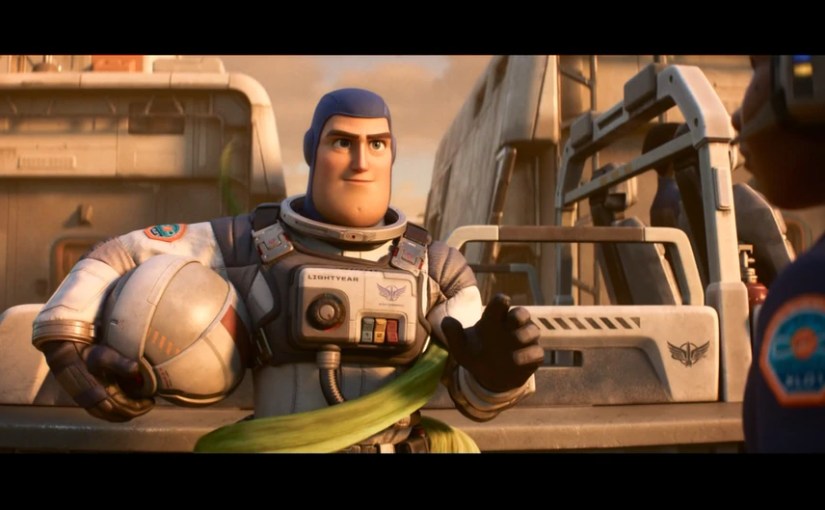
Buzz Lightyear (Chris Evans) is the eminent Space Ranger of Star Command, out to explore strange new worlds and seek out new life and– STOP! That’s another franchise.  When Captain Lightyear comes upon an unchartered planet, complications in unexpected science fiction adventure ensue.  Buzz and the small colony living on his global spaceship are marooned on this planet with no immediate solution for getting off and returning to Earth, 4.2 billion light years away.  Buzz makes it his mission to uncover a new kind of resource fuel that will eventually help the colony make its eventual return home.  Yet, with each experimental try, the minutes he spends in his super speed orbits around the planet equate to years for the colony who have set up habitation below.  His comrades on the ground below continue to age while Buzz does not.

I needed help with this picture.  My wife had to explain the staple lesson that usually comes with each Pixar film that I just didn’t catch while watching Lightyear.  I don’t think I’m spoiling anything, but the film reminds us to accept the hand dealt to us and appreciate what has come even if we never expected or planned on the circumstances in the first place.  It’s a good lesson.  I guess I just wish Lightyear made it a little clearer.  There’s a lot of mud on the windshield that I needed to wipe away before I realized what the message was about.

Maybe I was not fair with this film.  Tim Allen was not invited back to lend his recognizable voiceover to the character.  I guess Pixar is insistent that he’s reserved only for the toy version of the character.  Chris Evans is fine, mind you, and he doesn’t overdo it.  Yet, I could not help but think Tim Allen would have been just as capable and even more entitled to voice the role yet again.

Perhaps I was thinking that if Pixar wanted to go in another animated direction with the character, it just seemed completely fruitless.  How different could Lightyear be from the Toy Story films if the animated design is pretty similar in every frame?  Honestly, it doesn’t look like a new kind of device.  So that was a problem for me, as well.  It wasn’t inventive enough.  Maybe it’s time for a live action version of the space traveler.  Imagine Chris Evans wearing a live action and tactile version of the famous astronaut costume with the colorful buttons.  I still say that could work, and it’s what Disney/Pixar should have considered.

Maybe I’m getting bored with the time travel motif.  Isn’t everyone doing that these days?  Doesn’t it also seem like all our heroes are meeting their future selves and struggling to understand their current predicament?  Lightyear hinges on these story developments, and when the moments arrive my eyes rolled in the back of my head.  Time travel stories are very tricky for me to appreciate.  Often, the narrative paints itself into a corner, unable to explain itself back correctly.  Only two films that come to mind have worked their way out of it almost seamlessly – Back To The Future and 12 Monkeys.

So, while I love the lesson that Lightyear offers, the standard carbon copy plot outline left me unfocused at times.

The voiceover cast is well done with Keke Palmer, Taika Waititi and James Brolin.  The animation is gorgeous, most especially when Buzz is piloting his super jet around the planet’s sun. The atmosphere of the planet is fun when it becomes a nuisance with giant flying insects and vines that come alive to entangle the characters at any given moment.

Science Fiction can go to infinity and beyond with the directions it can take.  There is absolutely no limit.  With today’s technology in filmmaking and the endless resources that Disney provides, why didn’t the filmmakers try a little harder with Lightyear? Again, a live action interpretation would have allowed it to stand apart from the character’s prior Toy adventures, and some different avenues in space exploration would have opened a leaner and more entertaining story.  If Star Trek can do it, Lightyear can do it too.

I think Pixar tried to go the route of Christopher Nolan, by way of Interstellar.  However, Lightyear is designed for people of all ages where the brain of the show is in reminding us how to carry ourselves through life, and not to uncover the twists that a brilliant filmmaker like Nolan has become recognized for.  I didn’t want to resolve a puzzle in fictional science.  Lightyear is trying too hard to be to be brainy and thus we get distracted from its “The More You Know” lesson in self-effacement.

SORRY TO BOTHER YOU (2018)

by Miguel E. Rodriguez

Director: Boots Riley
Cast: LaKeith Stanfield, Tessa Thompson, Jermaine Fowler, Omari Hardwick
My Rating: 6/10
Rotten Tomatometer: 93% Certified Fresh

PLOT: In an alternate present-day version of Oakland, telemarketer Cassius Green discovers a magical key to professional success, propelling him into a universe of greed.


[Author’s Note: In my mind, it’s virtually impossible to discuss Sorry to Bother You without making comparisons to Jordan Peele’s Get Out and Us.  But I will give it the old college try…]


Boots Riley’s directorial debut, Sorry to Bother You, has been described by Riley himself as an absurdist dark comedy combined with magical realism and science fiction.  Talk about your genre mashups.  While other directors have proven this kind of filmmaking is not only possible but profitable (Being John Malkovich [1999], Eternal Sunshine of the Spotless Mind [2004]), Riley’s film feels like he bit off a little more than he could chew.  After it was over, instead of feeling like I had seen something groundbreaking and provocative, I felt like I had just sat through an ambitious student film.  At some point, it lost its way.

Cassius Green (LaKeith Stanfield) is an underachiever with an improbably gorgeous girlfriend named Detroit (Tessa Thompson), a performance artist who specializes in the kind of art that involves water balloons, spent bullet casings, and recitations from The Last Dragon (1985).  All righty, then.  Cassius is hired as a telemarketer at a company where the fact that he falsified his résumé and brought in fake trophies shows initiative.  On his first day on the job, the film shows flashes of promise.  As he makes the calls, his workstation magically drops into the homes of the people he’s calling, a perfect representation of the intrusion these callers make.  After repeated failures, an old-timer named Langston (an underused Danny Glover) gives him a tip: Use your white voice.  “I’m not talking about Will Smith-white.  That’s just proper.”  Now THAT’S funny.

So Cassius starts using a white voice (overdubbed by David Cross) on his calls, and wouldn’t you know it, he becomes the highest-selling telemarketer on the sales floor.  This is not fantasy, as far as I’m concerned.  I recently watched a documentary where a Latino man submitted hundreds of résumés while job hunting with no responses.  In desperation, he changed his name on his résumé from “Jose” to “Joseph.”  Presto…the calls started rolling in.  True story.

Anyway, Cassius gets a promotion and is moved upstairs to be a “Power Caller.”  Meanwhile, the other telemarketers organize and strike for better wages, so Cassius is derided as a scab every time he comes to work.  But then he discovers what he’s actually selling as a Power Caller.  It has something to do with a company called WorryFree, a system whereby workers sign a lifetime contract to live and work in a single communal location with no paychecks.  One of their slogans is, “If you worked here, you’d be home now!”

WorryFree is run by Steve Lift, played by Armie Hammer at his smarmy best.  In the movie’s most pointed satirical moment, Lift invites Cassius to a party where he goads Cassius into rapping for his party guests.  “Come on, you’re from Oakland, I refuse to believe you don’t know how to rap!”  Cassius tries some feeble rhymes, and then he realizes exactly what Lift and his party guests want to hear.  His solution is controversial, provocative, and hilarious.  I won’t spoil it for you…it’s the high point of the film.

Meanwhile, there are other scenes involving the strike, the strikers, an underground movement called Left Eye, a Claymation sequence, horses, and a nearly-naked Detroit wearing a costume that looks inspired by Janet Jackson’s infamous Rolling Stone cover shoot.  It’s all a little haphazard and cluttered and unfocused.

I believe this movie has a point.  I think it comes closest to MAKING its point when it deals specifically with how the telemarketing company and Steve Lift plan to transform their workforce to increase profits, and with how Cassius deals with the conflict between his steadily increasing paychecks and his moral conscience.  But in between those scenes are myriad other plotlines and side notes that were merely distracting rather than world-building.  (For example, did we really need those scenes where Detroit may or may not get involved with another man?  Was it necessary for Steve Lift’s party to devolve into an Eyes Wide Shut situation?  And in the name of M. Night Shyamalan…was that ending really necessary?)

Sorry to Bother You seems to have struck a chord with many viewers.  I am not one of them.  After it was over, I found it impossible not to compare it to other recent films like Get Out, Us, or even BlacKkKlansman.  Those films found their through lines, made their points, AND were also massively entertaining.  Sorry to Bother You feels like it fell short of the finish line with those goals in sight.

THE NAKED CITY (1948)

by Miguel E. Rodriguez

Director: Jules Dassin
Cast: Barry Fitzgerald, Howard Duff, Dorothy Hart, Don Taylor
My Rating: 7/10
Rotten Tomatometer: 85%

PLOT: In almost documentary-like fashion, New York City cops investigate the brutal murder of a young woman.


It’s that narration.

If The Naked City hadn’t included that cockamamie narration, I might have given it a “9” instead of a “7.”  Here is a police procedural ahead of its time, a pre-television-era herald of popular entertainments from Dragnet to Law and Order to CSI.  The story is absorbing and engaging from beginning to end, even if some of the acting is not especially Oscar-worthy.  There are enough twists and turns in the search for a cold-blooded killer – or killers – to keep your attention all the way through.  And over it all, intruding where it’s not wanted, is a Disney-esque narration from the film’s producer, Mark Hellinger, who also produced a superior prison film a year earlier, Brute Force (1947), also directed by Jules Dassin.

Imagine a scene where foot-weary detectives are pounding the streets, making inquiries at jewelry stores, hairdressers, pawnshops, looking for leads.  As we watch the scene progress, we hear the narrator: “Are your feet tired, detective?  Not to worry, only 400 more jewelry shops to go.”

Or another scene where a detective looks wearily through a window at the city laid out below, pondering where to go for the next clue.  Cue the narrator: “There’s your city, Halloran.  Take a good look.  Jean Dexter is dead, and the answer must be somewhere down there…”

I hated the narration in this movie.  It reduced what I was watching to the level of one of those Disney animated shorts where Goofy is playing some kind of sport and the narrator describes the action while Goofy screws it up spectacularly.  Another example, as morning comes to the city: “The city is quiet now, but soon it will be pounding with activity.  This time yesterday, Jean Dexter was just another pretty girl, but now she’s the marmalade on 10,000 pieces of toast.”  Give me a break.  I fully understand how future TV shows made use of this kind of narration, but not to this degree.  It made a crime story sound like an industrial video.

So let us stipulate that I hated the narration.  The rest of this review will discuss the film as if the narration didn’t exist.  It’s best for you, it’s best for me…it’s best for us.

The Naked City opens with the murder of a young woman, Jean Dexter.  The rest of the movie details the police investigation and search for her killer.  In broad strokes, that’s pretty much it.  In its own way, it reminded me a little bit of All the President’s Men (1976) in that we’re focused exclusively on the process of investigation with very little cutting away to other participants.  The lead figures are a very Oyrish Lieutenant Muldoon (Barry Fitzgerald) and the dependable Halloran (Don Taylor).  The chief suspect is Frank Niles (an impossibly young Howard Duff, whom you may recall as Ted Kramer’s attorney in Kramer vs. Kramer [1979]).  Niles raises so many red flags that I started to think he was an obvious red herring.  Under questioning, he lies and lies and lies again, even “forgetting” to tell the police he’s engaged to the dead woman’s best friend.  Can this guy be for real?  We have seen so many criminals in so many TV shows and movies who are so much better at lying to the police…but he’s so bad at it that he must be innocent by default, right?

The investigation continues.  Clues and leads are chased down.  Another murder occurs.  False confessions are heard and dismissed.  The dead girl’s parents come down to the mortuary to identify the body.  (That particular scene was notable for being filmed at an actual New York City mortuary, a first for its time.  In fact, the vast majority of The Naked City was filmed on location in the Big Apple, one of the first major Hollywood productions to do so.  It’s hard to conceive of now, but this caused a minor sensation upon the movie’s release.)

While the mystery of the murder is the real meat of the story, I got the impression that the goal of the film was to bring these mundane police procedures to the masses, to show audiences that, while you work and eat and play and raise your families and go to baseball games, the good guys are on the case whenever something goes wrong.  And this is what they do for just one murder case.  In a city like New York, who knows how many murder cases are being worked on at once?  As the closing narration famously says, “There are eight million stories in the naked city.  This has been one of them.”  (Okay, that’s the one bright spot in the narration, let us never speak of it again.)

I can even draw a direct line between The Naked City and The Silence of the Lambs (1991).  In The Naked City, Halloran uncovers a possible connection between the second murder victim and the prime suspect in the first murder.  (It’s complicated.)  He gets permission from Muldoon to chase it down, despite how unpromising it is.  As he’s following his nose, Muldoon chases down a lead of his own, getting closer to the true mastermind behind this case.  In this way, there is a direct parallel in The Silence of the Lambs where Crawford takes a task force to a suspect’s house while Clarice follows a nearly invisible trail to Jame Gumb’s doorstep.

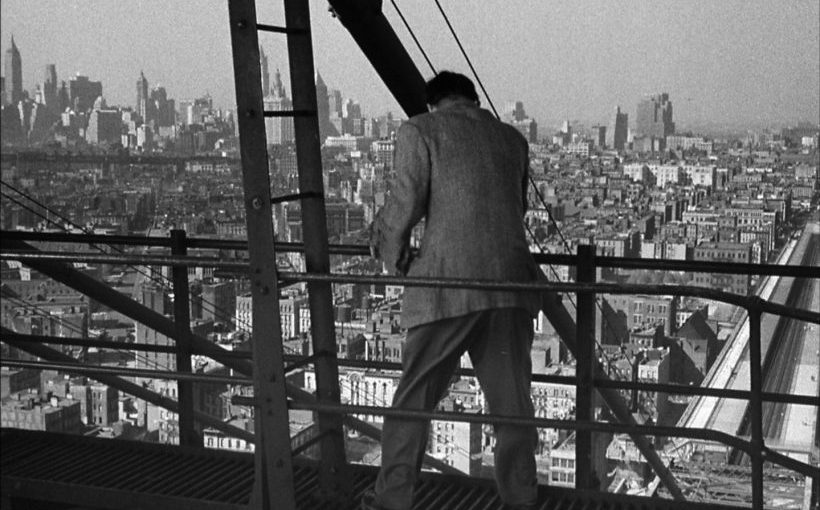
Everything comes to a head with a foot chase that leads to the Williamsburg Bridge, scenes that must have been a little mind-blowing for 1948 audiences as the camera seemingly defies gravity, climbing higher and higher into the scaffolding with the fleeing suspect.  (It should also be noted that the film perhaps romanticizes inner city life to a degree…as the suspect flees across the bridge, he breaks up a group of children skipping rope on the footpath.  Not the kind of thing I’d expect to see today, for sure.)

The Naked City is about as good as crime dramas in the ‘40s could get without resorting to the darkness and shadows of film noir.  This is, after all, a film about the good guys, not the bad.  Watching cops interrogate witnesses and compare notes about stolen jewelry isn’t quite as “sexy” as watching Bogie draw down on some hoodlums, but hey, that’s the kind of thing that really happens in the big bad city.

LA STRADA (1954, Italy)

by Miguel E. Rodriguez

Director: Federico Fellini
Cast: Anthony Quinn, Giulietta Masina, Richard Basehart
My Rating: 8/10
Rotten Tomatometer: 98% Certified Fresh

PLOT: A child-like woman is sold to a traveling entertainer, consequently enduring physical and emotional pain along the way.


Fellini’s La strada, the very first film to win the Academy Award for Best Foreign Film, is widely considered to be one of the greatest movies of all time, a touchstone of the Italian neo-realist movement that grew out of Bicycle Thieves (1948) and Umberto D. (1952).  Ask anyone who knows me, and they’ll tell you that, while I appreciate these kinds of films, they are not exactly my bread and butter.  There are some Italian movies that I will probably never watch, and I am quite sure I won’t miss them.  However, I am happy I finally sat and watched La strada.

But why?  La strada is not a happy movie by any stretch of the imagination.  It tells the story of a vaudevillian strongman, Zampanò (Anthony Quinn), who entertains street crowds by stretching a chain across his chest muscles until it breaks.  When the movie opens, he is paying the mother of a large family 10,000 lire for Gelsomina (Giulietta Masina), a child-like woman with a hugely expressive face.  For that princely sum, she will leave her family forever and learn a trade as Zampanò’s assistant.

They hit the road.  Zampanò is not a very nice man.  He teaches Gelsomina the basics but refuses to let her learn any more than is necessary.  When they eat dinner at a restaurant, he picks up a local floozy and ditches Gelsomina for the night.  When she tries to run away, he runs after her and beats her.  When they take up with a traveling circus, he refuses to let her perform with anyone else but him.  Gelsomina despairs of her existence, but she has convinced herself she can’t leave because she can’t think of anywhere else to go.

In a traveling circus, Gelsomina meets a carefree acrobat/clown known only as The Fool (Richard Basehart).  The Fool lives up to his name: performing dangerous high-wire acts and recklessly teasing Zampanò for no apparent reason, even heckling Zampanò during his act.  This is not a smart man, but he manages to steal a quiet moment with Gelsomina where, in his own way, he tries to let her know that her life has a purpose because EVERYTHING has a purpose, even a pebble he picks up off the ground.  “I don’t know what this pebble’s purpose is, but it must have one, because if this pebble has no purpose, then everything is pointless.  Even the stars!”

Examine that statement closely enough and it’s not quite as life-affirming as it seems, but it lights a spark in Gelsomina’s otherwise bleak existence.  From then on, she holds fast to that conversation, referring back to it when new hardships or doubts arise.  Meanwhile, Zampanò remains as cold and ruthless as ever, even trying to steal from a convent.

And then something unexpected happens that seems as if it will finally break Zampanò’s hold on Gelsomina, but no.  Gelsomina clings to the belief that her purpose is to be with Zampanò, no matter what happens or how miserable she might become.

…so, yeah, this isn’t exactly a happy film.  This is not the kind of movie I would normally seek out.  But in its bleakness, it achieves a kind of aching beauty, like Atonement (2007) or The Remains of the Day (1993).

A lot of that beauty is achieved through the must-see performance by Giulietta Masina as Gelsomina.  It’s clear that Gelsomina is stuck in a woman’s body but with the emotional maturity of a child.  Is she developmentally disabled?  The movie never makes it clear.  Perhaps she simply chose to retain her innocence while the rest of the world moved on around her.  In that way, she becomes almost like a character in a fairy tale.  I found myself wondering if the movie would have played the same had Gelsomina been a child rather than a grown woman.  It might have played a lot like the sequence in Pinocchio (1940) when he is captured by Stromboli and forced to perform for street crowds.

Masina’s performance as Gelsomina would be the single best reason I can think of to recommend this movie to anyone who might not otherwise watch it.  Her face and eyes light up like candles on a birthday cake when she smiles.  When she frowns, she puts clown makeup to shame.  And when she dons clown makeup herself and dances and plays the trombone, you can’t help but grin a little.  When she weeps because she can’t see The Fool anymore, she sounds like a little girl who’s lost a pet.  It’s one of the greatest performances I’ve ever seen.

That performance is key to the movie.  Zampanò’s cruelty and dismissive nature masks his own fear of Gelsomina’s innocence.  He keeps her down because he doesn’t dare allow himself to believe he might be in the wrong.  Watching the movie, we allow ourselves to hope that perhaps Zampanò will reach a turning point where he throws himself at Gelsomina’s feet, begging forgiveness for his terrible behavior and past misdeeds.  But will it happen in time to make a difference?

On the Criterion Blu-ray of La strada, director Martin Scorsese states in an interview that, if you’ve never seen a Fellini film in your life, you could watch La strada and 8 ½ (1963) and you’d know all there is to know about Fellini and his films.  I’m certainly no Fellini expert, but that sounds accurate to me.  La strada contains all the seeds – the score, the performances, the circus theme – that come to fruition in 8 ½.  But La strada is the more accessible of those two films, in my opinion.  If you’re going to start somewhere, start here.

THE LAST WALTZ (1978)

by Miguel E. Rodriguez

Director: Martin Scorsese
Cast: The Band, Eric Clapton, Neil Diamond, Bob Dylan, Joni Mitchell, Neil Young, Emmylou Harris, Ringo Starr, Dr. John, Van Morrison, Ronnie Hawkins, Muddy Waters, Ronnie Wood
My Rating: 8/10
Rotten Tomatometer: 98% Certified Fresh

PLOT: In 1976, American rockers The Band performed their last concert ever with an unforgettable guest list.  Director Martin Scorsese filmed it, and the rest is history.


I mean, 16 years on the road, the numbers start to scare ya. I mean, I couldn’t live with 20 years on the road. I don’t think I could even discuss it.
– Robbie Robertson, vocals and lead guitar, The Band


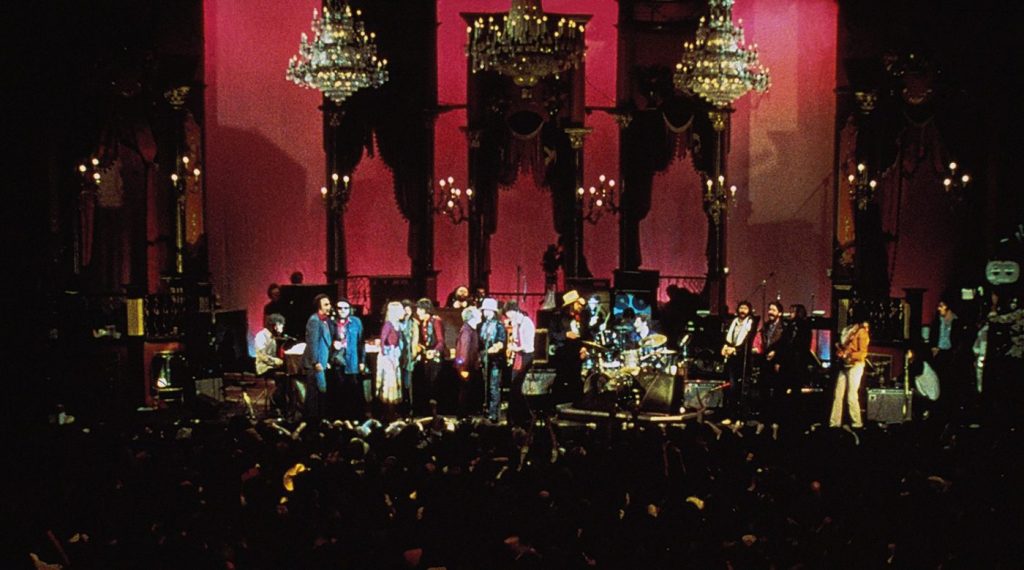
Martin Scorsese’s film of The Last Waltz, the Band’s epic final concert in 1976, is a curious exploration of the highs and lows of what it means to be a rock star.  Or not just a rock star, but one of the stars of a touring band, one of those perpetually traveling bands like The Grateful Dead or Phish or, God help us, The Rolling Stones.  In their performances, you can clearly see the heedless joy with which every musician plays their part, whether it’s a rockin’ guitar solo or a yell during the refrain or a keyboardist getting lost in his own world for a minute or two.  There are smiles and grins and humble bows to the cheering audience in the dark.

But Scorsese makes an important choice with The Last Waltz not to show just the highs of live performance.  With intercut interviews, filmed some months after the concert itself, we get quiet, introspective feedback from band members who clearly love performing, but who recognize just how much touring has taken from them.  They have no desire to follow in the footsteps of predecessors who paid the ultimate price for fame.  “You can press your luck,” says Robbie Robertson at one point.  “The road has taken a lot of great ones.  Hank Williams.  Buddy Holly.  Otis Redding.  Janis.  Jimi Hendrix.  Elvis.  It’s a goddamn impossible way of life.”  Here is a man who has decided it’s time to end the show before it jumps the ultimate shark.

In this way, The Last Waltz becomes more than just a concert film or a pretentious exercise in cinéma verité.  It clearly presents both sides and asks the viewer: how much would you give to achieve the fame and fortune of a rock star?  Certainly, the highs are deliriously addictive.  But in their interviews, members of The Band seem diffident or downright dismissive of their fame and fortune.  One band member is happier when they’re OUT of the spotlight.  “And as soon as company came, of course, you know, we’d start having fun.  And you know what happens when you have too much fun.”

But in focusing on their interviews, I don’t want to give the impression that The Last Waltz is anything but entertaining from beginning to end.  Let’s be honest: the concert footage is what’s going to amaze you at the outset.


Scorsese sets the tone right at the start with a title card in huge letters: THIS FILM SHOULD BE PLAYED LOUD.  The ensuing concert footage proves his point.  Especially on the newest Blu-ray from the Criterion Collection, the music coming out of the speakers is crisp and clean and begs to be blasted.  One number in particular, “Mystery Train”, is a pounding rockabilly song that felt and sounded most like I was really there.  The other guest performers do their part.  Muddy Waters gives a lesson on where the blues came from, putting pretenders to shame.  Joni Mitchell brings a more delicate touch with a heartfelt ballad about a wanderer who is imprisoned by the white lines on the road.  Van Morrison, whom I’ve never seen in any concert footage anywhere else, gives a damn good impression of Joe Cocker in his tight flared bellbottoms and low-cut T-shirt over his ample stomach – an image I would never have connected to Morrison.

I could go on, but you get the picture.  On the basis of the music and the performances alone, The Last Waltz is easily in my top three favorite concert films of all time, with first and second place rounded out by Monterey Pop and Gimme Shelter, respectively.  (For the record, I have never really cared for Woodstock…go figure.)  Combine that stirring music with the inside information from the interviews, and you’ve got a movie that captures a moment in time, a so-called “end of an era.”  Punk and disco are right around the corner.  Did The Band know it?  Watching it this time around, I couldn’t help but think of the ending of Peckinpah’s The Wild Bunch, with the gang walking to their certain doom because the world is changing, and they know they can’t change with it.  The Last Waltz isn’t quite that gloomy, of course.  But the sentiment is there.