DAWSON CITY: FROZEN TIME (2016)

by Miguel E. Rodriguez

Director: Bill Morrison
My Rating: 9/10
Rotten Tomatometer: 100% Certified Fresh

PLOT: In 1978, a treasure trove of lost silent films and newsreels is discovered buried under permafrost in the Yukon.


Time travel is real.  To the past, at least.  The future’s another story.  But you experience time travel every time you watch an old movie or look through photo albums.  Light waves from years, decades, or perhaps just minutes ago are captured and stored on paper or your phone (or the “cloud”) so you or someone in the future can look at it and see what you looked like in your high school yearbook, or an old newspaper clipping, or that one candid shot from your cousin’s wedding.

You ever find an old dusty photo album in someone’s attic or a thrift store?  You open it up, and there are people’s faces, and whether you know them or not, there they are.  They may be long dead, but you are a time traveler, looking through a window into the past.

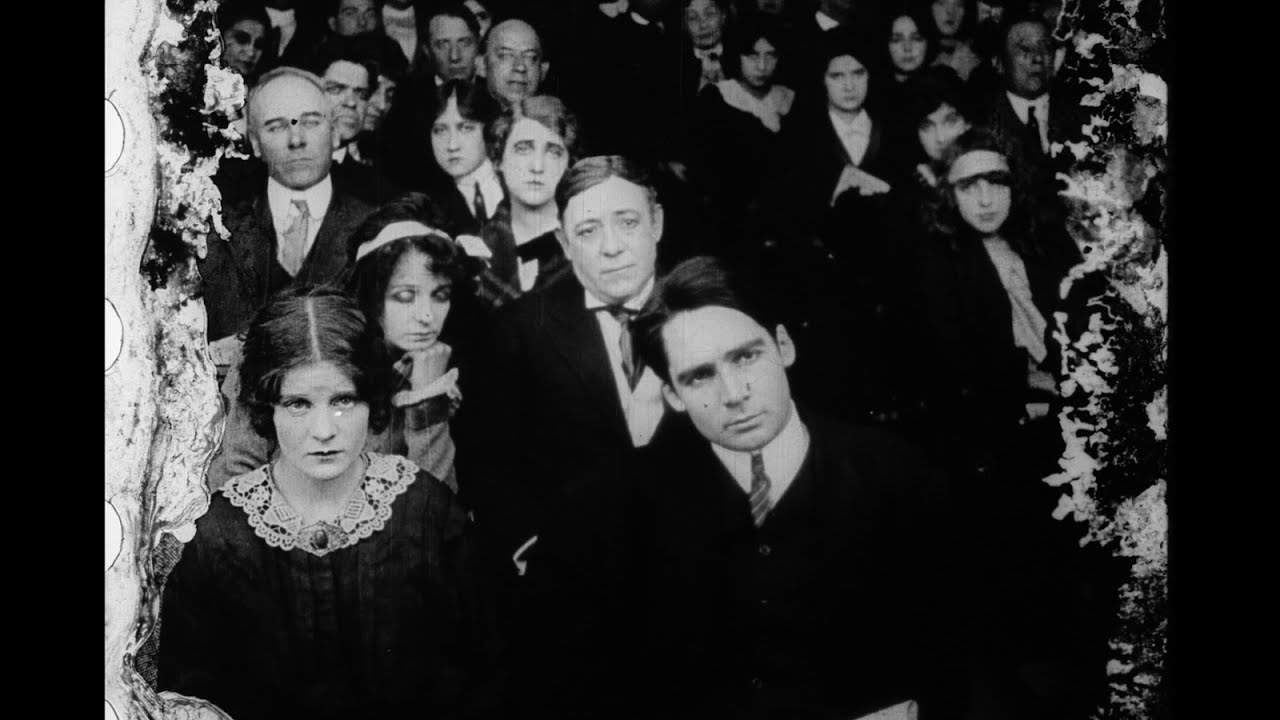
That’s what happened in 1978.  In a small town in the Canadian Yukon called Dawson City, construction workers uncovered an old swimming pool dating back to the 1910s and ‘20s.  Inside it, protected by the harsh permafrost, were hundreds of reels of old cellulose nitrate film.  These reels included old silent films long thought lost, travelogues, and old newsreels, back when the concept of the newsreel was first invented.  Back when cinema was a brand-new art form.

The story of how those films came to be buried for over sixty years is told in Brian Morrison’s documentary.  Dawson City sprouted almost overnight back in 1896 in the wake of the Klondike Gold Rush that brought thousands of prospectors to the area.  When they weren’t prospecting in the hills, all those people needed something to do.  Casinos, restaurants, and dance halls fit the bill, but at some point, someone hit on the idea of building a theater to take advantage of the new art form sweeping the nation: silent films.  Movie distributors down the coast in California included Dawson City on their list of customers, but because Dawson City was so remote, it was decided that it was too expensive to pay to have them shipped back to California.  So they asked the Dawson City officials to just store them away – safely, as cellulose nitrate film was extremely flammable.


At some point, when the storage facility got too full, those old silent films were either chucked into the nearest river or used as landfill for an old swimming pool that was converted into a hockey rink.  And there they stayed until 1978.  When they were uncovered, they were carefully packed away and shipped to facilities in Canada and the U.S. where technicians painstakingly restored the films as best as they could.

What makes Dawson City: Frozen Time so unique and compelling is the fact that this entire history is told with virtually no narration, using only titles and footage from the restored silent films themselves.  (Old photographs are also used, but these are no less haunting than the film clips themselves.)  There is a romance to seeing these relatively ancient images brought to life once more, especially the documentary scenes showing daily life in a rough boomtown.  We see old clips of men trudging up snowbound mountain passes for their shot at striking it rich.  People walking the streets looking curiously at the camera…what is that thing, they’re probably thinking.


We see newsreels featuring the likes of “Shoeless” Joe Jackson before he and seven other players tarnished themselves with the White Sox scandal.  We see a clip of spectators watching a baseball game from hundreds of miles away with the help of a telegraph and a big play-by-play scoreboard that featured little magnetic markers showing the progress of base runners in real time.  (Ever watch a fantasy football play-by-play on your computer or phone?  Same thing.)  I never even knew anything like that existed.

The silent films themselves, like all the other reels, have varying degrees of damage, especially water damage.  To try to watch one of them as an actual cinematic experience would be extremely distracting.  But as a previously closed window into the past, they are fascinating.  In my mind, it was like someone had opened a portal or a wormhole where we can see the past without interacting with it.  The warps and spots and tears only make the experience even more exotic.  It’s as if the fabric of the space-time continuum was being torn for our benefit, but it can only show us so much.

Maybe my imagination ran away with me.  Who knows?  I think this is the kind of documentary you’ll either love or hate.  All I can say is that, for two hours, Dawson City: Frozen Time made me feel as transported as only film can do.  The idea of knowing that these images were just waiting in a landfill to be discovered, and that here I am watching them now, sort of closing the circuit between past and present…it felt profound.  I don’t know if this is streaming anywhere, but if you’re any kind of film fanatic, you owe it to yourself to check this out.
STAR WARS EPISODE I: THE PHANTOM MENACE

By Marc S. Sanders

22 years after the first Star Wars film made a ginormous cultural impact on the world, George Lucas finally returned to the franchise to make the first film of a new prequel trilogy with Star Wars Episode I: The Phantom Menace. It was hyped beyond measure, and it sold gazillions in ticket sales but was nevertheless a letdown for diehard fans and pretty much everyone else. I don’t think it’s a terrible movie. I just don’t understand how necessary the film is.

There’s a lot of irrelevant moments here. Early on two Jedi step off a ship, and a droid introduces herself to them and says “this way please,” and the three figures literally walk out of frame. This takes up time that I don’t understand. Why couldn’t the three just end up in the room they were supposed to be in? There are a lot of “so what?” moments in The Phantom Menace, and it all weighs the film down, hindering a story.

Listening to an audio commentary a number of years ago, one of the visual effects makers pats himself on the back of a shot midway through the film that consists primarily of CGI characters and sets. That was when I realized the conception of The Phantom Menace was completed with a short-sighted intent. Sure the scene might have been a technical breakthrough in 1999, but where’s the story? Fact is, there is no story and little regard for the celebrated franchise in Episode I. Lucas and his team were more concerned with shooting new CGI discoveries blended with human interaction. They offered next to no regard for intelligent plot and storytelling. The film suffers because of Lucasfilm’s hubris.

Consider the pod race. There’s a moment where young Anakin’s (Jake Lloyd) racer falls apart at high speed and he’s gotta get it back together. He uses a magnetic tool to get a cable plugged back in. If this child is “the chosen one” and potentially “dangerous,” why not show the child potentially use the force to bring the cable back in place? Why not show moments where unexplainable power emits from Anakin, to what would imply the inevitablity we are aware will eventually happen?

Lucas is also all over the place in his storytelling and characters. From the Shakespearean manipulator, Senator Palpatine, to the immature cartoon like Jar Jar Binks. I think they all serve a purpose to entertain. Yet while adults and die hard fans will relish the return of Ian McDiarmid (a terrific actor) they’ll be bored to death with actor Ahmed Best in the Jar Jar role. This I expect happens in vice versa with 8 year olds seeing their toy figures come to life. There is a silly charm to Jar Jar, but what 8 year old wants to pay attention or even comprehend debates among galactic senators over taxation and trade? It’s as if Bugs Bunny entered the halls of Congress, or Othello walked in on a pie throwing melee among the Three Stooges. At almost every point in The Phantom Menace something doesn’t belong or seems out of place.

The film moves far away from the tradition of the original trilogy. For the first time the human characters are enormously flat. Liam Neeson, Natalie Portman, Ewan McGregor…all flat, all bland. There’s no snarkiness to them. No sarcasm. Before The Phantom Menace when was it ever said that the Jedi order was so formal in their ways? It doesn’t feel very fun to be a Jedi, like it did for Alec Guinness and Mark Hamill before.

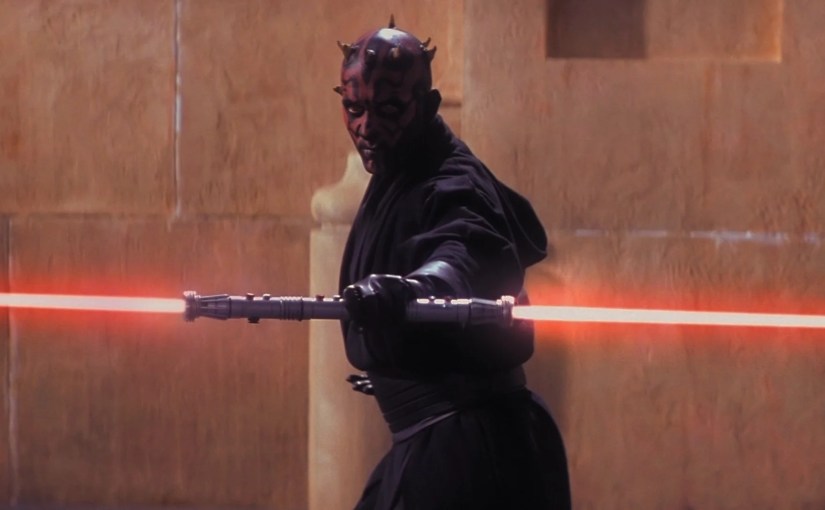
The two redeeming qualities of this film belong to the pod race which is thrillingly edited in sound and visuals. There’s some fun shots of each racer, the pit droids, the crowds in the stands and even Jabba The Hutt. The film really comes alive here much like the memorable cantina scene from the original Star Wars. The other best feature is the villain, the apprentice to the phantom menace, the red and black tattooed Darth Maul played by the agile martial artist Ray Park.

Lucas didn’t use Park enough in the film. With his double bladed lightsaber, the two on one dual Park has with the Jedi characters towards the end is one of the greatest sword fights in film. I would’ve welcomed an additional five minutes of this scene. Shamefully, this would be Ray Park’s only appearance in the film franchise, as well as Darth Maul. This was a great blend of actor and character. Lucas abandoned a good thing too soon.

Yes! I have much to complain about The Phantom Menace. Yet it is not all bad as a whole. I love the political trickery that McDiarmid displays and the senate meeting among the delegates is a nice foreshadowing for what we know will come of it. Visually, it’s a treat as well. (Again, though, what kids are going to be entertained by all of that?) The pod race and lightsaber dueling are masterful as well. There’s some good material here. There just could’ve been a whole lot more….and a whole lot less overall.

NIGHT FALLS ON MANHATTAN

By Marc S. Sanders

Sidney Lumet is the director known for shining a light on police corruption. His films were not crime dramas or legal thrillers really. They were an examination in what turns righteous professions within the confines of law and order into something tainted in violations of morality. Night Falls On Manhattan showed what can happen when the politics of New York City could be stained by the policemen who lost their sense of distinguishing right and wrong.

Andy Garcia plays Sean Casey, a newly deputized, very green district attorney and former street cop. His image looks perfect to prosecute a big time drug dealer who wounded his own policeman father, Liam (Ian Holm), and killed two other cops. Richard Dreyfuss does an inspired Alan Dershowitz personality portraying the defense attorney for the dealer, by angling a theory that police corruption is unfairly working against his client. It seems like a very open and shut case for Sean, which occupies the first half of the film.

Afterwards, Sean appears to have a white hot image in the public eye and he is quickly nominated and wins an election as Head District Attorney for the city, following a heart attack from the incumbent and his boss played by Ron Leibman. Conflicts arise though when it is uncovered that perhaps Liam, along with his partner Joey (James Gandolfini), have been taking money under the table as part of a group of dirty cops spread among three precincts.

Sidney Lumet’s films always present topical and complicated real life problems with no expected solutions. These issues of transgressions exceed any kind of quick fixes. He’s shown this time and again with films 12 Angry Men, Serpico, and The Verdict. With his original script here, Lumet gets a little personal. What can you do when a city relies on your image of ethical practice, but your own loving father may be a traitor to the laws he’s vowed to uphold? How can Sean work ethically for his constituents while his father and his longtime partner are possibly betraying sworn policy?

I was always engaged in Night Falls On Manhattan. What is Sean going to do? The dilemma is never patched up with a band aid. It actually feels like it gets worse and worse because it is next to unsolvable. Cops are heroes in this film and a cold blooded killer seems to have been rightfully sentenced? So how can Sean, Liam, Joe and the rest of the cast live with themselves when the end results they wanted all arrive, but came about in all the wrong ways?

This is a terrific assembly of talent. Most especially, credit has to go Ron Liebman as the head DA whose overbearing loud mouth is necessary for the city that never sleeps and the endless amount of police troops and city prosecutors he has to answer for. If New York City had an actual voice that emanates and speaks the endless noise of the Big Apple , it is Ron Liebman. He should have been Oscar nominated. He comes carved out of the concrete of the city landscape.

This is really an unsung picture of Lumet’s that should be seen, much like Find Me Guilty with Vin Diesel. My one issue is the preachy monologue that Sean delivers at the end of the picture. It comes off like a concluding statement and left me with the impression that the conflict of the story painted these characters into an inescapable corner. So, tack on a speech to bring on the credits. The monologue just didn’t work for me though. It didn’t give me that bookended impact I was hoping for.

Other than that, however, Night Falls On Manhattan is another fine piece of filmmaking rooted in a metropolitan setting that becomes a character all its own. Lumet was a genius about acknowledging his settings. This is another perfect example.

TOTAL RECALL

By Marc S. Sanders

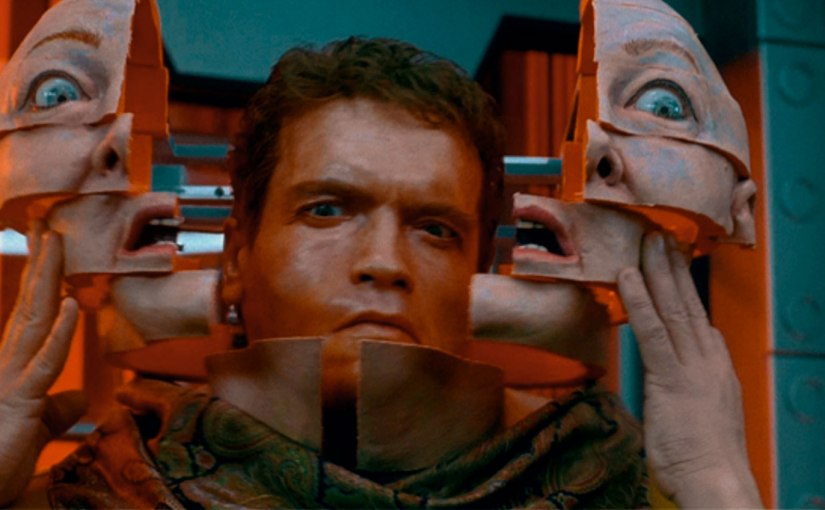
Paul Verhoeven is an in-your-face director. His material regarding sex and violence goes at least a ginormous step further than other directors. For an action film like Total Recall, if someone gets shot, they don’t get shot once but hundreds of times. That way we can see more blood splurt all over the place. I especially feel ashamed how much I laugh when a tourist extra gets caught in good guy/bad guy crossfire. Once this guy is dead, Verhoeven makes sure his central nervous system is nonfunctional and none of his vital organs will qualify for donation. If Verhoeven sets a scene in a Martian adult night club, then you’ll have ample opportunity to take in an upfront view of a three breasted woman, or a little person in stiletto heels and hooker garb with the boa included.

Total Recall is a well-regarded Arnold Schwarzenegger action flick with a psychological twist to keep your attention. As soon as the film begins, you are questioning if you are watching a real-life experience for Douglas Quaid (Schwarzenegger) or is this a dream or is this all a purchased memory. A purchased memory is the new novelty of this science fiction future. If you can’t travel to a destination like the planet Mars, you can certainly buy an implant that’ll convince you were there and even living the life of a secret agent while romancing a beautiful buxom brunette.

The exposition for Total Recall really arrives in the second half of the film. The first hour deliberately leaves the viewer as confused as Quaid while he tries to uncover why he’s being pursued and shot at.

The film is full of surprising twists including another character reveal that Schwarzenegger portrays. It’s hard to trust anyone Quaid comes in contact with or who is real or even what is real.

The settings are very well constructed. When you enter a security zone before hopping on a subway, your entire skeleton appears in blue on a screen you pass by. Mars is brutally red while it tries to comfort the civilization with familiar products like a Hilton Hotel or Pepsi. All of this sensory overload is present while a brutal overseer named Cohagen (an over-the-top Ronny Cox just like Paul Verhoeven likes it) seems to disregard the alien inhabitants by hoarding their breathable air.

It all feels familiar but the product placement is a little much as well. When I first saw the film in its theatrical release, I was enthralled with this picture. The action seemed to come as fast as the various twists. However, now it’s hard not to notice the blatant commercialization of the film. Its like watching a football game and every few minutes a commercial comes on. I’m aware of you, Pepsi. I don’t think I need a reminder during a loud, violent gun fight. Look! Instead of “USA Today” there’s “Mars Today.” Ha!!!! Even if you have the means to travel to Mars, you might want to visit the local Sharper Image for the latest high tech toy.

Total Recall relies on a story from sci fi writer Phillip K Dick who also inspired Minority Report and Blade Runner. Fortunately, that’s a good strength to hinge upon. I think the weirdness of it all makes Schwarzenegger a better actor; a muscle guy who can only appear more like an Everyman in a film like this. He’s good with emoting confusion. He’s as good as always with delivering a pun, and his fight scenes are consistent with his other actioners like Predator and Commando.

Total Recall is a good picture but it’s a lot to absorb in story. It’s over inflated in its unsubtle appearance of product placement, violence and nudity. If you’ve got the stomach for it, then you’ll have a good time. It’s not Star Wars lite. It’s definitely Star Wars heavy. Prepare to be bloated.

GRAN TORINO

By Marc S. Sanders

I had a few reasons to watch this movie. One, a good friend, Greg Spiegel, had given this film his full endorsement on a number of occasions. Two, as some of you know, I’ve been a huge admirer of Clint Eastwood for as long as I can remember, since age 8 or 9 I imagine, when I saw his Dirty Harry films and even Fido Beddow in Every Which Way But Loose (and its sequel; those films are much better than maybe they are given credit for actually).

Eastwood matured as a filmmaker during the mid 80s and on into the present. He transitioned into films that delivered messages that sometimes even contradicted his past films as the gunslinger who never asks questions and always knew where to shoot. Films like Unforgiven and A Perfect World really showcase the tragedies of violence perfectly, and I think Gran Torino is worthy of being added to that list.

Eastwood plays Walt Kowalski, a racist Korean War veteran, who never left the war he used to fight in. The war comes home with him 50 years later to his Michigan neighborhood where he seems to be the only Caucasian American to live among a melting pot of other races; highlighted especially here are his Hmong neighbors who look past Walt’s prejudices to befriend him following his unintended gesture of protection from an intrusive gang. From there, Walt makes a bond with young Tao, a boy with no male influence in his life, and Tao’s sister.

Eastwood is probably the best director to direct himself. He knows how to position his camera and lighting, or lack thereof, to carve out the lines on his face and hide himself in haunting shadows to show a riddled history to Walt. He also adheres to similar themes that worked well in other films. A defiance to religion represented by a young minister looking to help Walt is reminiscent to the sarcastic approach Eastwood’s character used in Million Dollar Baby. The neglect of a protagonist’s family, and most especially, the connection of the pessimistic old man with the young child, barely adult, as well echos the Clint Eastwood/Hilary Swank pairing in that film. I don’t mind if it’s a repeat actually. Relationships like these are hardly shown in films these days, and I think they are important. Films like Harold & Maude and The Karate Kid show that gaps in generations are not an excuse to separate ourselves. (Heck, I even attempted it when I wrote my play, Arnie & The Itch.)

Eastwood has great, uncompromising racial affection (yes, those two words work nicely here) with his two Asian co-stars Bee Vang and Ahney Her, who are well cast in their own right.

Name calling is a method of maintaining a relationship in a film like this. The PC bandwagon is tossed out so the actors, especially the minority Asians, find something more wholesome to a prejudiced old coot.

The language is strong in Gran Torino, but I say it’s an important film to show to many kids to learn of a neighbor’s tolerance; of what goes on behind a closed door or even if that neighbor sits quietly on his porch with a dog by his side and a beer in his hand. We learn of the roads they have crossed, the battles they have fought, and the accomplishments they’ve made. Learn from these people. Learn from the humanity they carry; the honest humanity that may look offensive on the outside yet is present due to a tormented history inside.

I could say “these whipper snappers with their phones” but it’s honest frustration. It’s hard to learn what a person really is by means of a handheld device. To learn about a person, you have to eat with them, work with them, speak to them and even appreciate their 1972 restored Ford Gran Torino, automobile.

This was a great effort in performance and production from Clint Eastwood. I’m glad I watched it finally.

BEASTS OF NO NATION (2015)

by Miguel E. Rodriguez

Director: Cary Joji Fukunaga
Cast: Idris Elba, Kurt Egyiawan, Abraham Attah
My Rating: 8/10
Rotten Tomatometer: 92% Certified Fresh

PLOT: In an unnamed African country, a young boy gets separated from his family and is trained to be a soldier for a guerilla combat unit.


It’s been said – I don’t remember by whom, maybe François Truffaut – that there is no such thing as an anti-war film because combat scenes are inherently thrilling.  Look at the D-Day landing in Spielberg’s Saving Private Ryan.  Brutal and horrific…but visceral and powerful and exciting at the same time.  Squint at those scenes a little bit, think about the ultimate sacrifice made by so many soldiers for their country, and it’s almost a recruitment film.

There are, as always, exceptions to the rule.  I challenge anyone to watch the Russian film Come and See, about the experiences of a young soldier during World War II, and come away feeling anything but dismay and disgust at the institution of war.

Beasts of No Nation is also an exception.  Directed by Cary Joji Fukunaga (No Time to Die, co-writer of It [2017]), it features numerous combat scenes involving pre-teen boys firing machine guns, tossing grenades, and wielding machetes on men, women, and children.  The movie is fictional, but the experiences are taken from true-life stories of real boys who were kidnapped by rebel armies.

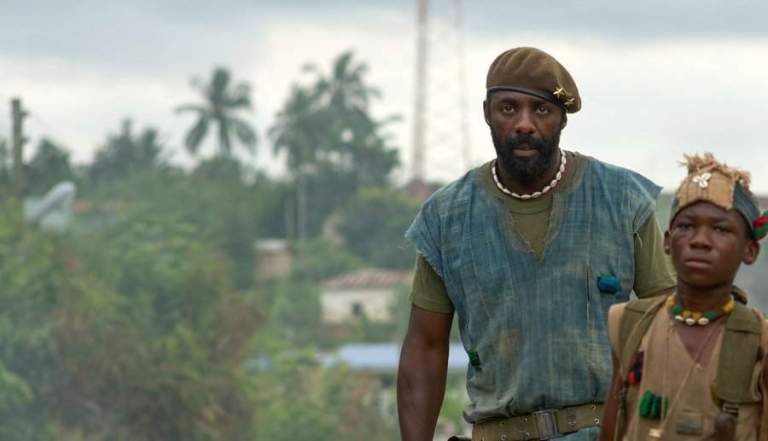
The young boy in this story is Agu (Abraham Attah in a brilliant, subtle performance).  He’s maybe 11 or 12 years old.  In the opening scenes, we see he and his family are poor, but happy.  He plays with his friends.  They try to sell an “imagination TV” to anyone who will listen to their pitch.  (What is an imagination TV?  …use your imagination.)

One day rebel forces march into town.  Or government forces.  It’s never made quite clear, and I think that’s on purpose.  In this unnamed country, one side is as bad as the other, so it really makes no difference.  His mother and sister are whisked out of town to relative safety, while Agu and his father and brother are left behind.  However, he is soon separated from them (in a scene that reminded me oddly of Empire of the Sun, though even more traumatic) and he runs into the jungle where he is soon captured by a roving combat squad led by a man known simply as the Commandant (Idris Elba, in another brilliant performance).  The Commandant sees potential in Agu and takes him under his wing.

Here’s where it starts to get disturbing.  Agu is trained to be a soldier.  This involves standard training about how to move in the field, but it also involves a brutal hazing ritual where he must run between two columns of men who beat him with heavy sticks as he passes.  Make it through and you graduate.  Get knocked out and…well, you don’t want to get knocked out.  He and other boys are subjected to a cloud of smoke and haze created by burning gunpowder.

Why do this?  From the army’s standpoint, a young boy makes an ideal soldier.  He requires little pay, eats less food than a grown man, never questions orders, and provides unswerving loyalty in return.  The trick is teaching them to kill on command.  For Agu, this part of his training comes when a prisoner pleading for his life is brought before him.  The Commandant hands him a machete.  “This man is with the people who killed your family,” he says.  The scene is simply shot, but it’s horrifying to see Agu’s eyes go blank as he stares at the prisoner.  The culmination of this scene is one of the most disturbing visuals I’ve seen since Requiem for a Dream.  The most chilling part is Agu’s voiceover, which we hear at many other points in the film: “God, I have killed a man.  It is the worst sin…but I am knowing, too, it is the right thing to be doing.”  Brr.

Whether Agu finds redemption or rescue or whatever, I leave to you to discover.  I will say the movie looks marvelous.  Director Fukunaga served as his own cinematographer AND camera operator (after the first operator tore a hammy on his first day).  It’s well made, directed with a sure hand and a fine visual instinct.  I don’t want to give away too much about the ending, but watch Agu’s face.  As he speaks, you can see the blank, flat stare of someone who has seen enough to know he’s seen too much.  It’s the face of someone who has been through more than any of us should be put through.  And he’s not even old enough to shave yet.  That’s what makes Beasts of No Nation a truly anti-war film.

TROUBLE WITH THE CURVE

By Marc S. Sanders

Roles for the “aging has been” who is either about to retire or refuses to retire seem reserved these days to Robert Redford or Clint Eastwood.

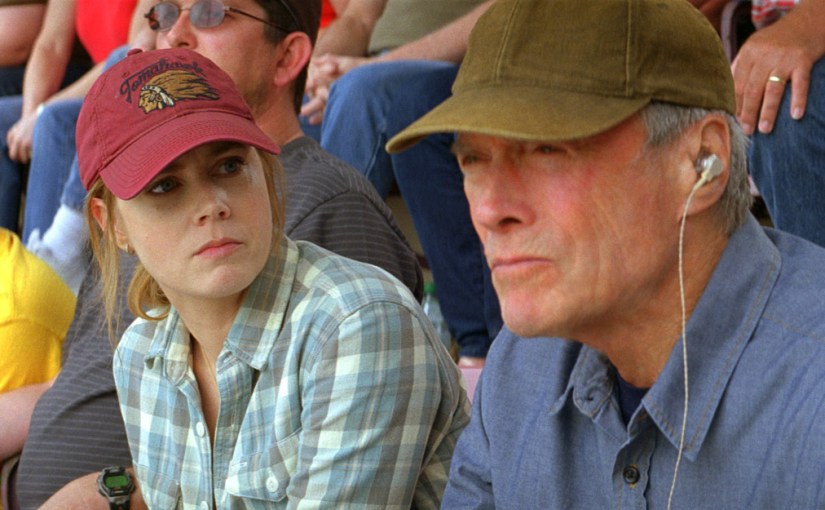
Back in 2012, Eastwood gave up his director’s chair to star in a little known film about an aging baseball scout in Trouble With The Curve. I’ve seen him play this kind of role many times before like In The Line Of Fire, or Grand Torino.

There’s nothing memorable about Trouble With The Curve, but it does feature some good scenes between Eastwood and Amy Adams as his tough as nails attorney/estranged daughter who forces herself upon his scouting trip to look after him when it seems his health, particularly his vision, is deteriorating. Adams is good as the underestimated baseball expert. She can recognize a 95 mph pitch and she can triumph over you in reciting RBI stats, batting averages, etc. Give her a bat and she can also cream a ball outta the park.

Justin Timberlake is the necessary pretty boy romantic interest for Adams, but he doesn’t offer much to the film in the way of humor or even sex appeal. This guy is a great actor beyond his music. (See The Social Network)

The movie belongs to Eastwood alone.

First time director and regular Eastwood crewman, Robert Lorenz does well with the baseball footage of young prospects and the end is satisfying as the argument weighs whether experience and instinct can still trump the power of technology.

Has baseball truly come to rely on what a computer says is the best first round draft pick? Wow…how sad.

PREDATOR

By Marc S. Sanders

Predator is not only my favorite Arnold Schwarzenegger film, but it also remains as one of the best action films of all time.

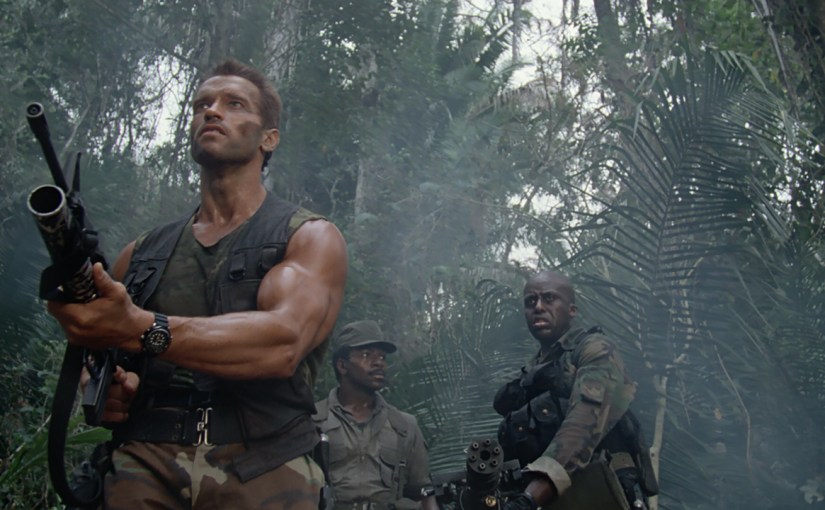
The main reason for my praise stems from its cast consisting of the Austrian headliner followed by Carl Weathers, Jesse Ventura, Bill Duke and Sonny Landham. The cast is sensational because they take the science fiction material seriously by evoking their machismo gradually evolving into fear. Director John McTiernan displays all of this very well through quiet and covert close ups as each character sums up the possibility that they are being hunted for sport by an entity they are not familiar with.

McTiernan makes use of his setting to the point that the real-life dense jungle of trees amid thick humidity, within South America, is its own character. I don’t know how he did it but, in this film, McTiernan and his cinematographer capture flawless tracking shots of running over uneven grounds and roots, leaves and low hanging foliage. It’s really spectacular how it all moves fast without any chopped up quick cuts like a Michael Bay movie for example. In this movie, the chases are actual chases.

An outrageous Oscar crime is that this film lost its Visual Effects prize to Innerspace. That gnaws at me when you consider the vagueness of the Predator’s chameleon like invisibility shape. It leaves the viewer intentionally as confused as these expert Gung Ho military men are. They can’t quite make out what this thing is because McTiernan wisely follows Spielberg’s Jaws technique by not showing you the creature until all the cards are dealt. The viewer is left curious and aware but still in suspense. There’s a kaleidoscope of transparency in the figure that scopes these men but what is it, really? The best horror films present the horror by literally not showing you the horror.

I like how this rescue team is continuously displayed with their talents for covert sabotage, hand signals, caution and focus. The actors are actually setting up the booby traps and climbing and ground crawling.

It’s honestly a very well-acted piece most especially from, yes Schwarzenegger, as well as Bill Duke and his psychological trauma during the 2nd half of the film, and Sonny Landham as the Tracker Billy who can relay what transpired with a keen Native American sense of environment. It’s a great collection of characters all together.

Sadly, the majority of the follow up films in the franchise do not live up to what originated here. In the first installment, the story is condensed in an efficient 90 minutes that leaves enough time for one story of adventure and rescue before it gets to all its sci fi suspenseful showpieces. The follow up films never took advantage of the strengths used here from over 30 years ago.

Predator is a brilliantly edited, well shot, taut and a gripping yarn of imagination and fear.

From 1987, it hasn’t aged a bit.

THE VERDICT

By Marc S. Sanders

Sidney Lumet is a master filmmaker at shooting predominantly talkie films. In The Verdict by David Mamet, his best special effect is, at least, the just as legendary Paul Newman as washed-up alcoholic attorney Frank Galvin. Lumet opts to shoot Newman for the screen talent he is. Occasionally, his camera points up at Newman, who looks as if he will fall over. Lumet also makes Newman look great as he runs down a hallway, or with a stare of his familiar blue eyes. The chemistry of camera and performance are blended rhythmically.

Alcoholism has been depicted countless times, but Newman’s interpretation ranks at the top of the list. He can’t function without his drink whether it’s gaining a high score on pinball, flirting, reading a brief or even getting a fast protein fix by dropping an egg yolk in a beer. Paul Newman makes you wonder if Frank Galvin is going to pass out or fall asleep even while he’s barely practicing legal brilliance. He toes the line beautifully between coming undone and barely squeaking by. This is one of his best roles ever.

Frank is given a chance to salvage himself as goes up against the Boston Archdiocese and the hospital it owns in a case of medical negligence, who are represented by a conniving antagonist in the form of James Mason with his limitless resources, power, strategies and army of lawyers. If this were a silent film, I’d buy it with Mason twisting a handlebar mustache. He’s absolutely a man you love to hate.

The dialogue crackles against simply the inflection of vocals from Newman, Mason, an unexpected Charlotte Rampling as Galvin’s sudden love interest, a difficult judge played by Milo O’Shea, and Frank’s assistant played Jack Warden. The delivery of lines, the twisty double crosses, and conflicts play to the precision of great Shakespeare. So much so that when on the rare occasion these characters curse or the ominous cue of music steps in, it’s all shocking and applauded.

The settings are great for atmosphere too. Worn in leather chairs, polished cherrywood tables and courtrooms with their squeaky floors. This is a well-worn Massachusetts backdrop of legal reputation and intimidation.

Every member of the filmmaking team from Lumet to the cast, to the composer,Johnny Mandel, and David Mamet’s fantastic script have been thought out and measured to completion.

Some will say this film is dated (rotary phones, ladies’ hairstyles, wardrobe; year of release was 1982). I say its themes are still significant. Power is something that must always be overcome by a weak, flawed protagonist. Whether or not Frank Galvin can do it, matters not. It’s the struggle that’s important to follow in a film like The Verdict.

STAR TREK IV: THE VOYAGE HOME

By Marc S. Sanders

We owe a lot to H.G. Wells, author of The Time Machine.  Without Wells, Marty McFly would not become familiarized with a souped-up DeLorean, and Earth as we know it would be decimated by the year 2286 because a probe, in the shape of a Ring Ding pastry, from the far reaches of space could not find its humpback whale friends to say hello to.  If Star Trek IV: The Voyage Home is not the best of the film series, it is certainly the most fun and delightful.  (For the record, my personal favorite is Star Trek II: The Wrath Of Khan but sometimes I switch to Star Trek VI: The Undiscovered Country.)

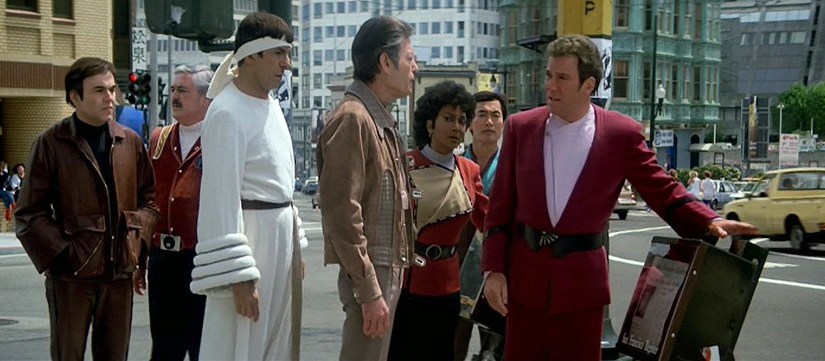
Kirk, McCoy (William Shatner, DeForest Kelley) and company have managed to resurrect their comrade Spock (Leonard Nimoy, also returning to the directing chair). Now, they are enroute from the planet Vulcan to Earth awaiting trial for the crimes and violations they committed in the prior film.  However, they must follow a detour back in time to the year 1986 and pick up a pair of humpback whales.  The sea mammals are the only creatures that can speak with an alien probe and salvage the Earth from becoming destroyed.  The probe isn’t an enemy.  Its arrival is simply unsettling the planet’s oceans and core because it can’t communicate with whale life, that is now extinct by the time 2286 has arrived.

So, in a Klingon Bird of Prey that they took command of and dubbed the HMS Bounty, our favorite Federation crew, arrive in late 20th century San Francisco.  Problems lay ahead though.  Their dilithium crystals (fuel) are depleted, they are unfamiliar with the daily activities of life during this period, and just how are they to find a pair of mammoth whales by walking around the city?  As well, Spock is not exactly himself since his rebirth.  His knowledge is there, but his common sense that stems from his human half is lacking.  This leads to some funny engagements with the city folk as he develops a habit for some colorful language not commonly used in the 23rd century.  A scene on a city bus with a punk rocker is a terrific highlight. 

Well, within the film’s two-hour time frame a pair of whales is located at The Cetacean Institute and they are overseen by a spunky and emotionally caring guide named Gillian portrayed by Catherine Hicks.  Now the gang has just gotta get home to their time before it’s too late.

The script for The Voyage Home is really quite brilliant and such a pleasant surprise.  All of the characters have their own moments for humor to occur.  The best being that Chekhov and Uhura (Walter Koenig, Nichelle Nichols) have to find a nuclear power source to make up for the lack of dilithium crystals.  Imagine, during the time of Reagan/Gorbachev Cold War politics, a man with a heavy Russian accent politely asking a motorcycle cop where he may find the “nuclear wessels…NUCLEAR… WESSELS.” It’s also inspiring to place a cynically cranky Dr. McCoy in a city hospital only to question how medical practices were ever tolerated at this time. “Is this the dark ages?”

William Shatner and Leonard Nimoy make such a sincere pair of friends as Kirk and Spock.  Shatner is especially good in the Star Trek films because he performs with a way of sarcasm and whimsy.  He works like Errol Flynn, unreserved while he swings into the danger.  Yet, he’s also so sincere.  There’s a flirtatiousness to him that’s impossible not to like.  He’s just so personable.  You also feel for his Kirk when he wishes his old friend, Spock, would just return to the way he once was and simply address him as “Jim,” not Admiral.  I couldn’t help but relate to it as someone who may wish that with a relative suffering from dementia.  The loved one is still there, and yet he/she is not there.  That’s how Shatner touchingly approaches this relationship.  The chemistry between Shatner and Nimoy is unparallel.  The recasting of the roles in later years has not matched up.  The original actors just read each other’s timing perfectly like Laurel & Hardy or Felix & Oscar.  There’s Newman & Redford.  There’s Lemmon & Mathau.  There’s Shatner & Nimoy.

I always had my facts mixed up.  I was always under the impression that this film was nominated for a Best Screenplay Oscar.  It in fact wasn’t.  Yet, it really should have been.   The Voyage Home has a message on the importance of preservation of life and an urge to hold on to the integrity of our environment.  Thankfully, it’s not preachy.  There’s a combination of science fiction, adventure and humor at play here that I don’t think has ever worked better in what I’ve seen of the Star Trek universe of films and TV series. This is just a very, very smart film with good, insightful direction from Leonard Nimoy. 

Nearly forty years later and this picture still holds up.  So many of our planet’s species remain endangered.  Many are suspected to be extinct by the hands of man.  The Voyage Home touches upon these facts.  It still feels so up to date that you even get a lump in your throat at the top of the film when a dedication is made to the memory of the Space Shuttle Challenger crew.  The makers of this Star Trek installment really presented a timeless film with the help of time travel, and you don’t have to be a Trek fan to appreciate its merits.