DUEL

By Marc S. Sanders

Duel – Steven Spielberg’s first full length film which he directed in 1971.  While it was originally a television movie in the United States on the ABC network, the feature made its way to European cinemas after Universal requested that Spielberg shoot additional scenes to bring the running time up to at least ninety minutes.  The final product still holds as a tight and intense depiction of nail biting, paranoid suspense.

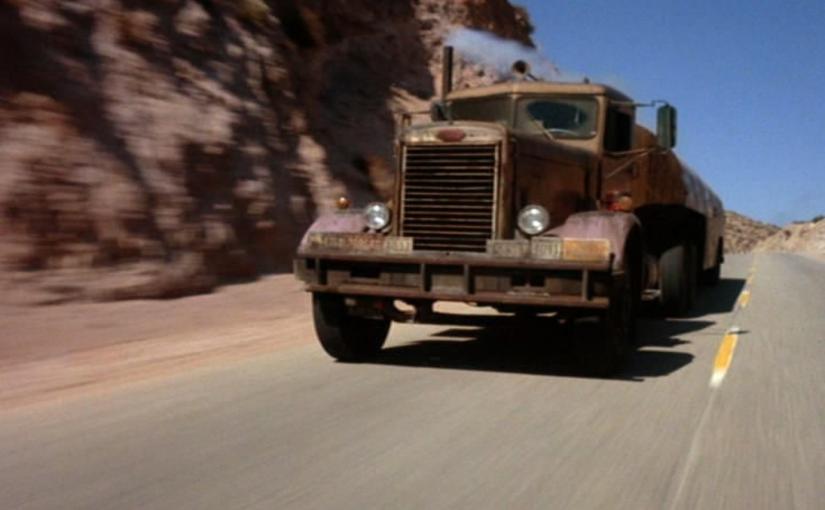
The story couldn’t be simpler.  A sales man (Dennis Weaver) driving a red Plymouth sedan across a never ending California highway comes up behind a grotesquely, offensive looking, smoking oil tanker.  He takes it upon himself to pass the truck on the left to continue his journey to his next appointment, and either a road rage from the unseen truck driver, or just a need to play cat and mouse begins.  No matter how fast and far the man’s car goes, the hulking, angry truck is terrorizing him to no end.  The truck will tailgate the car, or cut it off, or even just wait silently up ahead as the car continues on its path.  The salesman cannot understand the madness behind this unexpected scenario. 

As a film lover, what’s most fun about Duel is easily recognizing Spielberg’s attempt of building fear within his audience.  Steven Spielberg always has a unique approach to thrilling audiences.  He believes that what you don’t see is scarier than what you look at plain as day.  Like his eventual third feature film, Jaws with the submerged great white shark, along with Close Encounters Of The Third Kind and the unknown aliens that are blinded out by colorful light, or the hidden dinosaurs of Jurassic Park, and even Saving Private Ryan with the gear, grinding, at first unseen, German tank that occupies the final act of the film, with Duel you may get a look at the monster at play but you never get to meet the mind of the monster.  At best all that you see of a sinister truck driver is his left arm waving out the window or his cowboy boots.  Soon we learn that left arm is only baiting the salesman to drive into oncoming traffic destined for a violent collision.  (The shark’s fin in Jaws teases its hunters into similar kinds of danger as well.)  Otherwise, this mysterious truck driver has no dialogue, and expressions of evil come through close up and advance shots of the “face” the front of the truck seems to have with a long snout like extended hood for a nose/mouth and the dirty windshield for its eyes.  This approach alone is what keeps you glued until you reach the picture’s climax.

After the man is driven off the road the first time, Spielberg depicts the protagonist’s fear with a long hand-held camera that follows him walking from his crashed car into a diner across the street, past folks eating lunch, into the wash room and then back out again, only to end the shot on the enemy truck resting outside the restaurant as if it is waiting for its new found prey.  This truck is as scary as Spielberg’s shark or his dinosaurs.  The film was made long before the age of Steadicam, and this moment serves as a masterful sequence.  The poor guy is a stranger in an even stranger situation, and because none of us have seen what this terrorizing truck driver looks like, we are no wiser than this guy who is being victimized.  A voiceover of his thoughts plays out where he tries to reason with himself if what he did is so bad, or perhaps it’s all over and this crazed driver will let him go on his way now, or which one of the men sitting at the counter could possibly be the driver of this rusted, greasy, metal monster.  Even if he wanted to, the salesman can’t reason or negotiate with his new found enemy.  The paranoia is very real. 

Reading up on the background of Duel, many film critics and admirers seemed to have found certain symbolism with the film ranging from comparisons of status symbols of the car vs the truck, or between the two drivers.  The salesman’s name is David Mann. Is this biblical perhaps, like David vs. Goliath? Plus his last name is so simple – Mann. Observers even took note of a small early scene where the salesman has a tiff with his wife over the phone.  When he hangs up, the wife is long gone from his mindset and he’s left on his own to survive anything that comes his way.  I, however, didn’t regard the picture with much depth other than that Spielberg shot a taut film in just 12 days.  I didn’t need to look for much else.  My heart was racing.  My curiosity to see the truck driver stayed hungry and my need to know how or if this poor guy was ever going to escape this daylight nightmare persistently held strong.  

As well, I was amazed at the camera work on display.  No two shots of the vehicles appear the same.  Spielberg positions his camera on a low moving motorized crane (first used in the film Bullitt) to keep pace with the truck for upward facing perspectives.  He’s got overhead shots, perspectives from the rear and the sides and then of course the front with zoom close ups to bring a visual, frightful roar to the big rig.  The Plymouth also has its own blend of camera work that’s very effective.  Dennis Weaver as the salesman is seen looking in the rear-view mirrors.  Spielberg captures paranoia from inside the car underneath the steering wheel looking up and next to the actor from the passenger side or from the back seat.  He’s got close up shots of Weaver in sweat inducing paranoia.  For a car chase picture, every sequence looks new and different from what you see earlier in the film.  A young Steven Spielberg was always reinventing himself.

Though the film was made 50 years ago when the term “road rage” was not even thought of, the situation seems all too real and quite possible when watching it now.  The man relies on telephone booths or stops at gas stations to try and help his situation.  Not much good comes from that though.  Had Duel been made today, the car driver would use his cell phone and he’d likely drop it by accident or the battery or signal would die.  The point is at given moments in life, we are all left to our own devices and completely alone.  On a lonely, endless highway help is not necessarily something to count on.  Police cars are not to be found at any given moment.  The man finds opportunities to see if locals or another passerby could help, but no one is so inclined.  How often do you help a stranger that comes upon you on a desolate road?  So, you are left to fend for yourself where a vicious beast need not concern itself with the boundaries of law or morals.  The second half of Jaws would follow this theme as well.  Out in the middle of nowhere with no one around, what do you do when it only comes down to you and the terror that hunts you?

I believe Duel is essential viewing for any film lover.  More than standard schlock slasher films, Steven Spielberg’s film offered the new wave of presenting an effective thriller like Alfred Hitchcock had built his reputation on.  There’s nothing supernatural in this film.  This could happen at any given time.  People face insurmountable bullies or challenges that are never welcome and the strength of ourselves is tested when we realize we need to overcome these obstacles alone, without a hand to hold or a guide to steer us to safety.  It happens when we lose a loved one.  It could happen in a boring office job when the work is piling on or during finals week in school or while driving on a lonely stretch of highway.  When the challenge does occur though, and you are unfairly never given all of the facts, how will you react?  What will you do?

ANNIHILATION

By Marc S. Sanders

Science Fiction/Horror for the thinking viewer is the best way to describe this film.

Director Alex Garland has found a way to make a viewer’s eyes pop, not just with fear but with the unimaginable. This is as good an effort or better than his other well known film, Ex Machina. I foresee it will not be long before Garland is recognized among the ranks of today’s most notable and popular directors like Del Toro and Nolan.

This is not a run of the mill monster movie. This is fictionalized science that seems foreign and strange, yet makes complete sense by the time the credits roll. All questions are thankfully summed up despite a hanging thread or two to relish in deep thought long after the film has ended.

Natalie Portman strongly leads a nearly all female cast to uncover the purpose and functionality of “The Shimmer.” She does so, but at what expense? She’s great and believable in her role with lots of dimension by way of her career as a Johns Hopkins professor/former army infantry soldier and through periodic dreams of sin she feels guilty over.

Jennifer Jason Leigh does her best no nonsense disturbing creep. Gina Rodriguez makes good transitions in levels of sanity.

Like Black Panther, I’d argue this is also a front runner for art direction as an encapsulated swamp is overrun with strange pastel plant life, mixed up animal life and cinematic lens flare. Yes, here the lens flares serve a narrative purpose which is why the cinematography should also be given some recognition.

I’m looking forward to seeing this again to uncover what I missed the first time.

Annihilation turned out to be one of the biggest surprises of 2018.

CHRISTOPHER ROBIN

By Marc S. Sanders

Disney’s Christopher Robin is a live action interpretation of a classic story that I approve of. Like Maleficent, it’s a film that is based on new, original material with familiar and beloved classic characters of the Disney machine-unlike recent reinventions of Beauty & The Beast and Aladdin. Those films are just the same with minor tweaks that don’t generate enough hype or interest for me. (No—I will not be seeing The Lion King. I already saw it back in 1992.)

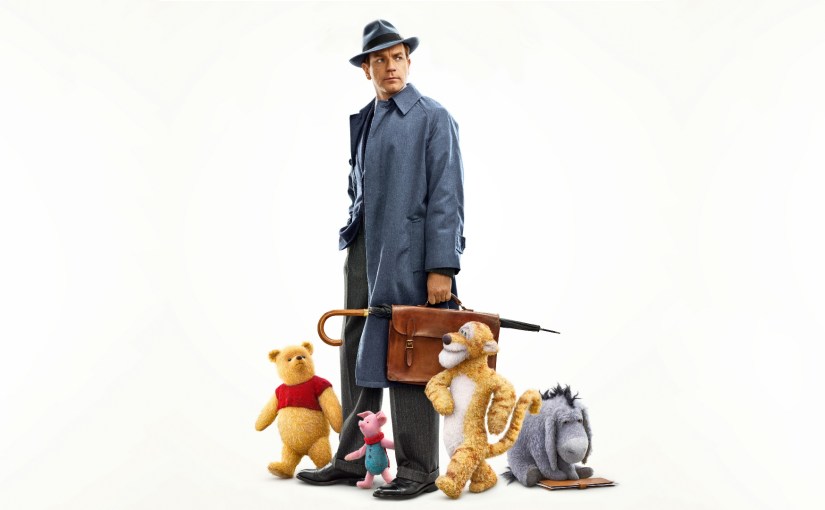
Marc Forster (Quantum Of Solace and Finding Neverland) directs while never losing sight of the fact that Winnie The Pooh, Tigger, Piglet, Eeyore, etc all stem from classic children’s literature by A.A. Milne. The film opens with a backstory on the title character starting with his playful adolescent connection to Pooh & Friends, followed by his departure from them into a strict boarding school and then into adulthood (played sweetly by Ewan MacGregor). Christopher falls in love with Evelyn (Hayley Atwood) and before their child is born he is sent off to war only to return as a no nonsense efficiency manager for a luggage company. He has forgotten his friends who live and do nothing (which always leads to something) in 100 Acre Woods. Worse, Christopher never laughs nor hardly acknowledges his daughter Madeline. He is not a child anymore.

This is the film that Steven Spielberg probably wanted when he directed Robin Williams and Dustin Hoffman in 1991’s Hook. It just came off too clunky and messy at the time.

As the story continues, Forster is not so covert in his symbolism of Christopher Robin shedding his crotchety adult persona and returning to his childhood whimsy. Christopher crawls through the hole in the tree, muddies his suit, loses his briefcase and disregards his paperwork.

I found myself rooting for Christopher’s new found happiness and his revived love for his wife and daughter. I loved the stuffed animal interpretations of the Pooh characters (with voice work from Jim Cummings, Brad Garrett and Toby Jones). Yet, the tears at the sweetness of it all never arrived. As quick as the film began, it was never a challenge to realize how it would all turn out.

So no surprises to be had in Christopher Robin, but an original story to appreciate nonetheless. That’s good enough for me.

A WRINKLE IN TIME

By Marc S. Sanders

Oprah Winfrey has a big head.

I don’t mean a big head as in a large ego. I mean Oprah Winfrey has a BIG HEAD. So BIG that I caught every sprinkle of glitter in her eyebrows and lipstick that it looked like it came out of the discount basket at Justice For Girls. Why do I focus on this first and foremost? Well…because that is about where the scope of imagination stops in Ava DuVernay’s direction of A Wrinkle In Time.

Remember the first time you saw The Wizard of Oz? Remember when Dorothy walks out of her monochromatic home and into the brightly lit Munchkinland? Judy Garland walked cautiously. Spoke carefully (“Toto, I have a feeling we’re not in Kansas anymore.”) There was a reaction to all of the grandeur and strangeness. Now, over 82 years later, many fantasies on film refuse to take inspiration from that timeless cinematic moment. A Wrinkle In Time definitely doesn’t.

In Duvaraney’s interpretation, Reese Witherspoon, dressed in a white king size bedsheet with hideously bright orange hair can just appear in the living room of a home and no one has nary a response to the unusual. There is neither panic, nor a “wow,” not an eye bulge, not a large swallow of gulp. Nothing. The protagonist, Meg, and her mother just say who are you (actually I’m not sure they even said that), and Reese puts on her over exaggerated smile and cheerful vocal inflection and speaks in some kind limerick dialogue. She walks out the front door, disappears into the night, and no one says anything; no one ponders anything. There is no imagination in the filmmaking here, nor in the scriptwriting. This is a fantasy, right?

Mindy Kaling is another fantasy character in garish makeup and costume. She quotes expressions from various poets and artists from history. Why? I don’t know. What does she lend to Meg’s mission? Yawn!!!! Nothing.

Zach Galifianakis accepted the role of another weird character that Johnny Depp probably turned down, and would have likely been offered to Robin Williams had he still been alive. Zach has nothing to say either.

Meg has a little brother named Charles Wallace. I know this because the script hammers away this kid’s name over and over again. Charles Wallace. Charles Wallace. CHARLES WALLACE!!!!! Not just Charles. This kid is always addressed as CHARLES WALLACE!!!! There’s a drinking game in the making. Give the movie 15 minutes and I promise you, you will be heavily intoxicated after hearing CHARLES WALLACE again and again and AGAIN!!!!

All of these claims go back to my one main, sole issue with this film. A complete lack of imagination and awareness of its fantasy.

DuVernay films Oprah as a towering 20 foot presence (literally) and fills in every void of space on the screen with her head. “CHARLES WALLACE” is about all Meg says to her little brother; there’s no sibling connection. Lastly, the most glaring error, is there is no reaction to the wonder of this fantasy. Were any of the actors informed there would be more to the green screens they were filming in front of?

So, it’s a nay for me. If you are going to do a fantasy make sure everyone in the production gets the memo please.

Oh yeah, Meg is on a mission to find her missing father in the universe of time or something like that. Yeah. That whole thing never mattered much to me. It didn’t really seem to matter much to Meg either.

READY PLAYER ONE

By Marc S. Sanders

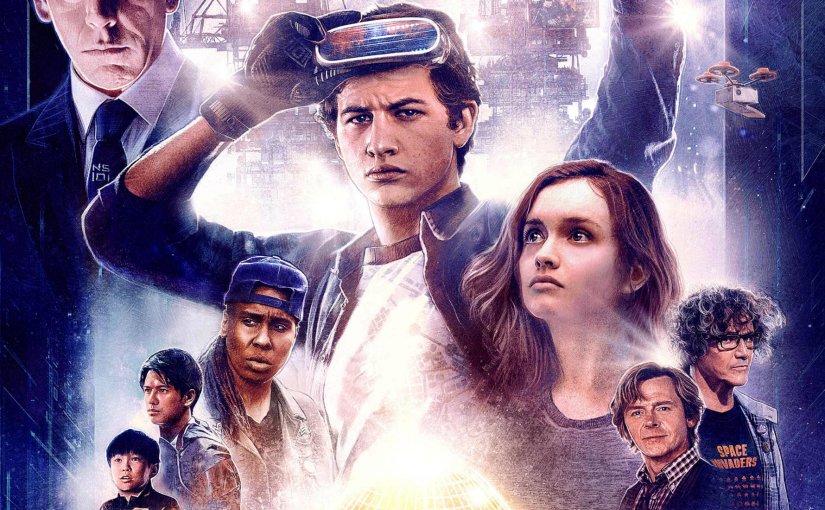
Steven Spielberg’s masterpiece, Ready Player One is the best Easter Egg to search for today.

As a huge fan of Ernest Cline’s novel chock full of pop culture salutes, this latest effort from Steven Spielberg is the film I was looking forward to the most in 2018; more than Solo and definitely more than Avengers: Infinity War.

The film adaptation almost completely succeeds. It is very well cast and the expansive imagination of Spielberg and his crew get everything right. It’s the greatest amusement park for the eyes. When there are not hidden gems to look for, I still found the young cast of characters portrayed by talented unknowns to be engrossing, and more importantly endearing to those cinematic kids of the ‘80s from John Hughes films, as well Spielberg’s other classics.

Authenticity was also truly a priority for Spielberg. I dare not spoil the highlight of the film’s second act but let’s just say the attention to detail was perfection to every minute crammed on the screen. You can’t help but laugh, grin and slap your knee. In fact, you really do it through the whole film practically, but Act 2 really reaches for the skies.

Now the one issue I have. Like Spielberg’s Jurassic Park, the villain was pulled back in their deviousness from the original source material. The danger did not feel threatening enough for me. Here the antagonist is this large conglomerate run by a CEO, and I’m afraid that’s all that Ben Mendelsohn is sadly reduced to. The stakes didn’t seem high enough. Cline’s novel made sure that your life could end as you got closer to solving the puzzles of the “Oasis,” the interactive virtual world that everyone willingly engulfs themselves in. The threat was more convincing in the novel. In the film, I’m afraid it’s a little too watered down.

Still, Ready Player One is incredibly fun with an awesome soundtrack; “Staying Alive” by The Bee Gees will always be the greatest song to bless any film, ever. This film especially supports that argument.

“LET’S SAVE THE OASIS”

THE MATRIX FRANCHISE

By Marc S. Sanders

Miguel and I went to see the The Matrix Resurrections last night and honestly, when I woke up this morning, I had forgotten I’d even seen it.  That’s because, other than the original Matrix film, the subsequent chapters are about as special as cheap food court Chinese food.  When you get home from the mall, you recall what you may have window shopped, but you never reflect on what you had for lunch; well maybe your gut does later on, and that’s certainly not doing you any favors. 

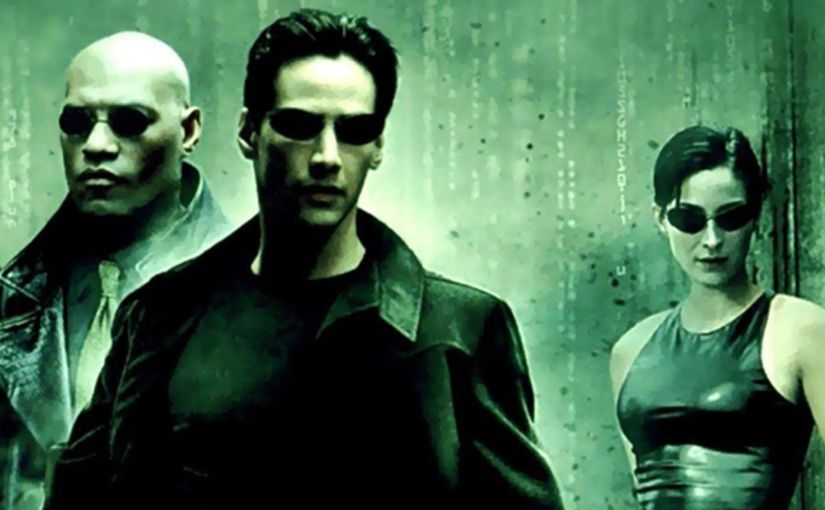
When The Wachowskis introduced the world to The Matrix way back in 1999, it was one of the biggest surprises in films.  No one saw its uniqueness coming.  Everyone was focused on the over hyped resurgence of Star Wars, or a kid who desecrated a pie, or a hand held video film that was seemingly terrorizing audiences.  Yet The Matrix arguably may have had the best longevity that year.  It seemed like a combo sci fi/super hero picture with the players looking ultra-cool in designer sunglasses and leather night club outfits.  Guns and jiu jitsu flew off the screen, but it was done in a new visual kind of way.  Bruce Lee would have likely been a part of this picture had he been alive.  When someone took a kick to the face, it was edited super cool looking sloooooowwww motion.  Bullet time became a thing with projectiles warping through the space between characters and these players, especially Keanu Reeves as the messianic Neo and Carrie Anne Moss as Trinity, would bend and twist and twirl acrobatically (again in slow motion style) to dodge machine gun fire and endless shrapnel.  The look of the film remains absolutely superb.  Nothing (other than maybe the film’s sequels) has duplicated what was accomplished here. 

As well, the original Matrix stands apart from the other three because it actually told a story and developed its protagonist and his mentor (Laurence Fishburne as Morpheus) into fleshed out characters.  It also went so far as to describe what the Matrix is, and what the world outside of that realm represents.  Like all humans, Neo, also known as Thomas Anderson, was actually under the control of a machine-like community designed to sustain a world known as the Matrix, and…well…that’s just bad!  There was solid storytelling here with setting and character development that was later accompanied by well-choregraphed action and pulse pounding club music.  When the film ended, audiences couldn’t wait for more and Warner Bros happily greenlit two more films that were shot back-to-back.  Only the train derailed from there.

Gearing up for the 2021 installment, directed by Lana Wachowski, I watched the first three films again.  Other than the first film, I had forgotten much of what occurred in the 2nd (The Matrix Reloaded) and 3rd (The Matrix Revolutions) pictures.  I realize now that I only forgot what really wasn’t there.  Substance!  Of the two films, Reloaded is likely better, thanks especially to an outstanding highway car chase involving sci fi effects of the characters bouncing off of big rig trucks, motorcycles and car roofs.  A pair of characters dressed in evil white leather with dreadlocks morph in and out of the vehicles and concrete streets as well.  The scene comes late in the film and only wakes you up from the meandering ahead of it.  Truly, it’s hard to comprehend what the hell is being explained in this second film.  The Wachowskis almost would prefer you be impressed with the monosyllabic vocabulary that’s exchanged with each character.  Dialogue doesn’t advance the story any further from where the first film left off.  All that I gathered was our band of rebels who successfully broke free from the slave-controlled Matrix are regrouping at the promised land of Zion, and the machines (squid like metal robots with countless red light bulbs) are advancing for an attack.  Morpheus, Trinity and Neo take it upon themselves to reenter the Matrix (because they look so much cooler there) and do who knows what.  Near the end of the film, Neo walks down a long hallway, opens a number of doorways and encounters the one supposedly responsible for the Matrix, an older gentleman known as The Architect.  This moment was intended to be a highlight of the film and yet it was anything but.  This architect spews out word diarrhea at an alarming rate that only clouds your mind further and further.  The guy has a great radio voice and has an antithetic appearance against the heroic looking Neo, but what in the hell are we supposed to do with any of this?  What’s the point?

On to Revolutions which begins exactly where Reloaded left off.  This is a picture that could have had a running time of thirty minutes at best.  The robots are finally attacking Zion.  One character who seems like he should be important or necessary to the Matrix storyline saddles up in a robot suit equipped with massive machine guns and The Wachowskis make the poor choice of feeding their audience a good seven or eight minutes of this guy spraying endless amounts of bullets in an upwards direction towards the infinite swarm of octopi robotic armies.  His guns never run out of ammo.  He just bellows as he continues to fire.  Where’s the story here?  Where’s the innovation that the first film offered?  Also, what goes up, must come down.  Shouldn’t some of that ammunition have dropped down in a hail storm eventually?  Reader, if I have to ask that last question then you know there’s not much to pay attention to in this film.

The wisest character of the Matrix films, Morpheus, is given very little to say or do in either film.  Fishburne stands in the background and let’s everything happen around him.  He’s not utilized to explain anything like he was in the first picture.  His skill for teaching the audience has been completely diminished.  Whatever he had to offer was exhausted following the first picture.  With Revolutions, especially, the filmmakers rely on B characters that we’ve never really gotten a chance to know or remember or adore like Yoda or Jabba or even Boba Fett in the films that followed the original Star Wars. In fact, Revolutions seems more concerned with its extras than any other film I can recall.  So much so that when a major character from the first film has a death scene, you hardly care for the loss.  There wasn’t much to expound on the character after the original film.  Revolutions only relies on the war nature of the human armies against the monochrome metallic squid race.  Beyond shooting at one another, where’s the conflict?  Ms. Pac Man and Frogger have more depth than any of this.

That’s the problem with these films.  A discovery was made with the 1999 installment and the filmmakers opted to capitalize on the effects and not the challenge of story. 

Furthermore, and this goes back to the original film when I first saw it in theatres, I was always of the mindset that I’d rather live in the Matrix.  After all that Morpheus has revealed to me, the Matrix still seems like the better place to reside.  The real world consists of living on a dirty, dreary ship and eating slop for food while wearing torn sweaters and having electrical plug orifices running down my spine.  Who wants that?  A Judas character from the first film turns on his crew by telling the evil Agent Smith that he will bring them Neo as long as in return he doesn’t know that he’s under the control of the Matrix and he can savor the taste of a juicy steak again.  Now I’m with this guy.  Aren’t The Wachowskis as well, though?  More footage and highlights take place in the computer mainframe of the Matrix than outside of it.  Thereby, more cool looking action sequences can happen and the cast appears more glamourized.  The films want us to fear the horrors of the Matrix on the humans by showing them plugged into wires while drowning in a pod like puddle of KY jelly embryonic ectoplasm.  You know what?  What I don’t know won’t kill me.  So, leave me be.  Perhaps the argument would have been more convincing had the environments been reversed.  Put the rebels as slave dilemma in the real-world areas and the utopian setting within the Matrix.  Then I might buy the problem here.

The newest film, Resurrections, is nothing special and nothing new.  It’s rather boring actually.  Revolutions was boring too.  It only kept me awake because it was two hours of headache inducing noise.  With the new 2021 film, apparently a new Matrix has been developed and thus a new Neo and Trinity have been conceived.  The antagonist is represented by Neil Patrick Harris and that’s about it.  Miguel pondered much, following the picture as to what was going on.  That’s not a good sign for a popcorn action flick, and it’s consistent with what was done with the 2nd and 3rd films.  What the hell is anyone talking about. Once again, dialogue moves to a beat of answering questions with questions. Even the allies speak to one another that way, and if it is not a question, then it is a cliché of some sort.  Don’t these people want to help one another?  If so, then speak to each other like your four years old and get to the point.  The action scenes drone on and on.  A goal of the picture is to keep Neo from finding Trinity because if they do, then the Matrix crashes.  Okay.  That’s simple enough.  Yet (spoiler alert), when they do find each other, somehow this new Matrix continues on.  Huh??????  The movie just betrayed me, and I don’t like that. 

Miguel attempted to conjure up the idea that Lana Wachowski was trying to demonstrate her transition from a man to a woman and this new picture was a representation of that.  Could that be true?  Maybe, but it never occurs to me while I’m watching the picture.  Am I watching The Matrix Resurrections because it’s the newest Wachowski film?  No.  This isn’t a Quentin Tarantino or Christopher Nolan piece.  This is leather and gunfire and sunglasses and noise, all depicted in a green DOS computer hue lens.

The Matrix was always worthy of a sequel; a subsequent follow up that explored imagination and perhaps more background.  What has Neo not yet uncovered.  Yet, the series as a whole continues to deny those opportunities and simply settles for cool looking visuals that get overly exhausted and tired.  No new skills are featured with each passing film.  Over the course of the series, the big bang, so to speak, of the first Matrix never reveals itself.  Instead, we are mind controlled viewers relegated to depend on overlong dialogue with no point and no where left to explore.  We are simply gifted with Neo punching Agent Smith and/or infinite duplicates of Agent Smith with no one getting weakened or wounded or defeated.  Look no further than an early fight scene in Reloaded.  The scene goes on forever.  The editing is amazing.  So is the choreography but after four minutes of this, it’s time to show some progress.  The Wachowskis limit their imagination to just having Neo fly away.  Scenes like this only allow me ample time to exit the theatre for a bathroom break and return having not lost out on any storytelling.  My friends, you can find plenty of bathroom breaks in this series of films.

The Matrix Reloaded, The Matrix Revolutions, and The Matrix Resurrections should never have been made.  Producer Joel Silver and Warner Bros would argue otherwise though.  Their wallets continue to get fatter, but at the cost of controlling moviegoers’ appetite for something more when all they really got was dry rice and overcooked orange chicken from the food court.

GOLD

By Marc S. Sanders

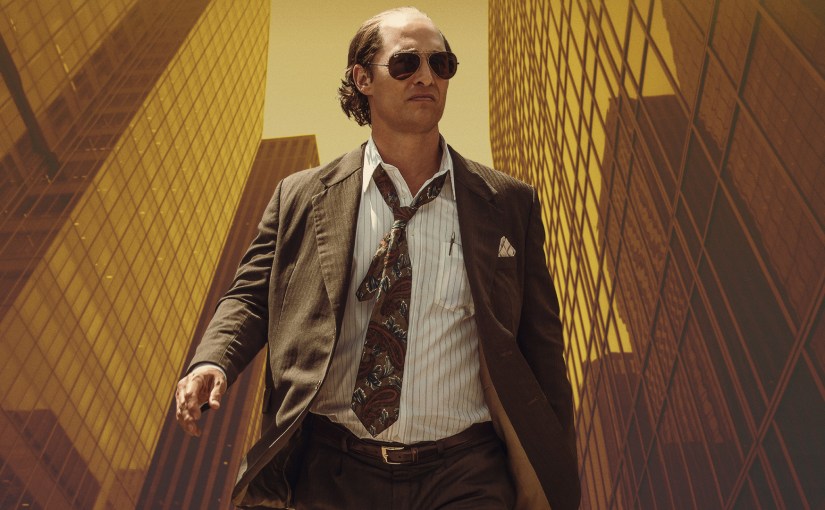
Fantastic find on Netflix with Matthew McConaughey doing his best chain smoking, hard drinking, pot bellied method acting.

Stephan Gaghan directs a patchwork film that zig zags from the sleazy get rich quick offices of Reno, NV, to the wet, mud strewn Indonesian jungles,and on to the steely ice nature of white collar New York City.

What is depicted is the hunt for the most precious metal, and when it is found how best to capitalize on it while maintaining your name and growing your fortunes. Yet any sudden development could crash it all in what seem like seconds.

I had no idea what to expect from this movie. Early on for about 15 minutes, it seemed to be moving too slow but then it picks up because the true life story is mired in twists I never saw coming. Great acting. Great script. Great direction.

Fantastic movie. McConaughey doesn’t get enough credit for his fantastic career of performances. He’s just a top notch actor in so many ways.

This is so worth checking out.

STAND AND DELIVER

By Marc S. Sanders

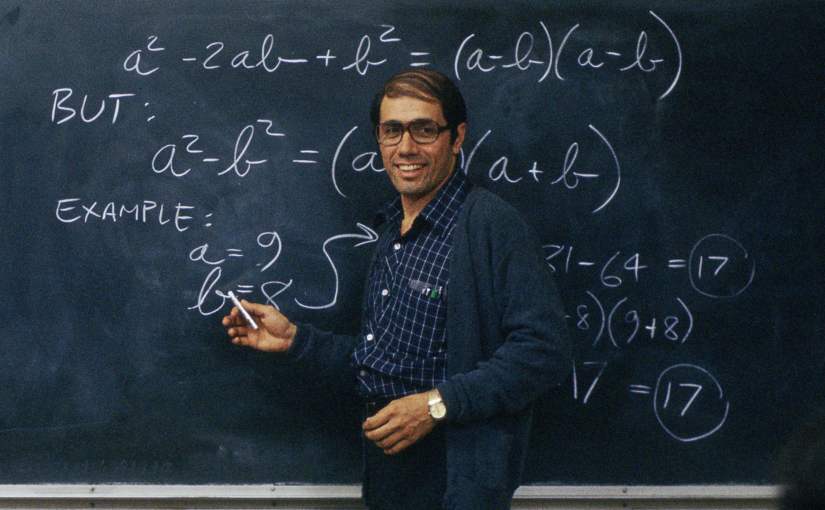
One of the most inspiring classroom setting films is Stand And Deliver directed by Ramon Menéndez and written by him with producer Tom Musca. This pair took great pains to protect the integrity of their script.

The film tells the story of math teacher Jaime Escalante’s (Edward James Olmos) uncompromising drive to bring 18 students at Garfield High School to passing the state’s AP Calculus exam. These students come from working class Hispanic families who hardly offer their own children any bright future beyond fixing cars, waitressing in the family restaurant or remaining as a gang member in a life of crime. Their parents laugh and shake their heads at their dreams of becoming doctors or engineers. Their parents never had a teacher like Jaime Escalante.

Escalante motivates them to find a ticket out, and become the first members of their families to graduate high school and go to college. The first two acts of the film focus on Escalante’s drive and brief encounters with some members of his classroom. He shows how he’s not intimidated by gang member Angel (Lou Diamond Phillips) and how he convinces a restauranteur to allow his daughter to return to class. Another student is overcome with stress. Escalante listens but doesn’t allow the student to give up. I like these scenes a lot and my descriptions do not give these moments enough credit.

The film does not rely on classroom speechifying or inspiring rock music to cut in with sequences of kids reading books. Instead, it drives home the fact that Jaime Escalante never loses sight of the nowhere potential these students live with. The students learn to respect the one man who never underestimates them, regarding him as “Kemosabe.” He never allows them to lose their “ganas;” a desire for something better.

Even after they pass the exam, the students’ own environment will not allow them to celebrate their success. It’s too hard to accept the result. It’s easier to accuse them of cheating as it’s presumed that this sect of Hispanic/Mexican people could never have accomplished what their scores indicate. No other explanation could merit what’s occurred. Escalante is angered by this racism, but his confidence in his students pushes them to retake the exam. Blatant racism will not prevent a future without poverty.

The students consist of mostly unknown actors. Following this film from 1988, I’d catch one of them guest starring on a TV show here or there. Collectively speaking though, they really come through by convincingly displaying their lower class lives. It’s easy to see a lack of potential for these kids early on in the film. It’s also comfortably easy to see how Escalante takes command of their lives with a sense of unity and motivation. No one ever told these kids they could solve some of the hardest mathematical equations ever conceived. No one ever told these kids they could amount to something. It took someone from their own environment to help them defy a stereotype and demonstrate that intelligence is a gift that any human being is blessed with. They just have to have the “ganas.”

Edward James Olmos was nominated for a Best Actor Oscar. I’d say it was one of the most under the radar performances to ever be considered frankly. Stand And Deliver was made on a small budget. It’s easy to see that. Still, that is also what is so special about the film. This film stood on its performances and the genuine inspiring story it’s based on. It had all the ingredients it needed to be a winning film. This film eventually reached the exclusive annals of the prestigious National Film Registry of the Library of Congress. Stand And Deliver will tell you to never surrender. 

THE KARATE KID (1984)

By Marc S. Sanders

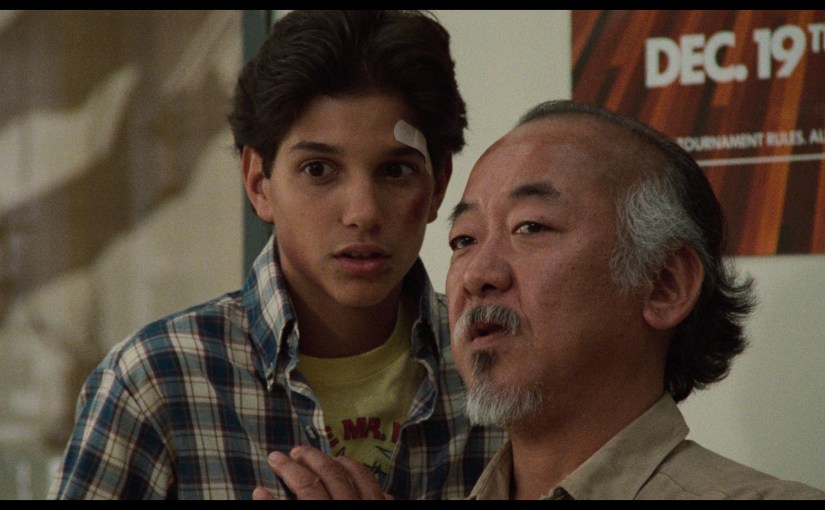
Though it may feel like an After School Special at times, there’s always been a charming quality about The Karate Kid, and that stems from the relationship between Daniel LaRouso (Ralph Macchio) and his elderly Asian mentor from Okinawa, Mr. Miyagi (Oscar nominee Pat Morita).

John G. Avildsen, director of Rocky, is harsh in the expository bullying that Daniel endures when he moves from Newark, NJ to California. The Kobra Kai kids led by William Zabka (your go to bully for 1980s films) are brutal in their fighting skills as they use Daniel as a means to exercise their Sensei’s philosophy of “No Mercy!” The Sensei is played very frighteningly by Martin Kove.

What’s hard for me to digest with The Karate Kid is that Macchio is not very good in the role. He kind of comes off as a kid I’d never want to hang out with. He tries too hard to be cool, but he doesn’t look cool. His sense of humor is really never funny. It’s too hokey really when he puts the charms on his crush Alli (Elisabeth Shue). While Shue is fine her in her sweetness, Macchio is really why I never found any chemistry between the two actors. He comes off like Shue’s little brother more than a high school crush. He’s a twerp. What saves me from giving up on Daniel, or Macchio in the role, is the maintenance man who steps in to rescue Daniel from another beating.

Pat Morita is excellent as Mr. Miyagi and has truly created one of the most pop culturally significant characters in film from the last forty years. There’s an authenticity to his role. Most importantly, he’s a veteran of World War II who suffered loss. A great scene occurs mid way through the film where Daniel finds a drunken Miyagi commemorating the death of his wife and newborn both lost due to complications in childbirth while he was away in service. Screenwriter Robert Mark Kamen brought a depth to the Miyagi role. Along with Morita’s performance, he allowed a likability in Daniel that eventually catches my interest. Daniel eventually appreciates the elderly man beyond his devotion of karate. When Macchio is responding to Morita, I like him. When he’s responding to any other character in the film, I don’t like him.

The centerpiece of the film is the mundane training that Daniel endures. “Wax on. Wax off,” and so on. It’s hardly forgettable but it’s also a little slow moving. Still, I like the lesson. Miyagi demonstrates that the best way to learn karate is ironically when you have no inkling that you’re learning karate. Use the fundamentals of any skill and apply it to the art of karate. Karate doesn’t stem from an urge of violence. It comes from something more intrinsic. Karen’s script with Avildsen’s direction never forgets that.

The payoff moment is when it dawns upon the very naive Daniel of what Miyagi was teaching him all along. Daniel might be painting the house and sanding the floor and waxing the cars on Miyagi’s property, but is that all he’s doing? Soon we discover the significance of this drawn out sequence. Morita opens your eyes when he throws punches and kicks at a frustrated Daniel, and it dawns on the kid that he suddenly knows how to defend himself. Avlidsen films a hair raising scene at this moment. Its like when the frail Yoda uses the Force to lift Luke’s X-Wing fighter out of the swamp. It’s another layer revealed in the Miyagi character.

So, without Mr. Miyagi The Karate Kid plays like a cheesy home room, early 80s lesson film. When a scene includes Morita, the wow factor is front and center. Often I talk about the best characters are the multi dimensional ones. Mr. Miyagi is the perfect example. We see him as the quiet maintenance man, then he’s the master fighter, then he’s the guy with a healing skill, then he’s the guy who’s got the secret crane technique for delivering a kick, and then he’s the guy with a sorrowful past and finally he’s the mentor and most importantly, he’s the friend. All of this crammed into one little old man from Okinawa. Pat Morita is the reason to watch The Karate Kid.

LEAN ON ME

By Marc S. Sanders

The career of director John G. Avildsen is best defined by his inspirational stories of athletic prowess for the underdog, particularly The Karate Kid from 1984, and the Oscar winning Best Picture sensation, Rocky.  Both films follow similar formulas once the exposition phase is completed.  Music montages fill the screen with endless training with the protagonists giving it their all.  Avildsen’s film, Lean On Me, teeters on these conventions and it tells me one thing.  Training montages belong in the field of physical activities, not with tests of intelligence and academics.

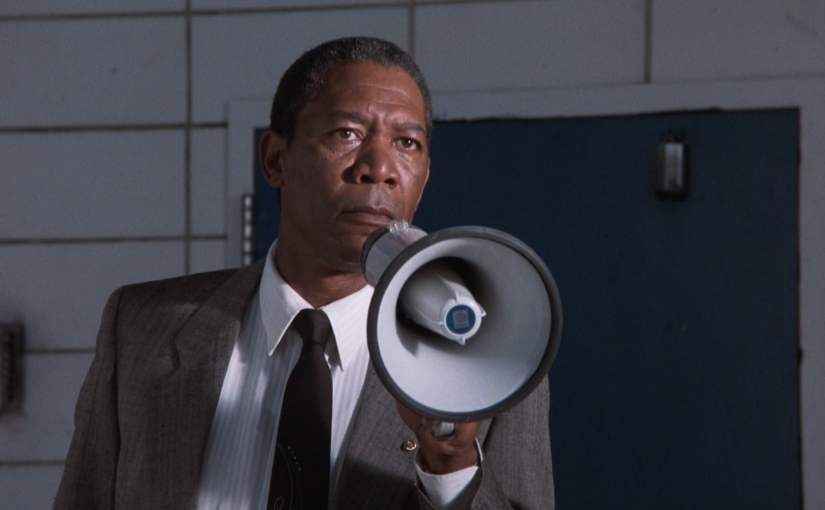
Morgan Freeman portrays Joe Clark, or Crazy Joe Clark with the baseball bat, who singlehandedly (at least according to the film) turned around the Eastside High School of Paterson, New Jersey from a hell hole of violence, drugs and terror into a respectable institution of education.  Eastside, where the actual film was shot, is depicted as the absolute worst.  You can’t even tell the original paint colors of walls because they are covered in so much graffiti.  Early in the film, a teacher’s head is bashed into a puddle of his own blood while trying to break up a fight among the students.  Drugs are exchanged out in the open.  This is a dangerous place. How dangerous?  “Welcome To The Jungle” by Guns N Roses is playing over all of this footage. 

Worst of all, however, seems to be the last place ranking of the school’s score on state’s standardized test for basic education.  After all that I saw in the first ten minutes of the film, that is the biggest concern? 

Joe seems to be the one and only candidate to get in there and clean this mess up.  His tough exterior and reputation for not getting along with his superiors or his peers is a gamble but what other choice does the mayor have at this point.  The first move that Joe carries out is to have all the drug pushers and criminals explicated from the school immediately.  His second move is to chain every door in the school to keep this riff raff out, which only ticks off the fire marshal and a firebrand activist mother who wants Clark terminated.  While I thought the mother was needlessly a pain in the ass, only to serve as a poorly written antagonist, I can’t help but empathize with the fire marshal; cuz, yeah, what would happen if there was an actual fire?

In between all of this, Crazy Joe bullies, berates and screams at his teaching staff and administration while the students paint over the graffiti.  Some of the staff scream back or toss over desks.  Morgan Freeman is such a capable actor and you can’t take your eyes off the energy he brings to his roles, whether they are subdued like in The Shawshank Redemption or Driving Miss Daisy, or they are out of control hyper as on display here.  Yet, I didn’t feel fulfilled or inspired by his portrayal of Mr. Clark or the film as a whole.  It’s not his fault.  Rather it’s the outline of the script.

A running theme here focuses on the scores of the test.  Joe is first mad as all hell at the low score of the practice tests.  We eventually reach the actual final exam.  Much has been cleaned up at Eastside and Joe screams like a hyped-up football or wrestling coach to the entire study body about how important it is to pass the exam they are about to take within the hour.  The students clap and applaud and sing the title song in harmony.  This scene supplies the inevitable and inspiring training montage that Avildsen relies on.  You know what’s going to happen, right?  They pass of course!  Yet, how did they really pass this exam within the ninety days that the film tells us they have to study?

Lean On Me gets distracted with its other problems such as single mothers who kick out their children and drug pushers who manage to get back into the school, where Crazy Joe disarms one of them threatening with a switch blade.  Late in the film, a teenage student gets pregnant, only to have this storyline abandoned thereafter.  The debate with the erratic mother and the fire marshal takes up large portions of the film as well, and when they don’t, Joe is screaming at his band of teachers making sure they know it is their own fault that the students are failing.  All of these moments are meant to get the audience to nod and shake their heads at how much the world is falling apart, while getting tearfully inspired by the angry, tough love of Mr. Clark.  Right on Joe!!!! It’s like a bad afterschool special, really.  I’m not in denial of the endless variety of problems our schools encounter.  However, this film is less than two hours, and these kids have a test to pass, people!

I just think the wrong movie was made here.  I recall from the late 1980s, the real Joe Clark on the cover a Time Magazine defiantly holding his baseball bat.  My teenage self found the cover shocking.  Having gone to private schools full of unspoken discipline, I’d never imagine a teacher brandishing a bat to make his point.  So unusual was this to me that naturally Clark’s story should be made into a movie.  Yet, the triumph of Lean On Me depends on the passing score of the state exam.  Only, just how did these students pass this exam? 

It’s easy to compare Lean On Me to the film Stand And Deliver.  It’s also easy to see which is the better film.  The latter film focused on underprivileged and uneducated Southeast Los Angeles students who triumphantly passed the most difficult of standardized mathematic exams.  When the passing scores arrive at the end, though, I believed the truth of it all because the film focused on the inspiring teacher Jaime Escalante and his methods for teaching algebra and calculus.  Stand And Deliver showed how those students sacrificed their Saturdays to attend class and studied while working or tending to their families.  In Lean On Me, I don’t recall one student opening a single book or any teacher even writing on a blackboard.  They did learn the school song though.

I don’t disagree with anything that Avildsen’s film offers.  Joe Clark saw the importance of learning the school song to build up pride among his students.  He saw the necessity in painting over the graffiti to maintain the image of a proper institution for learning.  He went to desperate and defiant measures to protect the integrity of Eastside High School.  My problem is the means don’t justify the end.  How does chaining doors, painting over graffiti, and singing the school song, accompanied with endless screaming measure up to passing a standardized test?  Did it all just hinge on one proud moment ahead of taking the test with a beautiful and soulful rendition of the song “Lean On Me”?   I know the passing scores were all achieved in real life.  I just wish I got to see it on screen.

Note: Eastside High School is where my mom graduated from.  It did her proud to see the school recover to its original reputation.