JUST ONE OF THE GUYS

By Marc S. Sanders

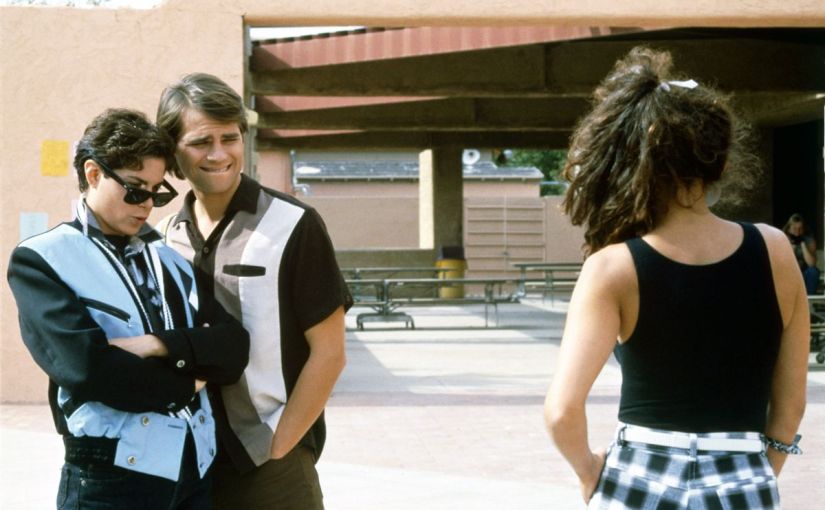
Okay. Okay. No need to throw darts my way. Sorry, but I love the 80s teen comedy Just One Of The Guys.

People please!!!!! Please understand my position on this subject. It’s Joyce Hyser!!!! One of my top three crushes from adolescence – Joyce Hyser. Joyce Freakin’ Hyser!!!!!

Now the irony is that while I have-yes, still have, and my wife has accepted this-a crush on Joyce Hyser the point of this film directed by Lisa Gottlieb is that lead character Terry needs to prove that she is more than just good looks. Terry is not just a hot chick. Terry has a brain, and to prove that she has the potential to be a fantastic journalist, she will register in another local high school where she will submit her article that’ll award her a summer internship at the Sun Tribune newspaper. Only thing is to keep her looks from getting in the way, she’ll have to register as a male student.

All the trappings of comedy cross dressing occur like using boys bathrooms and avoiding jock strap inspections from the gym teacher. She also has to put up with keeping her sex starved brother Buddy (Billy Jacoby) from teasing and revealing her secret. As well, her studly college boyfriend can never find out. An unwelcome crush (Sherilyn Fenn) on her male persona is trouble too. Oh yeah, and the typical 80s cinematic bully, actor William Zabka, has returned for the millionth time. There’s a lot packed into this cute flick that’s a loose adaptation of Shakespeare’s Twelfth Night.

Gottlieb’s film also steals elements from Jane Austen. The confused romance angle occurs. Terri decides to make Rick Morehouse (Clayton Rohner) the subject of her article. He’s a James Brown loving guy with no style and a crush on the bully’s girlfriend. Terri transforms him while she becomes Rick’s best guy pal. Only problem is that while Terri is working on finding a prom date for Rick, she’s also falling for him.

There’s a sweetness to Just One Of The Guys that always touched me as a teenager. Joyce Hyser as Terry is written more down to earth than characters from other teen 80s comedies. She has ambition and the movie stays with that theme. It’s important that Hyser is positively appealing in the looks department because it’s the Achilles heel of her character. Too often people are judged by their appearance. Her journalism teacher even suggests that she should pursue modeling with next to no shot at being a journalist. Interesting to see this scene in 2020 following the changes that sprung from “Me Too.” Frankly, the scene seems to have more impact today. It’s unfair to think that way about women. Just One Of The Guys with a script from Dennis Feldman & Jeff Franklin knew that well enough from the mid 1980s.

The film also has great side characters. It does really well in the geek gag department. One loves tiny reptiles, that he keeps housed in his pockets. Two others seem to share the same brain on a B movie science fiction level. They’re especially hilarious. Plus, the film boasts a zippy soundtrack that is one of my favorites.

I’ll also proudly say that the infamous topless scene that comes at the end actually seems necessary here, and not exploitive. It almost has to be done when the reveal is finally dawned upon Rick.

That and one of the best film ending on screen kisses make Just One Of The Guys one of my favorite 1980s byproducts.

OUT OF AFRICA

By Marc S. Sanders

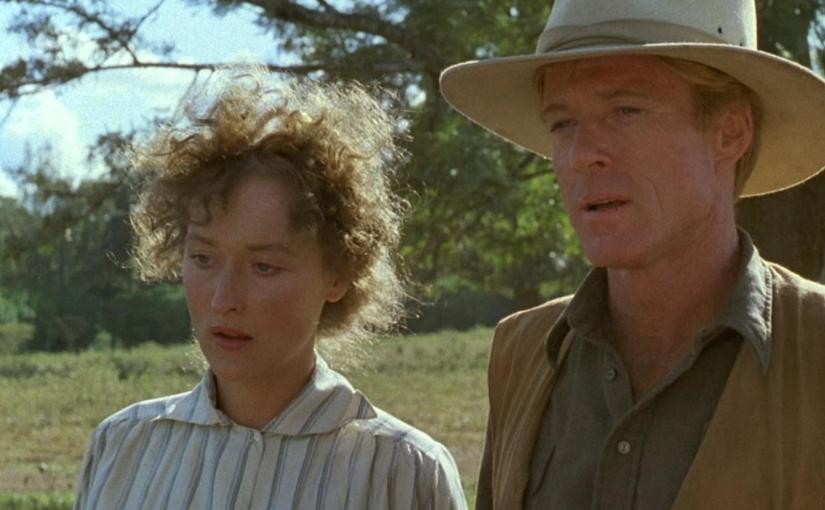
Sydney Pollack’s Out Of Africa might seem like a whirlwind romance if you’re only looking at the top billed names of the cast, Robert Redford and Meryl Streep, but it’s much more than that. It’s an education of the African continent beginning in 1913 when World War I was on the brink, and the British monarchy appeared to become territorial of its lands.

Karen Blixen (Streep) is a Danish Baroness who marries a Swedish nobleman, Baron Bror Blixen (Klaus Maria Brandauer) out of simple convenience. She plans to begin a cattle farm outside of Kenya to manage with Bror. To her unfortunate surprise, Bror has invested her monies in harvesting coffee on the land, which is much more difficult to produce at the altitude where they settle. Bror is also not so concerned with growing to love Karen and would much rather hunt on safari and be a womanizer, while welching off of Karen’s enterprise.

Karen grows to love Africa with its wildlife, as well as the local people whom she does not object to them squatting on her property. She provides medical aid and schooling for the children, too.

Karen also encounters the dashing adventurer, Denys Finch Hatton (Redford). Denys comes in and out of her life where he welcomes her on expeditions that are up close with lions and rhinos. He also takes her in his biplane to get God’s perspective of the lush scenery, a major centerpiece of the film. Denys, however, is not concerned with offering the full commitment Karen seeks. He’s happy to carry on with his safari treks only to return on occasion.

Clocking in at nearly three hours, Pollack’s film gives plenty of time and footage to absorb gorgeous landscape views of Africa from above and across the plains. The cinematography is on par with some of the best I’ve ever seen in a motion picture, compliments of David Watkin. The colors of sky with green, brown and yellow landscapes are breathtaking. Sunsets are spectacular with Redford’s silhouette in the foreground. Herds of cattle consisting of oxen, gazelles and lion feel so up close and personal. The production design of Karen’s home and coffee farm are also noticeably authentic. The home feels comfortable.

Out Of Africa is based on the stories told from Isek Denisen, Karen’s pseudonym. Like many of these sweeping epics, I find that I need to get accustomed to the nature of the film first. Dialects, when done authentically like Streep always strives for, are challenging for me to understand initially. The African people are hard to understand at times. As well, this is a period picture in a territory that I’m mostly unfamiliar with. So, I find that I have to adjust to the habitat and culture of the characters. Frankly, the first half hour or so was a little tough for me to stay with the picture. Once I got my footing with the film, though, I could not get enough. I felt terrible for Karen when she contracts syphilis. I was truly annoyed with how the Baron treats Karen with such disdain. It’s also heartbreaking when Karen and Denys are in disagreement with one another, simply because I loved the chemistry between Redford and Streep. Later setbacks feel tragic, especially as you feel like you’ve traveled through the progress and impactful differences that Karen affectionately made for Africa and its people.

Out Of Africa is an outstanding piece of filmmaking. It’s another example of a film where the setting is as much a character as the leads who carry the story. Sydney Pollack and his crew, which includes grand horn and string chords from Oscar winning composer John Barry present a captivating story that also feels rich in a documentarian point of view. A restored copy of the film on a large flat screen TV is a must see.

CLEAN AND SOBER

By Marc S. Sanders

There’s nothing pretty about alcoholism and drug addiction.  Surprisingly enough, I can only think of a handful of films that really explore the struggle ahead of the main character admitting to a problem, then going through the rehabilitation process, and then trying to live without the chemical dependency, thereafter.  Each of these stages have been depicted plenty of times, in all kinds of mediums.  Yet, Clean And Sober, directed by Glenn Gordon Caron, with Michael Keaton in the lead role, covers all three quite effectively.

Keaton portrays Daryl Poynter, a successful real estate broker.  When he’s awakened by a phone call one morning, his incessant sniffing is interrupted by his insistence to the caller that he’ll check on a missing $92,000 from an escrow account on Monday morning.  He quickly hangs up the phone and turns towards the nude woman in his bed.  Then it dawns on him that something is not right with her.  Police determine she has overdosed, and Daryl better stay in town. 

Instead, Daryl opts to check in anonymously to a nearby rehabilitation center.  He’ll get free room and board, and no one will know to look for him while he’s hiding out from those looking for the escrow money or how he may be responsible for the drugged woman.  He’s just hiding out, though.  Daryl has no intention of following the program the center offers.  So, Daryl is a rule breaker where he sneaks in phone calls to his stockbroker, and his friend that he insists send him an overnight package of cocaine he kept stashed in his office desk.  Morgan Freeman is Craig, the leader of the recovery program and a recovering addict.  He easily sees through Daryl’s shenanigans and kicks him out.  Following a late night, out-of-control episode at his office, while looking for his drugs, Daryl returns to the center and gradually acknowledges his problem, while still living in fear of the consequences when he learns the woman he was with has died and her father has gone out looking for him.  His bosses are also questioning the whereabouts of that money.

Keaton turns in a chain smoking, red eyed performance.  His appearance and body language convincingly send the message of his harmful addictions more than his line deliveries.  Honestly, I found him to be a little over the top with his rantings and “fuck you” temper tantrums.  When I was observing his behaviors, only then was I buying his portrayal.  This role should serve as a significant accomplishment in the history of Keaton’s career.  Before this film, from 1988, the actor was more well known for comedies (Mr. Mom, Gung Ho, Johnny Dangerously) and his tours on the stand-up circuit.  I think he became a better dramatic actor later on. 

Freeman is once again so good as a subdued, in charge and street-smart mentor.  Another good mentor comes from the never showy character actor, M Emmet Walsh (I find him in so many of these now classic films; he really had a presence in Hollywood.)  Walsh is Richard, the unglamourous sponsor that Daryl was never expecting.  Daryl was holding out for an attractive woman to be his sponsor.  A great scene occurs between the two actors when Daryl meets Richard at a diner for lunch.  Richard has three desserts and a milkshake on the table in front of him.  Daryl makes a crack about it, and Richard reminds him that they are addicts.  It’s in their nature to be compulsive, even with food.  Good writing here, from Tod Carroll, who doesn’t take for granted how a recovering addict lives with himself, for the rest of his life, from one day to the next.

Carrol offers up other special scenes.  We’ve all seen the staged AA meetings where the character stands up, says his name and the others say hello back.  Tod Carroll goes a step further.  Morgan Freeman as Craig is a smart character who sees past the well to do appearance, and smiling face of one young female character and calls her out for being high right in front of the group.  He immediately asks her to leave, and rather than come off embarrassed, she exits the room.  The rest of the group, Daryl included, are shocked.  They are only beginning to learn how people like them function only on the dependency of the drug and drink.

Kathy Baker portrays another addict that Daryl becomes attached to.  She’s also very good in her role as the lonely woman with the boyfriend who treats her like dirt, yet she can’t imagine anyone better for her; not even Daryl as he’s moving on a positive path towards recovery, and wants to begin a life with her.

Caron and Carroll focus the script of Clean And Sober on a variety of ways that addiction affects different walks of life.  It’s fortunate that the film does not fall into the trap of melodrama.  Chemical dependency is an ugly ordeal that destroys so many lives, not just the abuser.  Relationships are tested.  The will to function is also tested.  As well, the endurance to remain clean and sober is tested. 

This film might be from the late 1980s, but I’d argue that its themes and messages remain prevalent today.  Alcohol and drug addiction still stand as leading killers within the country.  I believe violations of DUI are not taken seriously enough.  Alcohol and drugs are too easily accessible and affordable, thereby feeding the illness.  Ultimately, we can only be responsible for ourselves.  One way to hold fast to our committments is to observe and learn.  Clean And Sober will allow you to do just that.

BACK TO THE FUTURE PART III

By Marc S. Sanders

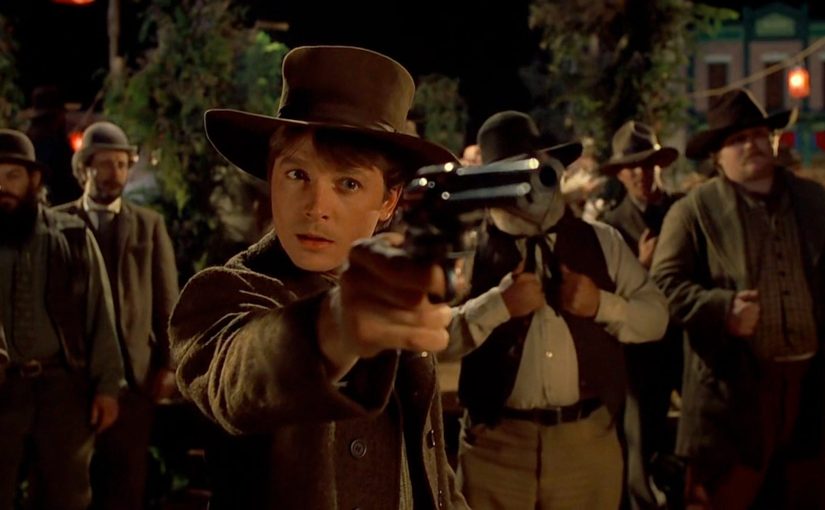
I think Bob Gale and director Robert Zemeckis forgot one thing about Back To The Future Part III. It was supposed to be a time travel movie. Sure, Marty McFly (Michael J Fox) travels back to the Hill Valley of the Old West in the year 1885, but once he gets there, there is not a lot of material for the beloved DeLorean.

The film picks up immediately where the last film cliff hanged. Marty is left trapped in 1955, and he receives a letter sent to him 70 years earlier from his present day Doc Brown companion (Christopher Lloyd) originally from 1985. You still with me? When Marty realizes that Doc gets shot in the back by Mad Dog Tannen (character actor great, Thomas F Wilson), he arranges with the 1955 Doc to send him back to the Old West and prevent that from ever happening.

From there, the film turns into a staple Western. There’s the calvary, Indians on horseback, quick draw duels in the street, a saloon, stage coach and wagons. Most importantly, there’s a steam engine to push the DeLorean to the necessary 88 miles per hour to send our heroes back to the future. That dilemma is solved quickly and early on. They now just have to wait for the train to arrive.

So the film calms down to allow a charming Mary Steenburgen as Clara Clayton, a schoolteacher, to capture the affection of the good ol’ Doc. When the romance seems impossible though, we get a depressed Doc. A depressed Doc Brown is never good for a movie. Consider this. It’d be so easy to just wait for the moment to travel back in time. However, obstacles get in the way, right? In the fantastic first film, Marty has to play guitar at the school dance to get the necessary first kiss between his parents thereby solidifying his existence. That’s fun…and then he kills it while performing “Johnnie B. Goode.” Here, the moment to time travel is approaching, but it can’t happen because Doc is depressed. What’s so fun about that?

Like Part II, Part III is watchable. It’s not terrible by any means. It’s just a little stale. The best gag, however, is Marty taking on the name of “Clint Eastwood” to build his status in the town. This allows a lot of inside jokes. What would’ve sent this film into the stratosphere is if they got the legend himself to make at least a cameo. Alas…. I can dream and wonder.

Back To Future Part III ends the film on a sweet message similar to what you get from other fantasies like The Wizard Of Oz or Willy Wonka & The Chocolate Factory. It reminds me that despite its shortcomings, the entire Future trilogy is great to share with the whole family. No doubt, there’s always something to look at and focus on.

Still, some movies that require focus specifically, takes work. The first film allowed me to wonder. Wonder if all of this could be true one day. Wonder how they thought all this up. Wonder how Marty is actually going to get back to the future.

If I have to choose, I’d rather not focus. I’d rather just wonder.

BACK TO THE FUTURE PART II

By Marc S. Sanders

Back To The Future Part II is a paint by numbers or recipe film more than just a film. This has to be done, so that that can be done, cook on high for just over two hours and all will be wrapped up. Because it is so focused on covering all bases it forgets the wonder and fun of the original film, and just gets down to business. Watching this film makes you feel like dad just won’t throw the football around with you in the front yard. He’s got work to do.

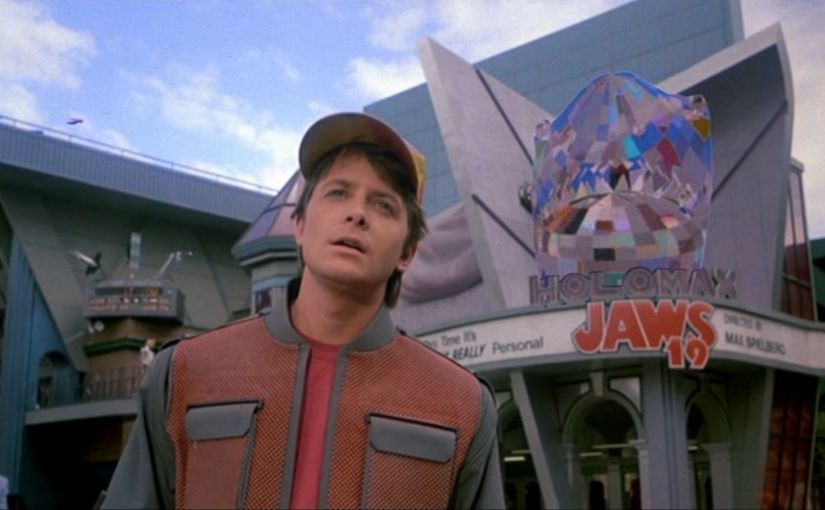
The sequel picks up immediately where the first film ended with Doc Brown (Christopher Lloyd) taking Marty McFly (Michael J Fox) and his girlfriend Jennifer (Elisabeth Shue) to a very zany looking future in the year 2015, complete with flying cars, Jaws 19, the abolition of lawyers, and opportunities to get a redesign of your body complete with a replacement of your spleen and colon just like Doc explains. When an elderly Biff Tannen gets a hold of a sports encyclopedia, he travels back in time to 1955 to tell his younger self to make bets he can’t lose. Now the future is entirely changed, riddled with crime, and Biff in absolute power. Worst of all, the brute is married to Lorraine, Marty’s mom (Lea Thompson, regrettably not given much to do this time around). So, Doc and Marty need to travel to 1955 to set things right all over again.

Look, if you were gonna make a sequel to Back To The Future, this is likely what the script was going to spit out. It’s a watchable film. However, it’s lost the soul of the original installment. It feels like an office project. The comedy is absent. A long sequence shows a middle age Marty in 2015 talking on video phone remotely with his bullying boss, and getting fired, with fax machines all over the house spitting out the message as well. This is supposed to leave me in awe? This is funny?

The second half of the film in 1955 has Marty pursuing Biff the bully while trying to get the sports book back. Biff, played by Thomas F Wilson, is more or less doing the same thing as the first film. Only he’s not the dumb buffoon we laughed at the first time. He doesn’t have George to bully around this time. You realize Biff and George made a perfect comedic pair. That’s missing here. So he bullies some little kids and with extreme harshness and tries to kill Marty on several occasions. It’s not so funny this time. It’s cruel.

A fun motif (that also carries forward in Part III) is that the actors are playing their characters at different ages 30-60 years apart from one another. Fox, Wilson and Shue also play their kids or grandkids. A nerdy Marty Jr is nerdy, but not quite funny. Fox is not doing the fantastic humor that Crispin Glover did as George in the first film. He’s just wearing an oversize jacket with his jeans inside out and squeaking his voice. Meh…not funny, just there.

Robert Zemeckis’ sequel is just okay. It’s disappointing because he and his collaborator Bob Gale worked so inventively on the first film. The construction is solid. I still love the various transformations of Hill Valley, California. If the film were made today that’d all be done with CGI. I appreciate the texture in the construction of the town’s past, present and future. Each time period allows me to look around and see what’s replaced what and so on. So, I’m truly grateful for that.

All and all though, Zemeckis and Gale had all the right ideas. They just didn’t have the best execution in mind.

BACK TO THE FUTURE

By Marc S. Sanders

One of the best fantasy films of all time is Robert Zemeckis’ Back To The Future. No matter how many times I see it I’m astounded by the imagination and attention to detail that is invested in its script penned by Zemeckis and Bob Gale.

First, there is the set that stands in for the town of Hill Valley, California. To set up the film which took place in the film’s present shooting period of 1985, everything appears modern from Pepsi Free soda to Huey Lewis and the News and Marty McFly’s (Michael J Fox) parka vest.

Through a set of circumstances, when Marty travels back in time to November 5, 1955, suddenly the hit song is “Mr. Sandman” and his vest is mistaken as a life preserver. But look at Hill Valley!!!! Twin Pines Mall is now Twin Pines Ranch belonging to a farmer. A exercise workout locale is the corner diner where the future mayor is a waiter, and Marty’s domestic subdivision isn’t even built yet. Zemeckis and his crew are religiously faithful to observing the “science” of time travel.

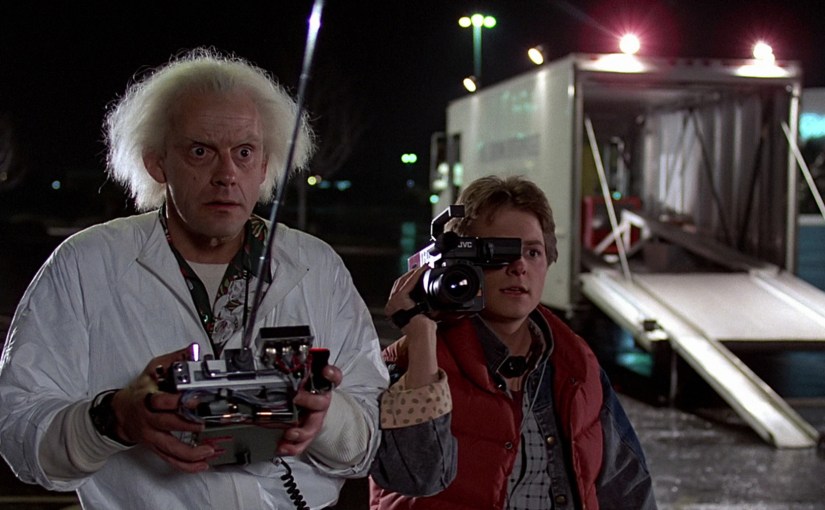
His minister so to speak is Doctor Emmett Brown (a should have been Oscar nominated Christopher Lloyd; absolutely brilliant in his bug eyed, crazy hair, fun loving role). Doc’s time machine comes by means of a DeLorean automobile – perfectly sci fi like. Marty recruits the younger version of Doc to get him back to his present day, or Doc’s future.

Complications occur when Marty interferes with how his parents originally met thereby causing his mother, (Lea Thompson also superb and maybe should’ve been nominated as well) a teen at the time, into falling in love with Marty. Now Marty is at risk of being erased from existence, while his mother has the hots for him.

Complications are compounded endlessly in Back To The Future, and it’s easy to learn all that is at stake. That’s only the skeleton of the nominated screenplay. The dialogue works beautifully as well. Imagine telling someone living in 1955 that Ronald Reagan is President in 1985, and see how he’ll respond. The conservative culture of 1955 vs the free liberal lifestyle 1985 clash so well in the film’s comedy.

Outstanding performances make up one of the greatest casts of all time. It’s difficult to believe that Eric Stoltz was originally cast as Marty. Michael J Fox is so perfectly natural in his hysteria and cool, yet panicky, swagger. Crispin Glover is hilarious as Marty’s ultra-nerd dad, George McFly, and Thomas F Wilson is one of the top ten on- screen bullies of all times as the towering buffoon Biff Tannen.

Without question, Back To The Future is one of the most imaginative films ever made. It has wonder, comedy, suspense, song (yes…we even learn how Chuck Berry came to play “Johnny B Goode”), and brilliant characterizations. It is wholly original in its creativity. It’s fast moving, and it’s great fun.

Credit also goes to Alan Silvestri’s catchy orchestral soundtrack. It is magnificent in accompanying the adventure and misunderstandings that occur. You see the film once, and you never forget Silvestri’s music.

Back To The Future is a magnificent film that every kid should eventually see.

UNDER SUSPICION

By Marc S. Sanders

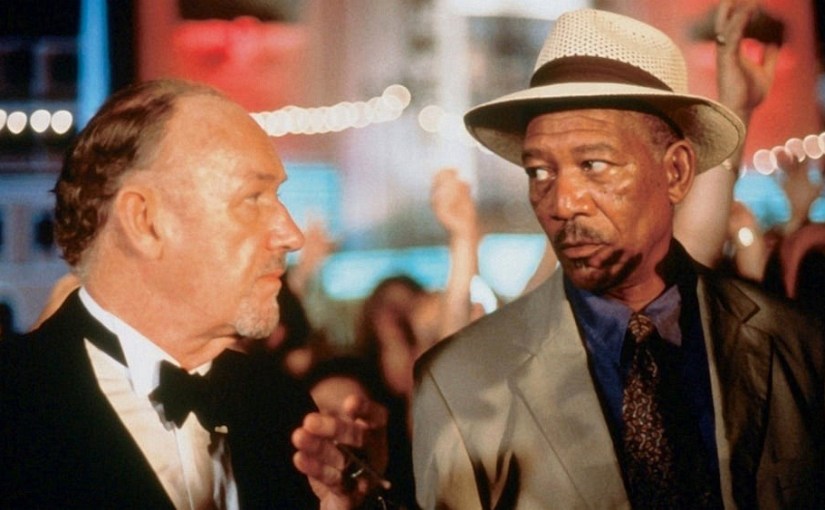
I’ve noted before how sometimes you can’t decide if you like a movie until it reaches the final, climatic five minutes that remains.  That’s the experience I had with a below the radar picture called Under Suspicion, which features two of the best headlining actors ever – Morgan Freeman and Gene Hackman.  Well, I didn’t care for the last five minutes of the film.  So, I didn’t care for Under Suspicion.

Gene Hackman plays Henry Hearst, a wealthy, hot shot tax attorney who resides and practices on the island of Puerto Rico.  When the film opens, he’s already dressed in his tuxedo and his gorgeous, much younger wife, Chantal, played by Monica Bellucci, is zipping up her black evening gown.  They are on their way to a benefit dinner to honor him for his charitable fundraising for underprivileged children.  Henry has to take a quick detour to the police station however to answer a few questions that Captain Victor Benezet (Freeman) has regarding the recent strangulations of two young girls. Victor plays good cop, while his underling, Felix Owens (Thomas Jane), does the bad cop routine on Henry. 

Since this is Gene Hackman playing a likely suspect, it’s no surprise that he’s cool as can be with Victor’s inquiries into some inconsistencies that have been uncovered.  Flashbacks to recent moments of where Henry has been jogging or visiting his sister-in-law cut in, and director Stephen Hopkins puts a present-day Victor within the scene of Henry’s recollections.

The theme of Under Suspicion is all about the gradual breakdown of a powerful guy.  Victor and Felix chip away at Henry’s alibis.  While Henry starts out virtually bulletproof to the cops’ questions, soon he’s reduced to being stuck without explanations, and even physically humiliated.  Let’s just say that more than just his tuxedo gets torn.  Eventually, the officers bring Chantal into the fold and the story diverts into a checkered relationship that Henry has with Chantal’s sister and her family, but what does that really have to do with the murders of two girls?  I hoped I’d see some relevance by the time the conclusion arrived.  I didn’t, and that’s the problem with this picture. 

What did I gain from the prior two hours that I was watching?  The main question at hand is did Henry murder these two girls?  Only if he did commit the acts is what the picture will have you believe is pertinent.  The script from John Wainwright (based on his book Brainwash), and Claude Miller & Jean Herman (based on their 1981 screenplay Garde à vue) never really scratches the surface for a motive.  Implications that Henry could be a child sex pervert come up, but I didn’t think it was explored deep enough to then bridge it to murder.  All that Victor and Felix seem concerned with is whether Henry killed the girls.  That’s too simple.  The movie isn’t thinking hard enough for us.  What makes this self-assured guy, with the familiar cockiness of Gene Hackman’s many other film personas, tick?

When the veil is finally lifted on who committed the murders, I felt emptyhanded like I’d been dealt a bait and switch.  The reveal comes out of nowhere and then the credits roll.  Under Suspicion practically promises a plot twist that never materializes.  A shame really, because there are winning moments between these two acting giants on screen.  Not an ounce of dialogue is memorable, however.  Yet, to see the pair together longer than the screen time they shared in Clint Eastwood’s award-winning film Unforgiven, bears my attention and curiosity.  Ultimately, Hopkins’ film is further proof that a script must come first before the talent is recruited.  It doesn’t matter if you have contracted the likes of Hackman and Freeman for your film.  If you don’t give them anything interesting to say, then there’s nothing interesting to see them do.

BLADE RUNNER

By Marc S. Sanders

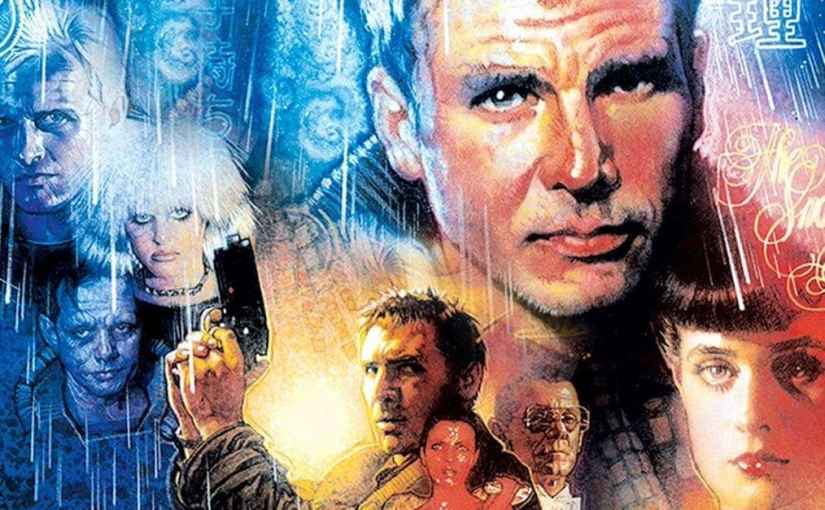
Ridley Scott’s Blade Runner is a technical and special effects masterpiece…however thin-very thin-its story may be. 

When the film was originally released in 1982, its period setting of November 2019 seemed unimaginable.  So, it was easy to accept that the dystopian future first conceived by author Phillip K. Dick (in his book Do Androids Dream Of Electric Sheep?) could actually happen.  With the Vietnam War behind us, and shopping malls becoming the happening place to be in our Members Only jackets and Jordache jeans with Swatch watches, the 1980s seemed like eternal bliss.  Middle class America felt prosperous and free and comfortable with a President on his way to eight years in office.  Bright pastel and neon colors took over.  A hopeless, dreary future was all but fantasy.  Therefore, just like Star Wars, a gritty, urban Los Angeles seemed like another possibility where science fiction had become as trendy as super hero movies are today.  It was cold and rainy and dirty, but we wanted to see that because that was nowhere near what we were living in, much less envisioning. 

Ridley Scott achieved greatness with visuals never thought possible.  George Lucas might have introduced moviegoers to desert and swamp planets and industrialist Death Stars, but Scott delivered an Earth where Coca-Cola, Pan Am, Atari and Cuisinart still existed amid a dark, rainy Chinatown section of Los Angeles with glowing umbrella handles, flying police cars and cabs, hovering electronic billboards, and exhaust flames that spewed out of the rooftops of cylindrical skyscrapers.  Ridley Scott might have supervised this palette of futuristic film-noir, but the real heroes of Blade Runner belong to its Oscar nominees Lawrence G. Paull, David L. Snyder, and Linda DeScenna for set decoration, as well as Douglas Trumbull (already a legend for 2001: A Space Odyssey), Richard Yuricich and David Dryer for visual effects.  All these years later, there’s much to explore within the appearance of Blade Runner, but the storyline still remains shallower than a puddle of water.

I’ve watched Blade Runner a number of times because fellow peers and colleagues carry such admiration for the film.  I cannot deny the first third of the film holds your attention as you acclimate yourself to this enveloping world.  Once your accustomed however, the story is what has to carry you through to the end, and the journey is as slow moving as a rickshaw on one wheel.  Harrison Ford is Rick Deckard, a blade runner and the best one there is.  Upon learning of an escape of four Replicants from an off-world slave site, Deckard is tasked with coming out of retirement to hunt down these Replicants and “retire” them.  Retire is the polite word for kill, exterminate, slaughter or execute.

A replicant is an android that looks completely human, bleeds like a human and talks like a human.  It’s near impossible to tell the difference on sight between a human and a replicant. As well, replicants are manufactured with four-year life spans and are not permitted on Earth.  They are intended for the sole purpose of slavery towards their human creators.  Yet, what makes them so exemplary or offensive?  What trait do they carry that threatens their human counterparts?  Racism often occurs because of fear derived from skin color or appearance.  Antisemitism will have you believe that Jews have horns growing out of their heads under their yarmulkas.  What is so terribly misconstrued or offensive or threatening about Replicants?  The film never makes clear, and that’s frustrating.  What makes a villain a villain?

M Emmet Walsh comes on early enough to tell us through dialogue that he needs the best of the blade runners back and that’s Deckard.  When I’m to understand that I’m watching the absolute best of something, whether it be a cop, lawyer, baker, student, doctor, painter or blade runner, I want to see what exactly makes them the best.  In Top Gun, I saw the aerial maneuvers that potentially justified why Maverick could be the best of the best fighter pilots.  The problem with Blade Runner and the script, written by Hampton Fancher and David Webb Peoples, is that I never see in its two-hour time span when or how Rick Deckard is such an exceptional blade runner.  How is a blade runner different from an ordinary cop or a simple person with a large gun?  No matter which of the various cuts of the film I’m watching, with or without Harrison Ford’s voiceover narration, I fail to see any outstanding fighting skills or clear thought-provoking intuition.  This guy is neither as good as Dirty Harry or Sherlock Holmes or even James Bond.  He’s not even as personable as Sam Spade, the original noir detective.  Rick Deckard just looks like Harrison Ford with a very large hand gun.  Furthermore, where does the term “Blade Runner” derive from?  Is it just there because it sounds cool?  The moniker wasn’t even created by Philip K. Dick.

The film’s eventual sequel, Blade Runner 2049, is a far superior film.  It’s longer, but it’s much more fleshed out in tone and character and understanding of its setting.  The original film stands on the heels of its cult like legendary status.  Some of the best filmmakers today cite Blade Runner as an influence in how they construct their own movies.  I buy that.  The assembly of whatever cut I’m watching is evident of how mind blowing its appearance is.  You can see some of the blue print visuals that carried over in to Christopher Nolan and Denis Villeneuve’s pictures. But I’m past all that.  Now I need to appreciate what it’s all there for, and who is playing in its yard. 

I cannot simply rely on IMDb trivia and endless social media sites that speculate on whether Deckard is a replicant himself, or why he dreams of a unicorn and why Ridley Scott opted not to include said dream in the original cut.  I cannot just tickle my curiosity with the picture’s eerie foreshadowing of the various product placements that suffered real life eventual downfalls after its release.  Beyond the visuals, what am I watching Blade Runner for?  This is not just a riddle in the Sunday paper.

The film boasts an eclectic cast that work well together.  I just wish they were provided with something much more insightful with background and personal experience.  Rutger Hauer became a familiar name following the release of this picture.  When he’s finally given the opportunity within the second hour of the film to come off as hideous and terrifying and strange, it’s worth looking at.  His famous “tears in the rain” closing dialogue is beautifully poetic, as it was personally written by him.  It’s as ambiguous as the film.  Yet, Shakespeare can be vague too.  I might not understand what anyone is talking about, but the performance can keep my attention.  Regrettably, he does not do much else in the film beyond his closing fight scene with Ford.  Ridley Scott insisted on casting Sean Young as Rachel, as her appearance was reminiscent of Vivian Leigh.  She’s intentionally mysterious as a likely replicant and/or niece of the wealthy creator of the replicants, Dr. Tyrell.  It works, but again, if the viewer is going to be questioned on the mystery of this major character early on, then why doesn’t the film follow further into that enigma?  You don’t have to say for sure, but at least give me evidence to argue one way or the other.  The same goes for the speculation on Deckard.  Had it not been for outside references, I’d never question who or what Deckard really is.  Daryl Hannah, Brion James and Joanna Cassidy round out the rest of the cast/replicants within the film.  Edward James Olmos is here too with a curious and odd habit of making origami.  They all have their unique way or look about them.  In science fiction, every character should stand apart.  Yet, again, it’s all about appearance.  What is the motivation here?  What is the motivation to live on earth or off earth?  What is the motivation to kill a human?  What is the motivation to kill a replicant?

I’ve beaten my head enough over this film.  Blade Runner has always been frustrating to me.  Maybe I’m not being fair to myself, as I try to find something else or some underlying layer each time I watch it.  Why do people love this movie so much?  Why does it consistently appear on “greatest of all time” tabulations?  Ultimately, I’ve come to the conclusion that I’m just pounding sand, or maybe as Rutger Hauer’s Roy Batty suggests, I’m impossibly looking for tears in rain.

DIE ANOTHER DAY

By Marc S. Sanders

Once the 2nd half of Die Another Day arrived, Pierce Brosnan’s interim as James Bond was all but wrapped up. This was gonna be his last film after this misfire, and the craftspeople at EON Productions knew something had to change.

What happened here? Director Lee Tamahori was on the right path from the get go with some real world parallels and surprising elements for the long lasting franchise. Then, the film goes sci fi gonzo with some kind of robotic armor for the villain, a space satellite that harnesses the power of the sun, a palace literally held together by ice, an invisible car, DNA switcheroos, and James Bond kite surfing to avoid a solar laser beam.

This movie got ridiculous really, really fast.

Early on, 007 covertly surfs his way onto the coast of North Korea to intercept an arms trade in exchange for diamonds. He’s captured and held for the following 14 months. When the British make a trade for Bond with a North Korean prisoner with a bad case of facial diamond acne, Bond is no longer trusted by M (Judi Dench) and he must become resourceful on his own in stopping whoever betrayed him before his capture. He also needs to figure out what a wealthy industrialist named Gustav Graves (Toby Stephens) is conjuring up in Iceland, with a literal ice palace hosted to Bond as well as a slew of investors and dignitaries.

Die Another Day began with a grounded intent. However, the stunts and gadgets that are introduced later in the film fly way off the rails, even for a James Bond film. Bond has always completed his mission by ridiculous measure. However, when your hero and villain are on an out-of-control airplane that is being torn apart by a solar beam from space, ala hammy CGI, well, reader how does 007 even survive that?

Another ridiculous plot element involves DNA transfers. So Gustav Graves, a man who claims he never sleeps, may not be who he claims to be. Graves is the villain here and Stephens plays him like a spoiled brat. I didn’t like him and the best Bond films are primarily weighted by the bad guy. For some reason he has to wear this bionic suit of some kind to control the satellite. A keyboard and mouse weren’t as efficient, I guess. It’s also capable of electrocuting Bond; lots of zig zaggy tesla/lightning bolts surround Bond and so on. You really don’t have to see it to believe it.

The Bond girl is Halle Berry and she’s pretty good as an American agent who goes by the name of Jinx. Yes, there’s time made for the two agents to have some flirtations together, but like Michelle Yeoh before her, Berry gets in on the action.

Man oh man! WOW!!!! Die Another Day started so good and then it fell apart. While I don’t think it is the worst of the series, it borders towards the bottom of the list. It’s a shame really. If only it stayed a little more grounded, maybe it wouldn’t have died on any day.

THE WORLD IS NOT ENOUGH

By Marc S. Sanders

The 19th installment in the James Bond series is The World Is Not Enough from 1999. By now Pierce Brosnan is comfortably established in the role and an expert at pun delivery and suave debonair swagger.

Michael Apted more or less delivers a standard fare. Nothing new here, really, with the exception of John Cleese (perhaps playing the role of R) as the would be successor to exiting mainstay Desmond Llewelyn as Q, the gadget specialist. I wish Cleese could have lasted longer than just his two film internship. He’s hilarious and well suited for the super spy’s tongue in cheek universe.

The story is similar to other Bond films. The one who we eventually realize to be the main villain wants to wipe out oil pipelines so that only their pipe is the only one exclusive to the region in the European west of the world. Auric Goldfinger had a similar idea with his affection for gold. A View To Kill aimed for this with Silicon Valley. Gold, silicone and now, here the commodity is oil.

The World Is Not Enough has a lot of crazy stunts and gadgets that we are always eager to see, such as a boat chase along the Thames River, snow ski escapes from parachuting snow mobiles (a fun sequence), deactivating bombs within underground mines and pipelines, underwater heroics in and out of a submarine and another buzz saw device, only this is a big one connected to a helicopter that is not just for cutting down forestry. BMW also makes its 3rd appearance in the franchise with a spiffy convertible.

The Bond gals are also up to the task. Sophie Marceau is Electra King. A one time kidnapping victim, she has taken over her father’s oil business following his assassination, which Bond is investigating. Marceau is beautiful as expected, but she’s got a great, mysterious way about her.

Denise Richards is fine (QUIET, you haters!) as a geologist swept up in assisting Bond. Her name, Dr. Christmas Jones, is deliberately laughable but she’s works well with Brosnan because there’s hardly any approach at seduction. They’re partners more than anything else. At least, they are until the end of the picture.

I do wish there was more to do for Robert Carlyle, though, as the bad guy Renard. He is impervious to pain thanks to a bullet resting in his brain. He is rapidly heading to death without any sensory feeling, but he gradually gets stronger with each passing day. I don’t know how you diagnose that, but in a James Bond picture, you take it at face value. Carlyle looks perfectly dastardly but he’s hardly on screen and has barely any exchanges with Brosnan’s Bond. When the real villain is finally revealed, Renard doesn’t serve much purpose any longer.

Judi Dench is back again as M. She is positively one of the best casting choices in the entire franchise. Bond remains a chauvinist (early on seducing his gorgeous doctor during an examination), but Dench as M counterpoints that stance and it is more than welcome. She is given more material here as well.

The World Is Not Enough didn’t reinvent the passenger ejector seat or the exploding pen per the nature of 007 films. Yet, it has a neat twist midway. Yeah, you might see it coming, but still it’s appreciated to keep the story developments ongoing. As well, the action plays well with a very good cast.

Brosnan was 3-0 by this point with the franchise.