KING KONG (2005)

By Miguel E. Rodriguez

Director: Peter Jackson
Cast: Naomi Watts, Jack Black, Adrien Brody, Andy Serkis (as Kong)
My Rating: 10/10
Rotten Tomatometer: 84% Certified Fresh

PLOT: In 1933 New York, an overly ambitious movie director (Black) coerces his cast and crew to travel to the mysterious Skull Island, where they encounter Kong, a giant ape who is immediately smitten with leading lady, Ann Darrow (Watts).


A cheesy screenplay, stupendous visual effects, breathtaking action sequences…James Cameron’s – sorry – Peter Jackson’s epic remake of THE classic monster movie may not have been the movie that anyone was clamoring for, but I, for one, am glad it was made.  To me, it’s one of the great monster movies of all time, and one of the greatest adventures since Jackson’s own epic adaptation of the Lord of the Rings trilogy.

To make things easier for myself, I’m just going to tick off the highlights.

  • The screenplay lacks any semblance of subtlety, but the dialogue is not exactly the point here.  It serves its purpose.  In fact, the best scenes that approach any emotional depth are the virtually wordless interactions between Ann Darrow and Kong.
  • The visual effects are stunning.  Even putting aside the spectacular action sequences, Kong himself is one of the great triumphs of modern CGI wizardry.  Building on the technology used to bring Gollum to life, Kong’s movements and facial expressions are based on the motion capture performance by the man who really pioneered this new branch of acting, Andy Serkis.  To watch Kong expressing, not just red fury, but also puzzlement, melancholy, happiness, even (for the briefest of moments) fear…to watch it happen, and to feel the character come to life, is awe-inspiring.  You look in his eyes, and you see the mind behind them, working things out.
  • The sequence that begins with Ann’s encounter with Skull Island’s version of the T-Rex, and which ends with Kong in single battle with said beastie, is the kind of thing we go to the movies for, or at least the kind of thing we go to these movies for.  It’s pure blockbuster gold, and mostly without any music in the background.  Blu-Ray/DTS bliss.
  • Okay, yes, Adrien Brody would not be the obvious choice for the hero if the movie.  But hey, in the film someone actually says something like, “Real heroes have lousy haircuts and a skin condition.”  Or something like that.  Which makes Brody, by that definition, hero material.
  • True story: the first time seeing the movie in the theater, there were sniffles in the audience as poor Kong expires and falls to his death.  (Did I ruin that for you?  How did you THINK it would end?)
  • The extended cut is not quite as good as the theatrical version.  With the additional animal attacks, the movie would have been just too exhausting in theaters.  (On home video, though, it’s cool to watch.)
  • Now that you’ve seen the remake, find and watch the original.  You’ll be amazed at how much of the original found its way into this new version.

In summary, King Kong is modern thriller moviemaking, with director Peter Jackson in peak form.  Sadly (at least so far), he hasn’t reached this pinnacle again.  But one can hope.
SPIDER-MAN: INTO THE SPIDER-VERSE (2018)

By Miguel E. Rodriguez

Directors: Bob Persichetti, Peter Ramsey, Rodney Rothman
Cast: Shameik Moore, Jake Johnson, Hailee Steinfeld, Mahershala Ali, Lily Tomlin, Kathryn Hahn, Liev Schrieber
My Rating: 10/10
Rotten Tomatometer: 97% Certified Fresh

PLOT: In an alternate New York City, Miles Morales is bitten by a spider that has been strangely affected by scientific experiments being conducted by Kingpin. He soon meets other Spider-People from OTHER alternate realities who were dragged to Miles’ reality by those same experiments…


Right from the opening credits, an intense, fan-boy-level love of the Spider-Man characters (and comic books in general) radiates from the heart of Spider-Man: Into the Spider-Verse like those little squiggly lines of “spider-sense” that instinctively tells the various spider-people that they are in the presence of other spider-people.  It tells the other fan-boys, fan-girls, and fan-adults that here, at last, is a cartoon comic-book movie worthy of standing with the live-action giants of the MCU, both in terms of visual spectacle and in terms of an extremely solid, well-told story.

When I saw the first trailers for this film, I instantly dismissed it as yet another cinematic screening of a forgettable, straight-to-video animated feature.  The style looked like some kind of mish-mash of CG figures and hand-drawn faces, trying way too hard to be different without actually being effective.  The story was ultra-cheese, the kind of thing that even comic-book writers would find old-hat: a trans-dimensional rift allows Spider-People from different alternate universes to interact with each other at the same time.  And one of them is a literal cartoon pig called Spider-Ham.

Right.

So the movie gets released, and one day I take a peek at the ol’ Rotten Tomatometer, and it’s like at 95 or 96 percent.  And I’m STILL skeptical because the Tomatometer is only really accurate about 80% of the time.  But it continues to get buzz, and everyone on Facebook who sees it posts saying, “WOW, was that a good movie!”  It suddenly becomes the must-see movie of the holiday season.

So.  We saw it today, and just got home.  And WOW, was that a good movie!  It is fulfilling in just about every way a movie can be.  It had loads of humor; it was brilliantly original; it was visually stunning; it had real, EARNED dramatic moments; and it has the best credit-cookie since Ralph Breaks the Internet.

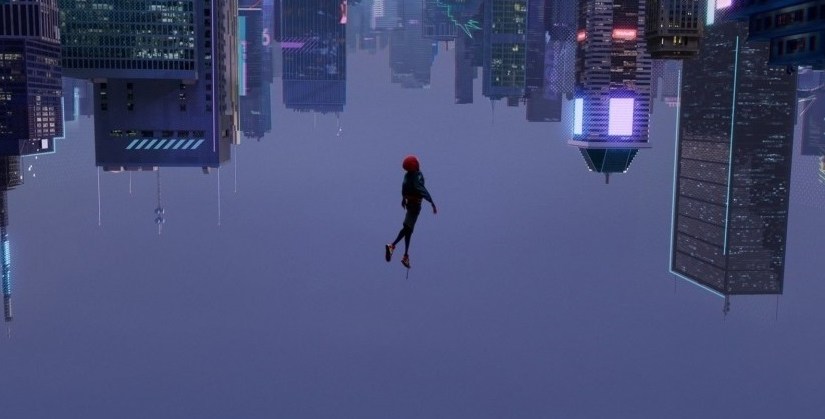
A lot of the film’s impact comes from that stunning visual style, which I initially dismissed.  As much as Sin City and Watchmen before it, Into the Spider-Verse takes great pains to recreate the look and feel of a comic book in as many ways as possible.  Speech panels appear occasionally.  Sound effects are manifested as words: “bap!” and “BOOM” and “bagel!”  (Yes, that is one of the sound effects.)  A lot of backgrounds are made to look as if they’re printed off-kilter, much like some comic books used to be printed back in the stone age.  This non-realistic style allows the filmmakers to create a crazy climax that would be virtually impossible with a live-action film; the CG would look too crazy to take seriously.

Aside from the visuals, there’s also the stunning originality with the screenplay.  For example, given the fact of many (infinite, really) alternate universes, the variations the screenwriters use are truly ingenious, particularly when it comes to the villains.  Kingpin makes an early, ENORMOUS appearance (he looks like the Hulk in a business suit), and he has a henchman that I really should have recognized earlier.  And the cleverness of Doc Ock’s arrival had me shaking my head in admiration.

The storytelling takes the time to let us get to know the inner workings of the main characters, a rarity in a non-Pixar film.  Miles Morales (the focal point of the story) is a high-school kid, loves his Latina mom and African-American dad, doesn’t love his new private school, loves bonding with his ne’er-do-well uncle…these connections are solidified in our minds so when the moment comes when a family member’s life is on the line, you feel it, man.  It’s not just drawings going through the motions.

It’s very hard for me to discuss the humor without giving away some of the best jokes.  You just have to trust me on this one, besides being one of the best comic-book movies of the year, it’s also one of the funniest.  (I LOVED the fake movie posters in Times Square.)

In closing, I can only apologize to the movie gods for completely dismissing this movie on the basis of the trailer.  Ever since that happened to me with Fight Club, I’ve tried to avoid making that kind of snap judgement.

ROMA (2018)

By Miguel E. Rodriguez

Director: Alfonso Cuarón
Cast: Yalitizia Aparicio, Marina de Tavira, Diego Cortina Autrey
My Rating: 10/10
Rotten Tomatometer: 96% Certified Fresh

PLOT: A year in the life of a middle-class family and their maid in Mexico City in the early 1970s.


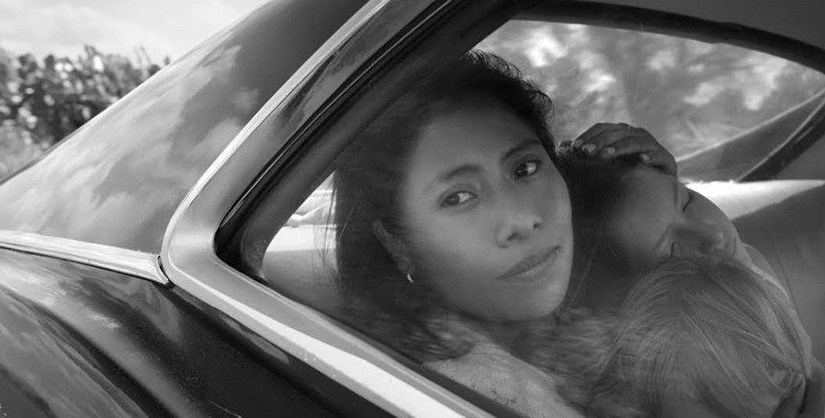
The closing credits of Alfonso Cuarón’s intensely personal, emotionally powerful Roma state unequivocally (in Spanish) that the entire movie was shot on 65mm film.  This is an important choice with a movie that communicates its emotional beats with strong, crisp visuals that don’t feel like a traditional movie.  To me, Roma feels like looking through an old, well-preserved photo album of a family I don’t know.  But the closer I look at the pictures, the more I can intuit how their lives are no less important or vital than my own.

More than most films, Roma exemplifies one of Roger Ebert’s core beliefs about film.  He said that movies “are like a machine that generates empathy. It lets you understand a little bit more about different hopes, aspirations, dreams and fears. It helps us to identify with the people who are sharing this journey with us.”

That’s how I felt watching Roma.  I never really felt like I was watching a film.  Director Cuarón (who served as his own cinematographer) uses his camera and shrewd editing to create the idea that I was looking at a fondly remembered memory instead of a traditional, plot-furthering movie sequence.  I didn’t grow up in Mexico or have a maid, but within just a few seconds of the opening scene – hell, during the opening CREDITS – I was sucked into the world of the film.

Another important element of this movie’s success is the exquisite sound design.  Over the opening credits, we see nothing except a close-up of some sort of tiled surface.  Soapy water spills over it a couple of times. We hear a mixture of street sounds, but not a busy street.  At one point a jet airliner flies far overhead, visible in the sky as reflected in a puddle of water. We can hear birds, and people talking and shouting in the distance, and a street vendor, and the occasional dog barking, and…it succeeds in placing you firmly in the world of the movie. It all feels completely organic, not engineered.

I’ve just realized I haven’t said a word about the plot.  The story, in itself, is nothing extraordinary.  We follow several months in the lives of a middle-class family in Mexico from 1970 to 1971.  They have a maid, Cleo, who discharges her duties with efficiency, who is beloved by the family children, who has a life of her own outside of her employer’s household.  Through various personal upheavals, both in her own life and the life of the family she works for, they all grow incredibly close.  …and I can almost hear your eyes glazing over as you read those words.

But, as is the case with every other film, what’s important is not WHAT this movie’s about, it’s about HOW it tells the story.  And Roma, if nothing else, solidifies Alfonso Cuarón’s standing as one of the great modern masters of cinematic storytelling.  In his hands, this humdrum story of middle-class life becomes a hymn to nostalgia. There’s a brief scene of everyone gathered around a television set, watching a variety show.  The sight of their smiling faces, illuminated by the screen, triggered a memory of my own family sitting around the TV back in ancient history, before VCRs and even cellphones(!), and watching the ABC Movie of the Week, like The Towering Inferno or Grey Lady Down.  It’s rare for a film to affect me like that.

I have to tread carefully here, because I want to mention a key event that occurs in the latter half of the film.  It’s immensely harrowing, all shot in one take (indeed, IMDb tells me it was shot only ONCE and not repeated).  In any other movie, I would say that it’s the kind of thing a screenwriter would throw in as a shamelessly manipulative plot twist, designed solely to elicit unearned emotions from the audience.  In Roma, however, the movie has so thoroughly worked its magic that the event, when it happens, is not shameless, but shocking and heartbreaking.  I was not watching an actor or actress.  I reacted as if I was watching a home movie of a real person going through a traumatic event, and it was devastating.  THAT’S the kind of rare cinematic event that I live for.

Roma is a black-and-white film shot in Spanish, with English subtitles, and which leans heavily on visual storytelling.  This may not be your cup of tea.  But if you like film at all, if you like the kind of movie where you can drink in the visuals like you were at a museum where the pictures breathed and lived and loved, then you owe it to yourself to see Roma as soon as possible.

THE FAVOURITE (2018)

By Miguel E. Rodriguez

Director: Yorgos Lanthimos
Cast: Olivia Colman, Rachel Weisz, Emma Stone, Nicholas Hoult
My Rating: 10/10
Rotten Tomatometer: 94% Certified Fresh

PLOT: In early 18th century England, a frail Queen Anne (Colman) enjoys the attentions of her close friend, Lady Sarah (Weisz), but when Sarah’s cousin (Stone) arrives at court, a subtle power struggle ensues.


This movie is a TRIP.  Imagine that someone crossed the sex-driven antics in Dangerous Liaisons with the cat-fighting in All About Eve, directed by someone who idolizes Stanley Kubrick and David Fincher.  It’s that good.

Where to begin?

I loved the story.  It’s a basic power struggle/love triangle, but told with immense wit and originality.  Queen Anne indulges in sexual dalliances with her closest confidante, Lady Sarah.  Then Abigail appears, a distant cousin to Lady Sarah; she’s hired as a scullery maid and slowly works her way into Lady Sarah’s confidence as her handmaiden.  When the Queen starts to show a preference for Abigail over Lady Sarah, oh, the fur doth fly.

Rarely has it been so much fun to see such bad people behaving so badly.  At first, I was rooting for Abigail, who is only doing what seems necessary to survive, but then it becomes obvious that there ARE no good guys in this movie.  Abigail proves herself just as capable of social atrocities as Lady Sarah or Queen Anne herself.  Normally, I HATE movies with no clear heroes, but the screenplay and camerawork kept me constantly engaged and entertained.  I think I had a smile on my face continuously after the 30-minute mark.

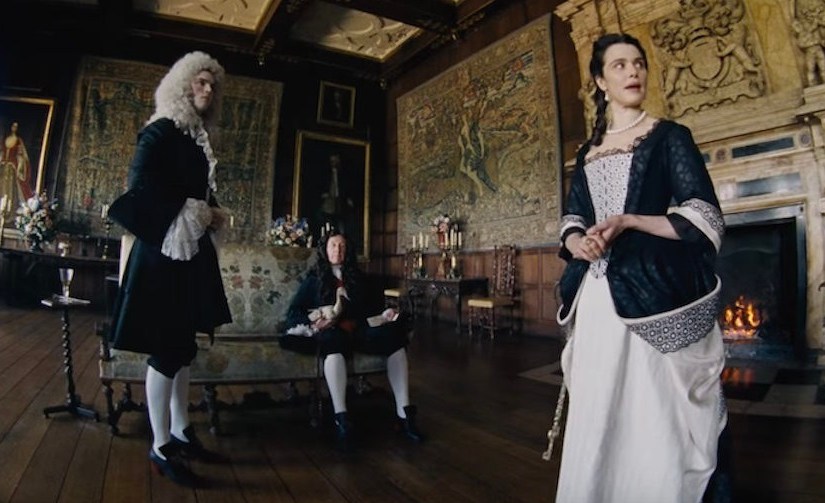
And let’s talk about that camerawork.  I’ve never seen one of this director Yorgos Lanthimos’s films before, but if they share the same visual inventiveness as THIS movie, I am going to seek them out.  The list of directors working today with visual styles unique to them is relatively short, so to find this fresh take on moving pictures was a delightful surprise.  There are a couple of places where extremely-wide-angle “fish-eye” lenses are used, distorting the picture on the edges so it looks like you’re looking at the scene through the bottom of a Coke bottle.  I found that particular device odd, calling attention to itself, but it worked.  It sort of created this idea that we’re looking at a staged performance rather than attempting to mimic or capture strict reality, which makes some of the behavior of the main characters more palatable than they might be in another film.

There are one or two moments that are so over the top, they might have derailed another film.  At one point, two characters dance during a formal party, as the Queen looks on.  It starts out daintily enough, like you’ve seen in countless other 18th-century films, the mincing steps back and forth, a little bow here, a curtsy there.  Then, as the music continues…something happens.  The man lifts the woman and swings her around on his hips like a swing dance.  They start to move their hands like in the “Vogue” video.  At one point, I’d swear the man started a rudimentary breakdancing move.  What’s going on here?  Why is this jarringly anachronistic dance intruding on the proceedings?

My first reaction while watching the movie was to just laugh in disbelief, while asking, “What IS this?”  Looking back on it now, I’d guess the purpose was to put ourselves into the mind of the Queen, whose perception of the dance starts to degrade the angrier she gets.  Regardless of its true purpose, it’s thoroughly weird but hilarious.

(Also, the screenplay contains some of the greatest zingers I’ve heard in a very long time, although I doubt some of them are historically accurate.  Not that I’m a historian, of course, but I remain unconvinced that British royals in the 1700s ever used the term “vajoojoo.”)

I’ll be honest, I was not previously aware of the actress Olivia Colman, who portrays the fragile, temperamental Queen Anne, before this movie, but I’ll be looking out for her from now on.  She more than holds her own with two Oscar winners (Emma Stone and Rachel Weisz).  Colman’s Queen Anne is a spoiled brat whose petulance is tolerated because, you know, she’s the Queen.  I loved a moment when she walks past an unsuspecting footman and yells at him, “Look at me!  Look at me!!!”  He turns and looks, and she immediately yells: “HOW DARE YOU LOOK AT ME!!!”  Right there, early on, her character is indelibly defined.

The depths to which all three women sink to exact their own particular brands of revenge upon each other will astonish you.  While the ending is not the one I quite hoped for, it’s extremely satisfying in a “be careful what you wish for” kind of way.  This movie was a delicious romp, and is definitely worth your time.

MATCH POINT (2005)

By Miguel E. Rodriguez

Director: Woody Allen
Cast: Jonathan Rhys Meyers, Scarlett Johansson, Emily Mortimer, Brian Cox
My Rating: 10/10
Rotten Tomatometer: 76% Certified Fresh

PLOT: At a turning point in his life, a struggling, engaged tennis instructor (Rhys Meyers) falls for an aspiring actress (Johansson), who also happens to be engaged…to his soon-to-be brother-in-law.


Watching Match Point is as exhilarating as any moviegoing experience I’ve ever had.  It’s pure soap, much like its uncredited (but obvious) inspiration, 1951’s A Place in the Sun with Elizabeth Taylor and Montgomery Clift.  But a crucial decision is made by the main character in Allen’s film that shifts everything into darker territory more comparable to Hitchcock than George Stevens.

One of the best things about the film is the editing.  It’s not a short film, clocking in at just over two hours, but everything feels pared down to the bare essentials.  The passage of time is indicated in efficient pans or quick cuts.  Unnecessary conversations are cut short.  Winter changes to spring in a single fade.  Allen wastes no time in getting to the meat of the story, and it makes for a film that hurtles along breathlessly.

The performance by the lead, Jonathan Rhys Meyers, is also a key factor.  Watching it again for the first time in quite a while, I was struck by how measured his deliveries are.  There’s nothing wrong with it on a technical level, but it always feels like he’s acting or performing.  Even when his character, Chris, interacts with his girlfriend who eventually becomes his fiancé, nothing he does feels real.  It’s almost distracting, how theatrical his performance is compared to everyone else’s.  I was thinking, “Well, I guess Rhys Meyers is the best they could get to stay under budget.”

EXCEPT…when he meets Scarlett Johnasson’s character, Nola.  Only then do his eyes and face reflect the lust in his words.  They flirt fiercely for about a minute before they’re interrupted, but the damage is done.  He’s hooked.  And it’s at THAT point I realized the “staginess” of his acting in previous scenes was intentional, because his character WAS acting.  Chris is ALWAYS putting on a performance for everyone around him, except Nola.  With Nola, we see the real Chris, the focused, hungry Chris who will stop at nothing to get what he wants.

It’s a brilliant layer to a brilliant film.  Woody Allen has created a movie that starts out exactly like so many of his previous character-driven art-house films, so much so that we never suspect the surprises in store.  For the score, he chose stock opera recordings, really OLD opera recordings that sound so scratchy I wonder if any of them were actually being played on the old Edison cylinder players.  It’s the PERFECT topping.  It creates a uniquely Allen-esque atmosphere that lulls us into the feeling that, well, I know where THIS is going.

But I assure you, you don’t.

Pay particularly close attention to the various discussions of luck peppered throughout the film.  At multiple milestones in the film, luck plays a HUGE part, not always for the good.  Are these plot conveniences?  Well, how much of our own lives are governed by luck, good or bad?  An acquaintance of mine was killed in a wreck where a truck toppled onto him from a highway overpass.  Another was killed because someone was driving at night with no headlights.  Another friend contracted breast cancer, but is now in remission.  I have two uncles who last cancer battles.  Yet another acquaintance, the daughter of a friend, beat childhood leukemia.

Luck is inextricably linked with our existence, to the degree that it’s a little frightening.  We can bitch and moan about plot contrivances in movies and convenient phone calls and the rest, but if you step back, everything in existence is a contrivance: random meetings and phone calls and stoplights that keep us from hitting that pedestrian, and missed flights on airplanes that end up crashing, etcetera.

That’s REALLY what Match Point is drilling down to.  We live our lives, we play our roles, we follow the scripts WE choose…or are they chosen for us? Even without the backdrop of luck as a metaphysical discussion, the movie is an absolute top-notch thriller, one of the best of 2005, or any year, for that matter.  But it’s that next level hanging in the background that makes it my favorite Woody Allen film.

NO TIME TO DIE

By Marc S. Sanders

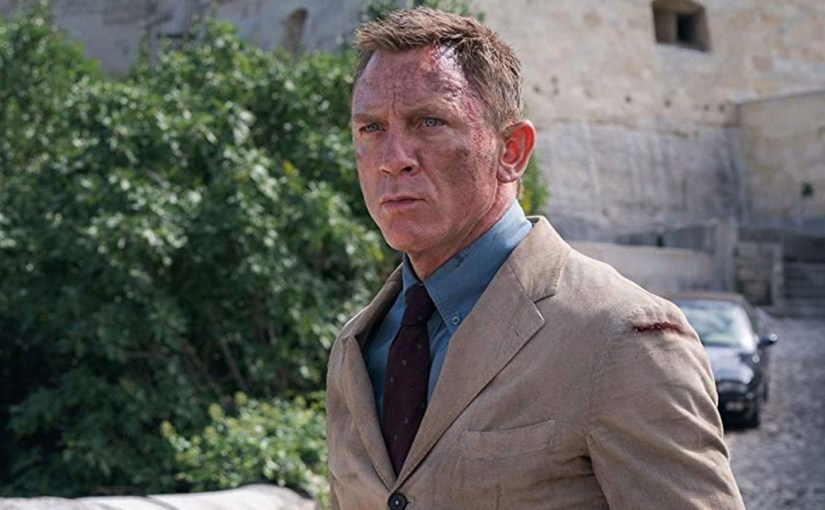
Any die-hard James Bond fan should absolutely love Daniel Craig’s final outing in No Time To Die.  Not only does the film work as a salute to the more serious aspects of past Bond films (not just Craig’s installments), but it is working with its tongue placed firmly in its cheek.  That is not to say that I still did take issue with a few narrative choices the film steers into.

Years have gone by for Craig’s interpretation of the famed secret agent.  He’s comfortably in love with Madeleine Swann (Lea Seydoux) from the prior film Spectre, and known daughter of Mr. White, one of Bond’s prior adversaries.  Suddenly though, Spectre seems to be back with a vengeance.  The imprisoned Blofeld (Christoph Waltz) somehow seems to be involved and 007 puts his guard back on opting not to trust Madeleine or anyone ever again.  The story jumps to five years later and Bond’s CIA friend, Felix Leiter (Jeffrey Wright) has convinced him to come out of seclusion and assist with recovering a kidnapped scientist who holds the formula to a deadly nanobot virus manufactured through plant life.  Bond travels to Jamaica to complete the mission.  From there, the story gets more complicated and more interesting.  Though I dare not spoil what comes next.  This film has a lot to tell in the near three hour running time.

Daniel Craig always had some sort of challenge with the general public while playing James Bond.  First, how dare he be blond?  James Bond is not blond.  He survived that ordeal to continue to make more films.  His second film suffered in storytelling due to a writer’s strike.  During press junkets for his fourth film, Craig was quoted out of context noting that he’d rather “slit his wrists” than play the character again.  As well, his films broke convention in the long running EON Production series, as each film served as a continuing story with much more serious, dramatic and sorrowful undertones than was ever presented before.  None of these challenges seemed fair to me.  After 25 films, you gotta stir the pot a little bit on a character that has been on screen for nearly 60 years.  It’s not enough that his gadgets change with the times of technology. 

I divert into this observation because No Time To Die offers some shocking developments for the Bond character, but when you return back to Craig’s first film, Casino Royale, you really start to understand why this latest picture goes in this wildly off direction.  In other words, the four films Craig performed in prior to this 2021 installment seemingly spell out the inevitable conclusion of his tenure as James Bond.  So, reader, when you go to see this last film from arguably the most controversial actor to play 007 to date, give some thought to what has already been covered before and maybe you’ll agree it beautifully makes a lot of sense.

As an action film, No Time To Die works solidly.  There’s amazing stunts and vehicles with car chases galore and nail biting shootouts.  I think this film has the longest pre-credit sequence of all the films and it’s amazing where one of the feature attractions is the famed Aston Martin DB5 against a slew of Range Rovers and motorcycles.

Rami Malek fills in as the lead villain eerily known as Safin, complete with the signature facial deformity, a shattered kabuki mask and a hell bent determination to destroy the world by means of turning people’s DNA against themselves.  Just go with it.  There’s not much weight to this dastardly mission.  It’s Malek’s performance that works. 

A new agent is also in the works and what’s this?  She is identified as 007????  Again, the newer films bravely go against convention to keep it interesting. Lashana Lynch plays Nomi.  This character was angled extensively in trailers and press junkets but honestly doesn’t live up to the hype enough.  The actor is fine.  She’s just not given much to make any kind of impact.  Ana de Armas is the actor who really makes a splash in a brief moment dressed in a gorgeous evening gown while giving high kicks to bad guys and armed with an adorable naivety about her and a killer machine gun.  Her character is reminiscent of the Bond girls who elevated the tongue and cheek elements of the series.  In a three hour film, more room should have been left for de Armas to play.

Moneypenny (Naomie Harris), Q (Ben Whishaw), Tanner (Rory Kinnear) and M (Ralph Fiennes) all return making for a solid support team for Bond.  It needs to be noted how well cast the Craig films always remained. During the five film series, each one of the characters had their memorable moments for sure.

The regrettable ingredients in No Time To Die lie in the lacking treatments of Lashana Lynch and Ana de Armas for sure.  Forgivable for the most part however.  Still, the story steers into one angle that I wish it didn’t when a young child is brought into the fold.  Children in serious peril was never part of the Bond formula.  So, while this is another new convention for the long running series, I think it was a poor choice.  I see the necessity of the young character to the story, but was it ever really necessary to put a child amid massive gun play, car wrecks and explosions.  There was something a little unsettling about that aspect of the film and the imminent danger to the girl really isn’t needed to heighten any kind of suspense.  Rather than play dramatically, it moves a little too disturbing.  Early on in the film, another child is placed in disturbing peril as well.  The story options here just don’t seem altogether appropriate.

No Time To Die is an appreciated conclusion to Daniel Craig’s version of the character.  There are great puns for Bond to deliver.  His interactions with Q and M are biting and fun.  His love story portrayal with Madeleine works more solidly here than in the last film they shared together, and his tete a tete with the villains, Blofeld and Safin, are equally strong.  These different relationships broaden the dimensions of Bond.  He’s no longer a cookie cutter character.  There’s a motivation to the guy. 

Having seen the film twice, I have an even further appreciation for this new film.  Hans Zimmer comes in to do the original score and particularly salutes the unexpected favorite among fans, On Her Majesty’s Secret Service with select notes and rhythms from that film.  Granted the script for No Time To Die makes obvious references as well.  I also appreciated the wink and nods to Bond’s very first adventure, Dr. No.  There was just a lot of smart, subtle honors presented here. 

Still, the best reference is left for one of the best lines in the film.  When Bond meets Felix’ partner ahead of a mission, Daniel Craig as 007 has to ask “Who’s the popular blond?”  After five hugely successful films, over a fifteen-year span, any one of us better know that the only blond that matters is “Bond.  James Bond.”

QUICK TAKE: Munich (2005)

By Miguel E. Rodriguez

Director: Steven Spielberg
Cast: Eric Bana, Daniel Craig, Ciarán Hinds
My Rating: 9/10
Rotten Tomatometer: 77% Certified Fresh

PLOT: After the terrorist group Black September kills Israeli athletes at the 1972 Olympic Games, Israel responds by sending covert hit squads after the men responsible.


Munich is an engrossing film that doesn’t pretend to have easy answers.  Anyone who comes out of the movie thinking that Spielberg has either denounced or commended Israel’s actions in the aftermath of the 1972 attack wasn’t paying attention.  The film simply portrays the aftermath in an extremely even-handed manner, presenting both sides of the argument without making a judgement call itself.  If there’s a judgement call to be made, that’s on you.

To make a movie that hinges on an attack by Arab terrorists just four years after 9/11 was a risky move.  Four years sounds like a long time, but I can assure you, it was still fresh in everyone’s minds at the time.  The film closes on an image of the New York skyline as it appeared in the ‘70s, complete with the digitally restored Twin Towers.  Aside from being an extremely effective visual statement tying the events in the film to today’s world, it was a little eerie.

Eric Bana is a mass of contradictions, a committed Israeli soldier who leads a squad of assassins, but who starts to have misgivings after a couple of close calls.  Their targets are essentially assigned via a safety deposit box.  No questions, no discussion: kill these men. But he starts asking the very questions that can’t be answered.  He wants proof that these assassinations are making a difference.  All he sees are newly vacant spots in the organization being filled by terrorists even MORE extreme than the one before.  So what’s the point?

Suffice to say, it’s one of Spielberg’s finer efforts, and it will challenge you to think critically about your deeply held views, whatever they may be.  And isn’t that a workable definition of “art?”

AQUAMAN (2018)

By Miguel E. Rodriguez

Director: James Wan
Cast: Jason Momoa, Amber Heard, Willem Dafoe, Patrick Wilson, Nicole Kidman, Dolph Lundgren
My Rating: 8/10
Rotten Tomatometer: 63%

PLOT: Arthur Curry learns that he is the heir to the underwater kingdom of Atlantis, and must step forward to lead his people and be a hero to the world.


Take the best parts of Tron: Legacy, Tomb Raider, and Disney’s animated Atlantis, and you’ll get an idea of how much fun Aquaman is.  For some people, saying it’s one of the best of the films set in the DC Universe isn’t saying much (peep that mediocre Tomatometer score), but speaking as someone who thoroughly enjoyed Justice League and Man of Steel and Wonder Woman, I had LOADS of fun watching an aquatic Dr. Doolittle kick some serious ass.

Admittedly, some of the underwater scenes are a little tricky.  It’s hard to take some of the weighty dialogue seriously when the people doing the talking are floating instead of standing, with their hair moving around like seaweed.  It’s the kind of thing that works great in animated movies or comic books, but to see it onscreen…it takes a little getting used to.

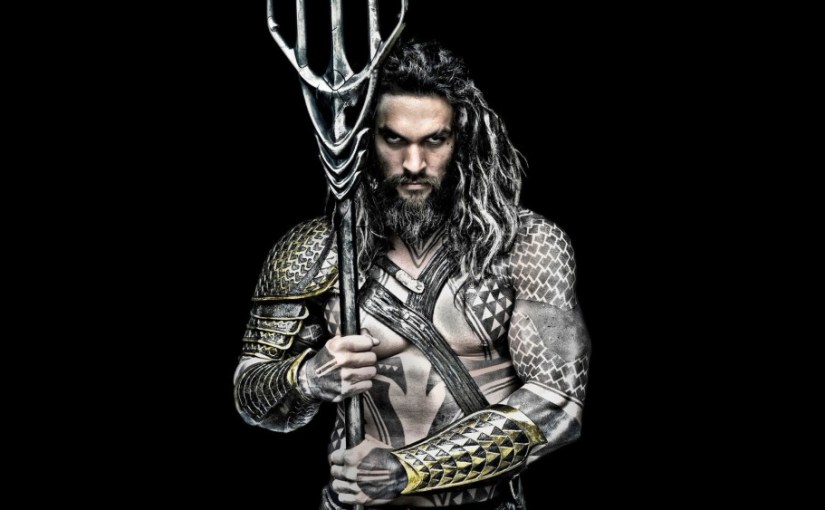
Once you get past that initial hurdle, though, this movie really cooks.  Jason Momoa was the best possible choice to make the much-maligned Aquaman character relatable to mass audiences.  He may not have the cocky delivery of a Robert Downey Jr. or a Chris Pratt, but he throws a mean glare, and, bro, dude is CHISELED.  When THIS guy emits sonar waves to talk to whales, it’s not a joke.  Hell, I wouldn’t laugh at a guy who looks like that.  “You talkin’ to fish?  Ping away, Muscles!”

The story is as ancient as Atlantis itself.  Arthur Curry returns to the land of his lineage to reclaim his birthright, but first he must overcome several trials before he can emerge triumphant.  Ho hum, been there, done that, bought the T-shirt.  But this movie really dresses it up and dazzles us with phenomenal sights.  Atlantis itself looks like someone mashed up Pandora from Avatar with the digital cityscapes in Tron: Legacy.  The various fight and battle scenes are handled extremely well, balancing clarity with incredibly elaborate CG fireworks.

(It was also nice to see one of Aquaman’s nemeses, Black Manta, rendered in a way that was EXTREMELY faithful to the source material, big head and big eyes included.  Of the actor portraying him, let it be said he was extremely adequate to the task, without really transcending the role he was given.)

Whatever gripes people may have, I would imagine it’s with being tired of overblown superhero movies, or the relatively few story gaps in the movie. (How did they get out of the desert?  How did Black Manta contact the Atlanteans in the first place?  If this is a sequel to Justice League, why are there no appearances or mention of the other members whatsoever?)  I can understand those gripes, but for me, the spectacle and the fun cancelled them out.

It’s not a perfect superhero movie; I wouldn’t quite rank it with the best Marvel films. But I gotta be honest: I had a blast.

QUICK TAKE: Mary Queen of Scots (2018)

By Miguel E. Rodriguez

Director: Josie Rourke
Cast: Saoirse Ronan, Margot Robbie, Guy Pearce
My Rating: 6/10
Rotten Tomatometer: 60%

PLOT: Mary Stuart attempts to unite England and Scotland, but her cousin, Elizabeth I, refuses to acknowledge her sovereignty, resulting in years of treachery and political maneuvering.


I came into Mary Queen of Scots with only movie knowledge to guide me, mostly from Elizabeth, the 1998 film starring Cate Blanchett.  After watching this movie, I can honestly say that, in terms of knowledge, not much has changed.  All I learned was that Mary Stuart would stop at nothing to keep the throne, which she believed was her birthright, and her cousin, Elizabeth I, refused to acknowledge that birthright because of her religion.  I think.  And much heartbreak and backstabbing ensued, resulting in Mary Stuart’s beheading.  (That’s not a spoiler, we see it happening at the very beginning.)

This isn’t so much a BAD movie, as it is a DENSE movie.  It assumes the audience knows much more about Elizabethan intrigues than I obviously do.  It becomes clearer as the movie progresses, but for the first 20 or 30 minutes, I was a little lost.  There is some excitement during a military attack, not to mention the unexpected exhibition of cunning linguistics, but for the most part the movie is content to sit back and simply regard the drama without getting invested in the story.  It was rather bland.  Not boring, just lacking in flavor.

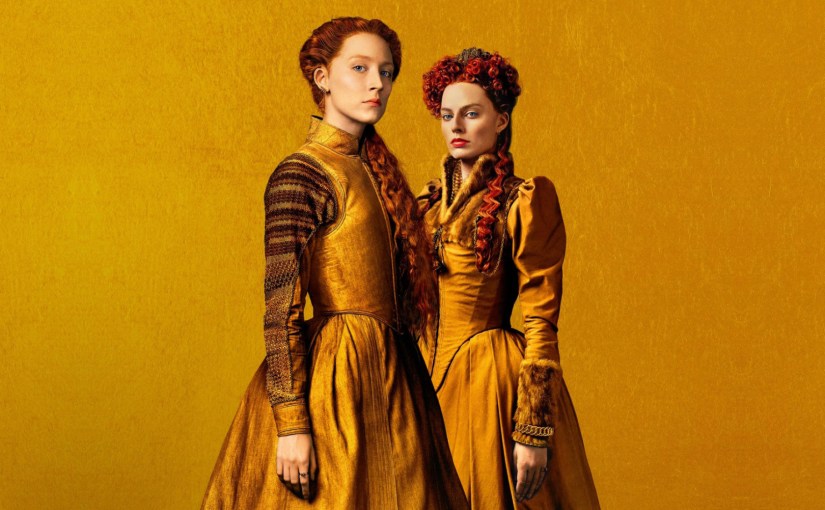
The biggest draws here are the performances from the two female leads.  Saoirse Ronan and Margot Robbie are riveting, Robbie in particular as Elizabeth I.  She disappears into the role, without any trace of her previous screen personas.  Ronan’s Scottish brogue is on point, and she brings Mary Stuart to fiery, red-headed life.  But the surrounding story density never seems to let the actors swing for the fences.  It was a muted experience.

Fans of this historical period will likely enjoy Mary Queen of Scots more than I, much as Queen fans adored Bohemian Rhapsody more than non-fans.  I wouldn’t necessarily run to theaters, though.  Maybe wait for cable or Netflix.  Yeah.

THE CHRONICLES OF NARNIA: THE LION, THE WITCH AND THE WARDROBE (2005)

By Miguel E. Rodriguez

Director: Andrew Adamson
Cast: Tilda Swinton, James McAvoy, Jim Broadbent, Liam Neeson
My Rating: 8/10
Rotten Tomatometer: 76% Certified Fresh

PLOT: In London, during the German blitzkrieg, four children travel through a wardrobe and discover the fantastic land of Narnia.


In the ranks of books aching for cinematic adaptations, C.S. Lewis’ classic fantasy riff on Christian symbolism surely must have been at the top of Hollywood’s list for years.  With the raging success of Peter Jackson’s Lord of the Rings and the Harry Potter films, someone must have decided it was finally time to get this on movie screens.

The only problem is, TCON: TLTWATW [it’s a mouthful] will inevitably be compared to those other immensely successful franchises.  As a result, while the movie itself succeeds admirably, I find myself thinking, “Yeah…but it doesn’t QUITE pack that Return of the King punch.”

But film appreciation/criticism/whatever is not about how a movie performs in comparison with other films.  It’s about how the movie tells its own story in its own way.  So.

This first installment in the Narnia franchise is a good old-fashioned, rollicking fantasy yarn.  Elements of the film will remind people of everything from Star Wars to Spartacus, in all the good ways.  There is, perhaps, a tendency to believe this movie is only for children, particularly due to the talking animals and the fact that the main characters are children.  (There’s also the unexplained appearance of no less than Father Christmas himself.)  But I disagree.  I think the story has a lot to offer to both kids and adults.

Take, for example, the overt Christian overtones of the story.  [SPOILER, SPOILER, SPOILER, SPOILER ALERT!!!]

Aslan, the lion king of Narnia, sacrifices his life to redeem the life of Edmond, one of the Pevensie children who briefly turned traitor.  The White Witch murders Aslan in an unexpectedly creepy ritual featuring orcs, minotaurs, and what appear to be some kind of vampire hybrids.  But, because of the “old magic”, Aslan returns to life.  There hasn’t been a Jesus story this obvious since E.T.…or maybe The Matrix.

This might make some folks believe the whole film is some kind of Christian propaganda, but it’s not.  To me, it’s a way of simply re-framing an ancient story in a way that brings that story to life for modern audiences.  Robert Zemeckis tried the same thing with Beowulf, of which I can only say, hey, better luck next time.  George Lucas did it with Star Wars, Cecil B. DeMille did it with The Ten Commandments, and so on and so on.

If I’m going to be picky, I give it an “8” instead of a higher score because of the “deus ex machina” nature of the finale, which can hardly be surprising due to the Biblical influence of the story.  It feels a little too convenient.  And I thought the battle scenes, while entertaining, were a little too bloodless…but what are you gonna do, they needed to keep it PG, this is a Disney film, for gosh sakes.