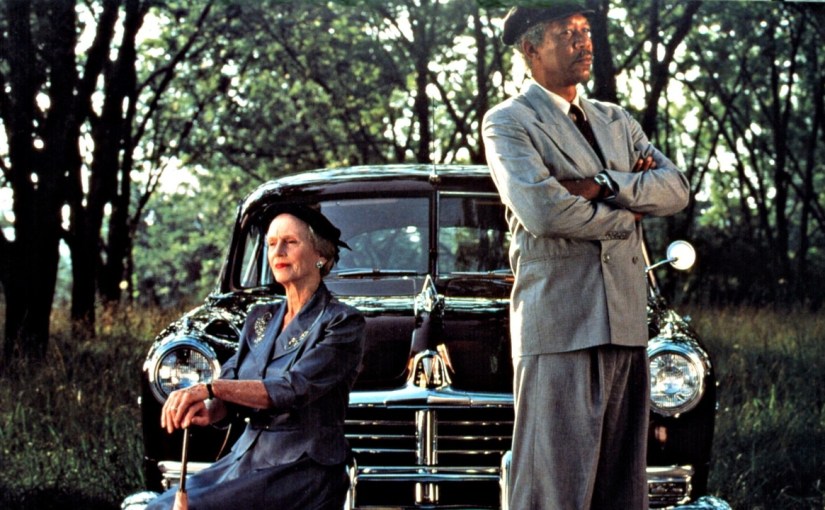
DRIVING MISS DAISY

By Marc S. Sanders

Mainstream films released by big studios suffer from a major problem these days.  Too often, they don’t allow their characters to breathe.  Films today rush to the climax or the action or the cliffhanger that’ll whet our appetites for a sequel or a crossover or a toy product.  Bruce Beresford’s Driving Miss Daisy escaped all of those conventions.  In fact, I’d argue that Beresford made a buddy picture with his Best Picture Winner based upon Alfred Uhry’s well received play.

Daisy Werthan (Jessica Tandy, who won the Oscar, and held the record for oldest recipient) is an insistently independent old southern Jewish woman living in Georgia.  She drives her car where she wants to and whenever she wants to go somewhere.  However, following an accident in her driveway, her son Boolie (Dan Aykroyd in a very surprisingly good performance) breaks the hard truth to Daisy that her driving days are over since it’s likely no insurance company will ever affordably cover her.  Boolie recruits Hoke Colburn (Morgan Freeman in one of the most gentle and delicate performances of his amazing career) to chauffer the proud woman around her Georgia neighborhood.  Naturally, Daisy does not take well to Hoke at first.

The film begins in the 1950’s and then spans roughly 20 years from that point.  I love how Beresford presents the passage of time.  The cars that Hoke carries Daisy in change as the years go by.  As a new car is shown parked in Daisy’s garage, the relationship and eventual friendship of Hoke and Daisy become stronger and, on some occasions, franker and more honest.  With Hans Zimmer’s energetic score that seems to accelerate the speed of the automobiles Hoke drives, Driving Miss Daisy feels like a very sweet and tender film.  It is.  Moreover, it’s an alive picture.  However, the film does not ignore the prejudiced mentality that’s embedded within the south.  A telling moment occurs when Hoke is driving Daisy to a family gathering in Alabama.  Why would an elderly black man with an elderly Jewish woman sitting in the back seat be met with such disdain by policemen who question their presence while eating lunch on the side of the rode?  I won’t repeat the officer’s comment here, but it is ugly and a sad reflection of how things were.  Are things still that way?

Uhry’s script adaptation from his play does not stop there though.  He questions Daisy’s own stance.  She takes no issue with black people catering to her and her home on regular basis, and she becomes enamored with Martin Luther King’s inspiring wisdom.  So, when she is given the opportunity to see Dr. King speak in person, it only makes sense that Hoke will question why he was invited last minute to join her.  After so many years of servitude, why did Daisy wait until Hoke literally drove up to the location of the speech to invite him in?  I’d argue that it never occurred to Daisy, and I think Alfred Uhry believed that is part of the problem.

Both Daisy and Hoke experience anti-Semitism and racism in the mid twentieth century south.  Ironically, the film demonstrates that common victimization is one reason why they need one another.  I’m thankful that Beresford does not show a burning synagogue for dramatic effect.  Instead, he relies on Uhry’s dialogue as Hoke breaks the news to Daisy when they are on their way for morning Shabbat services.  How does Daisy feel in this circumstance?  The synagogue can be rebuilt.  The horror of knowing this kind of hate exists will never be erased.  That’s the terrible shock.  As well to empathize, Hoke describes how as a child he saw his uncle get lynched and hung from a tree.  Daisy and Hoke unite in the hate that surrounds them.

The performances of Freeman, Tandy and Aykroyd are exquisite.  Their dialect for each of their respective characters rings so true of the Georgian southern regions they stem from.  Freeman has an enunciation that rings of a black man who never learned to read.  He even develops a laugh that seamlessly works into his dialogue and reaction to Daisy’s stubbornness.  His posture is marvelous as an elderly gentleman who will walk slowly while hunched over.  It just looks so natural. Aykroyd is in no way doing one of his comedy characters.  He carries the gut of a well-fed southern man who’s become successful with his family business while not taking every fit that his mother has so seriously.  If any of us have had to tend to an elderly relative, then we can certainly relate to Boolie’s position.  Tandy is wonderful at method acting; it should be studied in performance art classes.  She was an elderly woman already when cast in the role.  Yet, as the years carry on through the story, she changes her gait to how this woman’s bones might become more brittle, or how she might speak slower or smile or frown or chew her food.  She has such a fire in every one of her scenes.  A heartbreaking scene where she appears to be having a frantic form of dementia is very eye opening as she paces her historic two-story home looking for papers she graded years earlier as a teacher.  The younger Freeman (playing a far older man) has to keep up with Tandy in this moment; even Beresford’s steady cam has to move quickly to keep focus.

Recently, I had reviewed Terms Of Endearment, and I alluded to the fact that not enough films about middle age people are focused upon, or at least given the commercial attention that they should be given.  Why is that?  So many middle age and elderly characters are so interesting.  I said it before.  Look at The Golden Girls sitcom.  After all, characters with more years behind them have had more moments to live and breathe. Actually, they have a longer history with more nuances and meaningful events they have already encountered, as opposed to twenty somethings with hot cars, pecs and guns.  Film studios are missing out on a wealth of great storytelling. 

Driving Miss Daisy is well paced story of friendship and fear, and often natural comedic material within its three lead roles.  It’s never boring.  It’s only more and more interesting as the years of the story pass by.  It’s simply an endearing buddy picture of the finest quality. 
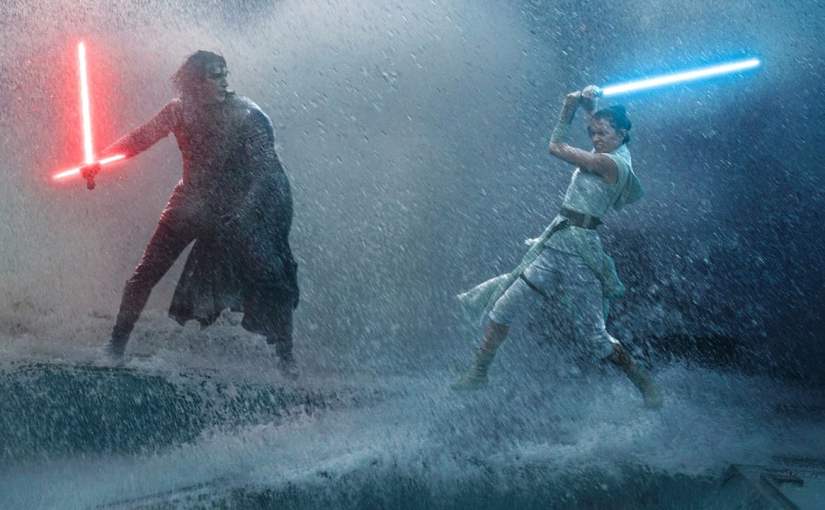
STAR WARS: THE RISE OF SKYWALKER

By Marc S. Sanders

Star Wars: The Rise Of Skywalker is a well packaged thrilling adventure of spectacle, emotion, thrill and salutations to a film saga that’s lasted nearly a half century. JJ Abrams, with backing from the franchise’s new owner Disney, invents a storyline that bears consistency with the episodes that have been seen before. There’s just so much to appreciate.

To get the story rolling, it appears the villainous Emperor Palpatine (Ian McDiarmid in a role that has never garnered enough deserving praise) returns from the dead, intent on recruiting the confused Kylo Ren to kill Rey. From there, it becomes a race for Rey and her allies (Finn, Poe, Chewbacca C3PO & BB8) to find “wayfinders” (like directional compasses) that will lead to Palpatine’s location. Naturally they get sidetracked with some unexpected encounters like flying Stormtroopers (“They fly now!”) and Lando Calrissean (a very welcome and delayed return for Billy Dee Williams). As well, Rey gradually learns more of her back story and there are some quite surprising moments to see.

ROS is really a beautifully shot piece of cinematography. Abrams still loves the occasional lens flare but it’s never distracting. Outer space flights and battles have a clear exactness to them. The moments between Rey and Kylo Ren are well edited conversations and lightsaber duals that occur at two different parts of the galaxy as background settings seamlessly change at times. This is an element from the prior often sour Episode VIII known as Rian Johnson’s The Last Jedi that still works for these new characters.

Abrams and company really get everything right here by neglecting wasteful narratives from Johnson’s installment to allow reflections on the other films in the series with fan loved cameos of characters and ships from before.

Episode IX is bound to displease some fans who carry their own vision that challenge them to accept something satisfying. I dare not consider what those thousands of possibilities could be.

All that I know is that the newest chapter is never boring, often surprising and in the most capable hands possible with the Mouse House engineers.

Major applause for the Daisy Ridley giving her best performance to date followed by John Boyega & Oscar Isaac offering terrific buddy chemistry with fun, wry dialogue and major kudos to Anthony Daniels who is given much material that reminds the audience that the Skywalker saga is quickly approaching closure. Daniels has always offered a quite humane performance to a character that can show one expression but still carries dimensions of fear, wisdom and humor. An actor limited in expression who only provides a vastness of emotion.

The Rise of Skywalker delivers a lot of story and some new, albeit unnecessary characters (except for new merchandising to sell), but everything is a visual treat.

Abrams’ contributions offer opportunities of laughter and tears and messages of redemption and sacrifice for a greater good.

There’s much to this to consider and appreciate. I absolutely loved Star Wars: The Rise of Skywalker.

A BEAUTIFUL DAY IN THE NEIGHBORHOOD

By Marc S. Sanders

Marielle Heller directs A Beautiful Day In The Neighborhood, but it’s not the movie I wanted, nor is it the movie most admirers of Mr. Rogers would want either. A film that boasts one of the most beloved actors of our generation, Tom Hanks, portraying one of the most influential figures of our youth, Fred Rogers, falls very short of offering anything entertaining much less insightful.

The problem with Heller’s film is we learn next to nothing about Rogers and we learn way too much about the depressive state of a fictional Esquire journalist named Lloyd Vogel (Matthew Rhys). He’s a pretty unlikable guy with daddy issues (Chris Cooper). The most eye opening thing about Lloyd is when he gets into a fistfight at his sister’s wedding with Dad. Beyond that, he’s a repetitive close up of sunken eyes and five o’clock shadow. I couldn’t even tell you if Lloyd is actually a good journalist, or a good husband or a good father.

The script by Micah Fitzerman-Blue & Noah Harpster is misguided in its subject matter of Lloyd’s struggles at the forefront of course, but also in delivery. I felt like I was watching Tom Hanks, not Fred Rogers. Hanks really doesn’t hide in the role very well. I only heard Hanks’ voice which is not pleasant for singing and lacks the comforting whisper the real Rogers had. I solidified my opinion when I saw a clip of the real Fred Rogers in the closing credits.

A scene midway through the film has Fred inviting Lloyd into his New York apartment. He tries to console Lloyd and get him to be comfortable with his feelings by use of his famous puppets Daniel The Tiger and King Friday VIII. It’s an absolute failure of a moment between the two leads of the film. What’s meant to be therapeutic and consoling comes off as creepy. Call me cynical, but this Fred Rogers is not a guy I would want to be left alone with. I know that wasn’t the intent, but that’s what was processed. A comparable scene occurs between Matt Damon and Robin Williams in Good Will Hunting (“It’s not your fault!”). You’ll quickly see the difference in effective acting and sensitive direction.

An uplifting moment occurs when they ride the subway together. A few kids recognize Rogers and soon the whole car (construction workers and police officers included) is singing his theme song in harmony. No, I don’t believe this ever occurred, but this is often why we go to movies; to see those opportunities that raise our spirits and help us escape. There are not enough moments like this in A Beautiful Day In The Neighborhood.

The screenplay always teeters on better story potential that never arrives. When we first meet Fred at his studio, he is interacting with a child banging a toy sword while his producer is once again frustrated with his delay in filming. Here are two angles I would have rather seen; how Fred interacts with his impatient producer and how he manages to converse with children. Yet, we don’t go any further than that. We have to be bogged down with Lloyd.

Another moment has Fred sharing with Lloyd better ways to let out your anger like slamming on the percussive notes on a piano. The final moment of the film shows Fred at the piano, alone, tickling the ivories, and then he too slams down on the keys. Fred is angry, and as he tells us repeatedly during the film, “that’s okay,” except now I’m angry. I’m angry because I want to know what Fred’s angry about.

Couldn’t a film that prominently features the human side of Fred Rogers privilege me to the Fred Rogers beyond his studio of make believe?

KNIVES OUT

By Marc S. Sanders

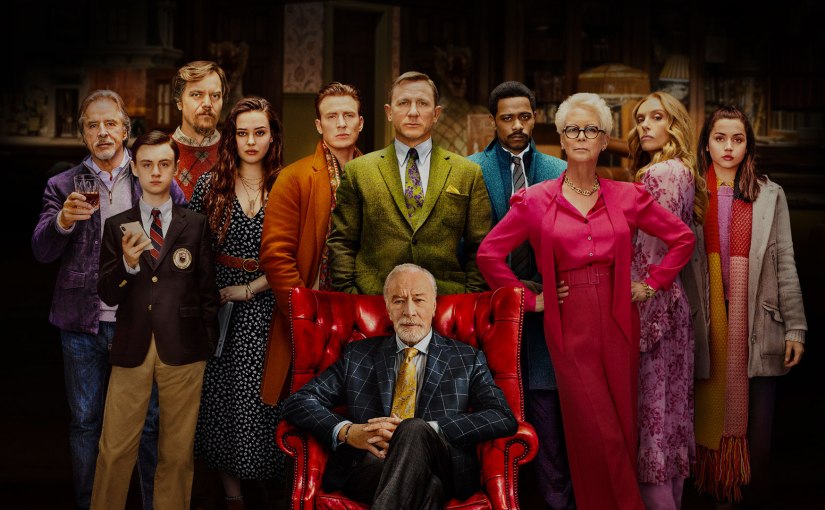
Rian Johnson’s new film Knives Out is an attempt to reinvent the Agatha Christie blueprint of The Who Done It? Murder Mystery. It primarily succeeds even if it is a little cookie cutter in its screenplay.

Famed best selling mystery writer Harlan Thrombley (Christopher Plummer) is discovered by his maid in his reading room to have slit his throat. All evidence points to suicide. Police follow through with simple procedural questioning of his next of kin, and yet a private detective (Daniel Craig) with an outstanding puzzle solving reputation is hired with a delivered envelope of cash from an unknown source. If it’s suicide, then why a detective, and who had reason to hire him?

Craig as Detective Benoit Blanc (great name) adopts a hilarious Kentucky southern drawl to rattle the cages of possible suspects, assuming that perhaps this wasn’t suicide. Could it have been…MURDER?

The suspects consist of family members and each is well exaggerated in their physical descriptions. Johnson wrote these connivers with possible motives to set them apart from one another-first by casting well known actors and then giving most of them a garish appearance or unusual trait. Jamie Lee Curtis as Linda with a short white as snow haircut and black circled glasses looks like no one else I can recall. Michael Shannon as Walt with a cane and exaggerated limp, not too bright but also quite discomforting. Don Johnson as Richard only with a goatee, Toni Collette as Joni putting on a bug eyed expression with ditzy delivery. Chris Evans as Ransom, with clean shaven good looks and a toothy smile in preppy, yet snobbish looking sweaters. Finally, Ana de Armas as Marta, Harlan’s nurse, who seems to be the only one devastated by what has transpired, and somehow inadvertently ends up being more involved than she ever expected. She can’t lie. If she does, she can’t help but vomit. A disadvantage perhaps but maybe a convenient advantage at times as well.

Early on, interviews are shown and it appears everyone has reason to maintain a grudge against Harlan. So if Harlan was in fact murdered, well then it’s fair to presume one of these people might have reason to commit the crime. A will is eventually read and then even more twists present themselves. Someone definitely wanted Harlan out.

Rian Johnson spells it out easily for the viewer. Each suspect has his/her own place in the film to toy around with. While I didn’t find it too challenging to predict a likely suspect that has orchestrated what’s occurred, it was more fun for me to watch how it was all pieced together. I kept asking myself what’s so important about the dogs or the baseball or the silent “Great Nana” (K Callan) who sits around the house but surely must have something to contribute.

Agatha Christie or Dashiell Hammet still hold as the much more clever writers. Still, Daniel Craig is having a blast in his role, conceived by Johnson. I’d like to see another mystery with this character. He’s funny at appearing unconcerned with new developments that could be occurring while he’s really just waiting for the inevitable fact that reveals the absolute truth.

Following leaving the scene of an arson a potential suspect makes an unexpected stop. Craig as Detective Blanc opts to wait in the car and put his ear buds on to sing show tunes. Who would do that? Yet, that’s what’s hilariously fun about this picture. A man has died but the shallowness of his surviving family and the disconnect of the detective are the entertainment factor.

Rian Johnson knows how to keep Knives Out amusingly interesting with a curiosity that does not stop.

FROZEN II

By Marc S. Sanders

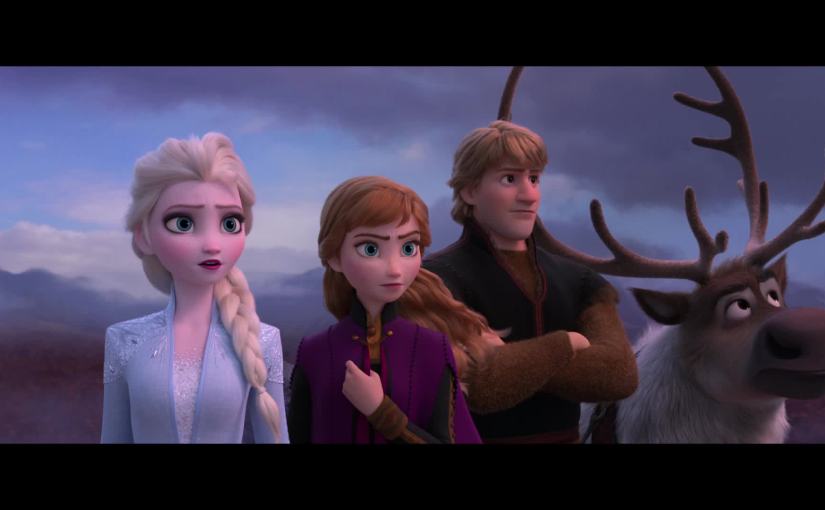
You’re not going to see anything you haven’t seen before in Frozen II. All that that you have witnessed in other Disney classics, particularly in the original film, is back again. Still, that doesn’t mean you’ll be disappointed either. Walt Disney Studios has become so meticulous and masterful at putting out project after project that they have literally altered the blueprint of the world’s pop culture psyche. Elsa is the modern day Cinderella. Anna is the modern day Ariel.

Frozen II opens with a flashback story involving young Anna & Elsa frolicking together before bed only to be told a story by their Father of a time when their grandfather led the people of Arrendelle to an enchanted forest and encountered the people of Northuldra. A dam is built as a gesture of peace to help Northuldra, and soon after both peoples witness the spirits of Earth, Wind, Fire & Water. It’s probably a more nuanced story in the visual sense, than I can describe here. Actually, the film gradually shows more to this tale as it progresses. Yet I dare not spoil anything.

Jump to present soon after where the last film left off and everyone is living happily ever after. Elsa is at peace but concerned over a repeatedly harmonious call from far away. Kristoff is stressed over how to propose to Anna-an overdone story only new to kids under 10. He is given too much story and is the weakest element of the picture. Even his solo number, though sung well, is even way too corny for a genuine laugh.

The call that Elsa hears doesn’t stop and is soon followed by a disturbance within the kingdom causing the streets to come up and strong winds to overtake everyone. It is up to Anna, Elsa, Olaf and the rest to journey into the enchanted forest where grandfather explored and uncover the source of the problem.

Frozen II is almost as good as the first film. The characters remain likable and colorful. The music is very strong and easy to learn. Maybe that’s because many of the songs seem to have an identical tempo to every number from the first film. “Show Yourself” sung by Idina Menzel as Elsa is this film’s “Let It Go.” “When I’m Older” is an adorable variation of “Summer” sung by Josh Gad as Olaf, the lovable, comic relief little snowman.

Again, you’re not gonna find anything new here, but the experience is lighthearted fun that’s impossible to resist.

Beyond the uninteresting Kristoff storyline-he gets an opportunity to ask for Anna’s hand in marriage, stutters and stutters, and gets interrupted…again! Yeah! You know what I’m talking about.

Frozen II has glorious animation that makes you wonder if the Swarovski franchise has an actual mine for all of its crystal products. Gorgeous animation of glass like cathedrals within the land and snowflakes in the sky offer prisms of color in blue, purple and pink. Directors Jennifer Lee & Chris Buck, using a script penned by Lee, give you something eye popping to take in with nearly even caption. It’s positively beautiful.

I took my daughter to see The Addams Family animated update. It was good. Had a message I appreciated. Yet, I couldn’t feel wowed by anything. When you are seeing a Disney production like Frozen II vs a Universal production like an Addams Family retread, you can’t fully appreciate what Universal settled for in its artwork of skinny legs and fat heads for its characters. I’m paying the same price for both films. I’m devoting comparably the same amount of time to both films. Universal gave me an overcooked hamburger. Disney gave me a juicy steak.

Make the right choice. Go see Frozen II. It’s a terrific experience for all ages.

JOKER

By Marc S. Sanders

It’s important to understand first and foremost, Todd Phillips’ film Joker is really not a Batman story, a comic book story or even the derivative of a Batman comic book story.

Consider the Martin Scorsese pictures Taxi Driver and The King Of Comedy. Both films focus on two different characters descending into a variation of psychological madness. Yet the the titles of each film are pretty random, generic almost. Joaquin Phoenix plays wannabe comedian Arthur Fleck (to my knowledge never a DC comics character before this film) and this latest release from Warner Bros is billed as the origin of the Joker. Nevertheless, other than calling the setting Gotham City and having a billionaire character named Thomas Wayne with a son named Bruce, there is nary any calling to the mythos that fans are so familiar with. Why not just present this film with a title called “The Comedian” for example and run with it? Calling it Joker feels like a shameless cash grab. This is not a Batman villain tale, folks.

Joaquin Phoenix is astonishing in the lead role. He’s in every scene of the film and the method to own the character of Fleck is shown both physically and mentally. The known method actor must have lost at least 75 pounds to show weird, stretching contortions that easily shown his rib cage and pale complexion. Phillips films Phoenix at times where there is no dialogue either grimacing in a mirror, randomly dancing or simply leaning his head against a cold transit bus window. Surprise moments also come with head slamming against walls or glass doors. This was not all direction by Phillips. Phoenix had to have invented some of these instances.

Robert DeNiro is an obvious nod in casting as a Merv Griffin/Johnny Carson role meant to salute the Scorsese films of his heyday. When he was the man bordering on insanity, DeNiro performed with method material. Think back to when he’s Jake LaMotta in Raging Bull bashing his head against a wall while in solitary confinement.

While Joker certainly offers probably the best performance of the year in any category, it’s not a pleasant film to watch. It lacks any sense of wryness or humor. It’s a very depressing film about a man’s inevitable descent into madness. I couldn’t take my eyes off of Phoenix in the role, but like other comic book based films it didn’t leave me wanting more. I’m not eager for a continuation of this character.

If they wanted to a popular comic character story then I wish there could have been some more slight nods to the ingredients of this pop culture legacy. Couldn’t Arthur Fleck have been mugged by Oswald Cobblepot or sidled up alongside Mr. Zzazzz? How about a quick encounter with Selina Kyle or Edward Nygma? There’s just not enough evidence here for me to accept this is a Batman tale. Again Warner Bros banked on the title and not much else.

I got my money’s worth from Phoenix and I’m gunning for him to win the Oscar (not just nominated), but I can’t help but feel a little let down as well.

THE LAUNDROMAT

By Marc S. Sanders

Steven Soderbergh gets a little too inventive in his delivery of revealing “The Panama Papers,” in his new film The Laundromat now showing on Netflix.

His film is too convoluted deliberately to drive home the point of shell company, laundered fraud within the world. As such, it makes it very challenging to comprehend every point crammed into his short 90 minute film.

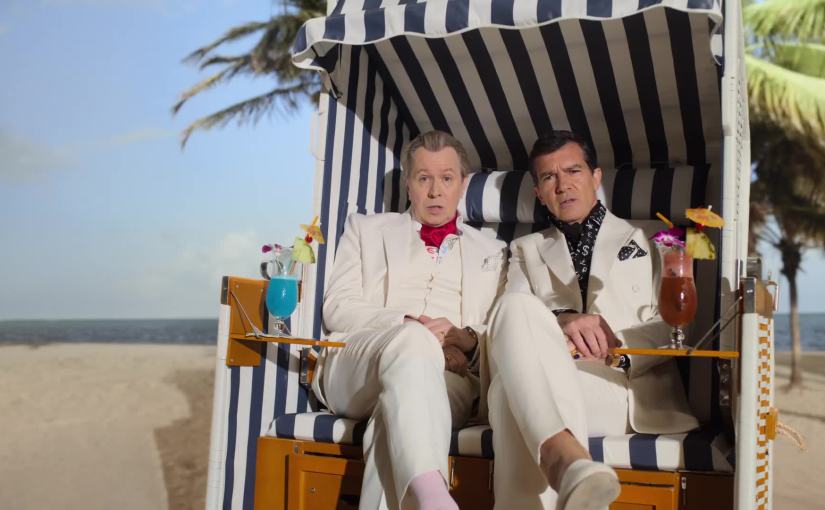
The two Panamanian attorneys behind the scheme, Mossack & Fonseca (played with great duet chemistry from Gary Oldman and Antonio Banderas) narrate the film by introducing different ways in which a shell company valued at everything on paper but tangibly nothing from an actual monetary standpoint.

Primarily, it focuses on Ellen Martin (Meryl Streep) a driven senior citizen who learns the truth of the plot when insurance does not compensate following the tragic accidental drowning of her husband on a boat tour.

Streep is brilliant as always. Such a natural with her monologues and her seemingly useless efforts to gain restitution for her loss.

The whole cast is excellent but the intentional confusion behind the story falls short of satisfying entertainment or enlightenment. I needed some moments where Soderbergh would give it to me straight. A diagram or a graph might have helped.

With The Laundromat Steven Soderbergh fails at becoming the next Jay Roach (The Big Short and Vice). Imagine if Roach actually got his hands on this script. Then there’d be a lot more buzz about this film. Oh well.

MALIFICENT: MISTRESS OF EVIL

By Marc S. Sanders

Maleficent: Mistress Of Evil has a strong cast and a serviceable approach for the sequel to Disney’s 2014 live action hit. Yet, the film falters anyway.

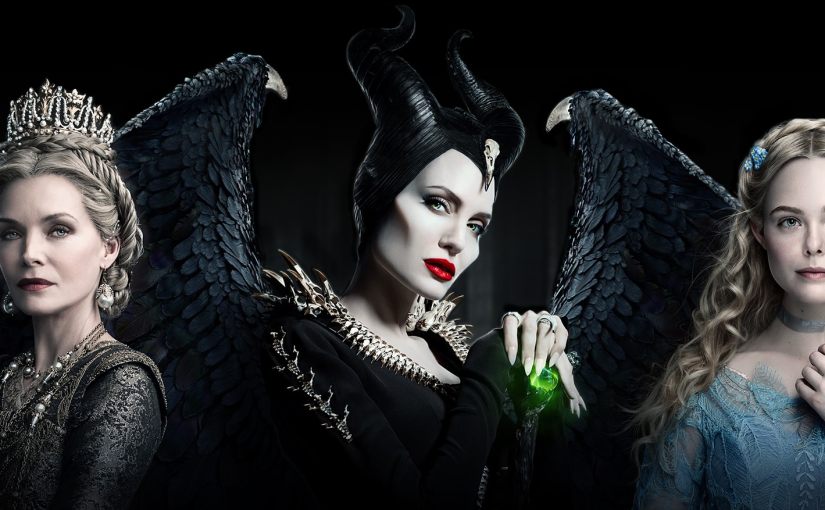
First, and this is always something that irks me, the sub title is completely inappropriate. (Like Star Wars: The Phantom Menace where the only menace was Jar Jar Binks, who was never my first choice to be a phantom.). The film carries a bait and switch title. Did the marketing department at the Happiest Place On Earth even watch the film? Angelina Jolie returns as the title character, still dressed in stereotypical evil black. However, the script penned by Linda Woolverton, Noah Harpster and Micah Fitzerman-Blue offer up an adoring struggle for her to keep up appearances. Never does the film imply that Maleficent returns to her evil impulses. Rather, she’s only characterized by Michelle Pfeiffer’s evil queen as such. So there’s a betrayal of advertising going on here.

The film directed by Jochaim Ronning is a Meet The Fockers variant. When Princess Aurora (Elle Fanning), who was unofficially adopted by Maleficent, gets engaged to the Prince, naturally the in laws have to become acquainted. As expected, dinner does not go very well and the King is spellbound, leaving Maleficent as the scapegoat forced into running underground where she meets up with her fellow fairy community ready to wage war against the human kingdom.

Pfeiffer’s queen uses this as an opportunity to convince the kingdom to wipe out the fairies. Yeah. You’ve heard this story a hundred times before.

I can forgive the redundancy of the storytelling. However, Rollins can’t get his film right. The cinematography is annoyingly murky in darkness and clouds and mist. Doesn’t matter if it’s the fairy kingdom, the castle or even the forest in daylight. Rollins serves up murky, dramatic effect for the sake of murky dramatic effect. It’s hardly visible. This film has Angelina Jolie and Michelle Pfeiffer. If I want to emit drama, I’m gonna rely on them to bring their game.

As well, and disappointingly, Jolie is hardly in the film, at least not enough to justify the title. Rather, Pfeiffer is here to chew up much of the scenes. There are long periods of storytelling where Jolie is nowhere to be seen. She actually doesn’t appear for at least the first 15 minutes. Again, like the title itself, the film under promises what it sells. I have no problem with Pfeiffer or Fanning. They’re really good. Yet, there’s just too many opportunities for them to exchange dialogue and threats, and not much else. Yes, you get to see the fairy kingdom, but they really are a miserable angry bunch for a family oriented film. The 3 fairies led by Imelda Staunton? Yup. They’re here…hardly though and they were the most fun of the last film. Maleficent’s sidekick, Diaval (Sam Riley) – the half man/raven? Well he’s only there when Maleficent is there (literal sidekick) and tell us he wishes he could be turned into a bear. What do you think happens? Incidentally, the CGI bear is nothing great, an uncolorful blur of roaring with a raven beak.

All of these elements present themselves but never follow through with any humor or fun or eye opening surprise. Instead we get a lot of Pfeiffer and Fanning.

The third act is straight out of Lord of the Rings with swords and shields and marching and charging. Meh. I was bored with all of this and the CGI of fairy flights and swoops looked blurry.

Clearly, Disney prioritized preparation of the film for IMAX and 3D. Can we let this go for a change, and just make a movie, please? It’s apparent, watching a 2D standard presentation of this film, where the 3D pops were to occur. Yet, it’s a lousy sacrifice for a simple view.

Maleficent: Mistress Of Evil is a shameless, opportune cash grab on Disney’s behalf. Crank out the sequel, prime it for 3D, get Jolie back for whatever time she’s available, and make sure to slap on a title that amps up the darkness that audiences relish and surefire goosebumps.

I like the story. The execution however fell very short however. No one will remember this sequel in a year from now.

ONCE UPON A TIME IN…HOLLYWOOD

By Marc S. Sanders

There’s no question the most different of Quentin Tarantino’s directorial efforts is his latest film, Once Upon A Time In… Hollywood. Already described as his “love letter to cinema of the late 60s,” his 9th effort also implies the end of the Hippie Era by devoting a portion of time to B movie actress Sharon Tate, infamously murdered by Charles Manson’s followers when she was 8 months pregnant with Roman Polanski’s child.

Margot Robbie plays a near, gorgeous exact replica of Tate. She’s deliberately short on dialogue and I like to believe it’s because Tarantino treasures her as an innocent angel who was loving the atmosphere of Hollywood. She’s preserved of being nothing but likable. She dances with glee in her bedroom in the Hills or in public at the Playboy Mansion. One day she visits the local cinema to see her performance in “The Wrecking Crew” with Dean Martin. Tarantino shoots close ups of Robbie loving her footage as a pratfall klutz while listening to the audience reaction. She’s loving every second of the experience. People love her and she sees the love she has for people. Critics took issue with Robbie’s lack of dialogue. Not me. The performance is all there. Robbie is wonderful to look at with responses of pure happiness and celebration.

The main focus of the film is on Rick Dalton played by Leonardo DiCaprio with a huge range of drama, comedy and well intentioned over acting when Tarantino is wanting to spoof the TV western for fun. We see a collection of Dalton’s work, most especially on the fictional black and white TV western that airs Sundays at 8:30 on NBC (cue Dalton’s cowboy hat close up accompanied with “BONG, BONG, BONG!).

Rick is realizing he’s becoming past his prime. Marty Schwarz, his agent and a producer, played by Al Pacino warns Rick that he’s at a point where he’s only going to be the villain of the week on The Green Hornet and Batman. Rick does not take this well. Using his stunt double pal, Cliff Booth (Brad Pitt) to talk to, Rick is consumed with insecurity and alcoholism.

Tarantino wants to depict an era in Hollywood on its way out. A fictional character like Rick and the well known fate of Sharon Tate symbolize this turning point.

A third example is with Cliff. Rumored to have killed his wife, Cliff has trouble finding stunt work on a set. So he’s happy enough to just drive Rick around in his Cadillac, and fix his antenna. A great moment occurs when Cliff antagonizes a cocksure fist of fury Bruce Lee to a fight. Bruce doesn’t do so well against Cliff. Bruce Lee maybe not be what he once was, or what audiences ever perceived. Times they a changin’.

This is not the aggressive film that Tarantino is mostly known for. It’s primarily calm as we see these characters navigate around Hollywood locals, listening to The Rolling Stones and the Mamas & The Papas, and various product advertisements. Rick and Cliff are suffering a little. Suffering at the loss of what they were and the world they are forced to enter, nor what they are accustomed to. Sharon is ready for what’s next. Yet, will she get the opportunity to carry on?

The ending is bound to leave people divided. It’s different and very, very unexpected. It makes no difference how you feel about it. What matters is if it generates a response, and based on the theatre where I saw the film, yes! Yes, there is a massive response to what occurs.

Tarantino’s Once Upon A Time In… Hollywood is not his best film. There were moments where I thought it was a little slow and the film lacks the dialogue punch that many know Tarantino for. There’s really not one memorable line that stayed with me. I guess that’s what the trade off is when you finally are served multi dimensional characters that Tarantino has hardly offered before.

It’s the best non Tarantino film that Quentin Tarantino has ever directed.

SPIDER-MAN: FAR FROM HOME

By Marc S. Sanders

Spider-Man: Far From Home is a good movie for all the wrong reasons.

People, it’s not much of a super hero movie. Rather, it teeters more on a teen angst comedy. The teen angst material works very well. I laughed a lot and I found all of this material very touching. Peter Parker struggles with a “like,like relationship” with MJ. His pal Ned is getting in good with another classmate, and his European vacation is getting upended because Nick Fury keeps getting in the way. Again, this is all funny and really cute material. I laughed often. Really enjoyable.

That being said, where’s Spider-Man? He’s hardly in the costume and he’s truly fighting a rather subpar villain. Then again, when I read the comics Mysterio (Jake Gyllenhall, doing the best he can here) was never a favorite of mine. Mysterio’s nefarious ways are a bit implausible. I don’t want to spoil what he’s exactly up to but I wasnt exactly feeling the suspense or admiring his schemes. It’s a little too over the top ridiculous.

The other hero, Nick Fury does not really live up to his character as well. He makes dumb decisions and believes the preposterous storyline a little too easily. Fury had never been written this way before. He’s not this stupid. It irritated me.

I like Tom Holland in the Peter Parker role, and the rest of the cast is good, especially Peter’s pals, Ned, Betty Brant, Flash and MJ. Jon Favreau is likable, and Marisa Tomei makes for a good younger Aunt May.

If only the producers went with a different villain in Spidey’s rogue gallery. Where the heck is Kraven The Hunter already????

I like the whole cast, but there was much to be desired here in the script. The 2nd act is a mess which left me wondering how could this be…if that just happened, and again….where is Spider-Man???

So yeah, Spider-Man: Far From Home is not what it could’ve been but rather something else altogether. That’s maybe good…and bad.